

Motorola Razr SEO Case Study: How We Hit Page One Without Selling Phones
This post isn't really about a Motorola phone.
We wrote it as a bet. The question was simple: could SuperHub rank a page on Google for a product we don't sell, in a market we don't operate in, for a brand we have nothing to do with? So we went and did it, just to prove the point. The post you're reading has been quietly pulling traffic ever since.
So here's the thing. We don't sell phones. We just ranked a post about one. And somehow it still threw off three Amazon affiliate sales we never went looking for. Three accidental pay-outs for ranking a product we had nothing to do with. Imagine what happens when we actually point this kind of ranking at something you do sell. That's the whole SuperHub pitch. We rank what you need ranked, in classic search and inside ChatGPT, Gemini and the AI engines people are actually asking now. No bullshit, no vanity metrics, no six month waiting game before you see anything move.
Book your free 15 minute ranking auditOr carry on and read the Motorola piece. It's actually not bad.
Sometimes the best proof of what works comes from unexpected places. Our Motorola Razr test content ranks on page one of Google, generating thousands of impressions monthly. Here's what that teaches us about content strategy and search visibility.
The Background
We created comprehensive content around the Motorola Razr — not because we sell phones, but because we were challenged to pick a highly competitive item to demonstrate what proper content structure and SEO fundamentals can achieve in a seriously crowded space. We picked mobile phones, which is regarded as some of the most contested search results on Google. Just look at the CPC on Google Ads, at the time the Motorola Razr CPC was over £5 per click. I had one so I thought lets give it a go.
The Challenge, get a piece of content for something entirely unrelated to our business, in the most competitive space possible by content alone with no backlinks curated by us. (Note here it may have gained some but these are organic) on page 1 of Google and keep it there!
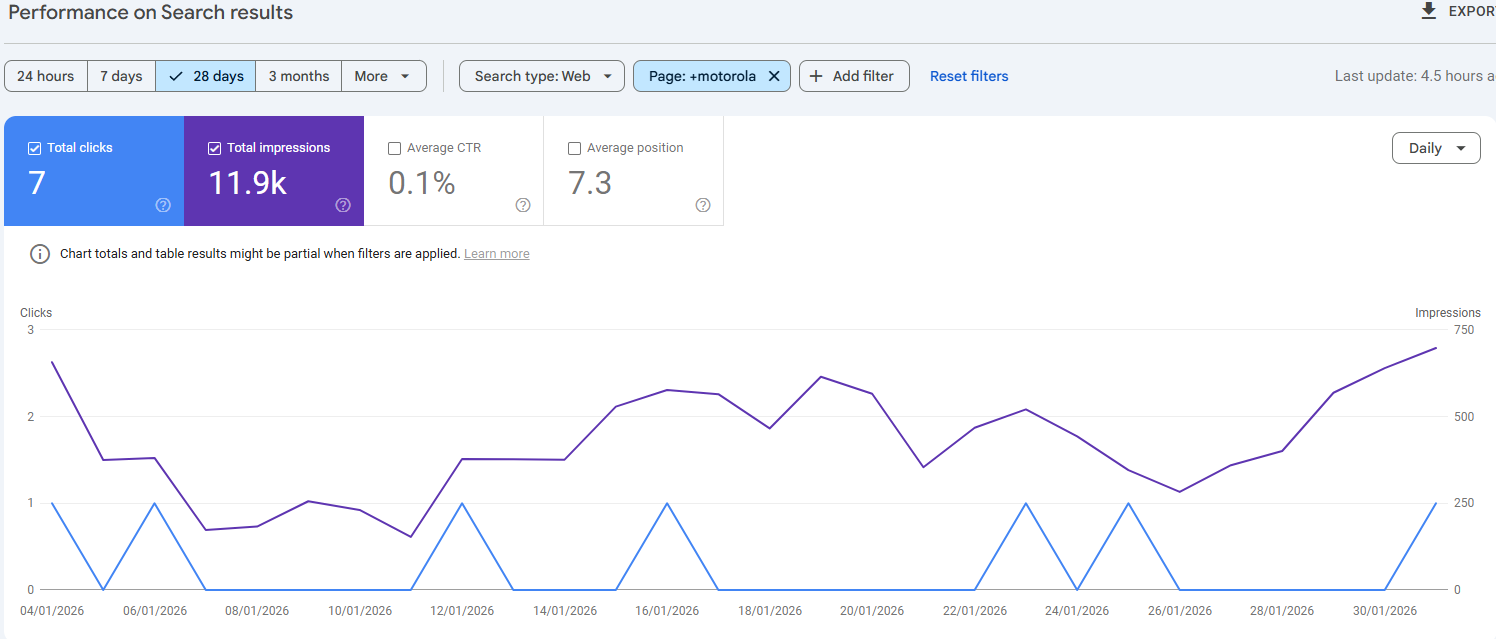
We did it... Here's how, but before you read on here is the proof.
The piece covered everything users searching for Razr information might want: specifications, comparisons, user experience insights and practical guidance.
Within weeks, the content was ranking. Not buried on page three where nobody looks, but on page one where traffic actually happens. Position 5.77 average with the highest postion of 5, generating over 21,000 impressions in a single reporting period. What you see is last week 11900 impressions in a week. Before you say look the CTR is terrible it is we are not a reseller of phones so I would expect it to be bad. Little nugget as I test we added and affliate link a week ago and we sold one via Amazon!
Why This Matters
The Razr content proves several things we tell clients every day:
First, search engines reward comprehensive, well-structured content. We didn't game the system or use tricks. We simply created genuinely useful content that answered the questions people were actually asking.
Second, rankings can happen faster than most people expect. The SEO industry sometimes makes everything sound like it takes 18 months. Properly executed content can perform in weeks.
Third, even content outside your core business niche can rank if it's done right. The principles are universal — the topic almost doesn't matter if the execution is sound.
The SuperHub Approach
What we did for the Razr content is exactly what we do for clients. We research what people are actually searching for. We create content that genuinely answers those questions. We structure it so search engines can understand and rank it. Then we let the results speak for themselves.
The difference between content that ranks and content that doesn't usually isn't budget or backlinks or technical wizardry. It's whether someone took the time to create something genuinely useful versus something that's just filling a page.
Our motorsport clients, our B2B clients, our local business clients — they all benefit from the same fundamental approach. Understand what your audience is searching for. Create content that serves them better than what's currently ranking. Structure it properly. Watch it climb.
Beyond Vanity Metrics
Impressions are nice. Rankings feel good. But what matters is whether traffic converts to business value. The Razr content taught us something about audience intent that we've applied across our client work.
Not every visitor will become a customer. Some content attracts researchers, some attracts tyre-kickers, some attracts people ready to buy. Understanding which is which — and creating content strategies that account for this — separates effective digital marketing from expensive vanity projects.
For our core services, we apply this thinking deliberately. Motorsport sponsorship content targets people actively looking to solve a funding problem. B2B lead generation content targets marketing managers with budget authority. The Razr experiment helped us refine how we think about intent matching.
What We'd Do Differently
Looking back, the Razr content would benefit from clearer conversion pathways. It ranks well, it generates traffic, but the commercial intent of visitors isn't aligned with what we sell. That's fine for a proof-of-concept, but for client work we'd ensure every piece of content has a logical next step for the right kind of visitor.
We'd also consider affiliate integration. If content is going to attract product-focused searches, there's no reason not to capture some commercial value from that traffic even if it's not your core business. A few quid from affiliate links is better than zero quid from traffic that was never going to convert anyway.
The Takeaway
The Motorola Razr case study and the piece of content you can check out the article about the RAZR here isn't about phones. It's about proving that the fundamentals work. Create useful content. Structure it properly. Let search engines do their job. The traffic follows.
If you want that approach applied to your business — whether you're in motorsport, professional services, local trades or anything else — that's what we do at SuperHub. The first conversation costs nothing, and we'll be honest about what's achievable for your specific situation.
The Razr is still ranking. Still generating impressions. Still proving that good content beats lazy content every single time.
Want This Done For You?
SuperHub helps UK brands with video, content, SEO and marketing that actually drives revenue. No vanity metrics. No bullsh*t.