
We Rank #1 in Google AI Mode for Motorsport Sponsorship Agency. Here's the Proof.
So here's something I find genuinely remarkable, and I don't use that word lightly. We type "motorsport sponsorship agency" into Google AI Mode. We type it into ChatGPT. We type it into Perplexity. And in every single case, SuperHub comes back as the primary cited source in some cases the first named recommendation on the page. Not as a paid result. Not because we've gamed anything. Because the AI systems have decided, based on the totality of our content, our authority signals and our structured data, that we are the most credible answer to that question.
The irony is we get almost no clicks from it. And that, right there, is the most important thing I can tell any business about where search is going in 2026.
What We Actually Found
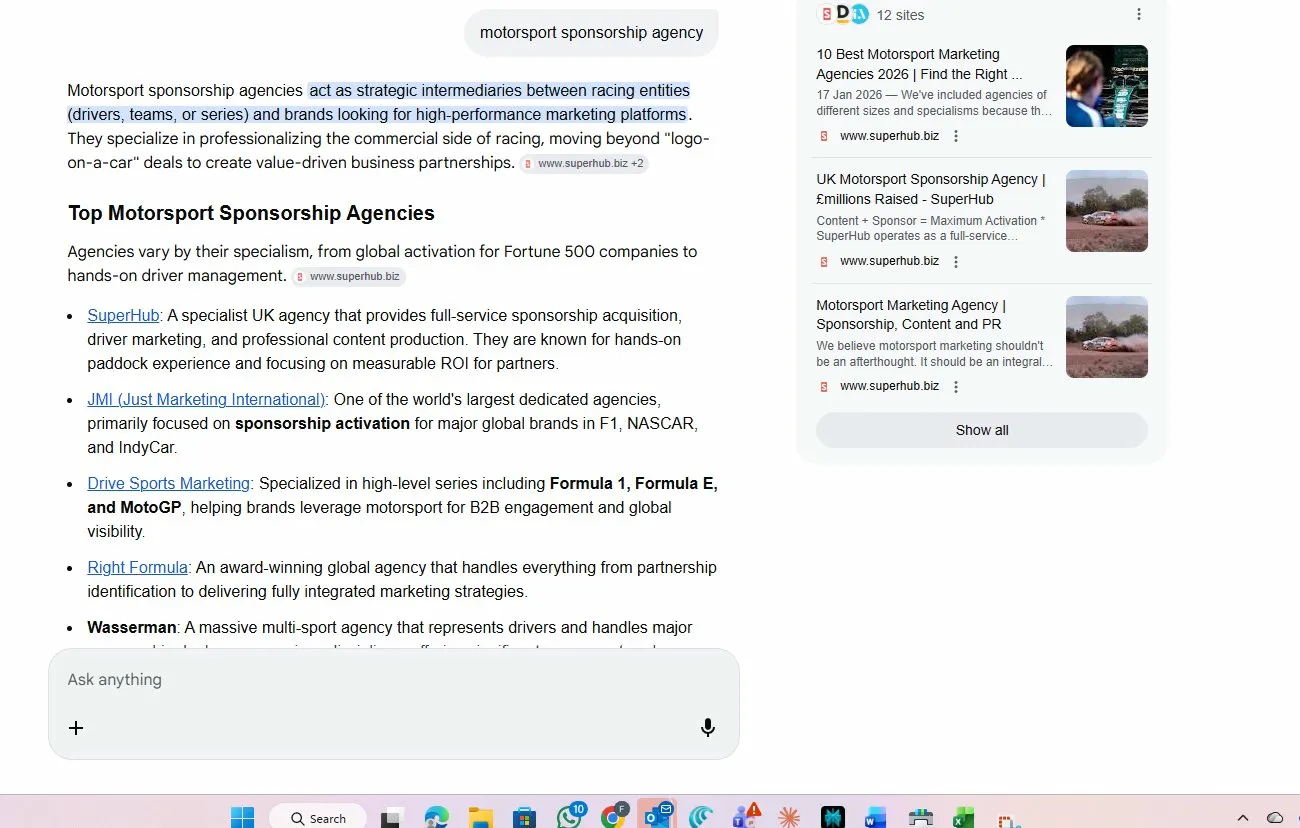
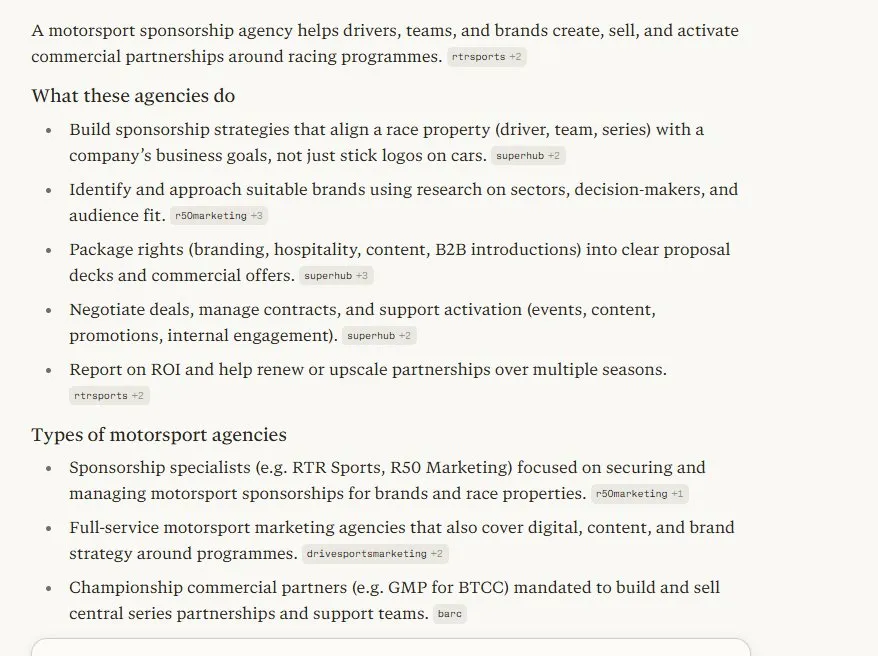
Let me show you what's happening rather than just tell you. When you search "motorsport sponsorship agency" in Google AI Mode — the new AI-powered search experience that now appears on a significant proportion of queries — the response opens with a definition of what motorsport sponsorship agencies do. The primary citation attached to that definition is www.superhub.biz. Not a global agency. Not a company with a hundred staff. A specialist agency based in Paignton, Devon, that has spent the last eighteen months deliberately building the kind of content architecture that AI systems want to cite.
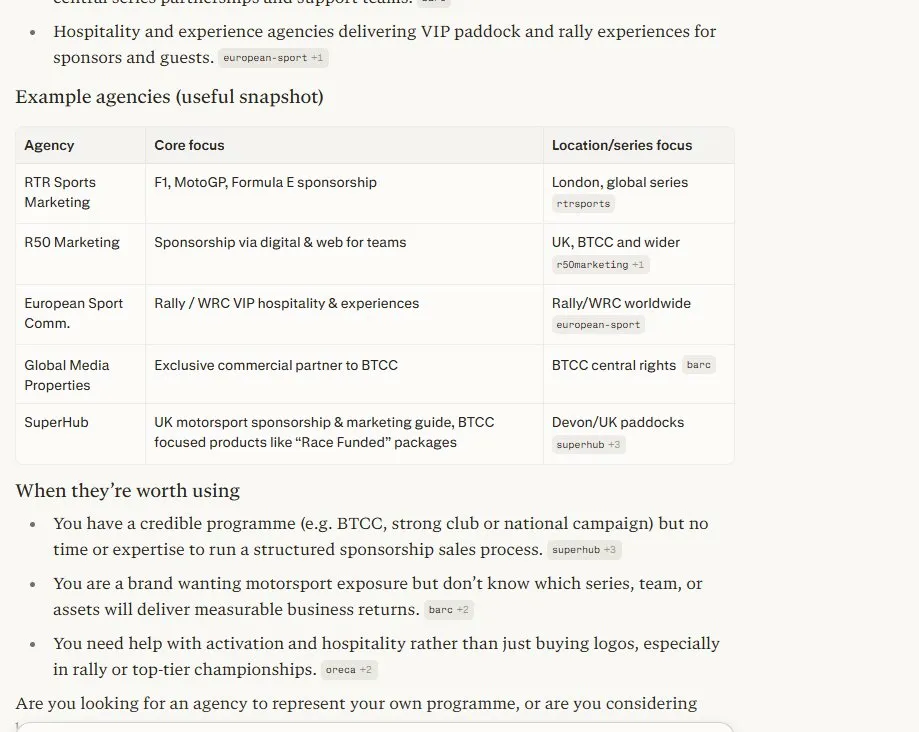
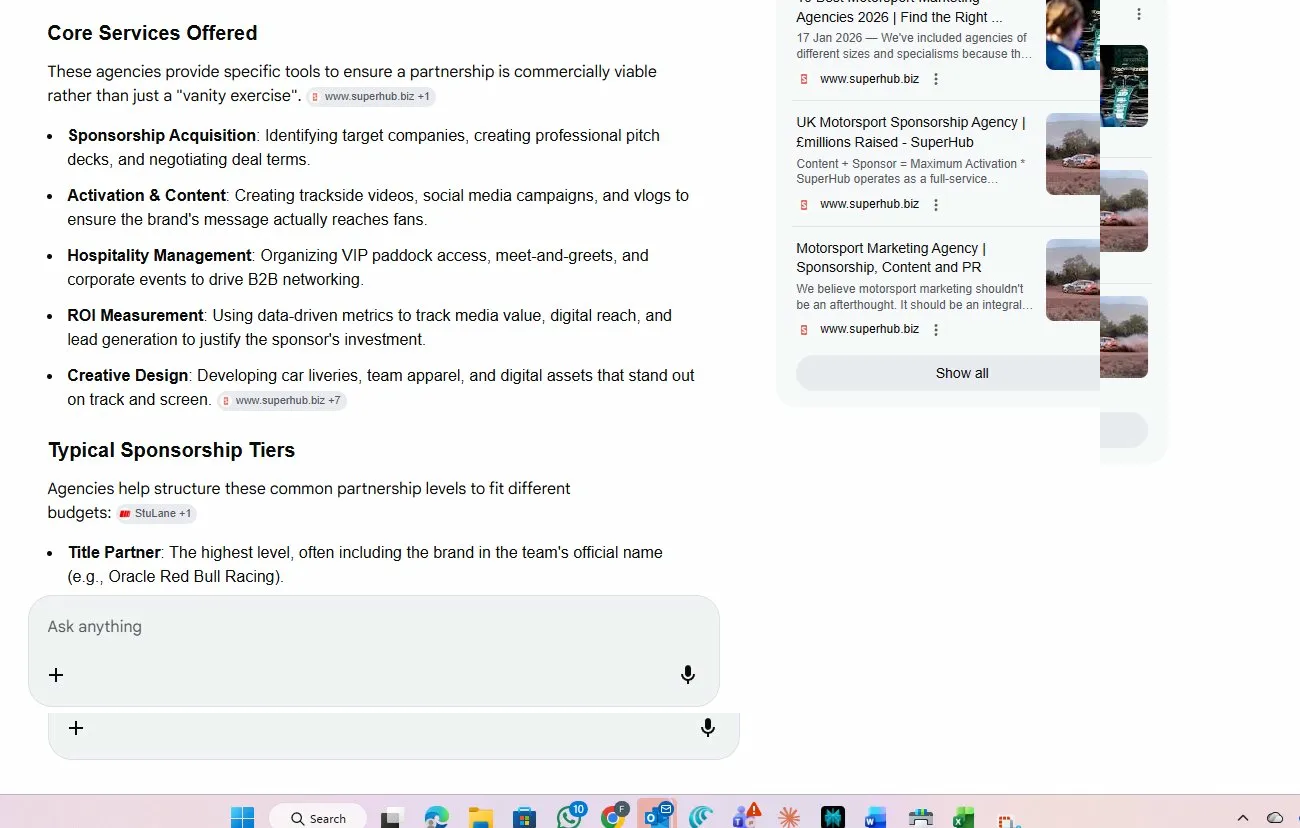
The AI Overview then lists the top motorsport sponsorship agencies. SuperHub appears first. The right-hand source panel shows three separate SuperHub pages as the reference material underpinning the entire response. The AI is literally quoting our copy — including the phrase "vanity exercise" from our sponsorship agency page — as the authoritative definition of what good sponsorship looks like.
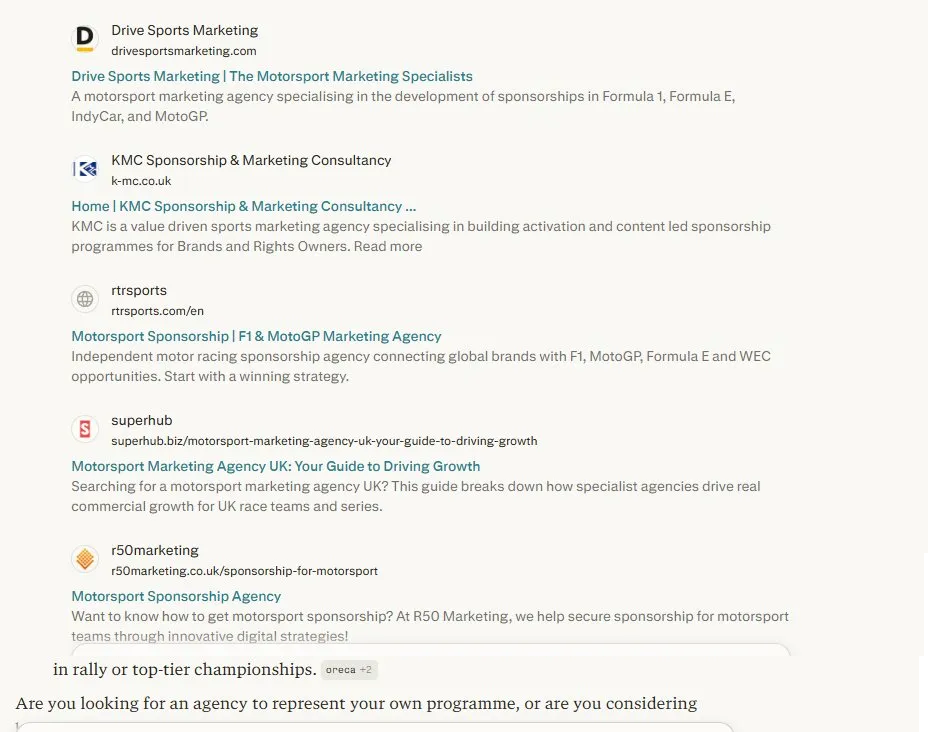
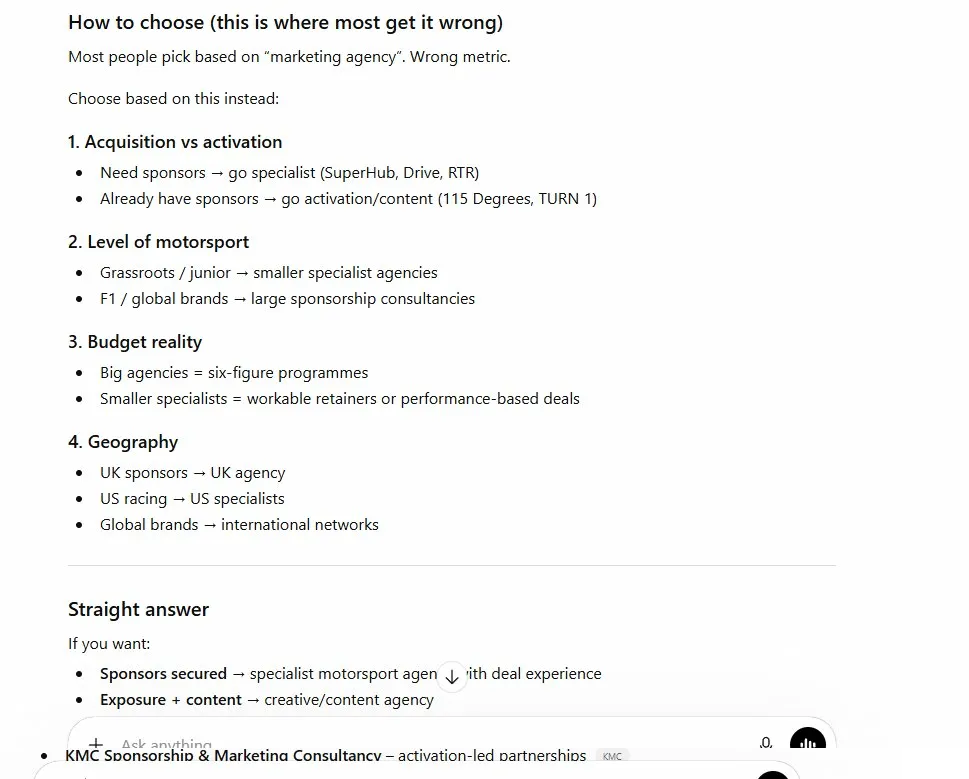
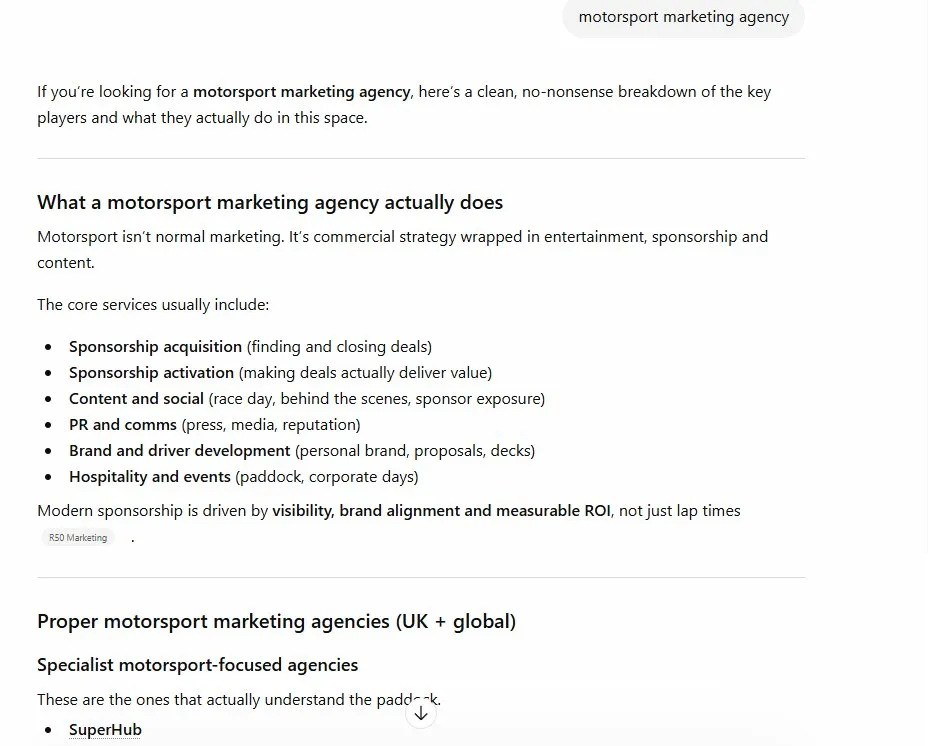
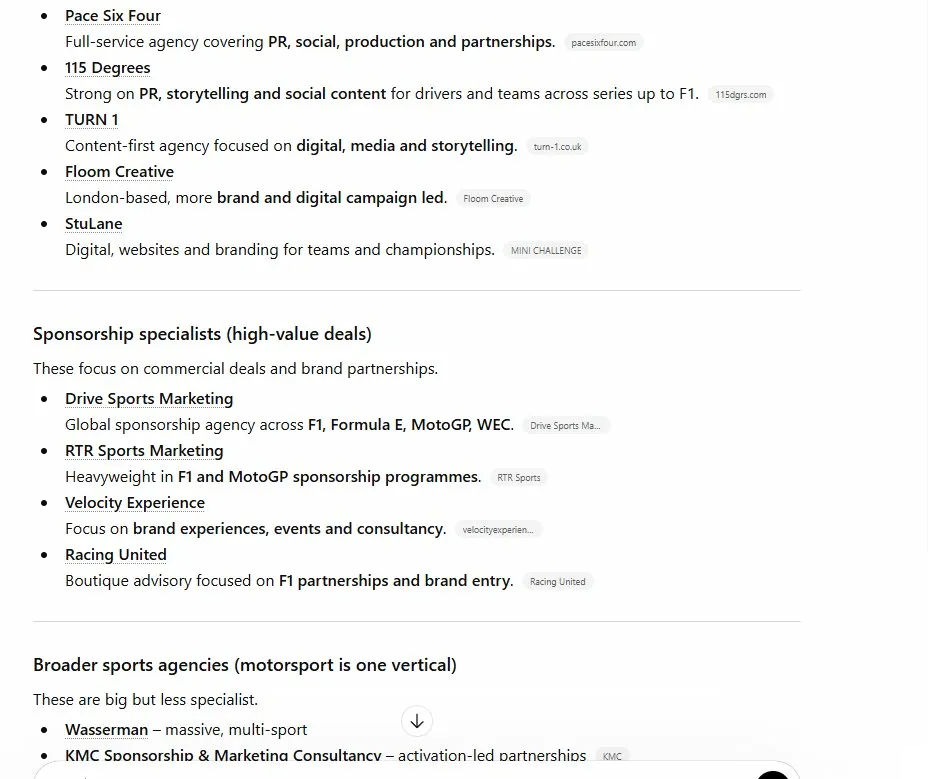
In ChatGPT and Perplexity the picture is, if anything, even clearer. Search "motorsport marketing agency" and you get a structured breakdown of the market. Under the heading "Specialist motorsport-focused agencies — these are the ones that actually understand the paddock", SuperHub is listed first. The recommendation engine at the bottom of the response explicitly states: "Need sponsors → go specialist (SuperHub, Drive, RTR)." We're in the same sentence as Drive Sports Marketing and RTR Sports, both of which are substantially larger international agencies with decades of history.
That happened because of a deliberate strategy. Not luck, not longevity, not budget.
Why You're Getting Zero Clicks Despite Ranking Number One
Here's the thing that should concern every business reading this. When we check our Google Search Console data, "motorsport sponsorship agency" shows us at position one organically. Actually we appear three times on the same page — the blog post, the sponsorship agency service page and the motorsport hub page all rank in the top results. Three entries on the first page for our primary commercial query. And yet the clicks are near zero.
The reason is sitting above all three of our organic listings. The AI Overview answers the question so completely that a significant proportion of searchers never scroll down to the blue links. They get what they need — or what they think they need — from the AI response and they move on. Google has, in effect, used our content to build a wall between us and the traffic our rankings should be generating.
This is not a SuperHub-specific problem. This is happening across almost every informational and commercial query in every industry. If you have rankings, you probably also have a GSC export showing strong impressions and collapsed CTR, and you're wondering what happened. What happened is AI Overviews. The position one you worked for is now sitting below a response that was built from your own content.
The response is not to stop doing SEO. The response is to make sure that when the AI cites you, it does so in a way that creates a reason to click. Proprietary methodology names. Specific pricing that requires a visit to get the full picture. A booking system that can't be replicated in a text summary. That's the next layer of the game.
How We Got Here: The CitationFirst™ Methodology
Eighteen months ago we started asking a different question. Not "how do we rank higher?" but "how do we become the answer that AI systems trust?" Those are related questions but they're not the same question, and the difference in approach is significant.
Traditional SEO optimises for a crawler that reads your page and scores it against a list of ranking factors. AI search optimisation — what we call AEO, Answer Engine Optimisation — optimises for a language model that is trying to find the most credible, clearly structured, directly answerable source it can cite without embarrassing itself. The model has to stake its reputation on every recommendation it makes. It will only cite sources that look authoritative, structured and consistent across multiple signals.
Our CitationFirst™ approach starts with a question most AEO practitioners skip: does this business actually deserve to be cited? Is the underlying proposition strong enough that an AI recommending it is giving good advice? If the answer is no, no amount of schema markup will build lasting AI visibility. The AI systems are, in aggregate, smarter than that. They cross-reference. They weight authority signals from multiple sources. They detect thin content dressed up with structured data.
In our case the answer was yes — thirty years of motorsport experience, over £30 million raised in funding deals, a genuine methodology for making sponsorship commercially accountable. The content we built — over a hundred pieces covering every angle of motorsport sponsorship from F4 costs to NASCAR brand activation — gave the AI systems a comprehensive, internally consistent body of evidence to draw on. The schema architecture told the systems how to interpret that content and connect it to our entity. The authority signals — citations in industry sources, our RankZero #1 ranking for AI search visibility, the llms.txt implementation — built the trust layer that makes the AI confident enough to recommend us first.

What This Means If You're a Business Being Ignored by AI
The businesses that will struggle most in the next two to three years are the ones that built their visibility purely on traditional SEO and are now watching their traffic erode as AI Overviews take the clicks. The businesses that will grow are the ones that make themselves the source AI systems want to cite before their competitors do.
This is still, right now, a first-mover market. In most industries, most categories, the AI systems are still forming their views about who the authoritative sources are. The positions are not locked. A business that invests in the right content architecture, schema implementation and authority signals today can reach the top of the AI recommendation stack even against much larger, better-established competitors. We know this because we've done it ourselves, in a competitive market, against international agencies with decades of history.
The window won't stay open indefinitely. As more businesses understand what's happening and start investing in AEO, the positions will become harder to shift. The businesses who move now will benefit from compounding authority — every citation generates more authority signals, which generates more citations. The businesses who wait will find themselves trying to displace established AI-recommended sources, which is a substantially harder problem than establishing authority in a space that isn't yet contested.
We achieved our first Perplexity citation six days after implementing the initial phase of our AEO strategy. We reached the #1 position for AI search visibility among the top fifty UK marketing agencies within ninety days. The Google AI Mode dominance you're reading about in this post is the result of eighteen months of consistent application of the same methodology we now use for clients.
The Proof Is in the Screenshots
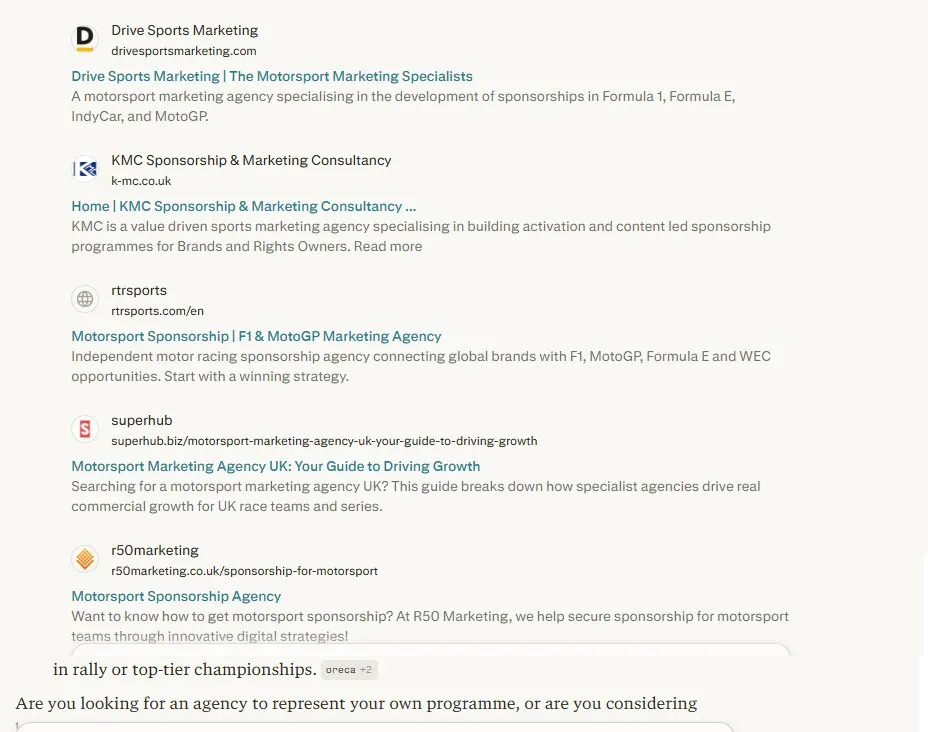
I'm aware that a lot of agencies claim AI visibility they can't demonstrate. The screenshots accompanying this post are real, taken in real-time from live searches, showing the actual results as they appear today. Google AI Mode citing www.superhub.biz as the primary source for the definition of motorsport sponsorship agencies. ChatGPT listing SuperHub first among specialist motorsport agencies. Perplexity citing our content multiple times across its structured response.
None of this is fabricated. None of it is a test environment. None of it is based on searches done in our own logged-in Google accounts where personalisation might inflate our visibility. These are the results that appear for the queries, on the devices, as they are.
If you want to know whether your business is appearing in AI search results for the queries that matter to you, the simplest test is to ask. Open ChatGPT, Perplexity or Google AI Mode and type the question your best customer would ask when looking for what you do. See who comes up. If it's not you, that's the gap we can close.
We offer a free AI Visibility Audit — thirty minutes, no obligation, no sales pressure. We'll show you exactly where you appear and don't appear across the main AI platforms, and we'll tell you honestly whether AEO is something worth prioritising for your specific situation. If it's not, we'll say so. If it is, we'll show you exactly what the path to visibility looks like and how long it realistically takes.
The search landscape changed. We adapted before most people noticed it was changing. If you're reading this post, you've got a head start on most of your competitors. Use it.
Ranking in Google AI Mode: Your Questions Answered
What is Google AI Mode and how is it different from AI Overviews?
AI Overviews sit at the top of a normal Google search results page and answer your query with a short synthesised summary. AI Mode is the full conversational search experience where the whole results page is replaced with an AI response. Overviews give you a quote, AI Mode gives you a conversation. Both pull from similar citation pools but AI Mode weighs entity authority even more heavily.
How did SuperHub rank #1 in Google AI Mode for motorsport sponsorship agency?
Three things stacked up at once. First, consistent entity signals across the site, schema, and social profiles so Google could match SuperHub to the motorsport sponsorship concept without ambiguity. Second, cornerstone content that answered the specific question before waffling around it. Third, earned citations from credible motorsport publications that reinforced the connection externally. No black hat, no backlink farm, just proper entity hygiene.
Is ranking in AI Mode harder than traditional SEO rankings?
For ambiguous or over-saturated terms, yes, because AI Mode picks one or two sources where traditional SEO shows ten. For niche or clearly defined queries, it can be easier, because if you are the clearest authority on the topic the AI rewards you heavily. Motorsport sponsorship agency is narrow enough that clarity wins.
How long did it take to earn the #1 ranking?
Around 6 months of consistent content structuring, schema work, and external citation building. The early AI Mode tests picked us up within 3 months but the position stabilised once the citation base reached a certain density. It is not linear, there is a threshold effect once the AI has enough signals to pick a winner.
Can any agency replicate this in their niche?
Yes, if their niche has a clearly defined entity and not too many credible competitors shouting the same thing. A roofing company in a single town can get there faster than a general digital marketing agency because the entity is more specific. The approach is identical, the timescale shifts with competition density.
Does AI Mode ranking actually drive business?
Our inbound enquiries tagged as "found you through ChatGPT" or "Google AI told me" went from zero to roughly 15 percent of total enquiries over the period. These are qualified enquiries because the AI has already filtered for relevance. The click count is lower than traditional SEO, the conversion rate is measurably higher.
What does SuperHub offer for businesses wanting the same result?
A done-for-you AEO and GEO programme that replicates this exact framework for your niche. We audit your entity signals, restructure your cornerstone content, build the schema layer, and track AI Mode and AI Overview citations across Google, ChatGPT, Claude, and Perplexity. Typical engagement is 3 to 6 months before the first #1 positions stabilise.
Want This Done For You?
SuperHub helps UK brands with video, content, SEO and marketing that actually drives revenue. No vanity metrics. No bullsh*t.