
How much do Google Ads cost: UK guide to PPC
So, how much do Google Ads really cost? The honest answer is, it depends. There’s no fixed price tag because the cost is shaped by your industry, your goals, and just how fierce the competition is.
For most businesses in the UK, a realistic monthly spend can be anywhere from £500 to over £10,000 .
Your Guide to Google Ads Costs in the UK
Thinking about Google Ads pricing isn’t like buying a product off a shelf. It’s more like entering a live auction. You’re bidding for prime advertising real estate, right in front of potential customers at the exact moment they’re searching for what you offer. And naturally, the most valuable spots command the highest price.
This auction system puts you in the driving seat. You set your own budget and decide the absolute maximum you’re willing to pay for a single click. It's this flexibility that makes a simple answer to "how much does it cost?" so tricky. The investment for a local plumber in Plymouth will look worlds apart from a national law firm based in London.
To get a clearer picture, let's pull together a quick summary of what you can generally expect.
Google Ads Cost at a Glance for UK Businesses
Here's a simplified table to give you a feel for the average costs across different Google Ads networks. Think of these as ballpark figures—your actual costs will be unique to your campaigns.
| Metric | Average Cost (UK) |
|---|---|
| Average Cost Per Click (Search) | £1.00 – £3.50 |
| Average Cost Per Click (Display) | Under £1.00 |
| Average Cost Per Thousand Impressions (CPM) | £2.00 – £4.00 |
| Average Cost Per Acquisition (CPA) | £40 – £80 |
These numbers are a great starting point, but the real story is in the details of your specific industry and strategy.
Understanding the Core Pricing Model
At its heart, Google Ads runs on a Cost Per Click (CPC) model. This is the most common setup and the concept is simple: you only pay when someone is interested enough in your ad to actually click on it. If your ad shows up but nobody clicks, you don’t pay a penny.
This performance based approach is one of the platform's biggest strengths. You're paying for a tangible action—a potential customer landing on your website—not just for eyeballs. While other pricing models exist (we'll get to those), understanding CPC is the first crucial step.
What Is a Typical Cost Per Click in the UK?
The amount you pay per click is directly influenced by how many other businesses want the same keywords. In the UK, the average CPC can swing wildly. For most standard industries, you can expect to pay between £0.50 and £3.50 per click . This wide range just shows how different every sector and campaign can be.
But step into highly competitive arenas like legal services, finance, or insurance, and those costs can easily shoot up to £5.00–£15.00 , or even higher for the most sought after keywords.
Across all industries, the average CPC on the Google Search Network hovers around £1.95 . If you want to dive deeper, there are some great resources breaking down UK Google Ads cost benchmarks on breezedevelopment.co.uk.
The key takeaway is that your budget isn’t a static figure but an active investment. The goal isn’t just to spend, but to spend wisely, targeting the right audience with the right message to achieve a profitable return.
Breaking Down the Google Ads Pricing Models
So, how does Google actually take your money? It’s not as simple as a single flat fee. Instead, you choose between different ways to pay, and the one you pick should line up directly with what you’re trying to achieve.
Getting your head around these pricing models is step one. Why? Because it dictates where your budget goes and what you’re actually paying for.
Think of it like booking travel. You could pay per mile (for the exact distance you cover), buy a weekly pass (for unlimited travel in one zone), or only pay once you arrive at your destination. Each one makes sense for a different kind of journey. The same logic applies to Google Ads. Let's break down the three main models.
Cost Per Click (CPC): The Direct Route to Your Website
The most common model, and the one most people start with, is Cost Per Click (CPC) . It’s exactly what it sounds like: you only pay when someone is interested enough in your ad to actually click on it and visit your website.
Your ad could be shown a thousand times, but if not a single person clicks, you don’t spend a penny.
Imagine your website is a shop on a busy high street. With CPC, you’re not paying rent just to have a shopfront there (that's the ad being seen). You’re only paying a small fee each time a customer opens the door and walks inside.
This makes it an incredibly efficient way to pay for genuine interest. It’s the go-to model if your goal is to drive traffic, get leads, or make sales directly from your site. You’re paying for a real action that moves someone one step closer to becoming a customer.
Cost Per Mille (CPM): Paying for Visibility
Next up is Cost Per Mille (CPM) . ‘Mille’ is Latin for thousand, so you’re paying a flat rate for every 1,000 times your ad is shown on someone's screen. Clicks don’t matter here at all.
This is your digital billboard on the motorway. You’re not paying for every car that pulls off the exit to visit your business; you’re paying for the sheer volume of eyeballs that see your sign as they drive past. The goal isn’t an immediate click, but to build brand recognition and stay front of mind.
This strategy is perfect for:
- Brand Awareness Campaigns: Getting your name, logo, and message out to a massive, relevant audience.
- New Product Launches: Making a big splash and creating some initial buzz.
- Major Announcements: Pushing a specific message to as many people as possible in your target market.
If your main aim is broad visibility rather than direct action, CPM can be a seriously cost effective way to get it.
Cost Per Acquisition (CPA): The Performance Based Model
Finally, we have Cost Per Acquisition (CPA) , which is sometimes called Cost Per Conversion. This is the most performance focused model of the lot. Here, you only pay when someone completes a specific, valuable action on your website after clicking your ad.
You get to define what that ‘acquisition’ or ‘conversion’ is. It could be:
- Making a purchase
- Filling out a contact form
- Signing up for a newsletter
- Downloading a guide
This is like hiring a salesperson who works purely on commission. You don’t pay them for the calls they make or the emails they send; you only pay them when they close a deal. It ties your ad spend directly to tangible results, making it an incredibly powerful option when return on investment is everything.
Choosing between CPC, CPM, and CPA is all about aligning your spend with your goals, ensuring every pound you invest is working towards the outcome you need.
What Really Influences Your Google Ads Spend?
Ever looked at your Google Ads bill and wondered why it is what it is? Or why a friend in another industry pays a completely different price for their clicks? It all comes down to the Google Ads auction, and it’s not just a case of the highest bidder wins.
Think of it less like a simple auction and more like a complex marketplace where a few key levers determine what you actually pay. A local bakery in Bristol is playing a totally different game to a national law firm, and their costs will reflect that. Once you understand these levers, you can stop just spending money and start investing it.
Let's pull back the curtain on what’s really driving the cost.
Your Industry and the Competition You’re Up Against
The single biggest factor dictating your costs is the battlefield you're on: your industry. In highly competitive sectors, the cost for a single click (CPC) can be eye-watering. Why? Because a single new customer in fields like legal services, finance, or home improvements could be worth thousands.
When the stakes are that high, your competitors are willing to bid aggressively to get that lead, and that drives up the price for everyone.
- High-Stakes Sectors: Industries like legal services can see an average CPC of over £8.00 . Home improvement isn't far behind at nearly £8.00 a click. A click costs a lot because a conversion is worth a fortune.
- Lower-Stakes Sectors: On the flip side, industries with smaller transaction values, like arts and entertainment , often have much lower CPCs, sometimes under £2.00 . They need more customers, but the fight for each one isn't quite so fierce.
This means your budget has to be grounded in reality. You can't show up to a legal services auction with a restaurant's budget and expect to make a dent.
Quality Score: Your Secret Weapon for Cheaper Clicks
You can't change your industry, but you have absolute control over your Quality Score . This is Google’s report card for your ads, keywords, and landing pages, graded from 1 to 10. A high score is Google's way of saying, "You're giving our users exactly what they want."
And they reward you for it.
A high Quality Score isn't just a pat on the back from Google. It's a genuine thank you in the form of a discount on your cost per click and a better ad position. It’s your unfair advantage.
A brilliant Quality Score can slash your CPCs, letting you outrank a competitor even if they're bidding more than you. It all boils down to three core parts:
- Expected Click Through Rate (CTR): Based on past performance, how likely are people to click your ad when they see it?
- Ad Relevance: Does your ad copy actually match what the person searched for?
- Landing Page Experience: When someone clicks, does your landing page deliver on the ad's promise? Is it clear, relevant, and easy to use?
Nailing these three elements is the most powerful way to bring your Google Ads costs down without turning off your campaigns.
The Keywords You Choose and How You Target Them
Not all keywords are created equal. Bidding on broad, hugely competitive terms like "car insurance" will always cost a fortune. But getting more specific with long tail keywords like "classic car insurance for over 50s in Scotland" is where you find the real value.
Beyond the words themselves, who you show your ads to is just as critical:
- Geographical Targeting: Why advertise to the whole of the UK if your customers are all in Manchester? Focusing your budget on a specific city, or even a postcode, is one of the quickest ways to stop wasting money.
- Ad Scheduling: If your business is only open 9 to 5, why pay for clicks at midnight? Ad scheduling (or 'dayparting') lets you show ads only when you're open for business, ensuring you don't pay for calls that go to voicemail.
- Device Targeting: You might discover that your customers love to browse on their phones but always make the final purchase on a desktop. By digging into your data, you can adjust your bids to spend more on the devices that actually make you money.
When you manage these factors with care, you build a campaign that isn’t just effective, but ruthlessly efficient. You make every single pound work as hard as it possibly can.
Setting a Realistic Google Ads Budget
Knowing what affects your Google Ads costs is one thing, but turning that knowledge into a real world monthly budget is where the rubber meets the road. So, how much should you actually be spending?
The honest answer? It depends entirely on your business, your goals, and how quickly you want to grow. There's no magic number.
To give you a clearer picture, let's walk through some sensible budget scenarios for different UK businesses. Think of these as starting points to help you benchmark your own investment and set achievable targets for your campaigns.
In the UK, a monthly Google Ads budget can be anything from a few hundred quid to tens of thousands. Most small businesses should probably be thinking somewhere in the region of £750 to £7,500 per month . If you’re serious about growth and want to make a proper impact, you’ll likely need to be in the £3,000 to £10,000 range to get meaningful traction.
Example Monthly Google Ads Budgets for UK Businesses
To make this even more practical, here’s a table outlining some typical budget ranges and what the primary focus would be for each type of business.
| Business Type | Suggested Monthly Budget | Primary Goal |
|---|---|---|
| Local Tradesperson (e.g., plumber, electrician) | £800 – £1,500 | Generating local phone calls and quote requests. |
| National E-commerce Store (e.g., selling skincare) | £5,000 – £15,000+ | Driving online sales and maximising Return on Ad Spend (ROAS). |
| B2B Tech Company (e.g., selling software) | £4,000 – £12,000 | Acquiring high value leads like demo requests or downloads. |
These figures are illustrative, of course. Your own costs will be shaped by the factors we've already discussed, like competition and keyword choice.
Local Tradesperson in Manchester
Let's start with a classic example: a self employed electrician in Manchester. Their goal isn't to become a household name across the country. They just need the phone to ring with jobs in their local area.
- Suggested Monthly Budget: £800 – £1,500
- Primary Goal: Lead Generation (phone calls, quote requests)
- Strategy: The name of the game here is hyper local targeting . This budget is focused on a tight radius around Manchester, bidding on high intent, specific keywords like "emergency electrician Didsbury" or "house rewire cost Stockport". Ad scheduling is also critical – you only want ads running when someone is actually there to answer the phone. With this kind of focused budget, our electrician can expect a steady stream of qualified local enquiries each month.
The image below gives a simple breakdown of the main dials you can turn – your industry, keyword choices, and Quality Score – all of which determine how far that budget will stretch.
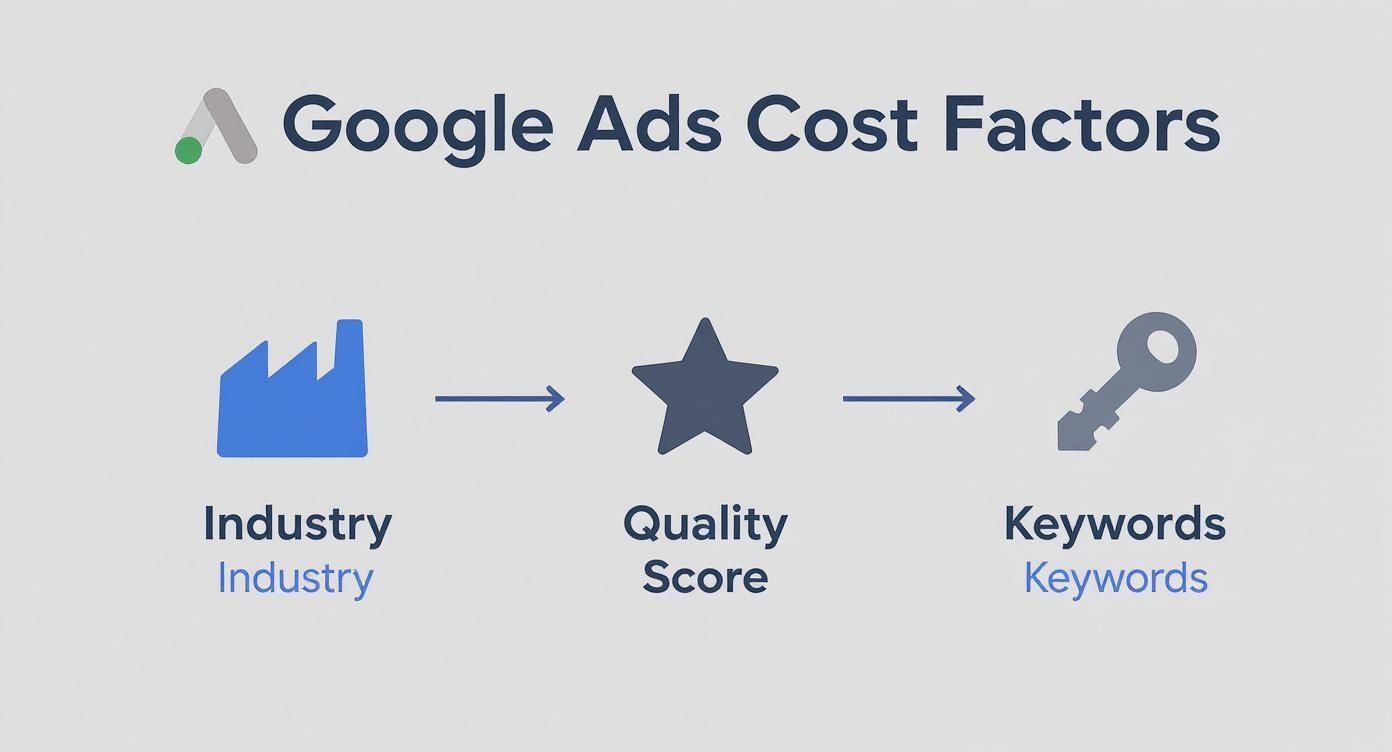
As you can see, a competitive industry (like trades) and the specific keywords you chase will directly impact your cost per click.
National E-commerce Brand
Now let's switch gears to a national e-commerce brand selling specialist skincare products across the UK. Their ambitions are much bigger: they need to drive online sales, build brand recognition, and win new customers from a much larger audience.
- Suggested Monthly Budget: £5,000 – £15,000+
- Primary Goal: Direct Sales (and a healthy Return on Ad Spend)
- Strategy: A budget of this size allows for a far more sophisticated approach. A big chunk will go straight into Google Shopping campaigns , which are an absolute must for e-commerce. The rest would be split between Search ads targeting specific product terms ("vegan anti ageing serum") and perhaps Display or YouTube ads for remarketing to people who’ve already visited the website. The single most important metric here is Return On Ad Spend (ROAS), making sure every pound invested brings back profitable revenue. For anyone in this boat, knowing how to measure ROI effectively is crucial for UK marketers.
A larger budget buys you more than just clicks; it buys you data and speed. You can test different ad formats, audiences, and messages much faster, letting you quickly find what works and scale up the winning campaigns to maximise profit.
B2B Technology Firm
Finally, imagine a B2B tech firm that sells project management software to other companies. Here, the sales cycle is much longer, but a single new client could be worth thousands over their lifetime. Leads are tougher to get, but they are incredibly valuable when they land.
- Suggested Monthly Budget: £4,000 – £12,000
- Primary Goal: High Value Lead Generation (demo requests, whitepaper downloads)
- Strategy: This is all about precision. Forget broad keywords. The focus is on niche, professional search terms like "Gantt chart software for construction firms" or "agile project tool for developers". A decent portion of the budget might also go towards LinkedIn ads or using remarketing lists for search ads (RLSAs) to get back in front of people who’ve shown interest before. The goal isn't a high volume of clicks; it's about attracting a handful of highly qualified decision makers.
Proven Ways to Reduce Your Ad Spend

Knowing your budget is only half the battle. The other half is making every single pound work as hard as it possibly can. The real goal isn't just to spend less money, but to get more for the money you're already spending. This is where smart optimisation turns your ad spend from a simple expense into a powerful, efficient investment.
The good news? You have a surprising amount of control over how efficiently your budget gets used. By dialling in on a few key areas, you can slash wasted spend, bring down your advertising costs, and see a much healthier return.
Let's walk through the most effective strategies you can put into play right now.
Master Your Keyword List With Negative Keywords
One of the fastest ways to stop haemorrhaging cash is to stop your ads from showing up for irrelevant searches. This is where negative keywords become your new best friend. Simply put, they are terms you add to your campaign to tell Google not to show your ad when a search includes that word.
Think of it like being a bouncer at an exclusive club. You've got your guest list (your target keywords), but you've also got a very clear list of people who are definitely not getting past the velvet rope (your negative keywords). This simple act ensures only the most relevant, high intent audience ever sees your ad.
For example, if you sell premium, brand new lawnmowers, you’d want to add negative keywords like:
- "free"
- "second hand"
- "repair"
- "reviews"
Adding these instantly stops you from paying for clicks from people who are obviously not in the market for what you’re selling. It’s a small tweak that can have a massive impact on your campaign's profitability.
Relentlessly Improve Your Quality Score
We've touched on this already, but it’s worth repeating: your Quality Score is Google’s report card on the quality and relevance of your ads. It’s one of the most critical factors in determining what you pay per click, making it a powerful lever for cutting costs.
A higher score tells Google your ads are genuinely helpful, and in return, it rewards you with lower CPCs and better ad positions.
Think of a high Quality Score as an "express lane" in the Google Ads auction. While others are paying a premium to get ahead, your high quality, relevant ads let you move to the front of the queue for a lower price.
To give your score a serious boost, focus on these three core areas:
- Sharpen Your Ad Copy: Your ad text needs to be a mirror image of the keywords in its ad group. If someone searches for "leather Chelsea boots," your headline should say exactly that. No messing about.
- Enhance Your Landing Page: The page a user lands on after clicking your ad must deliver on its promise. That means it needs to be fast, mobile friendly, and directly related to their search.
- Boost Your Click Through Rate (CTR): Write compelling ads that grab attention and demand a click. Use ad extensions, powerful calls to action, and make your unique selling points impossible to ignore.
Working on your Quality Score is a marathon, not a sprint, but the savings are well worth the effort. For many online stores, mastering this is what separates profit from loss. You can find more strategies by exploring how to achieve PPC for e-commerce success on our blog.
Implement Smart Bidding And Scheduling
Getting a grip on when and how your budget is spent is another vital tactic for cutting waste. Your ads don’t need to be running 24/7 if your ideal customers are only searching during specific hours. A key metric to get right here is to understand your Cost Per Acquisition (CPA).
Use ad scheduling to show your ads only when they're most likely to convert. If you're a B2B company and you know your best leads come in during office hours, why run ads overnight or on a Sunday? This simple adjustment focuses your budget right where it will have the biggest impact, ensuring you’re not just spending, but spending smart.
Planning Your Next Steps with Google Ads
Okay, so now you've got a much better handle on how Google Ads pricing works. You're in a far stronger position to either get your first campaign off the ground or, just as importantly, sharpen up an existing one.
Success on Google Ads isn't about having the deepest pockets. It’s about being smart with your investment, guided by a solid strategy.
The main thing to remember is that you are always in the driving seat with your budget. It doesn't matter if you're a local plumber spending a few hundred pounds or a national e-commerce brand investing thousands every month—the rules of the game are the same. Focus on relevance , obsess over your Quality Score , and be absolutely ruthless about chopping out wasted spend.
In-House Management or Professional Agency?
This leads to the next big question: who's actually going to manage all this?
Loads of business owners start out running their own campaigns. It’s a brilliant way to learn the platform from the inside out and get a real feel for your market. But as your business scales, so does the complexity of your Google Ads account.
The time you spend trying to keep up with Google's constant updates, digging through performance data, and fine tuning keywords can quickly start to feel like a full time job. That's usually the tipping point where bringing in an expert isn't just a cost, but a sound commercial decision.
Hiring a professional pay per click (PPC) agency isn't about admitting you can't do it. It's a strategic move to buy back your time and use specialist expertise to get a much better return on your ad spend.
Signs It’s Time to Hire an Expert
Knowing when to pass the baton can be tricky. If any of these points sound painfully familiar, it might be time to look for some professional backup:
- You're burning cash: Is your ad spend going up while your leads or sales stay stubbornly flat? An expert can spot the leaks and plug them.
- You're out of time: Proper campaign management isn't a "set and forget" task. If you're only dipping in once a week, you're missing huge opportunities to optimise.
- You feel completely lost: The platform changes constantly. A good agency lives and breathes this stuff so you don't have to.
- You've hit a wall: Maybe what used to work isn't working any more. A specialist can bring a fresh perspective, finding new growth areas from untapped keywords to different ad formats.
A dedicated agency doesn't just manage your account; they bring strategic knowledge, advanced tools, and years of focused experience to the table. Their entire job is to deliver a return that makes their management fee look like a bargain, freeing you up to do what you do best—run your business.
If you're thinking this might be the right path for you, we've put together a helpful article on choosing a PPC marketing company in the UK to help you make the right choice.
Frequently Asked Questions
Once you’ve got your head around how Google Ads costs are calculated, a few practical questions usually pop up. Here are some straight answers to the most common queries we hear from business owners ready to get started.
What Is the Minimum I Should Spend to See if It Works?
While Google Ads doesn’t have an official minimum spend, you need to set a sensible test budget to gather enough data to know if it’s actually working for you. For most small UK businesses, a good starting point is between £20 and £50 per day .
Anything less than that, and you’ll struggle to get enough clicks to spot patterns or drive any real conversions. You’ll just be left guessing. An initial investment at this level, over a month, should give you enough solid data to judge which keywords are performing and what your initial return looks like.
Think of it like a scientific experiment. You need a big enough sample size (clicks) to draw a valid conclusion. A tiny budget only gives you anecdotal evidence, not actionable data.
This approach lets you properly test the waters without having to commit to a huge budget from day one.
How Does My Daily Budget Relate to My Monthly Spend?
Your daily budget isn't a hard, fixed cap. It’s better to think of it as an average. On certain days, if Google spots a surge in high quality traffic that’s likely to convert, it might spend up to double your set daily budget.
But don't worry, it balances this out over the course of the month. You will never be charged more than your daily budget multiplied by 30.4 (the average number of days in a month). So, if your daily budget is £30, your maximum monthly spend will be capped at £912.
This built in flexibility allows Google to capitalise on busy search days, all while keeping your overall monthly budget predictable and under your control.
How Long Does It Take to See a Return on Investment?
Seeing a return from a brand new Google Ads campaign isn't an overnight thing. You can start getting traffic on day one, sure, but achieving a profitable return on investment (ROI) almost always takes time.
Most new campaigns need a 'data gathering' phase, which typically lasts anywhere from one to three months . During this period, you and your agency (or Google's own algorithm) are learning which keywords, ads, and audiences are actually delivering the goods.
It’s only after this initial phase of testing and tweaking that you’ll start to see a more consistent and positive ROI. Patience is key here. Treating Google Ads as a long term investment, not a quick fix, is what gets the best results in the end.
Ready to take the guesswork out of your advertising and achieve a predictable return on your investment? The expert team at Superhub specialises in creating and managing high performance Google Ads campaigns that deliver tangible results. Let's talk about growing your business today.