

What Is Brand Positioning: A Complete Guide for UK Businesses
Let's get one thing straight: brand positioning isn't just marketing fluff. It's the art of deliberately carving out a specific, meaningful space for your brand inside your ideal customer's head.
This is how you make sure you're not just another option, but the only option that makes sense to them. It’s the difference between being a memorable brand and just being background noise.
Defining Your Space in a Crowded Market

Think about finding a spot on a packed beach in the middle of summer. Everywhere you look, it’s a sea of towels and umbrellas. Your goal is to find that one perfect, unoccupied patch of sand. That’s exactly what brand positioning does for your business—it finds your unique spot in the market.
It is so much more than a slick logo or a memorable tagline. Your positioning dictates the entire feeling and experience your brand delivers, influencing everything from the tone of your emails to the features you build into your product.
A great way to get your bearings and find those gaps in the market is to understand how to conduct a SWOT analysis. It gives you the clear-eyed view you need to see where you stand and where you can win.
Brand Positioning at a Glance
To really nail this, you need to understand the core pillars that hold up a strong brand position. This table breaks it down simply.
| Element | What It Means for Your Brand |
|---|---|
| Target Audience | Who are you really for? Get specific. You cannot be for everyone. |
| Market Category | What 'box' do customers put you in? Are you luxury, budget, or something new? |
| Brand Promise | What's the one big, compelling benefit you guarantee to your customers? |
| Evidence | How do you prove it? What are the features or facts that back up your promise? |
Getting these elements right is the first step toward building a brand that sticks.
Answering Key Customer Questions
When someone first encounters your brand, they are subconsciously asking a few make or break questions. Your positioning needs to answer them instantly.
- Who are you? This quickly establishes your identity and the industry you're in.
- What do you offer? This clarifies your core value and the problems you solve.
- Why should I care? This is the kicker—it highlights what makes you different and better than anyone else.
By answering these questions clearly and consistently, you create mental shortcuts for your audience. You make it easy for them to choose you. This clarity is the foundation of any powerful brand.
This is not just a task for the marketing department; it is a core business strategy. Without a clear position, your brand is just another voice shouting into the void, easily ignored and quickly forgotten.
It's a huge challenge, and one we break down further in our guide on how to stand out in a competitive market in 2025. Understanding what brand positioning truly is sets the stage for everything that follows. It's the "why" behind the "what."
Why Strong Brand Positioning Is a Business Essential
So, we have covered what brand positioning is. But let's get to the real question: why does it matter so much?
Think of it as your company’s North Star. A strong position does not just sit on a slide deck; it guides every single decision you make. From the features you develop and the marketing campaigns you run, to the way your team handles customer service and even who you decide to hire. It is the invisible thread that ensures every part of your business is telling the same story.
This is not just a fluffy marketing task—it's a core business strategy. In a world where customers are drowning in options, a clear position acts as a mental shortcut. When your brand instantly means something specific, it makes the buying decision simpler, faster, and much less overwhelming for them.
Cultivating Loyalty and Justifying Your Price Tag
One of the biggest wins from solid positioning is the ability to build genuine customer loyalty. When a brand consistently shows up and delivers on its promise, it builds an incredible amount of trust and an emotional connection.
That connection is pure gold. It’s what turns a one-time buyer into a loyal advocate—someone who not only keeps coming back but tells their friends about you, too. You can see just how brand storytelling builds loyalty and revenue and the impact it has.
Strong positioning also gives you the confidence to charge what you're worth. When customers see your brand as offering something unique that no one else can—whether that's unmatched quality, incredible service, or game-changing features—they're far more willing to pay for it. You stop being just another commodity competing on price and become a distinct solution worth investing in.
A well-positioned brand does not just compete; it creates its own category of one. It becomes the benchmark against which all alternatives are judged, giving it a powerful defensive advantage in a noisy marketplace.
Building a Defence Against Competitors
Think of a robust brand position as your moat. When you own a specific piece of real estate in your customer's mind, it becomes incredibly difficult for rivals to shift you out.
Sure, they can copy your features or try to undercut your prices, but they cannot easily replicate the trust and perception you have worked so hard to build.
This resilience becomes particularly vital when the market gets shaky or the economy tightens. Brands with a clear identity and a loyal following are built to last. Their customers stick around because the value they get goes way beyond the product itself. Ultimately, this strategic clarity is what helps your business not just survive in a crowded market, but thrive in it.
The Building Blocks of a Powerful Brand Position
So, what actually goes into creating a strong brand position? Think of it like building a house. You cannot just throw up some walls and hope for the best; you need a solid foundation and a sturdy frame. A powerful brand position is built from four essential building blocks.
Getting these right is not just a nice-to-have, it is the entire foundation. It's what allows a brand to stand firm against market pressures and actually connect with people. Each piece answers a critical question about your place in the world.
Define Your Target Audience
First up, and most importantly, you need to know exactly who you're talking to. Trying to be everything to everyone is a classic recipe for becoming nothing to no one. Your target audience is the specific group of people who will get the most value from what you do.
And I mean really know them. Go deeper than basic demographics like age and location. Dig into their psychographics. What do they believe in? What keeps them up at night? What drives their decisions? When you paint a detailed picture of your ideal customer, your message will hit home instead of just bouncing off the surface.
A sustainable clothing brand, for instance, is not just targeting "women aged 25-40." It's targeting women aged 25-40 who care deeply about ethical production, who appreciate high-quality natural materials, and who are ready to invest in clothes that last. That level of focus is everything.
Establish Your Market Category
Next, you have to define your market category . This is the mental box customers will put you in to understand what you do. It’s their frame of reference. Are you a luxury sports car, a budget-friendly family saloon, or a high-performance electric vehicle?
Your category instantly sets expectations around price, quality, and features. Sometimes you'll slot into a well-known category, but other times, you might just create a new one. Think about when the first smartwatches came along – they carved out a whole new space between traditional watches and simple fitness trackers.
Choosing your market category is a strategic decision. It tells your audience who you’re up against and what kind of value they should expect, setting the stage for you to show them what makes you different.
Identify Your Points of Difference
Once you know your audience and your category, you have to nail your points of difference . These are the unique, compelling benefits you offer that your competitors cannot (or do not). This is your secret sauce. It’s the one reason a customer should pick you over all the other options.
Your points of difference must be:
- Relevant: They have to actually matter to your target audience.
- Distinctive: They need to be genuinely different from your competitors.
- Believable: You must be able to back them up, every single time.
This is a massive piece of your overall strategy. To see how this fits into the bigger picture, check out our complete guide on how to develop a brand strategy.
Provide Reasons to Believe
Finally, you need reasons to believe . These are the hard facts and proof points that back up everything you claim. Without solid evidence, your unique selling points are just empty marketing talk.
Reasons to believe can be anything from glowing customer testimonials and industry awards to specific product features, scientific data, or killer case studies. If a software company claims to be the "easiest to use," its proof might be a 98% customer satisfaction score and an average setup time of just 15 minutes. This is what turns a bold claim into a credible fact.
How to Craft Your Brand Positioning Statement
So, you have done the groundwork. Now it is time to pull it all together and build your brand positioning statement .
Think of this statement less as a flashy public slogan and more as an internal compass for your entire organisation. It is the North Star that keeps everyone, from product development to the sales team, rowing in the same direction. It is about total alignment.
A simple but powerful template is the best way to get this done. It forces you to get brutally clear and distil your entire strategy into a single, actionable sentence. No fluff, no ambiguity.
The Classic Positioning Statement Template
There is a reason this formula has been around for so long—it works. It brings together the four core components we have explored into one coherent thought.
For [Your Target Audience], [Your Brand] is the [Market Category] that delivers [Your Brand Promise/Point of Difference] because [Your Reason to Believe].
This is not just a fill-in-the-blanks exercise. It is a strategic gauntlet that forces you to make hard choices: who you are for, where you compete, what you promise, and—critically—how you will back it up. Understanding how business strategy translates into brand language is vital here. It ensures your statement is a genuine reflection of your business goals, not just a marketing one-liner.
Breaking Down the Statement
Let's quickly pull apart each component to make sure you get it right:
- For [Target Audience]: Get specific. ‘Small business owners’ will not cut it. ‘UK-based freelance graphic designers in their first three years of business’? Much better.
- [Your Brand] is the: Simple. State your name.
- [Market Category]: This is your battleground. Are you a premium accounting software or a budget-friendly project management tool? Define your space.
- That delivers [Brand Promise]: Here is your knockout punch. What is the single most compelling benefit you offer that nobody else can touch?
- Because [Reason to Believe]: Show, do not just tell. This is where you bring the proof. Mention that unique feature, proprietary tech, or a key stat that makes your promise believable.
The model below gives you a visual for how these elements stack up. Your position is the peak of the pyramid, but it is only as strong as the foundation it is built on.
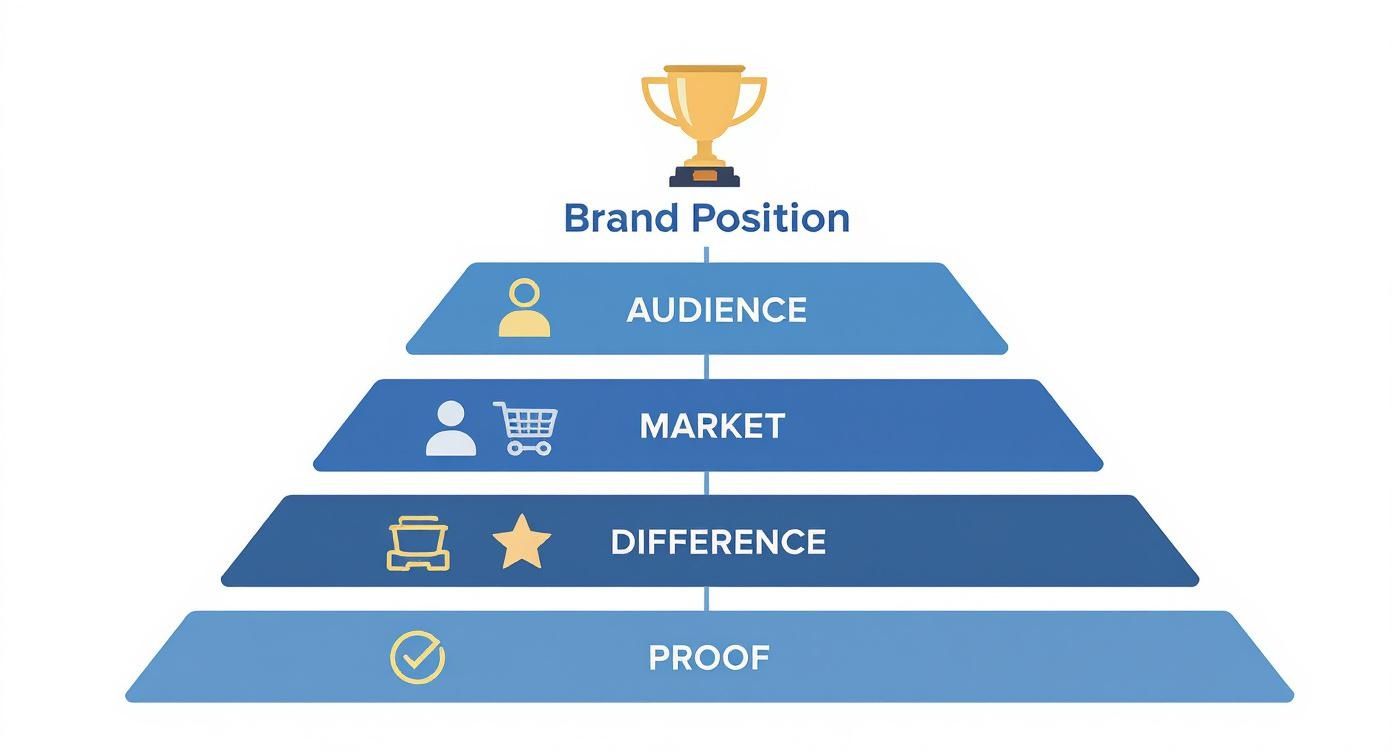
As you can see, a powerful brand position is the result of deep thinking about your audience, your market, your unique difference, and your proof points. It all has to connect.
Putting It All Together: A Fictional Example
Let’s make this real. Imagine a fictional brand called "CommuteCycle" that sells folding electric bikes.
- Target Audience: Urban professionals in London stuck with long, expensive, and crowded daily commutes.
- Market Category: Premium folding electric bike manufacturer.
- Brand Promise: The fastest and most convenient way to navigate the city.
- Reason to Believe: A unique one-click folding mechanism and a frame that’s 25% lighter than any competitor.
Putting it all together, their positioning statement would be:
"For urban professionals in London, CommuteCycle is the premium folding electric bike that delivers the fastest and most convenient commute because of its unique one-click folding mechanism and ultra-lightweight frame."
In a market as tough as UK retail, that kind of clarity is a superpower. Brand awareness and recognition are everything, especially when research shows 37% of UK consumers have ditched brands they once loved because they no longer felt relevant. A sharp positioning statement is your best defence against being forgotten.
How UK Success Stories Nail Their Brand Positioning
Theory is one thing, but seeing brand positioning out in the wild is where it really clicks. The UK market is packed with brilliant examples of brands that have carved out a space in customers' minds through sheer strategic focus.
To see what that looks like, let's unpack how two completely different brands—a modern fintech disruptor and a century-old luxury carmaker—mastered their markets.
The Challenger: Monzo
Monzo did not just burst onto the UK banking scene; it completely rewrote the rules. Their strategy was not about being a better traditional bank, but a fundamentally different one.
- The Enemy: The slow, stuffy, and frustratingly opaque high street banks.
- The Hero: Simplicity, total transparency, and putting the user in control.
Every single thing they do backs this up. Instant spending alerts, fee-free spending abroad, and easy-to-use spending pots. That hot coral card? It’s not just a colour. It’s a deliberate middle finger to the boring corporate blues of the old guard.
Monzo positioned itself as the bank for modern life, and its explosive growth proves just how much that idea resonated.
The Icon: Rolls-Royce
At the absolute other end of the scale, Rolls-Royce has a brand position meticulously crafted over a century. They do not just occupy the ‘luxury car’ space; they own the territory of ultimate automotive craftsmanship and bespoke excellence.
Rolls-Royce does not sell you a way to get from A to B. It offers an experience of unparalleled, handcrafted luxury. Its positioning is so powerful it does not even need to mention competitors—it exists in a category of one.
Everything they do reinforces this idea of exclusivity. The whisper-quiet cabins, the hand-stitched interiors, the ridiculously personal client service. It’s not about driving; it’s about arriving in a piece of art.
The Shift to Values-Based Positioning
Today, a brand's position in the UK is about more than just its price or features. There is a huge shift happening, with brands now aligning with what their customers actually care about. New data shows a massive 78% of UK consumers now actively choose brands that reflect their personal values.
This means a brand's stance on things like sustainability or ethical sourcing has become a seriously powerful positioning tool. We're seeing brands that earn certifications like B Corp getting a 25% bump in consumer trust . It's solid proof that modern positioning is just as much about what you stand for as what you sell.
You can dig deeper into how businesses are using these trends over on BeMySocial.
How to Measure and Adapt Your Brand Position
Nailing down your brand position is a massive milestone, but it's certainly not a ‘set it and forget it’ job. Markets move, customer needs change, and new competitors show up all the time. Your positioning has to be a living, breathing strategy that you constantly monitor and tweak to keep it sharp.
Think of it like navigating a ship. You plot your course, but you still need to keep a close eye on the compass and the weather to make sure you are actually heading in the right direction. Measuring your brand position is how you check that compass.
Checking Your Compass: Key Measurement Tactics
To figure out if your intended position lines up with reality, you need to get feedback. This is not about guesswork; it's about collecting real-world data to see how your brand is actually perceived out in the wild.
Here are a few essential ways to do it:
- Brand Perception Surveys: Go straight to the source. Ask your target audience and the wider market what they think of your brand. The right questions can tell you if they see you as a leader in your category or if they associate you with the key things that make you different.
- Social Listening: Keep an ear to the ground by monitoring conversations on social media, forums, and review sites. What words do people use when they talk about you? This gives you unfiltered, honest insight into how people really feel.
- Market Share and Sales Data: Dig into your sales figures and see how they stack up against your main competitors. If your market share is growing, it is a good sign that your positioning is hitting home and winning over customers.
This constant feedback loop is absolutely vital for staying on course and making sure your message is landing as intended.
When to Adjust Your Course
Sometimes, the data will show you there is a gap between the position you want and the perception people have. That's your cue to make an adjustment.
A brand's position is not static; it is an ongoing dialogue with the market. The goal is to ensure your intended message is the one being received, and to adapt when a disconnect appears.
Other triggers might include big shifts in consumer trends, the arrival of a disruptive new competitor, or even your own company expanding into new markets. One powerful way to track this is through influencer collaborations. The UK influencer market is projected to grow at a CAGR of 29.5% through 2033 , with a huge 81% of brands now using micro-influencers to connect with their audiences in a more genuine way. These partnerships give you invaluable, real-time feedback on how your brand's position is being received. You can read more about these UK influencer marketing trends and see how they can inform your strategy.
Staying agile and responding to these signals is how you maintain a strong, relevant brand position for the long haul.
Still Have Questions About Brand Positioning?
Even after laying out the groundwork, a few common questions always seem to pop up. It's completely normal. Let's tackle some of the most frequent ones head-on to clear up any confusion.
What's the Real Difference Between Branding and Positioning?
This is easily the most common point of confusion, but the distinction is simple when you think about it this way.
Branding is your entire toolkit – the logo, the colours you use, your tone of voice, the design of your website. It’s all the tangible stuff people see and feel. It’s the what.
Positioning , on the other hand, is the strategic thinking behind the toolkit. It’s the specific piece of mental real estate you want to own in your customer's mind. It's the why you chose that logo and the where you want to sit in the market compared to everyone else.
How Often Should We Revisit Our Brand Position?
Look, your brand position is not carved in stone, but you cannot be changing it with the seasons either. A good rhythm is to conduct a proper review every one to two years , or immediately if something big rocks your industry.
You'll know it's time for a review when:
- A disruptive new competitor crashes the party.
- Your customers start behaving differently or caring about new things.
- You're about to launch a major new product or expand into a completely new market.
Is a Formal Positioning Strategy Overkill for a Small Business?
Absolutely not. In fact, you could argue it is more critical for a small business. When you're working with a tight budget, every single penny has to count. You simply cannot afford to throw money at a message that does not land.
A formal positioning strategy makes sure every pound you spend is laser-focused on hitting the right audience with a message that makes you their only logical choice. It is how you level the playing field, competing on pure clarity and relevance, not just a bigger wallet.
Ready to carve out your unique space in the market? The team at Superhub lives and breathes this stuff. We specialise in building powerful brand positioning strategies that do not just sound good—they drive real growth and build fierce customer loyalty. Discover how our services can elevate your brand today.
Want This Done For You?
SuperHub helps UK brands with video, content, SEO and marketing that actually drives revenue. No vanity metrics. No bullsh*t.