


How to measure social media engagement: a UK guide
Measuring social media engagement is all about tracking the key interactions – the likes, comments and shares – to figure out how your content is actually landing with your audience. It means looking past simple follower counts to see the real story behind the numbers, turning raw data into a clear strategy.
What social media engagement really means in the UK

Real engagement goes way beyond just counting likes. It’s about the quality of the conversations and interactions your brand inspires. Here in the UK user habits are changing; people are spending less time scrolling aimlessly and are instead interacting more deliberately with content that genuinely grabs their attention.
Think about it: a focused fifteen-minute interaction where someone comments, shares your post and explores your profile is far more valuable than forty minutes of passive viewing. For UK businesses, realising this shift is crucial.
Moving beyond vanity metrics
Getting measurement right isn’t about chasing vanity metrics like follower numbers. It's about understanding the narrative your data is telling you. This insight is the foundation for making sense of the platform-specific formulas and benchmarks we’ll get into later.
We're seeing a few key shifts in UK user behaviour:
- A clear move towards purposeful interactions over just passive scrolling.
- A growing appetite for authentic, value-driven content .
- Higher engagement with short-form video and interactive formats .
In fact, tracking interactions like likes, comments and shares is really a proxy for how involved your audience is and how well your brand is resonating. The data shows that in 2025, UK social media users are expected to spend an average of 1 hour and 37 minutes per day on social platforms, which is actually an 11% decrease from 2023 . But while the time spent might be down, the quality of engagement seems to be rising as people prioritise more meaningful online activity.
Grasping these nuances is what separates a strategy built on real UK audience behaviour from one based on generic global trends. It's the difference between just collecting data and gaining genuine business intelligence.
The strategic importance of engagement
Before you can measure engagement effectively, you need to understand why it matters so much. Strong engagement is a clear signal that your content is hitting the mark, helping you build a community and ultimately supporting your business goals. You can read our detailed guide on why social media is important for your business to learn more.
To get a firmer grip on the core concepts, it’s also worth consulting a comprehensive guide on measuring social media engagement. This groundwork will set you up perfectly as we move on to choosing the right metrics in the next section.
Choosing metrics that actually matter
It’s incredibly easy to get lost chasing the wrong numbers on social media. To figure out what’s really working, you have to start by picking Key Performance Indicators (KPIs) that genuinely reflect what you’re trying to achieve. Your measurement strategy should always begin with the end goal, not a generic list of metrics.
Think about it. If your main objective is to build brand awareness then metrics like reach (how many unique people see your post) and impressions (the total number of times your post is seen) are your bread and butter. These figures tell you just how far your message is travelling across the UK.
But what if your goal is to generate leads? Suddenly reach doesn't matter nearly as much. Your focus shifts to metrics that signal real intent, like link clicks , website traffic coming from social and of course conversions . A post can reach tens of thousands but if nobody clicks through to your site, it’s not doing its job.
Matching actions to your objectives
Different goals demand a focus on different user behaviours. It’s all about creating a measurement framework that gives you real business intelligence, not just a bunch of numbers to stick in a report.
Here’s a simple way to think about it:
- Want to build brand awareness? Your best friends here are reach , impressions and shares . A high number of shares is a brilliant sign—it means your content is compelling enough for people to turn into advocates for your brand.
- Trying to drive customer loyalty? Look at comments , replies and direct messages . These are conversational metrics that show you’re building a community, not just broadcasting to an audience.
- Focused on generating leads & sales? The only KPIs that really count are your click-through rate (CTR) , website referral traffic and conversion rate . These metrics directly connect your social media activity to your bottom line.
A quick tip: always distinguish between your primary metrics—the ones you make decisions on—and the secondary ones that just add a bit of context. For a lead generation campaign, CTR is primary. The number of likes? That’s secondary. It’s nice to have but it doesn't define success.
To make this even clearer, here's a quick guide to help you match the right UK social media metrics to your business goals. This table breaks down what you should be tracking based on what you want to accomplish.
Matching UK social media metrics to business goals
A guide to selecting the correct social media KPIs based on your specific marketing objectives in the UK market.
| Business Goal | Primary Metric | Secondary Metric | Example Platform |
|---|---|---|---|
| Increase Brand Awareness | Reach & Impressions | Shares, Follower Growth | |
| Drive Website Traffic | Click-Through Rate (CTR) | Outbound Clicks | |
| Generate Leads | Conversion Rate | Cost Per Lead (CPL) | |
| Build a Community | Comments & Replies | Direct Messages (DMs) | X (Twitter) |
| Boost Customer Loyalty | Mentions & Tags | User-Generated Content | TikTok |
| Drive E-commerce Sales | Revenue from Social | Add to Cart Rate |
This framework helps cut through the noise and ensures you're focusing on data that will genuinely inform your strategy, rather than just stroking your ego.
Creating a practical framework
So, where do you start? First, get crystal clear on your top one or two social media objectives for this quarter. Are you launching a new service and just need to get the word out? Or are you trying to drive more sales from your existing followers?
Once your goals are set, pick the primary and secondary metrics that line up with them. This focused approach stops you from drowning in a sea of data and makes sure you’re measuring what really moves the needle. To get a better handle on the specifics, exploring different social media engagement metrics can give you a much richer perspective. It’s how you build a measurement strategy that is both simple and incredibly powerful.
How to calculate your engagement rate
Once you’ve nailed down your goals and picked the right metrics, it’s time to get your hands dirty with the actual calculations. Figuring out your engagement rate isn't just about crunching numbers; it’s about knowing which formula tells the real story for a particular post, campaign or platform.
There are two main formulas I always come back to. Each gives you a slightly different angle on your performance and choosing the right one depends on what you want to know. Are you interested in how many people who saw your post engaged, or how your entire follower base is responding?
Engagement Rate by Reach (ERR)
I often find that Engagement Rate by Reach (ERR) is the most honest measure of how good your content actually is. It tells you the percentage of people who saw your post and were compelled enough to interact with it.
This is a really useful one because, thanks to the ever-changing algorithms, not every one of your followers will see every single post. ERR cuts through that noise.
The formula is pretty simple:
ERR = (Total Engagements on a Post / Reach of that Post) x 100
So, let's say an Instagram post you shared got 250
engagements (a mix of likes, comments and saves) and it was seen by 3,000
unique people. The maths would look like this:
( 250
/ 3,000
) x 100
= 8.3% ERR
Engagement Rate by Post (ER Post)
The other key formula is Engagement Rate by Post (ER Post). This one measures engagement against your total follower count, not just the people who saw it.
It's a solid way to track the general health and responsiveness of your audience over the long term. Just be aware that big swings in your post's reach can make this number a bit wobbly.
Here's the formula:
ER Post = (Total Engagements on a Post / Total Followers) x 100
Using that same example, if your account has 10,000
followers, the result is quite different:
( 250
/ 10,000
) x 100
= 2.5% ER Post
This whole process shows how you can go from a broad business goal to a specific, tangible insight about what’s working and what isn’t.
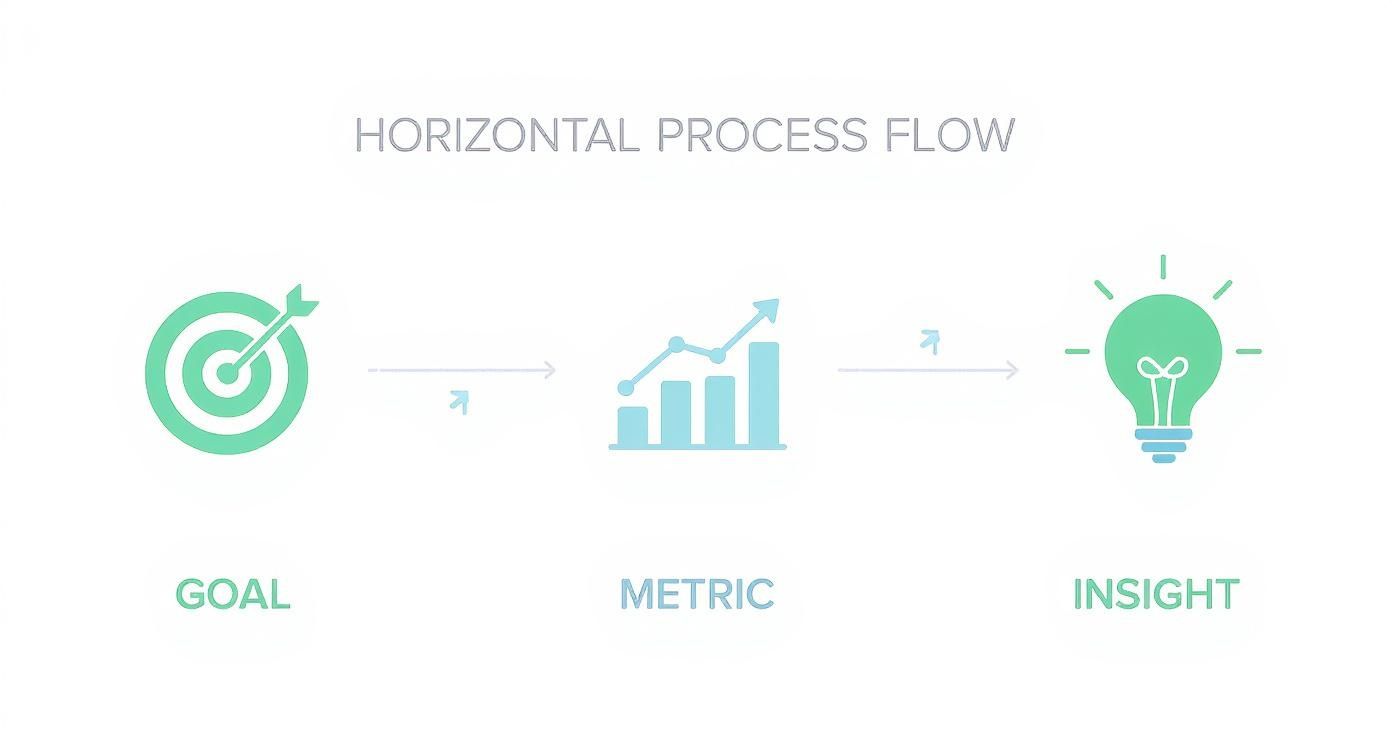
This flow really drives home the point that great measurement always, always starts with a clear goal. The insights you pull are only as good as the objective you tie them to. If you want to go deeper, our guide on mastering marketing performance metrics explores this in much more detail.
Platform-specific benchmarks in the UK
Knowing the formulas is one thing but applying them with the right context is everything. Here in the UK the social media landscape is incredibly varied, which makes platform-specific benchmarks essential.
For example, TikTok is the clear winner on engagement, with an average rate of 5.4% per post. That’s no surprise when you see that UK users are spending over 49 hours a month scrolling the app.
Meanwhile, Instagram Reels pull in a respectable 1.22% average engagement but Facebook has slipped, now hovering around 0.48% per post. You can find more UK-specific stats and insights on talkwalker.com.
It's clear that a 'good' engagement rate is not a one-size-fits-all figure. What looks exceptional on Facebook might be considered average on TikTok, making platform-specific benchmarks essential for realistic performance analysis.
Tools for gathering your engagement data
Let's be honest, manually crunching engagement numbers for every single post is a surefire way to lose your mind. It’s just not a scalable way to measure what’s working. To move from tedious calculations to efficient data collection, you need the right tools. Thankfully, there are plenty of options out there, from powerful free platforms to more advanced third-party solutions.
Your first port of call should always be the tools you already have access to. I’m talking about the native analytics platforms provided directly by the social networks themselves.
For a UK small business, these free options are the perfect starting point. Why? Because they're accurate, easy to get to and won't cost you a penny.
Start with native analytics platforms
The analytics built into each social platform are surprisingly robust. They give you a direct line to your performance data without any extra cost, making them an essential resource for any business getting serious about measurement.
Here are the main ones you’ll be using:
- Meta Business Suite: This is your one-stop shop for both Facebook and Instagram analytics. It gives you detailed insights into reach, impressions, audience demographics and individual post performance, all in one place.
- TikTok Analytics: TikTok’s own tool is fantastic for getting to grips with video performance. You can track video views, follower growth, profile views and where your audience is based, giving you a clear picture of what’s capturing people's attention.
- LinkedIn Analytics: For any B2B business, LinkedIn’s analytics are crucial. The platform offers specific data on visitor demographics, content engagement and follower trends, helping you really understand your professional audience.
The biggest advantage of native tools is their data accuracy . Since the information comes straight from the source, you can trust it completely. The only real drawback is having to check each platform individually, which can get a bit time-consuming as you grow.
When to consider third-party tools
As your social media presence expands, juggling multiple analytics dashboards can become a real headache. This is where third-party tools like Sprout Social or Hootsuite come into their own, offering a consolidated view of your performance across all channels.
These platforms are particularly useful for a few reasons:
- Unified reporting: They pull all your data into a single, customisable dashboard.
- Competitor analysis: Many paid tools allow you to keep an eye on what your competitors are up to.
- Advanced features: You often get access to things like social listening and sentiment analysis.
For instance, a local e-commerce brand could use Meta Business Suite to monitor daily Instagram post engagement for free. As they expand, they might invest in a tool like Sprout Social to generate a single monthly report that includes their TikTok data and tracks the activity of their main competitors. This combination of free and paid tools creates a practical and scalable analytics stack.
For more ideas on what's available, you might find it useful to check out our list of the best free competitor analysis tools.
Right, you've gathered all this engagement data. What now? Piling up numbers is easy but the real magic happens when you start digging into them to find out what they’re actually telling you. This is where you shift from just collecting stats to becoming a data-driven strategist.
The goal here isn't just to see which posts got the most likes. It’s about answering the important questions. What kind of content makes people stop scrolling and actually comment? When are our followers in the UK online and ready to engage? The answers turn raw data into a clear roadmap for what you should be doing next.

Conducting a content audit
A content audit sounds more intimidating than it is. It's a great place to start and doesn't need to be a massive undertaking. Just export your post data from the last three months and start grouping it by format.
You're looking for patterns across the different types of content you've put out there:
- Single images: Which visual styles get the most likes? Is it polished product shots or candid, behind-the-scenes snaps?
- Carousels: What's the average swipe-through rate? Do posts with more slides lead to more comments and saves?
- Videos (Reels/TikToks): Keep a close eye on watch time and shares . These are your strongest clues that a video has genuinely hit the mark.
For instance, a UK-based clothing brand might notice that while their professional product shots get a steady stream of likes, it's the grainy, behind-the-scenes videos of their design process that get shared and talked about. That’s a massive insight. It tells them their audience is hungry for authenticity and wants to feel connected to the brand, not just sold to. That one finding can reshape their entire content plan.
Pinpointing your best posting times
Next up is timing. Yes, there are plenty of articles out there with general UK benchmarks but your audience is unique. Your own data will always be the most reliable guide for figuring out when your specific followers are most active.
Most social media platforms have built-in analytics that show you exactly when your audience is online. Have a look at this data over a month or so to spot the patterns. You might find your followers are most engaged during their weekday lunch break from 12 PM to 1 PM but are more likely to do some relaxed scrolling on a Sunday evening.
The key here is to test and learn. Once you've identified what looks like a peak time, schedule some of your best content for that slot and watch what happens. Did the engagement rate go up like you expected? This cycle of analysing, testing and tweaking is the very core of a smart social media strategy.
Communicating your findings to stakeholders
Finally, none of these insights mean a thing if you can't get your team or clients on board. When you're putting together a report, think clarity and impact. Nobody wants to be buried under a mountain of spreadsheets.
Simple charts and graphs are your best friend here. A bar chart that clearly shows video posts outperform static images is far more powerful than a table of numbers ever will be.
And when you're writing up your findings, use blockquotes to make the most important takeaways jump off the page. A statement like, "Carousel posts in Q3 generated 40% more saves than any other format," makes the conclusion impossible to ignore. It turns a dry stat into a clear, strategic recommendation that everyone can understand and act on.
Got questions? We’ve got answers.
When you start digging into the numbers, it’s natural for a few questions to pop up. Measuring social media engagement isn't always straightforward, so let's clear up some of the most common queries that come our way. Think of this as your go-to guide for those practical, "what-should-I-actually-do?" moments.
We'll cover everything from what a ‘good’ engagement rate really looks like here in the UK to how often you should be pulling reports.
What is a good engagement rate in the UK?
This is the million-dollar question but there’s no single magic number. A "good" engagement rate really depends on the platform you're using and the industry you're in.
Based on the latest UK data, TikTok is miles ahead, with an average engagement rate of 5.4% . If you’re hitting anything above that, you’re doing exceptionally well. Over on Instagram, a solid benchmark to aim for is around 1-2% , especially for Reels which tend to perform best.
Facebook is a tougher nut to crack. The average has dipped below 0.5% so if you can manage to get even a 1% engagement rate on your posts, that should be considered a big win.
The most important thing is to benchmark your performance against two key things: your own past results and what your direct competitors are doing. Context is everything. A slightly lower rate on an account with a massive following can still mean a huge number of valuable interactions.
How often should I measure social media engagement?
The right answer here comes down to your goals. For your everyday social media management and general health check, a monthly report is usually the sweet spot. This gives you enough time for data to build up, helping you spot real trends instead of overreacting to daily blips.
However, if you're in the middle of a specific, time-sensitive campaign—like a product launch or a big seasonal sale—you’ll want to be checking your metrics much more frequently. Think weekly or even daily. This lets you make smart adjustments on the fly and optimise performance while the campaign is still running.
The key is consistency. Set a reporting schedule that works for you and stick to it. You might use a dashboard for a continuous, at-a-glance view but make sure you schedule time for a deeper dive at regular intervals.
Should I focus more on reach or engagement rate?
Ah, the classic debate. The truth is, one isn't better than the other; it all comes down to what you’re trying to achieve with a specific campaign.
If your main goal is brand awareness then reach is your north star. You want to get your message in front of as many new eyeballs as possible and reach directly measures how far your content is travelling.
On the other hand, if you're trying to build a loyal community, drive sales or encourage people to become advocates for your brand then your engagement rate is far more important. A high engagement rate shows that your content is truly connecting with the people who see it, which is a powerful sign of loyalty and interest.
Ultimately, the best strategies find a healthy balance between both. But always prioritise the metric that aligns most closely with your immediate goal—that’s how you’ll know if what you’re doing is actually working.
Ready to turn engagement data into a powerful growth strategy? The team at Superhub specialises in creating bespoke digital marketing plans that drive real results for businesses in the UK. From social media management to data-driven SEO, we help brands in motorsport, tourism and automotive sectors realise their full potential. Visit us at Superhub to learn how we can help you grow.
Want This Done For You?
SuperHub helps UK brands with video, content, SEO and marketing that actually drives revenue. No vanity metrics. No bullsh*t.