


Customer Journey Optimisation: A Practical Guide to Better UX
Customer journey optimisation is all about looking at the entire experience someone has with your brand and making it better, every step of the way. The real goal is to create a seamless, positive flow across every touchpoint—from the moment they first hear about you to the point where they become a loyal advocate for your business.
Why You Can't Ignore the Customer Journey
Let's be honest, the modern customer path is messy. It’s never a straight line. It might start with a social media post that catches their eye, lead to a website visit, then an email newsletter and eventually a support ticket. Trying to manage each of these moments in isolation just doesn't work anymore. Customer journey optimisation brings it all together under one cohesive strategy, building trust and delivering real value at every single stage.
Thinking about the journey as a whole is critical because every interaction, big or small, shapes how people see your brand. A fantastic marketing campaign can be completely torpedoed by a clunky checkout process or painfully slow customer service. This is why mapping and improving the entire flow is directly tied to better business results.
The Five Core Stages of Any Journey
To really get this right, you first need to understand the fundamental stages of the journey. While every business has its own quirks, the progression usually follows a familiar pattern:
- Awareness: This is the very first hello. It’s where a potential customer realises your brand or solution even exists.
- Consideration: Now they're interested. They’re actively researching, comparing your offerings against competitors and trying to figure out if you're the right fit.
- Conversion: This is the moment of truth. It's the action you've been working towards, whether that's a purchase, a sign-up or a subscription.
- Retention: The sale is just the beginning. The focus now shifts to keeping your customers happy and engaged, encouraging them to come back for more.
- Advocacy: This is the ultimate prize. A happy, loyal customer starts telling their friends, leaving positive reviews and becoming a genuine champion for your brand.
This map gives a simple visual of how these stages and touchpoints connect to form a complete journey.
What a map like this really shows is how a customer's actions, thoughts and feelings evolve as they move from one stage to the next. More importantly, it shines a light on all the opportunities you have to make their experience better.
By focusing on the entire customer journey, you stop chasing short-term wins like a single sale. Instead, you build a sustainable way to grow that boosts crucial metrics like customer lifetime value (CLV) and creates real brand loyalty. Every small improvement you make adds up to a stronger, more resilient relationship with your audience.
How To Map The Journey Through Your Customer's Eyes
To really get this right, you have to step out of your own shoes and into your customer's. It's so easy to assume you know what their experience is like but honestly, assumptions are where good intentions go to die. The only way to truly understand their path is to map it based on real data and honest feedback, not internal guesswork.
This isn't about abstract ideas; it's about the practical work of building a journey map that reflects reality. Think of it as a blend of art and science. You'll need the quantitative data that tells you what people are doing but you'll also need the qualitative insights that explain why. Bringing these two together is the secret to creating a map that uncovers genuine opportunities.
Gathering The Right Intelligence
The foundation of any accurate journey map is solid data. You need to pull information from multiple sources to build a complete picture of how customers interact with you. Just looking at one thing, like website analytics, will only ever give you a fraction of the story.
Your existing analytics are a great place to start. Tools like Google Analytics can show you the common paths people take on your website, where they drop off and which content they actually spend time with. This is your quantitative evidence—it shows you real user behaviour at scale.
But numbers without context are just noise. This is where qualitative research comes in to provide the story behind the data:
- Customer Interviews: Actually talk to your customers. Ask open-ended questions about their initial problem, how they found you and what their experience was really like. Dig into their emotions and frustrations at each stage.
- Surveys: Use simple tools like Typeform or SurveyMonkey to get feedback on specific touchpoints. A quick post-purchase survey can reveal issues with your checkout process you’d never spot otherwise.
- Frontline Staff Feedback: Your sales and customer service teams are on the ground every single day. They hold a goldmine of knowledge about common customer questions, complaints and compliments. Tap into it.
Creating Personas That Feel Real
Once you've gathered all this rich data, the next step is to shape it into customer personas. A persona is a fictional character that represents a key segment of your audience. The goal here isn't to create a dry list of data points; it's to build a profile that feels like a real person you could have a conversation with.
A strong persona should include:
- Demographic info (age, location, job title)
- Goals and motivations (what are they trying to achieve?)
- Pain points and frustrations (what's getting in their way?)
- Preferred channels (where do they hang out online?)
For instance, an automotive brand might create a persona for "Performance Pete," a 35-year-old motorsport fan who obsesses over engine power and track-day performance. Another could be "Safety-First Sarah," a 40-year-old parent whose main concern is family safety features and reliability. These two people will have completely different customer journeys. A modern B2B sales funnel guide offers a great model for mapping these kinds of distinct journeys and figuring out where to engage them.
This infographic breaks down the core stages every persona will move through.
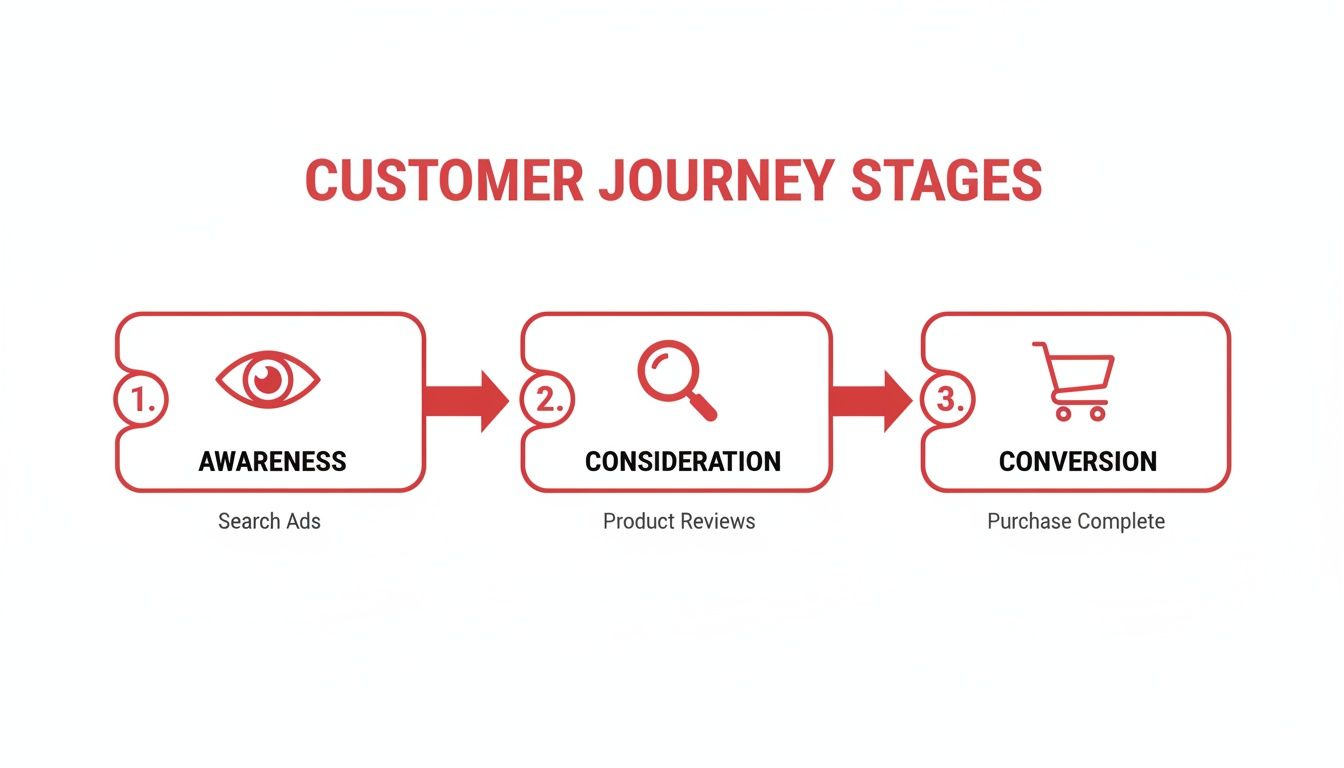
Understanding how a customer's needs shift across Awareness, Consideration and Conversion is absolutely fundamental to mapping their journey effectively.
Visualising The Path Forward
With your research done and personas defined, it’s time to bring it all to life. A customer journey map is a visual representation of the entire process a customer goes through with your company. It needs to pinpoint every single touchpoint, from the first time they see a social media ad to a post-purchase support email. For a deeper dive into the mechanics, check out our guide on what customer journey mapping is and how it can boost your customer experience.
For each stage of the journey, your map should detail:
- Actions: What is the customer actually doing ? (e.g. clicking an ad, reading a review).
- Thoughts: What’s going through their mind? (e.g. "Is this product worth the price?").
- Feelings: What emotions are they experiencing? (e.g. excitement, confusion, frustration).
- Pain Points: Where are the moments of friction? (e.g. a slow website, unclear pricing).
- Opportunities: How can you improve the experience right here, right now?
The real power of a journey map is its ability to shine a spotlight on those moments of friction. A travel company, for example, might discover that customers are excited during the holiday discovery phase but get intensely frustrated by a clunky online booking system. That insight immediately points to a clear, high-impact area for optimisation.
At every stage, being responsive is key. In the UK, a massive 71% of consumers would jump to a competitor if a brand fails to reply promptly on social media. This isn't just a UK trend; 72% of customers globally now expect immediate service. Get this right and you build serious loyalty—customers who have issues resolved quickly are 2.4 times more likely to stick around.
Finding Your Biggest Opportunities for Improvement
Right, you’ve done the hard work and now you have a detailed customer journey map in front of you. This is where the real fun begins. Optimisation isn't just about spotting what’s broken; it’s about finding those specific moments where a small tweak can deliver a massive impact.
The secret is to mix the rich, human stories from your research with the cold, hard data. One tells you what is happening, the other tells you why. This is how you turn a simple diagram into a strategic weapon for making smarter decisions.
Diagnosing Problems With the Right Metrics
To find your biggest opportunities, you need to measure what actually matters. Different metrics will be important at different stages but focusing on a few key performance indicators (KPIs) helps you quickly see where things are falling apart.
Below is a quick overview of the essential metrics you'll want to track at each stage of the journey. Think of it as a health check for your customer experience.
Key Metrics for Journey Stage Analysis
| Journey Stage | Primary KPI | Secondary Metrics | Optimisation Goal |
|---|---|---|---|
| Awareness | Reach / Impressions | Branded Search Volume, Social Mentions | Increase brand visibility to the right audience. |
| Consideration | Engagement Rate | Time on Page, Bounce Rate, Clicks to Key Pages | Keep potential customers engaged and educated. |
| Conversion | Conversion Rate | Basket Abandonment Rate, Form Completion Rate | Reduce friction and make it easy for users to buy. |
| Loyalty | Customer Lifetime Value (CLV) | Repeat Purchase Rate, Churn Rate | Encourage repeat business and long-term value. |
| Advocacy | Net Promoter Score (NPS) | Customer Satisfaction (CSAT), Online Reviews | Turn satisfied customers into vocal brand fans. |
Let's unpack a few of the most critical ones. A low conversion rate at a specific stage, say from the basket to checkout, is a huge red flag signalling friction. Suddenly seeing a big drop-off points you directly to an area that needs fixing, fast. Understanding what drives these numbers is a core part of CRO; we have a whole guide on conversion rate optimisation and how to boost your website’s performance if you want to go deeper.
Meanwhile, Customer Satisfaction (CSAT) scores, often from a simple post-interaction survey, are incredibly revealing. A low score after a support chat, for example, tells you the experience is failing to meet expectations right when it matters most.
Identifying Friction Points and Moments of Truth
Your analysis really needs to zero in on two critical types of moments in the journey.
First, you’re hunting for points of friction . These are the roadblocks, frustrations and dead ends that make people give up. It could be a confusing menu on your website, a shock shipping cost appearing at the last minute or a painfully slow reply from customer service. These are the negative experiences that actively push people away.
Your data shows you where people are leaving but your qualitative feedback—the customer interviews, the survey comments—tells you why. For instance, analytics might show a high exit rate on a product page but a customer comment reveals the real reason is a lack of decent product photos.
Just as important are the moments of truth . These are the pivotal interactions where you have a golden opportunity to deliver an incredible experience that locks in a customer's loyalty. It could be an incredibly helpful blog post that solves a real problem, a personalised recommendation that feels genuinely useful or a support agent who goes above and beyond. These are the moments that create brand advocates for life.
A Simple Framework for Prioritisation
Once you have a list of potential fixes, it’s easy to feel overwhelmed. You can’t tackle everything at once, so you need a straightforward way to prioritise. My go-to method is a simple impact versus effort matrix .
For each potential improvement, ask yourself two simple questions:
- What's the potential impact on the customer and our business goals? (High, Medium or Low)
- How much effort will it take to implement this? (High, Medium or Low)
This simple exercise helps you focus your time and money where they’ll make the most difference. Start with the high-impact, low-effort tasks —these are your quick wins. Then you can plan for the high-impact, high-effort projects that promise the biggest returns down the line. It’s a pragmatic way to make sure your optimisation strategy is both effective and sustainable.
Using Personalisation to Create Better Experiences

Generic, one-size-fits-all marketing just doesn't connect anymore. Today’s customers expect you to recognise them as individuals, not just another number in a database. This is where personalisation stops being a 'nice-to-have' and becomes a critical part of optimising the entire customer journey.
The aim is to create experiences that feel genuinely relevant to each person. This goes way beyond just dropping a first name into an email. It’s about using data and technology to deliver the right message, on the right channel, at precisely the right moment.
True personalisation makes customers feel seen and valued, which is the fastest way to build trust and strengthen their bond with your brand. It’s the difference between a business that shouts at everyone and one that has a meaningful, one-to-one conversation.
Leveraging Technology for Tailored Interactions
Delivering personalised experiences at scale isn't something you can manage manually. It demands a smart blend of data, automation and increasingly, artificial intelligence (AI). These tools are the engine that turns raw customer data into seamless, individualised journeys.
The core technologies driving modern personalisation include:
- Dynamic Website Content: This allows you to show different versions of your website to different visitors. A returning customer might see a "Welcome Back" message and products based on past purchases, while a new visitor sees a special introductory offer.
- Tailored Email Marketing: Automation platforms can trigger emails based on specific actions. If someone abandons their shopping basket, you can automatically send a reminder, maybe with a small discount, to nudge them toward completing the purchase.
- Highly Targeted Advertising: Instead of broad, scattergun campaigns, you can use data to create tiny, highly specific audience segments. A motorsport brand could target ads for upcoming race tickets only to users who have previously watched highlights from that particular circuit.
Hyper-personalisation is a cornerstone of any modern customer journey strategy. In the UK, the expectation for it is soaring, with 62% of consumers now preferring personalised recommendations over general ones. Get this right and you’ll foster loyalty— 60% of people become repeat customers after these kinds of experiences.
AI and Automation: The Engine of Personalisation
Marketing automation platforms are the workhorses that make scaled personalisation possible. They handle the mechanics of segmenting audiences and delivering content but it’s AI that brings the real intelligence.
AI-powered predictive analytics can sift through past behaviour to anticipate what a customer might need or want next. It spots patterns a human analyst might easily miss, allowing you to be proactive rather than reactive.
For instance, a travel company's AI could analyse a user’s booking for a trip to the Scottish Highlands. Based on this, it could automatically send a customised travel guide a week before their trip, packed with recommendations for local restaurants and hiking trails near their hotel. This makes the customer feel genuinely understood and cared for.
If you're keen to explore this further, our article on the power of personalisation in digital marketing is a great next step.
Real-World Examples in Action
Let’s bring this to life with a couple of sector-specific scenarios. These show how personalisation directly improves the customer journey by adding real, tangible value.
Scenario 1: The Motorsport Enthusiast A motorsport fan regularly watches race highlights on a brand's YouTube channel.
- The Data: Their viewing history shows a clear preference for a specific racing series.
- The Personalisation: When tickets for a race in that series go on sale, the system automatically sends a targeted email to this user with an early-bird offer. The brand's website also dynamically updates to show a banner promoting the event when they next visit.
- The Outcome: The fan feels the brand gets their passion and is rewarded with a relevant, timely offer, dramatically increasing the chance of a purchase.
Scenario 2: The Adventure Traveller A user books a family holiday package to a coastal resort in Devon through a travel agency.
- The Data: Booking details confirm the destination, travel dates and the fact they are travelling with children.
- The Personalisation: Two weeks before their trip, they receive a "Your Devon Adventure Guide" PDF. This isn't generic; it includes family-friendly restaurant suggestions, information on local beaches and a discount code for a nearby theme park.
- The Outcome: The customer receives genuinely useful content that helps them plan their holiday. This thoughtful touch enhances their experience and builds serious brand loyalty before they've even packed their bags.
In both cases, technology is used not just to sell but to serve. This focus on adding value is the secret to creating better experiences that turn casual browsers into lifelong fans.
Building a Seamless Omnichannel Strategy

Customers don’t think in channels. They just think about your brand. They expect a fluid experience, whether they’re browsing your site on a laptop, scrolling through Instagram or talking to a support agent. An omnichannel strategy is how you deliver that.
This isn’t just about being present on multiple platforms—that’s multichannel. Omnichannel means creating a single, unified journey where every touchpoint is connected. It demands a fundamental shift in how your teams and your tech talk to each other.
Dismantling Internal Silos
One of the biggest hurdles to a true omnichannel experience is your own internal structure. When marketing, sales and customer service operate in their own little worlds, the customer is the one who pays the price. They end up repeating their story, getting conflicting information and navigating a broken journey.
Tearing down those walls is the first, most critical step. It starts with shared goals and metrics that focus on the total customer experience, not just how one channel is performing. This forces collaboration and gets everyone pulling in the same direction.
The technical backbone for this is an integrated data system. A central Customer Relationship Management (CRM) or Customer Data Platform (CDP) is non-negotiable. It gives every team a 360-degree view of the customer, ensuring context is never lost as they move from one channel to the next.
Maintaining a Consistent Brand Voice
Your brand’s personality shouldn't change just because the platform does. A consistent voice and tone across every single interaction is vital for building trust and recognition. This has to be applied everywhere:
- Website: The messaging on your homepage and product descriptions.
- Social Media: The tone of your posts, comments and DMs.
- Email Marketing: The language in your newsletters and automated replies.
- Customer Support: How your agents communicate on the phone, via live chat or email.
A simple brand style guide is incredibly effective here. It should outline your core values, personality and even specific words to use (or avoid). It’s about getting every team member on the same page. To build a truly seamless strategy, you have to drive success through omnichannel customer engagement.
Creating a Frictionless Cross-Channel Journey
The end goal of customer journey optimisation is to make switching between channels completely effortless. Customers should be able to pick up on one device exactly where they left off on another, without skipping a beat.
Think about a classic retail example: someone sees a sponsored post for a jacket on Instagram. They click through on their phone and add it to their basket but get distracted. Later that night, they open their laptop, see a perfectly timed abandoned basket email and complete the purchase. That’s a frictionless experience.
This level of cohesion isn’t a luxury anymore; it’s a baseline expectation. In the UK, where online sales make up over 27% of all retail, the demand for brilliant service everywhere is huge. British shoppers have become less patient—a striking 67% expect a response to enquiries within just two hours. This shows that a connected, responsive strategy isn't just an advantage; it's essential for survival.
How to Measure and Continuously Refine Your Journey
Customer journey optimisation isn't a one-and-done project. There’s no finish line. The real work lies in a continuous cycle of learning, testing and improving. To build something that lasts, you have to measure the impact of your changes and foster a culture of ongoing refinement.
This final stage is all about proving your efforts are actually paying off. By tracking the right numbers, you can shift from guesswork to data-backed decisions, ensuring every tweak you make contributes to real, long-term growth.
Setting Up Your Measurement Framework
Before you can refine anything, you need to know what success actually looks like. It’s time to revisit those crucial key performance indicators (KPIs) that give you a high-level view of your journey's health. Think of them as your North Star metrics.
A couple of the big ones include:
- Customer Lifetime Value (CLV) : This is the ultimate indicator of a healthy journey. When CLV is on the rise, it’s a clear sign your improvements are encouraging repeat business and building genuine loyalty.
- Churn Rate : This is simply the percentage of customers who stop doing business with you. A falling churn rate tells you that your optimisation efforts are successfully smoothing out friction points and keeping people happy.
Set up a simple dashboard using a tool like Google Analytics or your CRM to track these KPIs alongside other vitals like conversion rates and customer satisfaction scores. Seeing the data visually makes it far easier to spot trends and understand what's working over time.
Don't get lost in a sea of data. Focus on a handful of core metrics that directly reflect the health of your customer relationships. A clear, simple dashboard is far more effective than an overly complex report that no one reads.
Building a Structured Testing Roadmap
With your measurement framework in place, you can start experimenting methodically. A structured testing roadmap is your plan for making incremental improvements based on evidence, not just assumptions. This is where you test specific elements to see what truly connects with your audience.
The two main ways to approach this are:
- A/B Testing : This is where you compare two versions of a single element—like two different email subject lines—to see which one performs better. It’s perfect for isolating the impact of one specific change.
- Multivariate Testing : This gets a bit more complex, involving testing multiple changes at once to see which combination delivers the best results. For example, you might test different headlines, images and call-to-action buttons on a landing page all at the same time.
Your roadmap should prioritise tests based on their potential impact. Start with high-traffic pages or critical touchpoints like the checkout process, where even small improvements can deliver significant returns.
This disciplined approach ensures your customer journey optimisation strategy is always evolving. Every test, whether it wins or loses, provides a valuable lesson that refines your understanding of the customer and gets you one step closer to creating a genuinely seamless experience.
Got Questions? We've Got Answers
Where Should I Start with Customer Journey Optimisation?
The very first place to look is your customer. Before you can dream of improving their journey, you have to walk a mile in their shoes. It all starts with deep, honest customer research.
This isn’t just about analytics. You need to gather real stories through interviews and surveys to get the 'why' behind the 'what'. Combine this qualitative insight with your quantitative data and you’ll be able to build customer personas that actually feel like real people and map out the journey they’re really taking – complete with all its frustrations and highlights.
Isn't This Just a Fancy Name for CRO?
That’s a great question and it's a common point of confusion. While they're definitely related, they play in different leagues.
Conversion Rate Optimisation (CRO) is usually about micro-improvements. Think of it as perfecting a single moment, like tweaking a button on a landing page to get more clicks. It’s a laser-focused tactic. Customer journey optimisation , on the other hand, is the whole grand strategy. It zooms out to look at the entire end-to-end experience, across every single channel, with the goal of building genuine loyalty and lifetime value – not just winning a single conversion.
Remember, a customer journey map isn't a "set it and forget it" document. Treat it as a living, breathing guide for your team. Best practice is to revisit and update it at least once a year or whenever something big changes – like a new product launch, a shift in the market or a wave of fresh customer feedback. This keeps your insights sharp and your strategy relevant.
Ready to transform your customer experience from the ground up? The team at Superhub uses data-driven strategies and bespoke AI technology to map, analyse and perfect every single touchpoint. Discover how our digital marketing expertise can drive your growth.
Want This Done For You?
SuperHub helps UK brands with video, content, SEO and marketing that actually drives revenue. No vanity metrics. No bullsh*t.