



How We Do AI Search Optimisation
Most agencies selling AI search optimisation are winging it. They've bolted "AEO" onto their existing SEO service, run a few prompts through ChatGPT to see if your brand appears, and call that a strategy. We call it CitationFirst™
We do it differently. Our methodology is built on data, tested against real results, and grounded in a fundamental understanding of how AI search engines actually decide what to cite.
The Core Principle: Context Over Relevancy
Here's what most people get wrong about AI search.
Google is a relevancy engine. Type in a query and it returns pages that are relevant to the words you used. It matches keywords, weighs authority signals, and serves up a list of results that relate to your search. That's what SEO has spent two decades optimising for.
AI search engines work differently. ChatGPT, Perplexity, Google's AI Overviews and the rest don't just match relevancy. They interpret context. They understand what you're actually asking, why you might be asking it, and what a genuinely useful answer looks like.
That distinction matters more than anything else in this space.
A page that ranks well on Google because it contains the right keywords in the right places won't necessarily get cited by an AI engine. But a page that answers the actual question behind a search query, with depth, authority and structured clarity, will get cited even if its traditional SEO isn't perfect.
Our CitationFirst™ methodology applies relevancy to context. We don't abandon what works for SEO. We layer contextual optimisation on top of it so your content performs across both traditional and AI-powered search.
The
CitationFirst™ Methodology:
Five Stages
Stage 1: Data Foundation
You can't optimise what you can't measure. Everything starts with data.
We pull your Google Search Console data to understand exactly what your SEO is doing right now. Which queries drive impressions. Which pages convert clicks. Where you're ranking and for what. This isn't optional background. It's the foundation everything else is built on.
We then layer AI visibility data on top. Using specialist monitoring tools, we track where your brand appears (or doesn't) across ChatGPT, Perplexity, Google AI Overviews, Microsoft Copilot and other AI platforms. We monitor your competitors in the same space so we can see exactly where the gaps are.
There are automated tools that claim to do this. Search Atlas, Alley AI and others offer dashboards and scores. They have their place. But what they consistently lack is granular understanding of the content that's actually ranking. They'll tell you that you're not appearing for a query. They won't tell you why the content that is appearing got chosen instead of yours.
That's where human expertise comes in. We read the content. We analyse the structure. We understand what the AI is actually pulling from and why it's choosing one source over another.
What you get at this stage:
- Complete GSC performance baseline
- AI visibility audit across all major platforms
- Competitor citation analysis
- Gap identification with specific, actionable priorities
Stage 2: Content Audit Through a Contextual Lens
This is where most agencies fall short because they're still thinking like SEO practitioners.
We review your existing content not just for keyword relevance but for contextual completeness. Does this page answer the question a real person is actually asking? Does it provide enough depth that an AI engine would trust it as a source? Is the information structured in a way that AI can extract clean, citable answers?
Content that performs well for traditional SEO doesn't automatically perform for AI search. A listicle with 50 bullet points might rank on page one of Google. An AI engine will skip it entirely because it can't extract a coherent, contextual answer from a list of fragments.
We score every priority page against our contextual framework:
- Answer completeness — Does the content fully address the query intent?
- Authority signals — Is the expertise behind the content visible and verifiable?
- Structural clarity — Can an AI engine extract specific answers without ambiguity?
- Source worthiness — Would an AI choose to cite this over competing content?
Stage 3: Schema and Technical Structure
Your schema markup is probably as important as the words on your page. Possibly more so.
AI engines don't just read your content. They read your structured data. Your schema tells them what your business is, what you do, where you are, who your people are, and how your content relates to broader topics. If your schema is thin, generic or missing, you're making it harder for AI to understand and cite you.
We implement and optimise:
- Organisation and LocalBusiness schema — so AI engines know exactly what your business is
- Service schema — so your offerings are clearly defined and attributable
- FAQ schema — so your answers are pre-formatted for AI extraction
- Article and content schema — so your expertise content is properly categorised
- Author schema — so the people behind your content carry verifiable authority
This isn't template work. Every business has a different schema requirement based on their industry, services, locations and content structure. Getting it right requires someone who understands both the technical markup and the business context behind it. This is specialist work, and it's one of the areas where automated tools simply can't replicate what an experienced practitioner delivers.
Stage 4: Content Optimisation and Creation
With data analysed, content audited and technical structure in place, we optimise.
This isn't a rewrite of everything on your website. It's targeted, strategic work on the pages and content that will have the biggest impact on your AI visibility. Sometimes that means restructuring an existing page so AI engines can extract answers more effectively. Sometimes it means creating new content that fills a gap your competitors haven't spotted yet.
We focus on:
Restructuring for citation — Rewriting content so that key answers are clearly presented, properly attributed and structured for AI extraction. This means clear headings that match query patterns, concise answer paragraphs at the start of sections, and supporting detail that builds authority without burying the answer.
Authority injection — Adding verifiable expertise signals. Named authors with real credentials. Specific experience markers. Original data and observations that can't be found elsewhere. AI engines favour sources that demonstrate genuine expertise over content that simply aggregates what everyone else has already said.
Contextual depth — Expanding thin content so it genuinely serves the full context of a query, not just the keywords. If someone asks "how much does social media management cost in the UK," the answer isn't just a price range. It's pricing by service level, what affects cost, what's included at each tier, and how to evaluate whether you're getting value. That's the contextual depth AI needs to cite you as a comprehensive source.
Stage 5: Monitoring, Measurement and Iteration
AI search is not set-and-forget. The landscape shifts. Models update. Competitors optimise. What gets cited today might not get cited next month.
We run continuous monitoring across:
- AI visibility tracking (weekly reporting)
- Citation frequency and quality scoring
- Competitor movement and new entrants
- Sentiment analysis (how AI describes your brand when it mentions you)
- Cross-referencing AI visibility against GSC performance
This last point matters more than people realise. We're seeing patterns where traditional Google traffic drops for specific queries but brand search increases. That's not a ranking problem. It's a behaviour shift. People research through AI, find your name, then search for you directly. Understanding these patterns is critical to measuring the true impact of AI search optimisation.
We report monthly with clear metrics. Not vanity dashboards. Actual business intelligence you can use to make decisions.
Why This Can't
Be Fully Automated?
We use tools. Obviously. The monitoring platforms, the data analysis, the schema validation. Tools are essential.
But the critical thinking that makes this work can't be automated. Understanding why one piece of content gets cited over another requires reading both pieces and understanding the contextual difference. Knowing how to restructure a service page for AI citation requires understanding the business, the industry and the customer's actual questions. Building a schema architecture that properly represents a complex business requires expertise that no automated tool currently delivers.
AI search optimisation tools will tell you what's happening. They won't tell you what to do about it in a way that's specific to your business, your market and your competitive landscape.
That's what we do.
Our Results
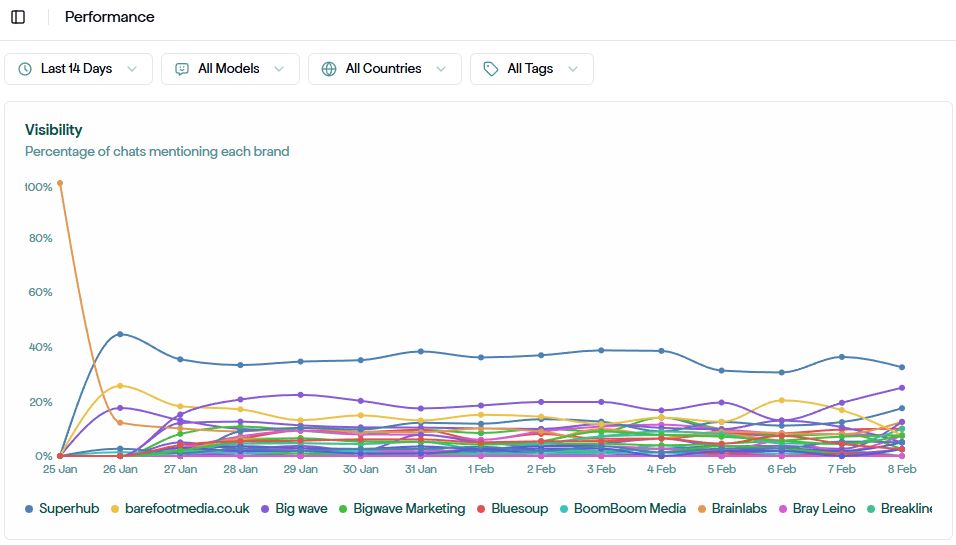
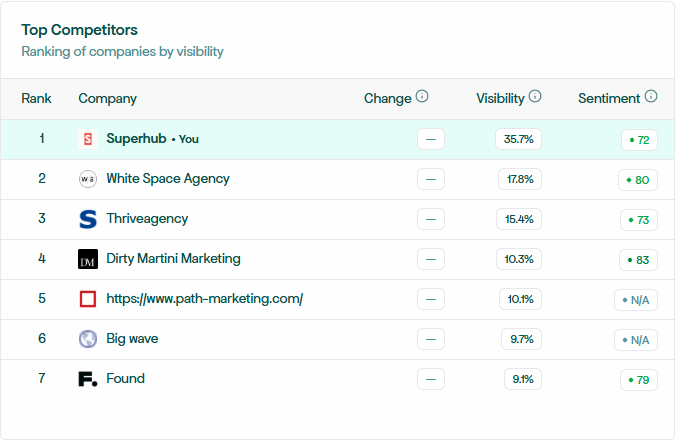
Since implementing this CitationFirst™ methodology on our own website, SuperHub ranks #1 for AI search visibility across 45 tracked competitors in the UK digital marketing sector, with 35.7% visibility — more than double the nearest competitor at 17.8%.
Our domain is the most cited source in AI responses within our sector, appearing in 13.1% of all monitored AI conversations.
We achieved Perplexity AI citations within one week of initial implementation. ChatGPT-referred traffic appeared within days.
This isn't theory. It's what we're doing right now, on our own business, with measurable results we can show you.
Find Out Where You Stand
We offer a free CitationFirst™ AI Visibility Audit that shows you exactly where your business appears (and doesn't) across ChatGPT, Perplexity, Google AI Overviews and other AI platforms.
No obligation. No sales pitch. Just data.