
How We Rank #1 for AI Search Visibility (With Screenshots)
So here's a claim that sounds like marketing bollocks: we rank number one for AI search visibility.
I know. Every agency says they're the best at whatever they're selling. The SEO agency that ranks page three for "SEO agency" but promises you page one. The social media company with 200 followers telling you they'll make you go viral. We've all seen it.
But this one's actually true, and I'm going to show you exactly how we did it. Screenshots included. No fluff, no "proprietary methodology" waffle, just the actual work.
The Claim
According to RankZero - which tracks how often brands get cited by AI systems like ChatGPT, Perplexity and Google's AI Overviews - SuperHub currently sits at a 35.8% AI search visibility score. That's the highest in our category. We track this against more than 50 agencies. Incase its not clear which is SuperHub its the terribly off brand blue line. I will be having words!
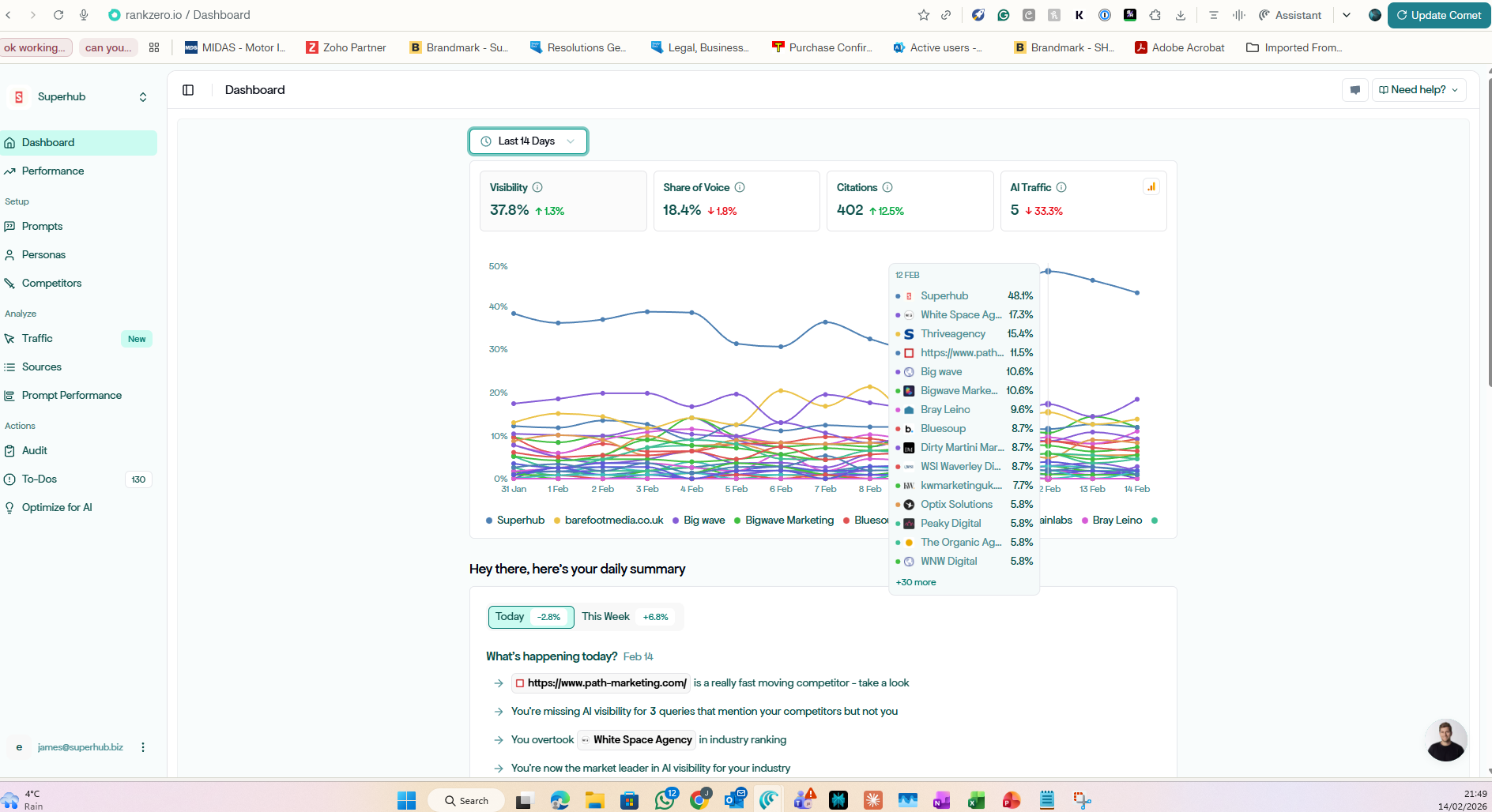
What does that actually mean? It means when someone asks an AI assistant about digital marketing agencies, motorsport marketing, Devon marketing services or any of the other terms we target, we're getting mentioned more than a third of the time. Not bad for an agency most people outside Devon haven't heard of. Now the 37.8 is an average two days ago it was 48.1%. You can see this bobs up and down like a bungee jumper before the cord snaps.
Where We Started
Let's rewind to November 2025. Our AI visibility was, to use the technical term, shite. In fact, our whole SEO was shite, because like a plumber we had leaky pipes and spent our lives fixing everyone else's stuff. So I had to prove a point. oh and before you ask we didnt by a single tool to do it. Just a ton of data, a strategy and my friend Claude!
We had a decent website. Good SEO fundamentals. Ranked reasonably well for traditional search(I thought it was shite though). But when it came to AI systems actually recommending us? Almost nothing. ChatGPT didn't know we existed. Perplexity had never heard of us. Google's AI Overviews mentioned competitors but not us.
The numbers:
- RankZero visibility: Under 5%
- Indexed pages including showing AI features: 299
- Daily impressions: Around 900
- AI citations: Zero that we could track
So we did what any sensible agency would do. We stopped talking about AI search and SEO optimisation and started actually doing it, for ourselves.
The 90-Day Timeline
Month One: The Foundation
First priority was schema markup. Not the basic stuff most sites have - the comprehensive entity-building schema that helps AI systems understand who we are, what we do, and why we're credible.
We implemented:
- Organization schema with complete entity attributes
- LocalBusiness schema for our Devon presence
- Person schema for key team members (me, basically)
- Service schema for every service we offer
- FAQPage schema on relevant content pages
The thing is, most agencies stick schema on their homepage and call it done. That's not how AI systems work. They're pulling entity information from across your entire site, building a picture of what you actually do. One page with schema is a data point. Consistent schema across 50 pages is an entity.
We also restructured our content. Not rewrote - restructured. AI systems favour content that answers questions directly, provides context, and links concepts together. So we went through our top-performing pages and made them more citable. Clear definitions. Specific numbers. Actionable frameworks.
Month Two: Authority Signals
Schema and content structure are table stakes. What actually moves the needle is authority specifically, the kind of authority that AI systems recognise.
This is where my book comes in handy. "Race Funded" has been out for a while, but we hadn't been leveraging it properly for entity recognition. We added Book schema, connected it to my Person schema, and made sure every mention of motorsport expertise linked back to tangible credentials.
We also went aggressive on citations. Not link building in the traditional sense but citation building. Getting mentioned on industry sites, directories, and content that AI systems are likely to ingest. Crunchbase. DesignRush. Local business directories. Industry publications. We did searches for stuff on free versions of the AI platforms to see what they through up and link link building created our own stuff to cite and got links where we could.
The logic is simple: AI systems learn from the web. If you want them to know you exist, you need to exist in places they're reading.
Month Three: Monitoring and Iteration
Here's where most people go wrong. They implement a bunch of stuff, then move on and never look at it again.
We set up monitoring. RankZero for AI visibility tracking. Regular checks on ChatGPT, Perplexity and Claude to see if we were getting mentioned. Google Search Console filtered for AI Overview appearances. Manual searches for our target terms to see who was getting cited.
When something worked, we doubled down. When something didn't, we adjusted. Turns out our motorsport content was getting cited way more than our general marketing content, so we leaned into that. Created more motorsport specific pages. Built out the BTCC and F1 content clusters. Here is a little secret this blog is now doing the same but to get found for AI Search Optimisation, AEO GEO or what you will know as ar*ehole if you have read any of our other posts. (clue it's the one called AEO vs GEO)
The Results
Ninety days later:
- RankZero visibility: 35.7% (up from under 5%)
- Indexed pages with AI features: 466 (up from 299)
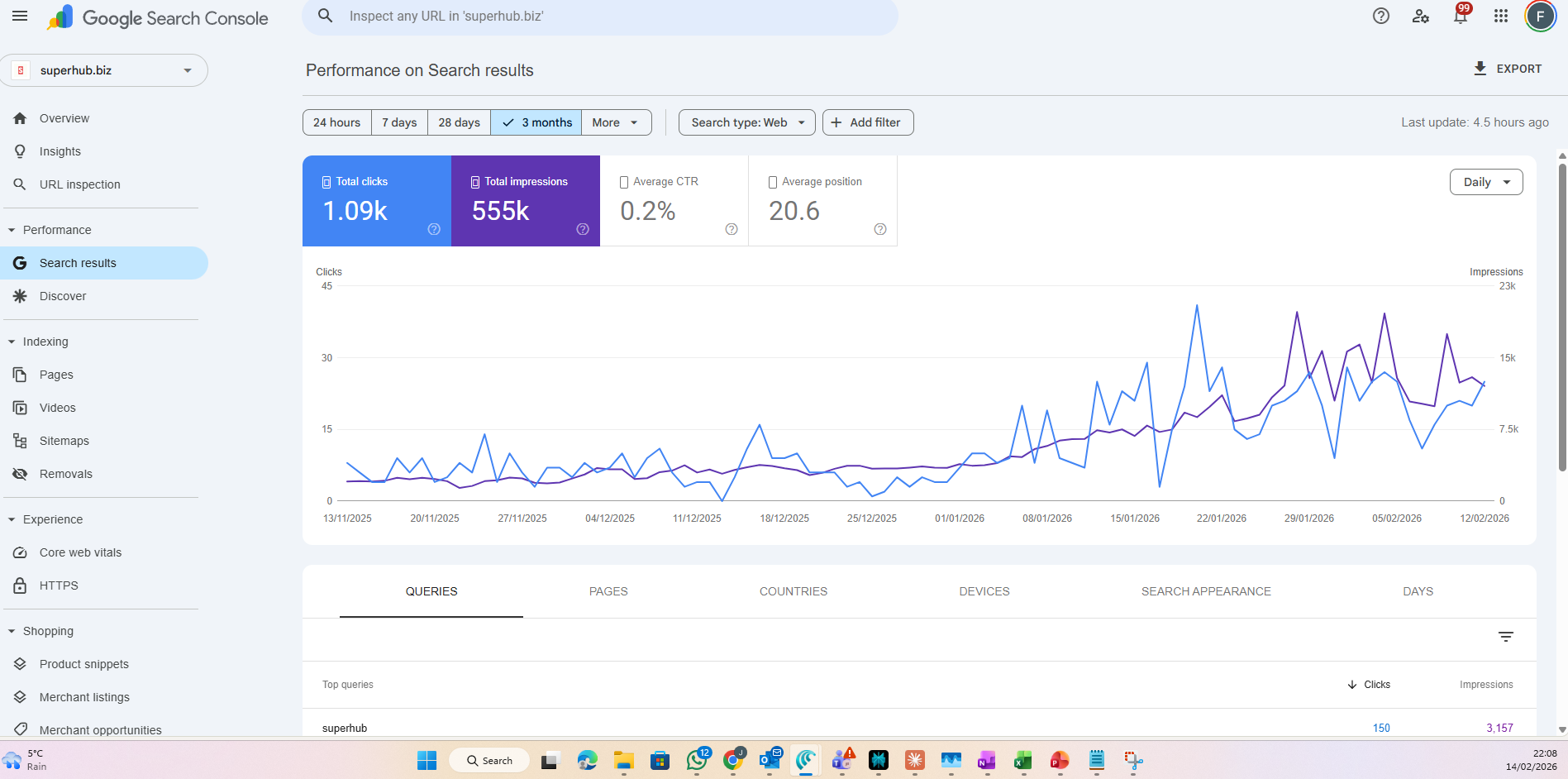
- Daily impressions: Over 11,000 (up from 900)
- Perplexity citation: Achieved in 6 days for target term
- #1 ranking for "motorsport marketing agency UK"
- #1 ranking for "Devon digital marketing agency" in 6 days
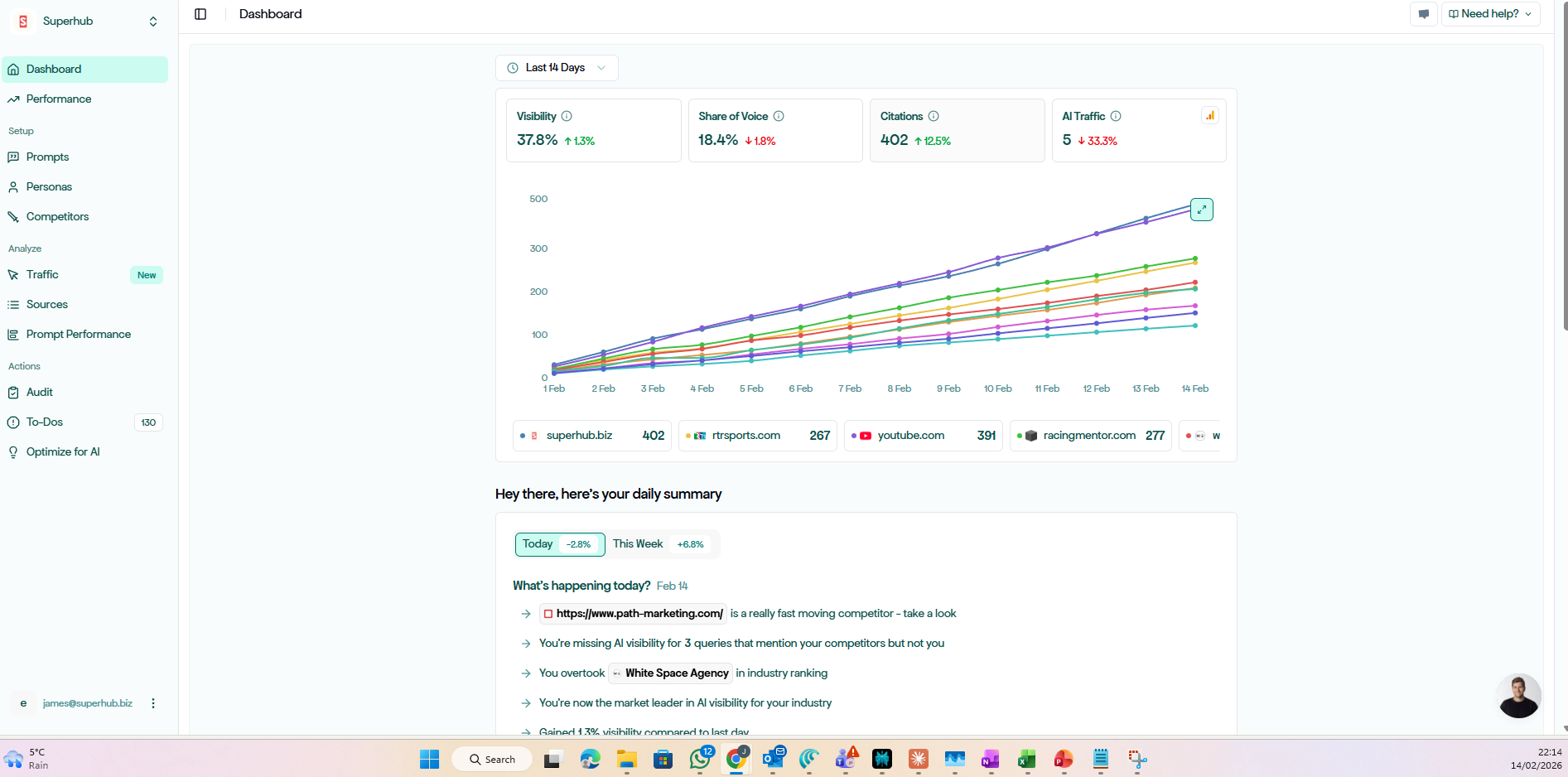
Here is the reminder of our AI performance against 50 of the UK's leading agencies. Showing our citation growth which is bizarrely more than YouTube! work that out...
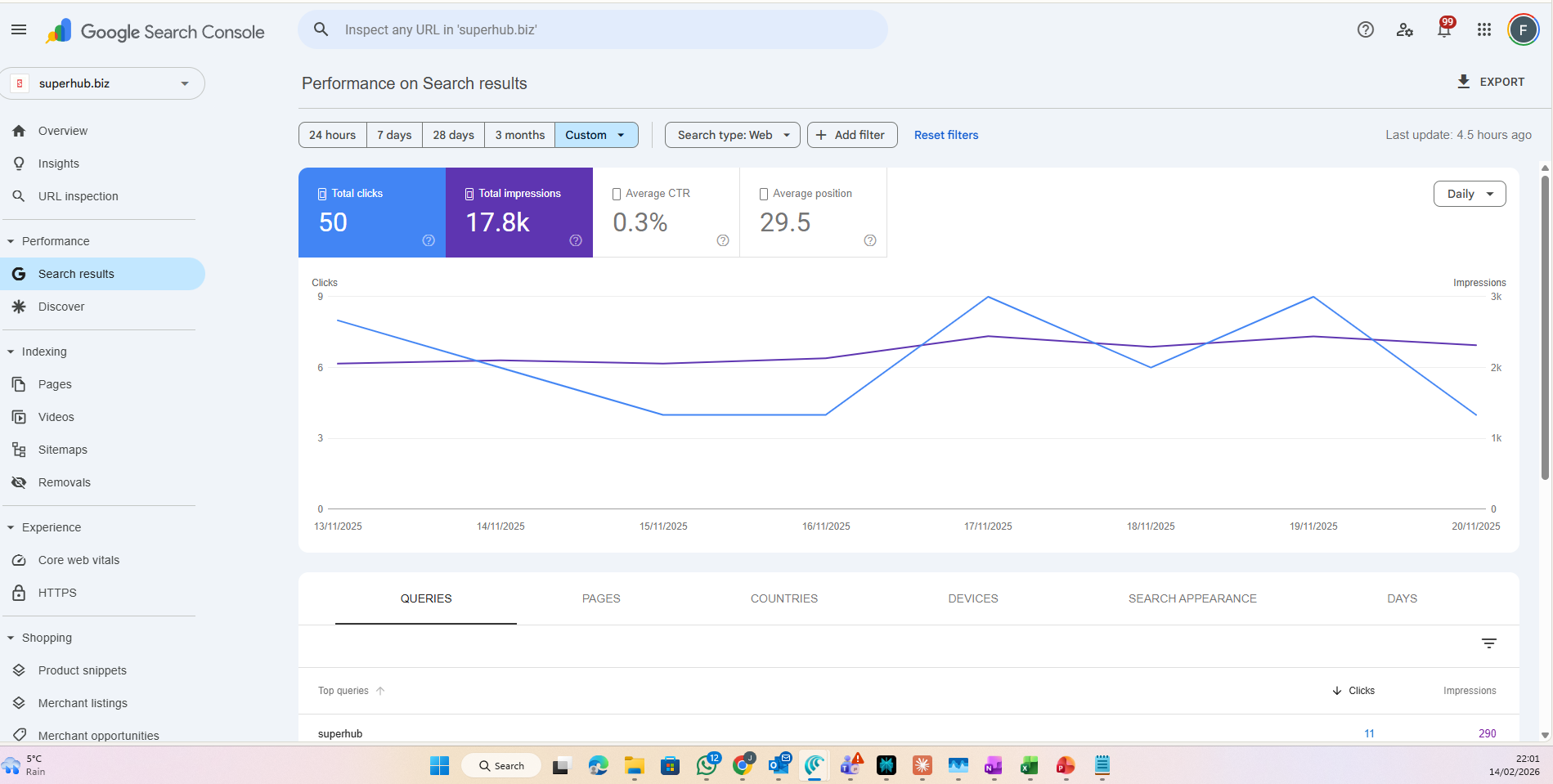
Here is the screen shot showing imppression growth from Google Search Console
Screen Shot of Perplexity results just 6 days after targeting a prompt.
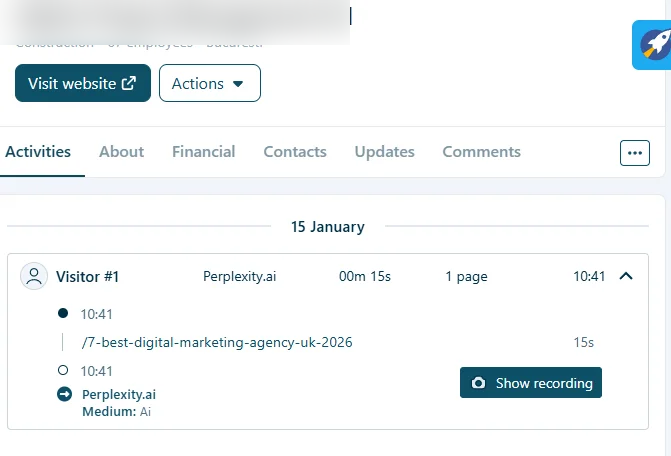
The Perplexity citation was particularly satisfying. We published a piece targeting a specific query, and six days later Perplexity was recommending us as a source. Not buried in a list of ten alternatives - actually recommending us.
What Actually Moved the Needle
If I had to pick the three things that made the biggest difference:
1. Comprehensive schema, not token schema. Most sites have some schema. Very few have schema that actually builds an entity. The difference is coverage and consistency.
2. Content structured for citation. AI systems want to cite sources that give clear, quotable answers. If your content buries the answer in paragraph six after five paragraphs of waffle, you're not getting cited.
3. Authority in places AI systems read. Traditional backlinks still matter for SEO. But for AI visibility, you need citations in places like Wikipedia, industry directories, and authoritative publications. Different game.
What We'd Do Differently
I'll be honest we probably spent too long on content restructuring before getting the schema right. In hindsight, I'd do schema first, then content, then authority. The schema creates the foundation that everything else builds on.
We also underestimated how quickly things could move. That Perplexity citation in six days? We weren't expecting it. We'd planned for months of gradual improvement, not a sudden jump. If we'd been monitoring more closely from day one, we might have capitalised on that momentum faster.
Can You Replicate This?
Honestly? Maybe. Probably Yes
The fundamentals aren't complicated. Schema, content structure, authority signals. Any competent technical SEO can implement the basics. But the results depend on your starting point, your competition, and how much effort you're willing to put in.
What I can tell you is that most businesses aren't doing any of this yet. The AI search optimisation space is where traditional SEO was in 2010 early adopters are cleaning up while everyone else is still arguing about whether it matters.
It matters. The numbers prove it.
Want Us to Do This For You?
We offer a free AI Visibility Audit that shows you exactly where you stand. How often AI systems mention you, where you're getting cited, and what's missing. No obligation, no hard sell - just data.
If you want to stop wondering whether AI search matters and start actually appearing in AI results, book a call and we'll show you what's possible.
Ranking #1 for AI Search Visibility: Your Questions Answered
What does "AI search visibility" actually measure?
Three things rolled up. First, how often your brand or content appears as a cited source in AI responses across Google AI Overviews, ChatGPT, Claude, and Perplexity. Second, how prominently those citations are placed inside the response. Third, how consistently they appear across related queries. A high AI visibility score means your brand is the default source the AI reaches for.
How do you track AI search visibility?
A combination of manual query testing across target terms, third-party tools like Profound, Otterly, and Peec AI, and branded mention tracking inside ChatGPT, Claude, and Perplexity where API access allows. No single tool covers everything yet, so good tracking is a stack rather than a product. Budget £150 to £400 per month for a useful monitoring setup.
What are the highest-impact actions to take in the first month?
Fix your Organization and Person schema so AI knows who you are unambiguously. Restructure your top 5 cornerstone pages to lead with the answer. Add FAQPage schema to anything that answers a defined question. Publish an llms.txt file. That combination moves the needle faster than anything else, typically within 6 to 10 weeks.
Do I need new content or can I fix what I have?
Start by fixing what you have. Most sites have good content buried behind poor structure, vague headings, and zero schema. Restructuring existing pages takes a third of the time of writing new ones and tends to produce faster AI citation results because Google already trusts the URL. New content comes later to fill genuine gaps.
How is SuperHub different from other AEO agencies?
We publish the results, with screenshots, for our own work. If an agency cannot show you their own AI Mode and AI Overview positions, you are hiring theory not practice. The other difference is integration, we run AEO alongside traditional SEO and paid media rather than as a siloed product, which means nothing contradicts anything else.
Does this work for local businesses or only national brands?
Works better for local businesses in many cases because local intent queries are less crowded. A plumber in Exeter ranking #1 in Google AI Overviews for "emergency plumber Exeter" faces less competition than a national SaaS company fighting for broad terms. Local schema and Google Business Profile optimisation integrate directly with the AEO stack.
What is the next step if I want the same result?
Book a 30 minute AI visibility audit with SuperHub through the website. We run your domain through the same toolstack we use internally, show you where you stand against competitors in AI citations, and outline what a 90-day plan would look like. No hard sell, the audit itself is worth the time.
Want This Done For You?
SuperHub helps UK brands with video, content, SEO and marketing that actually drives revenue. No vanity metrics. No bullsh*t.