

Social Media Marketing for Startups: A Practical UK Guide
Forget chasing viral trends. For a startup, social media marketing isn't about luck; it's about building a predictable engine for growth. It’s your most direct route to market, letting you connect with ideal customers on platforms like LinkedIn, Instagram, and Facebook to generate real leads and carve out your space—all without a corporate-sized budget.
Building Your Startup Social Media Foundation
Before you post a single thing, stop. The biggest mistake we see startups make is diving in headfirst, spraying content randomly and hoping something sticks. That’s a guaranteed way to burn through your time and cash.
A solid foundation isn't some 50-page document that gathers dust. It’s a brutally honest framework that guides every decision you make.
It all starts by defining what success actually looks like for your business, not someone else's. Get specific. Are you trying to build brand awareness in the UK motorsport scene, or are you generating concrete leads for your sales team in Devon? The goal dictates the entire approach.
Define Your Commercial Goals First
Vanity metrics like likes and followers are useless unless they connect to a real business outcome. Forget them for now. Your social media goals have to be welded to your startup's commercial objectives.
What are you actually trying to achieve?
- Lead Generation: Need to fill the sales pipeline with qualified enquiries? This is the bread and butter for B2B tech startups or local tradespeople in the South West. Success here is measured in cost per lead and conversion rates. Simple as that.
- Brand Awareness: Are you a new automotive brand trying to carve out a niche? Or a BTCC team that needs to deliver serious sponsor recognition? Here, success is about reach, share of voice, and genuine engagement within a very specific community.
- Direct Sales: If you're an e-commerce startup, the goal is beautifully simple: drive traffic to your website that turns into sales. Every post and ad is measured against revenue and return on ad spend (ROAS).
Pinpoint Your Ideal UK Customer
Once the goal is clear, you need to know exactly who you're talking to. "UK SMEs" is not an audience. It's a lazy shortcut.
"Marketing managers at British motorsport circuits with a budget for sponsorship activation" is an audience. "Homeowners in Devon planning a kitchen renovation" is an audience.
You need to understand their specific problems, the language they use, and where they actually spend their time online. Forget vague demographics and dig into the psychographics—their motivations, challenges, and goals. This clarity stops you from wasting resources trying to appeal to everyone.
To get this right, you'll need to build out a more comprehensive plan. Our guide on how to create a social media strategy offers a deeper dive into this process.
Choose Your Battlegrounds Wisely
You can't be everywhere. Spreading yourself too thin is a recipe for mediocrity. Instead, pick one or two platforms where your ideal customer is most active and focus all your firepower there. A B2B manufacturing firm will find far more traction on LinkedIn, while a Devon tourism business will thrive on the visual storytelling of Instagram and Facebook.
Social media is how UK startups punch above their weight. There are over 50 million social media users in the UK, giving you unparalleled access. The data shows most small businesses using Facebook, followed by Instagram and LinkedIn. These are your primary channels for targeting everyone from BTCC teams to South West SMEs.
To get a strong start without breaking the bank, look at the best free social media management tools available. They can handle the basics of scheduling and engagement, freeing you up to focus on the strategy that actually matters.
Platform Selection Matrix For UK Startups
Choosing the right platform from the start is half the battle. This isn't about personal preference; it's about going where your customers are and where your content will have the most impact. Here’s a no-nonsense breakdown to help you prioritise.
| Platform | Best For Industry | Primary Goal Alignment | SuperHub Pro-Tip |
|---|---|---|---|
| B2B Tech, Professional Services, Manufacturing, Energy & Renewables | Lead Generation, Brand Credibility, Networking | Go beyond just posting. Use Sales Navigator for targeted outreach and join industry-specific groups to listen, not just broadcast. | |
| Tourism, Hospitality, Automotive (dealerships, lifestyle), E-commerce, Motorsport | Brand Awareness, Community Building, Direct Sales (via Shops) | Focus on high-quality visuals—Reels and Stories are non-negotiable. Collaborate with local micro-influencers to build trust quickly. | |
| Local Services (trades), Tourism, Automotive, Community-based Startups | Lead Generation (especially via ads), Community Building, Customer Service | Use Facebook Groups to build a loyal community. The ad targeting capabilities are still unmatched for local B2C businesses. | |
| TikTok | B2C E-commerce, Startups targeting Gen Z, Creative Industries | Top-of-Funnel Brand Awareness, Viral Potential | Don't overproduce it. Authenticity and behind-the-scenes content win here. Jump on relevant trends, but make them your own. |
| X (Twitter) | Tech, Media, Motorsport, Public Figures | Real-time Engagement, PR, Customer Service | Best for quick updates, joining live conversations (e.g., race weekends), and connecting directly with journalists and industry leaders. |
This matrix should give you a clear starting point. Don't try to master all of them at once. Pick your primary channel, get consistent, and only then consider expanding to a secondary platform once you have a process that works.
Developing a Lean Content Creation System

Content is the engine for your social media, but most startups get it wrong. They either overthink themselves into a creative standstill or just spray random posts into the void, hoping something sticks. Both approaches are a phenomenal waste of time.
A lean content system isn't about random bursts of creativity. It's about building a sustainable process that delivers real value, consistently, without burning out your small team.
Forget trying to be everything to everyone. Your content needs a ruthless focus. This starts by defining your content pillars —the 3-4 core themes that become the foundation of everything you create. These pillars should live right at the intersection of your audience's biggest headaches and your startup's genuine expertise.
Establishing Your Core Content Pillars
Think of your content pillars as strategic anchors. They make sure every post, video, and story you share is relevant and reinforces what your brand is all about. More importantly, they stop you from chasing pointless trends and keep your messaging tight.
For a UK startup, these need to be specific. Let’s get practical:
- A Devon-based tourism operator: Your pillars could be "Hidden South West Gems," "Family-Friendly Adventures," and "A Day in the Life at Our Venue."
- A marketing agency for a BTCC team: You might focus on "Sponsorship ROI Tactics," "Engaging Motorsport Fans," and "Driver Spotlights."
- A B2B tech firm: Pillars could be "Productivity Hacks for SMEs," "Customer Success Stories," and "Navigating Industry Regulations."
See how these pillars directly tackle what your audience cares about while showing off what you do best? Suddenly, content planning gets a whole lot simpler. You’re no longer staring at a blank calendar wondering what on earth to post.
Building a Practical Content Calendar
For a startup, a content calendar shouldn't be some complex, colour-coded spreadsheet that needs a dedicated manager. It just needs to be a simple tool to help you plan, organise, and maintain a realistic posting schedule. Consistency beats intensity, every single time.
A good calendar balances different types of content to keep your audience engaged and gently move them towards becoming customers. The easiest way to get this right is the 80/20 rule : 80% of your content should provide pure value (educate, entertain, inspire), and only 20% should be directly promotional (sales offers, product demos).
This approach builds trust. You earn the right to sell by consistently delivering valuable, non-salesy content first. You can get more insight into building out your pipeline in our guide on how to master content for social media success.
Forget posting daily if you can't maintain the quality. Three high-value posts a week, published like clockwork, are far more effective than seven rushed, mediocre ones. The goal is to establish a rhythm that keeps you visible without trashing the quality that builds your brand's reputation.
The Art of Content Repurposing
Here’s the secret to lean content production: work smarter, not harder. This means creating one "hero" piece of content and then slicing it up into multiple smaller assets for different channels. For a startup without a big production team, this is the most efficient way to fill a content calendar.
One chunky, long-form asset can fuel your social media for an entire week, maybe more.
- A 10-minute video: This can be chopped into 5-6 short clips (Reels/Shorts), a full-length YouTube video, an audio snippet for a podcast, and a handful of quote graphics for Instagram and LinkedIn.
- A detailed blog post: This can become a Twitter thread, an infographic, a downloadable checklist, and several LinkedIn posts to spark discussion.
- A client case study: Turn this into a testimonial graphic, a short video interview, and a series of posts highlighting the key results.
This multi-channel approach maximises the return on your initial time investment. For UK startups in sectors like motorsport or automotive, you can amplify this content even further with influencer marketing. It’s a shortcut to credibility without needing a massive budget.
Mastering Organic Growth and Community Building

Everyone will tell you organic reach is dead. It’s not. It just demands more hustle, and that’s your biggest advantage as a startup. While bigger competitors are just throwing money at ads, you can out-work and out-care them by building a genuine community. This is where your sweat equity turns directly into brand loyalty.
Forget just broadcasting your message. The real goal is conversation. Building a community means creating a space where your audience feels seen, heard, and valued. It’s the difference between shouting into a crowd and hosting a great conversation in a pub. One gets ignored; the other builds relationships that last.
This approach is perfect for lean startups because it requires more time than money. It's about showing up, day in and day out, and engaging with real people. Done right, you’ll turn passive followers into your most vocal advocates.
Strategic Engagement, Not Random Likes
Randomly liking a few posts here and there won't move the needle. You need a targeted, almost surgical approach. This means actively seeking out and joining conversations where your ideal customers are already hanging out.
It’s about being a valuable member of the community, not just another marketer trying to flog something. Add your two cents to a relevant LinkedIn discussion. Answer a question properly in a Facebook group. Leave a thoughtful, insightful comment on a potential client's Instagram post.
The aim is to become a recognised and trusted voice within your niche. People buy from people they know, like, and trust. Consistent, valuable engagement is the fastest way to build that trust organically.
This isn't about spending hours glued to your phone, either. It’s about focused, high-impact interactions. Dedicate a small, consistent block of time each day, and you'll see the results compound surprisingly quickly.
Hashtags and Direct Interaction: Your Secret Weapons
Hashtags aren't just an afterthought you tack on at the end of a post; they are a powerful tool for discovery. But using generic tags like #startup is a complete waste of time. You need to get specific to your niche and your location to attract the right kind of attention.
You have to think like your customer. A Devon-based tradesperson isn't searching for #business . They're looking at #DevonBusiness , #ExeterTrades , or #SouthWestBuilds . By the same token, a potential motorsport sponsor will be following #BTCC or #BritishGT , not something generic like #Marketing .
For the best results, use a mix of hashtag types:
- Broad Industry Tags: To reach a wider audience interested in your field (e.g., #AutomotiveMarketing ).
- Niche-Specific Tags: To connect with a highly relevant, engaged group (e.g., #MotorsportSponsorship ).
- Location-Based Tags: Crucial for local businesses to attract customers in their area (e.g., #DevonTourism ).
Beyond hashtags, direct interaction is where you really win. When someone follows you, send them a quick, non-salesy message. If a potential partner shares something interesting, comment with a genuine insight. These small interactions build real connections that algorithms simply can't replicate.
Turning a Following Into a Community
A following is passive. A community is active. The key to making this shift is to give people a genuine reason to get involved. Stop talking at them and start talking with them.
Run simple polls asking for their opinions. Post questions that invite proper responses, not just one-word answers. For instance, instead of "Do you like our new product?", ask "What's the one challenge you're facing that our new product could help solve?".
Most importantly, you need to leverage user-generated content (UGC) . Encourage your customers to share photos or stories of them using your product or service. When they do, celebrate it. Share their post on your Stories, comment on it, and make them feel like a valued part of your brand's journey. This is social proof at its most powerful, and it costs you nothing but your time and attention. It’s the ultimate validation that you're building something people actually care about.
Using Paid Social for Immediate Impact
Organic growth is a long game. When you need to pour petrol on the fire and get leads coming in now , paid social is your best friend. This isn’t about randomly boosting a few posts and crossing your fingers; it’s about building a predictable, scalable system for winning new customers.
Forget the complicated agency jargon. For a startup, paid social should work like a tap. When you need leads, you turn it on. When the sales pipeline is full, you can dial it back. It’s all about direct, measurable impact on your bottom line—not fuzzy ‘awareness’ metrics.
The real magic of paid social is its precision. You can put your message right in front of the exact people who need to see it, whether that’s a procurement manager in the UK energy sector or an automotive enthusiast living within a 10-mile radius of your garage in Devon.
Defining Your Target Audience with Precision
The success of any paid campaign boils down to one thing: how well you define and target your audience. Get this wrong, and you might as well be throwing money into a black hole. Get it right, and your ad spend will work incredibly hard for you.
Platforms like Facebook, Instagram, and LinkedIn have incredibly powerful targeting tools. Don't just scratch the surface with basic demographics. Go deeper.
- For B2B Startups: LinkedIn is where you need to be. You can target by job title, industry, company size, and even specific skills listed on a profile. Want to reach decision-makers in British motorsport? You can build an audience of Commercial Directors and Partnership Managers at UK-based race teams in minutes.
- For B2C and Local Businesses: Facebook and Instagram are still unmatched. A tourism business in the South West can target users who have recently shown interest in "staycations in Devon," live within a three-hour drive, and have an interest in family-friendly activities.
Our advice? Build several distinct audiences to test against each other. Create one based on interests, another on job roles, and a "lookalike" audience based on your existing customer list. This lets you see which group actually responds without betting your entire budget on a single assumption. If you want to dive deeper into the specifics, check out our breakdown of how to boost ROI with targeted social media ads.
Crafting Ads That Actually Convert
Your ad creative—the mix of your image or video and your copy—is what stops the scroll. In a crowded feed, you have about two seconds to earn someone's attention.
Your ad copy has to be direct and focused on the benefit. Don't talk about what your product is ; talk about the problem it solves for the customer. Use a clear, compelling hook in the very first sentence.
As for visuals, they must be high-quality and relevant. Video consistently outperforms static images, especially for showing a product in action or telling a quick story. This doesn't require a Hollywood budget; a well-shot phone video can be incredibly effective if the message is sharp.
The single most important part of your ad is the Call to Action (CTA) . Tell people exactly what you want them to do next: "Book a Demo," "Download the Guide," "Shop Now." Ambiguity kills conversions.
Setting a Lean Budget and Testing Everything
You don’t need a massive budget to get started. In fact, you shouldn’t use one.
Begin with a small, controlled test budget—even £10-£20 per day is plenty to start gathering data. The goal of your first few campaigns isn't to generate a massive ROI; it's to learn what works.
Run A/B tests on everything:
- Audiences: Pit your interest-based audience against your lookalike audience.
- Creatives: Test a video ad against a static image ad.
- Headlines: Try a question-based headline against a benefit-led statement.
After a few days, look at the data. Be ruthless. Turn off the ads that are underperforming (e.g., high cost per click, low click-through rate) and push that budget towards the winners. This simple, iterative process of testing and optimisation is how you turn a small starting budget into a profitable lead generation machine.
Recent data shows just how dominant video and social commerce have become for UK businesses. Mid-market brands, like those we see in the BTCC series or automotive sectors, are prioritising YouTube, Instagram, and TikTok Shop. Meanwhile, our tourism and hospitality clients are finding huge success on Facebook and Instagram. With YouTube's ad reach in the UK now staggeringly high, it's a channel startups simply can't afford to ignore. You can find out more about the latest UK social media platform trends yourself. This is where your paid social strategy can deliver immediate, tangible results.
Measuring What Matters for Startup Growth
"If you can't measure it, you can't improve it." It's a cliché for a reason. In social media, it’s ridiculously easy to get distracted by numbers that look good on a screen but do absolutely nothing for your business. Likes, follower counts, shares – they're vanity metrics. They make you feel popular but often have zero connection to your bank balance.
Let's cut through that noise. Real growth comes from tracking the key performance indicators (KPIs) that directly hit your startup's bottom line. It’s about knowing what's working and what's a complete waste of your limited time and money.
Focus on KPIs That Drive Revenue
For a startup, there are only a handful of social media metrics that truly matter. These are the numbers that tell you if your efforts are actually generating business, not just online chatter.
- Lead Conversion Rate: This is the big one. It’s the percentage of people who take a valuable action after clicking through from your social channels. That action could be booking a demo, signing up for a newsletter, or downloading a guide. A high conversion rate means your message and targeting are bang on.
- Cost Per Acquisition (CPA): How much does it really cost to win a new, paying customer through your social media ads? This is the acid test for any paid campaign. A low CPA means you're running a profitable, efficient machine.
- Customer Lifetime Value (CLV): This metric zooms out to look at the total revenue you can expect from a single customer over their entire relationship with you. Knowing your CLV is critical because it tells you exactly how much you can afford to spend on your CPA and still stay profitable.
Tracking these three KPIs gives you a brutally honest picture of your return on investment. It turns social media from a guessing game into a predictable growth engine.
For your paid ads, you need a simple, repeatable process to refine what you're doing. It’s all about moving from initial setup to profitable scaling in a structured way.
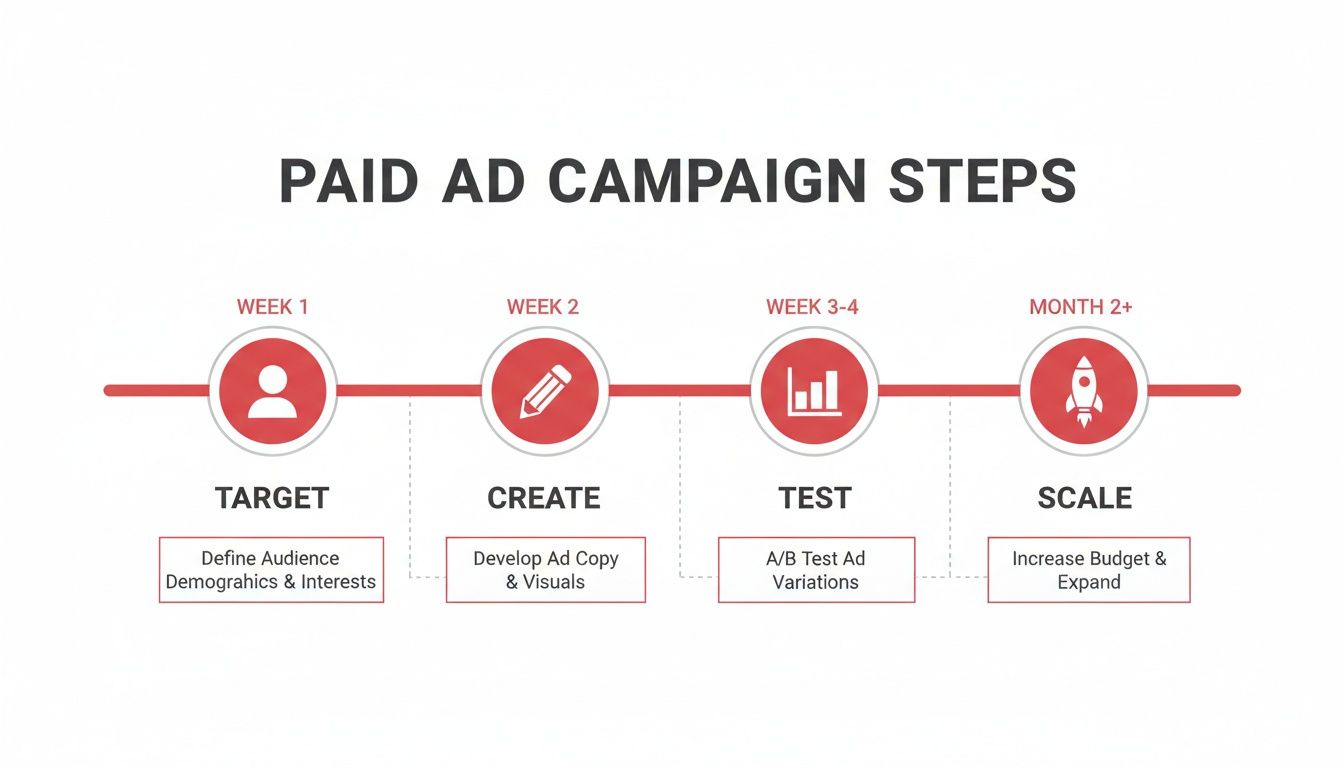
This simple loop—Target, Create, Test, Scale—is your best friend. The data from your tests directly informs how you scale the winning campaigns for maximum impact. Everything else is just noise.
Your Actionable 90-Day Launch Plan
Theory is one thing; execution is everything. This isn't a vague strategic document—it's a practical roadmap with specific milestones for your first three months. The plan is designed to build momentum and deliver tangible results, fast.
Forget trying to do everything at once. This 90-day sprint is about focusing on the right activities at the right time. Each phase builds on the last, creating a solid foundation for long-term, sustainable growth.
This structured approach stops you from getting overwhelmed and makes sure your efforts are focused where they’ll make the biggest difference at each stage.
The Startup 90-Day Social Media Launch Plan
Here’s a step-by-step action plan, breaking down your focus and goals for the first three months. It’s built to take you from a standing start to a scalable system in a logical, measurable way.
| Phase | Days 1-30 Focus | Days 31-60 Focus | Days 61-90 Focus |
|---|---|---|---|
| Theme | Foundation & Setup | Engagement & Testing | Analysis & Scaling |
| Actions | - Define goals & KPIs - Pinpoint ideal customer - Select 1-2 primary platforms - Set up profiles professionally - Create first month's content |
- Post consistently (3-5 times/week) - Daily organic engagement - Launch first small-budget paid ad tests (£10/day) - A/B test ad creatives & audiences |
- Analyse results from month two - Double down on winning content & ads - Kill underperforming campaigns - Increase budget on profitable ads - Plan next quarter's strategy |
| Motorsport Example | Set up LinkedIn/X. Create content around sponsorship value. Identify key commercial director targets. | Engage in conversations around #BTCC. Test LinkedIn ads targeting "Partnership Managers". | Analyse which ad creative drove the most demo requests. Scale budget for the winning audience. |
| Tourism Example | Set up Instagram/Facebook. Create high-quality visual content of your Devon location. | Run daily Stories. Test Facebook ads targeting users interested in "UK Staycations" within a 150-mile radius. | Identify if video ads outperform image ads for bookings. Reallocate spend to the best performer. |
| Tradesperson Example | Set up a Facebook Business Page. Post before/after photos of recent jobs in the South West. | Engage in local community groups. Test ads targeting homeowners in specific postcodes with a "Free Quote" offer. | Measure Cost Per Lead for each ad set. Focus the entire budget on the ad delivering the cheapest qualified leads. |
This isn't just about being busy for 90 days. It's about being effective, learning quickly from real-world data, and building a social media presence that actually contributes to your startup's success.
Straight Answers to Common Startup Social Media Questions
Let’s get straight to it. You’ve got real-world questions about making social media work for your startup, and you need answers without the usual agency waffle. We’ve pulled together the most common queries we hear from UK founders and given them the no-nonsense treatment.
How Much Should a Startup Actually Budget for Social Ads?
There’s no magic number here, but the answer definitely isn’t “as much as you can afford.” The smart money starts small.
We usually advise clients to begin with a test budget of £10-£20 a day on their main platform for the first month. The goal isn't to get a flood of sales on day one; it's to buy data. That initial spend is your intelligence-gathering phase. It tells you which audiences are biting, what ad creative actually resonates, and what your initial Cost Per Lead (CPL) looks like.
Once you’ve found a profitable formula, you can scale the budget with confidence because you’re pouring fuel on a fire you know is already burning. Don’t just throw a grand at a campaign and hope for the best.
How Do We Handle Negative Feedback or Complaints?
First off, don't panic. And whatever you do, don't delete the comment unless it’s genuinely abusive or spam. A public complaint is actually a golden opportunity to show everyone else how brilliant your customer service is.
Here’s a simple process to follow:
- Acknowledge Publicly: Jump on it quickly and politely. Thank them for the feedback and show you understand their frustration.
- Take It Offline: Your goal is to move the detailed conversation into a private channel. Say something like, "We're really sorry to hear about this. Could you please pop us a DM with your contact details so our team can investigate and get this sorted for you?"
- Resolve Privately: This is the important bit. Actually follow up and fix their problem.
- (Optional) Close the Loop: Once it’s all resolved, you can add a final reply to the original comment: "Thanks for getting in touch, glad we were able to get this sorted for you."
This simple act turns a potential PR headache into a public demonstration of how much you care about your customers.
How Long Does It Take to See Real Results?
This all comes down to your goals and how you're trying to achieve them. The timeline for paid ads is completely different from organic growth.
If you're running a tightly targeted paid social campaign for something specific like lead generation, you can see results trickling in within a few days. But if you’re playing the long game with organic growth and community building, you need to be patient. It generally takes 3-6 months of consistent, high-value posting and genuine engagement to build momentum, earn trust, and see a reliable flow of inbound enquiries.
The single most important factor is consistency. Random bursts of activity get you random results. A steady, focused approach—even with a small team—will always win out. Think of social media as a marathon, but paid ads are your secret weapon for the crucial sprints when you really need them.
Tired of social media strategies that deliver likes but no leads? At SuperHub , we build no-nonsense marketing engines that drive real, measurable growth for ambitious UK businesses. We skip the fluff and focus on what actually impacts your bottom line.
See how our direct, results-focused approach can work for you. Visit us at https://www.superhub.biz.
Want This Done For You?
SuperHub helps UK brands with video, content, SEO and marketing that actually drives revenue. No vanity metrics. No bullsh*t.