


What is brand storytelling: A Guide to Crafting Compelling Narratives
Forget everything you think you know about marketing for a second. Features, benefits, USPs… they all have their place, but they do not make people feel anything. Brand storytelling is about ditching the corporate script and connecting with your audience on a genuinely human level.
It is the difference between listing a car’s horsepower and telling the story of the engineering team who stayed up all night to shave a tenth of a second off its lap time. It is about sharing your purpose, your struggles, and your victories to build an identity people remember and trust.
What Is Brand Storytelling?

Think of your brand not as a company selling something, but as a character in a story that your customers want to be a part of. That, right there, is the heart of brand storytelling. It is the art of weaving a single, compelling narrative through every single touchpoint—from your website's 'About Us' page to the caption on your latest Instagram post.
This is not just about reciting your company history. A powerful brand story makes the customer the hero. Your brand simply acts as the trusted guide, the mentor with the tools and wisdom to help them conquer their challenges and win the day.
This approach transforms your business from a faceless logo into a relatable personality people actually want to engage with.
The Power of Narrative in Business
In a marketplace screaming for attention, a good story is what makes you heard. It is what separates the brands we love from the ones we simply buy from. It humanises your business, forging a connection that creates loyalty far more effectively than any sales pitch ever could.
And this is not just a hunch; the numbers back it up. In the UK, a massive 77% of adults believe brands should be telling their stories. People are actively looking for the 'why' behind the 'what'. You can dig into more of the data behind brand storytelling and see the impact for yourself.
A great brand story does not just sell a product; it sells a feeling, a belief, and a reason for customers to choose you over everyone else. It builds a community around shared values.
This is about creating more than just a customer base. When you consistently tell your story, you build a loyal tribe of advocates who do not just buy from you—they believe in you.
Storytelling vs. Traditional Advertising
It is easy to confuse storytelling with a clever ad campaign, but they are fundamentally different. One builds a relationship, the other just asks for a sale.
Here is a clearer look at how they stack up:
| Aspect | Brand Storytelling | Traditional Advertising |
|---|---|---|
| Primary Goal | Build emotional connection and long-term loyalty. | Drive immediate sales and promote features. |
| Approach | Pulls the audience in with a relatable narrative. | Pushes a direct sales message out to the audience. |
| Focus | On the customer's journey, values, and emotions. | On the product's features, benefits, and price. |
| Timescale | A long-term strategy for building brand equity. | A short-term tactic focused on campaigns. |
| Customer Role | The hero of the story. | A passive recipient of information. |
Ultimately, traditional advertising tells people what you do, while brand storytelling shows them who you are. In a world where people buy from brands they trust, the latter is infinitely more powerful.
Why a Strong Narrative Is a Business Essential
In a marketplace crammed with lookalike products and services, a strong story is not just a nice extra—it is a core business asset. If you are only competing on features or price, you are fighting a race to the bottom. A compelling narrative, on the other hand, lifts you above the noise and gives you a powerful, lasting edge.
A good story is what builds a genuine emotional connection with your customers. People do not form relationships with spec sheets or profit margins; they connect with purpose, values, and a shared journey. That connection is the bedrock of real loyalty and brand advocacy.
When your audience feels like they are part of your story, they are far more likely to stick with you, turning from one-off buyers into a proper community. This is where the true power of brand storytelling really kicks in.
Differentiating Through Authenticity
Your story is the one thing your competitors cannot steal. They might copy your product or undercut your price, but they can never replicate your unique history, your founding ‘why’, or the values that genuinely drive your team. This makes your narrative the ultimate differentiator.
It puts a human face on your business, giving it a personality people can actually trust. By sharing the real purpose behind your work, celebrating the wins, and even being open about the struggles, you build a level of credibility a faceless corporation just cannot touch. A strong story makes you memorable.
A story gives customers a reason to choose you that goes beyond the rational. It taps into their beliefs and identity, creating a bond that is far more resilient than one based on price alone.
This authentic connection drives tangible business results. Here in the UK, the data makes a clear case for investing in your narrative: 15% of adults say they would buy a product immediately after being hooked by a brand's story. Even better, compelling stories can increase conversion rates by 30% and boost the perceived value of a product by an incredible 2,706% . You can explore more data-driven insights on brand storytelling's impact to see the full picture.
Driving Growth and Securing Market Position
At the end of the day, a strong narrative is an engine for growth. It does not just bring in customers; it attracts the right customers—the ones who share your values and are much more likely to become high-value, long-term partners.
It also sharpens your internal culture, uniting everyone on your team around a shared mission. When everyone is aligned, every decision—from product development to customer service—becomes more cohesive and impactful.
By investing in your narrative, you are building a sustainable asset that secures your place in the market. You are creating brand equity that grows over time, building a moat around your business that competitors will find incredibly difficult to cross. For a deeper look at how this all works, check out our guide on how brand storytelling builds loyalty and revenue. A powerful story turns your business from just a company into a movement people want to join.
The Building Blocks of an Unforgettable Brand Story
Every great story you have ever loved, from a blockbuster film to a book you could not put down, follows a proven structure. Your brand’s story is no different. To build something that genuinely connects, you first need to understand the fundamental components that give it shape, meaning, and emotional punch.
Here is the most important shift you need to make: a brilliant brand story is not about your company. It is about your customer.
They are the hero of this story, and they are facing a challenge they need to solve. That challenge is the conflict . Your brand is not the hero swooping in to save the day—you are the mentor . You are the one with the wisdom, the tools, or the support that helps the hero win.
Defining Your Core Narrative Elements
To build this framework properly, you need to nail down a few key elements that will keep your story straight. Think of these as the foundational pillars holding everything up, ensuring you always come across as consistent and authentic.
- Your Mission: This is your ‘why’. It is the reason your business exists beyond just turning a profit. A clear mission gives your story a soul.
- Authentic Values: What principles does your brand truly live by? These values need to show up in your actions, not just as words on a webpage. This is how your audience connects with you on a human level.
- Consistent Tone of Voice: How do you sound? Are you witty and sharp, or compassionate and reassuring? A consistent tone makes your brand feel familiar and trustworthy, no matter where people find you. Our guide explains in detail how to create brand guidelines that actually work.
With these pieces locked in, your narrative has a solid base. You are no longer just selling; you are building a story that can turn passive customers into loyal fans who genuinely believe in what you are doing.
The Customer-Centric Story Arc
Think of this as a simple, repeatable structure for every story you tell, always keeping the customer right at the centre of the action. It humanises your brand and makes what you have to say infinitely more relatable.
Your brand’s story is not a monologue about your achievements; it is a dialogue where you show customers you understand their journey and can help them reach their destination.
The demand for this human-first approach is undeniable. In the UK, a staggering 77% of adults believe it is vital for brands to tell their stories. This is not just a consumer whim; brand-builders agree, ranking personal messaging as the single most important ingredient for effective storytelling. The message is clear: humanise your brand, or risk being ignored.
To truly master this, exploring powerful visual storytelling techniques can add another dimension to your narrative. After all, visuals can bring the hero’s journey to life in a way words alone simply cannot.
This is not just about feeling good; it is about getting results.
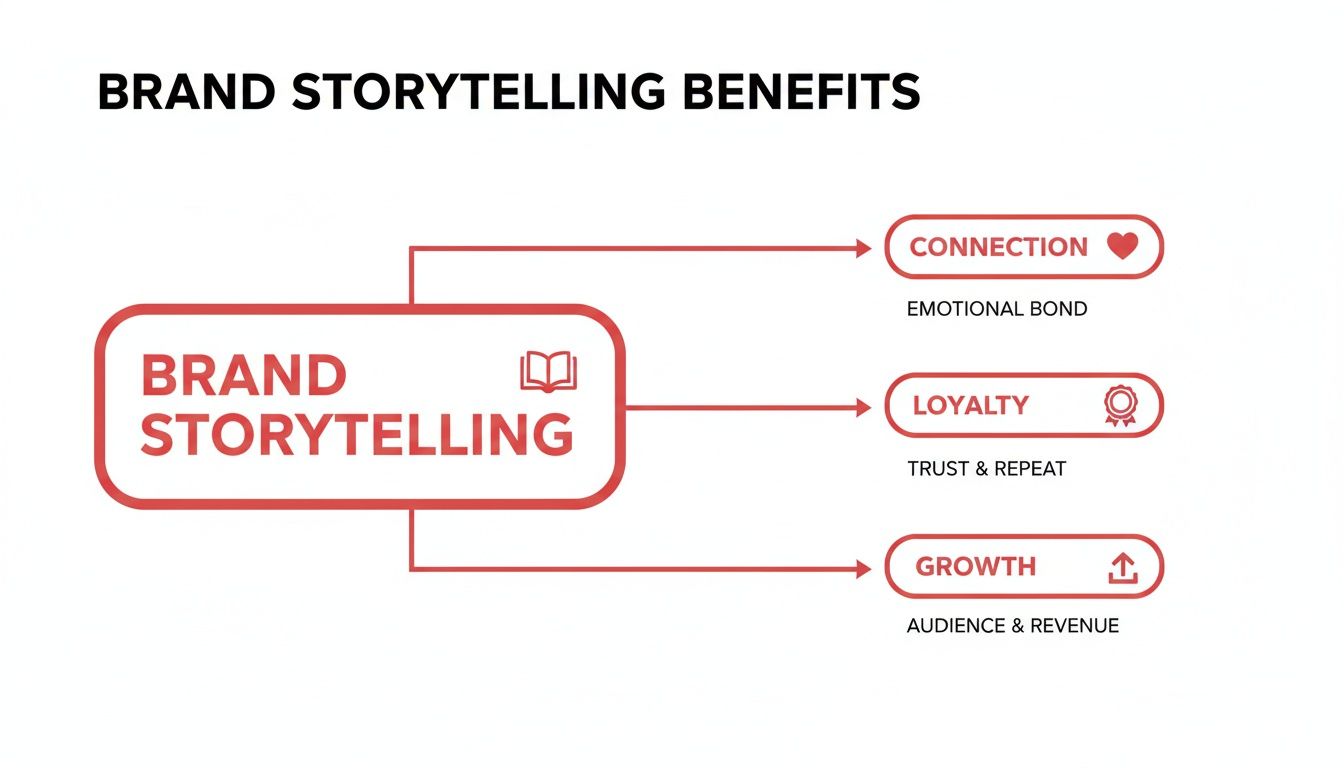
When you focus on these core pillars, your brand story becomes a powerful engine for connection, loyalty, and real, sustainable business growth.
Real-World Examples of Powerful Brand Storytelling

Theory is one thing, but seeing brand storytelling out in the wild is where it all clicks. The brands that truly stick with us do not just sell a product; they sell a feeling, a belief, an identity. They invite us into a world that mirrors our own hopes and values.
Let us look at how two very different brands pull this off. One is a giant built on decades of heritage, the other a plucky disruptor. Both prove that a great story is your most powerful asset, no matter your industry.
To see just how versatile this strategy is, it is worth checking out these other digital storytelling examples that show how a strong narrative can become a brand’s north star.
Heritage Brand Storytelling: Land Rover
Land Rover is the quintessential British icon, and its story is one of rugged adventure, unshakable durability, and quiet confidence. They are not just selling 4x4s; they are selling the promise of exploration. The customer is the hero, poised to conquer any challenge, and the Land Rover is their unflinching ally.
This narrative is woven into every single thing they do:
- Their visuals are pure cinematic adventure. Think sweeping shots of remote landscapes and vehicles tackling impossible conditions. It is a constant reminder of the brand's resilience.
- Their content backs it up with proof. They share incredible stories from real-world expeditions and humanitarian missions where their vehicles are the lifeline, cementing their promise of capability.
- Their language is never boastful. It is confident and understated, reflecting a legacy of reliability that speaks for itself.
By anchoring its story in a rich history of overcoming every obstacle imaginable, Land Rover has built immense trust and prestige. You are not just buying a car; you are buying into a legacy. You are becoming part of the adventure.
Challenger Brand Storytelling: Oatly
Then you have Oatly. The Swedish oat drink brand burst onto the scene with a story built to challenge the old guard of the dairy industry. Their narrative is one of witty, rebellious, and purpose-driven innovation. They play the role of the quirky but principled mentor guiding the health-conscious, eco-aware consumer (the hero) toward a better choice.
Oatly’s story works because it feels real and refreshingly imperfect. They use self-deprecating humour and radical transparency to connect with an audience that is completely over the usual corporate polish.
They use their packaging as a billboard for their personality, with chatty, direct, and often hilarious text that feels like a conversation with a friend. Their ad campaigns are famously disruptive, poking fun at industry norms and positioning themselves as the underdog fighting for what is right.
This has cultivated a fiercely loyal community. People choose Oatly not just because they like the product, but because they see themselves in the brand's cheeky, anti-establishment story. It is a masterclass in how a challenger can use narrative to carve out a massive space in a market dominated by giants.
How to Craft and Share Your Brand Narrative
So, how do we move from theory to action? Crafting a powerful brand narrative is not about pulling a clever tagline out of thin air. It starts with some foundational work—getting to the core of who you are and, crucially, who you are speaking to.
The aim is to build a central story so genuine and consistent that every single interaction becomes another chapter. This turns your narrative from a one-off campaign into the very pulse of your business.
Step 1: Start with Your Foundation
Before you can tell a great story, you need to know what it is actually about. This first step is all about defining the purpose and personality that will steer every piece of content you ever create.
Do not rush this part. Take the time to answer these fundamental questions, because the answers will become your north star for everything that follows.
- What is your mission? Why does your business exist beyond just making money? This is the soul of your story.
- Who is your audience? Go deeper than simple demographics. What are their biggest frustrations, their challenges, and their dreams? Your story has to connect with their world.
- What is your personality? Are you a disruptive innovator or a steady hand people can trust? Defining this shapes your entire tone of voice.
A clear personality is non-negotiable for consistency. Realising that your tone of voice isn't fluff, it's a revenue tool is a lightbulb moment for any business serious about building a real connection with its customers.
Step 2: Develop Your Central Story Arc
With your foundation firmly in place, it is time to give your narrative some structure. Here is the secret: the most powerful brand stories make the customer the hero, not the company. Your brand is simply the trusted guide on their journey.
Using a classic story arc makes your message instantly relatable and far more memorable. There is a reason these structures have been used for centuries—they tap into the fundamental way we process information and connect with one another.
A great brand story is not a monologue about how brilliant your company is. It is a dialogue that shows your audience you understand their struggle and have the tools to help them win.
This customer-first approach is what separates genuine brand storytelling from basic advertising. It shifts the entire conversation from "buy our stuff" to "let us achieve this together," creating a much stronger emotional pull.
Step 3: Choose the Right Channels and Formats
Your central story is the main theme, but you will need to adapt how you tell it for different platforms. Every channel gives you a unique stage to reveal another part of your larger narrative.
Think of it like a film franchise. The core plot stays consistent, but each film or series explores new angles and character details. Your content should work the same way, creating an experience that is cohesive but never repetitive.
- Long-form blog posts are perfect for sharing your detailed origin story or walking through case studies that bring your company values to life.
- Video content is unbeatable for creating an emotional punch. Use it for behind-the-scenes glimpses, powerful customer testimonials, or founder interviews.
- Social media is where your story unfolds daily. Share small, authentic moments that reinforce your mission and personality, turning a list of followers into a real community.
By tailoring your story to the right format, you make sure your message does not just reach people, but truly lands with them, wherever they find you. This builds a strong, authentic narrative that makes your brand more resilient with every single post.
Common Questions About Brand Storytelling
Even with a solid plan in place, a few questions always pop up when it comes to putting brand storytelling into practice. Let us tackle some of the most common ones head-on so you can move forward with confidence.
Lots of businesses, especially smaller ones or those in technical sectors, wonder if this whole storytelling thing is really for them. The short answer? Yes. A powerful story is a universal tool, and any organisation can use it, as long as you are willing to find your authentic voice.
Is Brand Storytelling Only for Large Companies?
Not at all. In fact, it is often the small businesses and startups that have the most authentic and gripping stories to tell.
A genuine narrative about where you started, the problems you have solved, and the mission that gets you out of bed in the morning creates a human connection that massive corporations often spend millions trying to fake.
Authenticity is your secret weapon, not the size of your marketing budget. Your unique journey is an asset that no one can copy, making it a seriously effective way for smaller players to cut through the noise.
A great brand story is not about having a huge history; it is about having a clear purpose and sharing it with honesty. For small businesses, this is a distinct advantage.
That personal touch helps you build a loyal community around shared values—something a faceless entity just cannot do as well.
How Can I Measure the Success of My Story?
While the feeling a story creates might seem a bit abstract, its impact is completely measurable. To figure out if your story is working, you need to look beyond vanity metrics and connect your narrative to real business goals.
Keep an eye on a few concrete metrics that show how people are actually engaging with your story:
- Engagement Rates: Track comments, shares, and likes on your story-driven content. A handful of thoughtful comments are far more valuable than hundreds of mindless likes.
- Time on Page: Check how long people are sticking around on your 'About Us' page or blog posts that tell your story. If they are staying longer, your narrative is holding their attention.
- Brand Sentiment: Use social listening tools to see how people are talking about you online. A clear shift towards positive language is a great sign your story is resonating.
Over time, a strong story should lead to a higher customer lifetime value, more organic traffic from people searching your name, and better conversion rates where it counts.
What if My Industry Is Considered Boring?
Let us be clear: no industry is truly ‘boring’. Every single business, at its core, is about people solving problems for other people. That is a story right there.
Your narrative is not just about technical specs or product features. It is about the expertise of your team, the values that guide every decision, and the real-world impact you have on your clients' lives or businesses.
To find your story, focus on the human element. Share client success stories. Shine a spotlight on the passion and dedication of your employees. Dig into your company’s origin story. Even in a B2B world, decisions are ultimately made by people who connect with stories of reliability, innovation, and trust.
Every business has a story worth telling. You just have to find it.
Ready to tell your brand’s story and drive real growth? At Superhub , we specialise in crafting compelling narratives that connect with your audience and deliver tangible results. Learn how our digital marketing expertise can elevate your brand.
Want This Done For You?
SuperHub helps UK brands with video, content, SEO and marketing that actually drives revenue. No vanity metrics. No bullsh*t.