

Programmatic advertising what is: A UK Guide
Let's be honest, the old way of buying ad space was a slog. It was a world of endless phone calls, back and forth emails, and tedious negotiations with individual website owners. It was slow, inefficient, and often felt like guesswork.
Programmatic advertising completely rips up that old rulebook.
At its heart, it is about using smart technology to buy and sell digital ad space automatically. Think of it less like a series of drawn-out meetings and more like a high speed stock exchange for adverts. The entire process—bidding, buying, and placing an ad—happens in the milliseconds it takes for a webpage to load.
What Programmatic Advertising Means for Your Business
This shift from manual to automated is not just about speed; it is about a fundamental change in focus from guesswork to data driven decisions. For a deeper dive into the mechanics, this resource on What Is Programmatic Advertising is a great place to start.
The real goal here is to serve a relevant advert to the right person, at the perfect moment, for the best possible price. That precision is what makes it such a powerful tool for businesses across the UK.
A Shift From Manual To Automated
The move away from traditional ad buying frees up your marketing team to focus on what really matters: strategy and creativity. Instead of getting bogged down in administrative tasks, they can think about the bigger picture.
Imagine this: instead of buying a huge block of one million ad views on a single popular website (and hoping for the best), you can now buy one ad view across a million different sites. The catch? You only buy the ad space if the specific person viewing it fits your ideal customer profile.
The core idea is simple yet powerful: you are not just buying ad space on a website any more. You are buying access to a specific audience, wherever they happen to be online. This audience first approach is the foundation of modern digital advertising.
Before we go further, it helps to see the two approaches side by side. This table breaks down the key differences between the old manual process and the new programmatic world.
Programmatic vs Traditional Ad Buying At a Glance
| Feature | Programmatic Advertising | Traditional Ad Buying |
|---|---|---|
| Process | Automated, real time bidding using software. | Manual negotiations, direct deals, and insertion orders. |
| Speed | Instantaneous; happens in milliseconds. | Slow; can take days or weeks to finalise. |
| Targeting | Highly specific (audience behaviour, demographics, location). | Broad (based on website content or general audience). |
| Focus | Audience centric; buying access to specific users. | Placement centric; buying space on specific websites. |
| Efficiency | Extremely high; less human intervention needed. | Labour intensive; requires significant manual effort. |
| Cost | More efficient use of budget through targeted bids. | Often involves fixed rates and potential for wasted spend. |
| Scale | Massive reach across millions of websites and apps. | Limited to the publisher relationships you can manage. |
As you can see, the programmatic approach brings a level of precision and efficiency that was simply impossible with traditional methods.
The Power of Data in Real Time
So, how does it all work? Data.
Programmatic advertising hinges on using anonymous user information—like browsing history, location, and demographics—to make those split second buying decisions. The system instantly analyses this data to figure out if a particular ad impression is valuable to an advertiser.
This incredible level of targeting ensures marketing budgets are spent effectively, reaching potential customers who are genuinely interested in what you have to offer. It is a key part of what we discuss in our article on the power of personalisation in digital marketing.
This data first mindset has totally reshaped the UK's marketing world. Driven by advanced real time bidding (RTB) technology, advertisers can pinpoint individual user behaviours with incredible accuracy. It is no surprise, then, that programmatic now accounts for a landmark 78% of the UK's digital display ad spend . It is not just the future; it is the here and now.
The Core Components of the Programmatic Ecosystem
To really get your head around programmatic advertising, you need to understand the tech that makes it all tick. It is not one single bit of software but a whole ecosystem of moving parts, all working together in perfect harmony. Think of it as a super efficient digital stock exchange, but for ad space, with specialist roles for buyers, sellers, and the marketplace itself.
Each player has a very specific job, but they are all interconnected, making sure the right advert finds the right person at the right time—all in a fraction of a second. Understanding who does what is the first step to figuring out how you can make this powerful system work for your business.
At its heart, this whole operation rests on four key pillars. Take one away, and the entire automated process would simply fall apart.
The Advertiser's Toolkit: The Demand-Side Platform (DSP)
For any advertiser or agency, the Demand-Side Platform (DSP) is mission control. It is the software that lets you buy ad space across millions of websites from one single, unified dashboard. No more calling up individual publishers.
Let's say you want to advertise your new running shoes to fitness fanatics in Manchester. A DSP lets you dial in your exact criteria, like:
- Who you are targeting: Think age, location, interests, and even their recent browsing habits.
- Your budget: How much you are willing to spend for every thousand impressions (your CPM).
- What success looks like: Are you after clicks, sales, or just getting your name out there?
The DSP then plugs into the wider marketplace and uses clever algorithms to bid automatically on the ad spots that fit your brief. It does the heavy lifting, finding the best value inventory to hit your campaign goals.
The Publisher's Sales Force: The Supply-Side Platform (SSP)
So, if the DSP works for the advertiser (the demand), then the Supply-Side Platform (SSP) works for the publisher (the supply). Website owners and app developers use an SSP to sell their available ad space, or ‘inventory’.
Its main job is to squeeze every last drop of revenue out of a publisher's ad slots. The SSP connects their inventory to a massive pool of potential buyers—multiple ad exchanges, DSPs, and ad networks—all at the same time. This creates a bidding war, which naturally pushes up the price for each impression.
An easy way to keep them straight: DSPs help advertisers demand ad space , while SSPs help publishers supply ad space . They are two sides of the same coin, both working to make the whole process slick and profitable for everyone.
By automating their sales, publishers make sure they are always getting the best possible price from the highest bidder, second by second.
The Central Marketplace: The Ad Exchange
If a DSP is the buyer's agent and an SSP is the seller's agent, then the Ad Exchange is the marketplace where they all meet to trade. It is the neutral, tech driven platform that makes the buying and selling of ad inventory happen through lightning fast auctions.
Think of it like the London Stock Exchange, but for digital ad impressions. The exchange sees the available ad space coming in from the SSPs and, simultaneously, sees the bids coming in from the DSPs. It runs an auction, picks a winner, and tells the publisher's website which ad to show—all in the time it takes for the page to load.
The Data Powerhouse: The Data Management Platform (DMP)
The final piece of the puzzle is the Data Management Platform (DMP) . A DMP is basically a huge data warehouse that collects, sorts, and activates massive amounts of audience data from all over the place. This could be your own first party data (like your customer list), second party data (another company's customer list), or third party data from big data brokers.
The DMP makes the whole process smarter by adding a rich layer of audience insight. An advertiser can connect their DSP to a DMP to get incredibly specific with their targeting. For example, a travel company could use a DMP to build an audience of "people who have looked at holiday comparison sites in the last 30 days" and then target them directly through their DSP. This makes sure your ads are not just placed efficiently—they are shown to people who actually care.
How a Programmatic Ad Auction Actually Works
Ever wondered what happens in the milliseconds between you clicking on a webpage and an advert appearing? It is not magic; it is a lightning fast auction. This whole process is known as real time bidding (RTB) , and it is the engine that powers most programmatic advertising.
Let’s break down the journey of a single ad impression. From the moment you land on a page to the ad flashing up on your screen, the entire sequence unfolds in less time than it takes to blink.
Step 1: The User Arrives and an Ad Request Is Sent
It all kicks off the instant you visit a website or open an app. As the page starts to load, the publisher’s site sends out a signal saying, "Hey, I have an ad space available for this particular visitor."
But this is not just a simple alert. The publisher's Supply-Side Platform (SSP) packages this request with a bundle of anonymous data about you, the user. This data might include:
- Demographics: Inferred details like your age range and gender.
- Location: Your city or region.
- Browsing History: The kinds of sites or articles you have been looking at.
- Device Information: Whether you are on a mobile, tablet, or desktop.
The SSP then fires this ad request, complete with the user profile, over to multiple ad exchanges, officially putting the ad space up for auction.
Step 2: The Real-Time Bidding Auction Begins
Once the ad exchange gets the request, it immediately offers this ad impression to a whole crowd of Demand-Side Platforms (DSPs). This is where the advertisers—the demand side—jump into the action.
Each DSP represents different brands and their campaigns. The DSPs analyse the data from the SSP in real time, checking if this user is a perfect match for any of their active campaigns. For example, a sports brand’s DSP will be on the lookout for users who have recently visited fitness blogs or searched for running shoes.
This is where artificial intelligence and machine learning really come into their own, allowing the DSP to make a near instantaneous decision. You can learn more about how artificial intelligence is revolutionising digital marketing in our detailed guide. If the user fits the bill, the DSP automatically calculates how much that ad impression is worth and places a bid.
In essence, dozens, if not hundreds, of advertisers are competing for that single ad spot in a live, automated auction. The whole decision is made based on the goals, budgets, and audience criteria the advertiser set up beforehand.
This entire ecosystem is a testament to the incredible efficiency of programmatic tech. It is no wonder the UK programmatic advertising market, valued at around $2.75 billion , is projected to rocket to an impressive $38 billion by 2035 . That's a compound annual growth rate of roughly 26.97% , all driven by the laser focused targeting that advertisers now expect.
This flow diagram shows how all the pieces of the puzzle fit together.
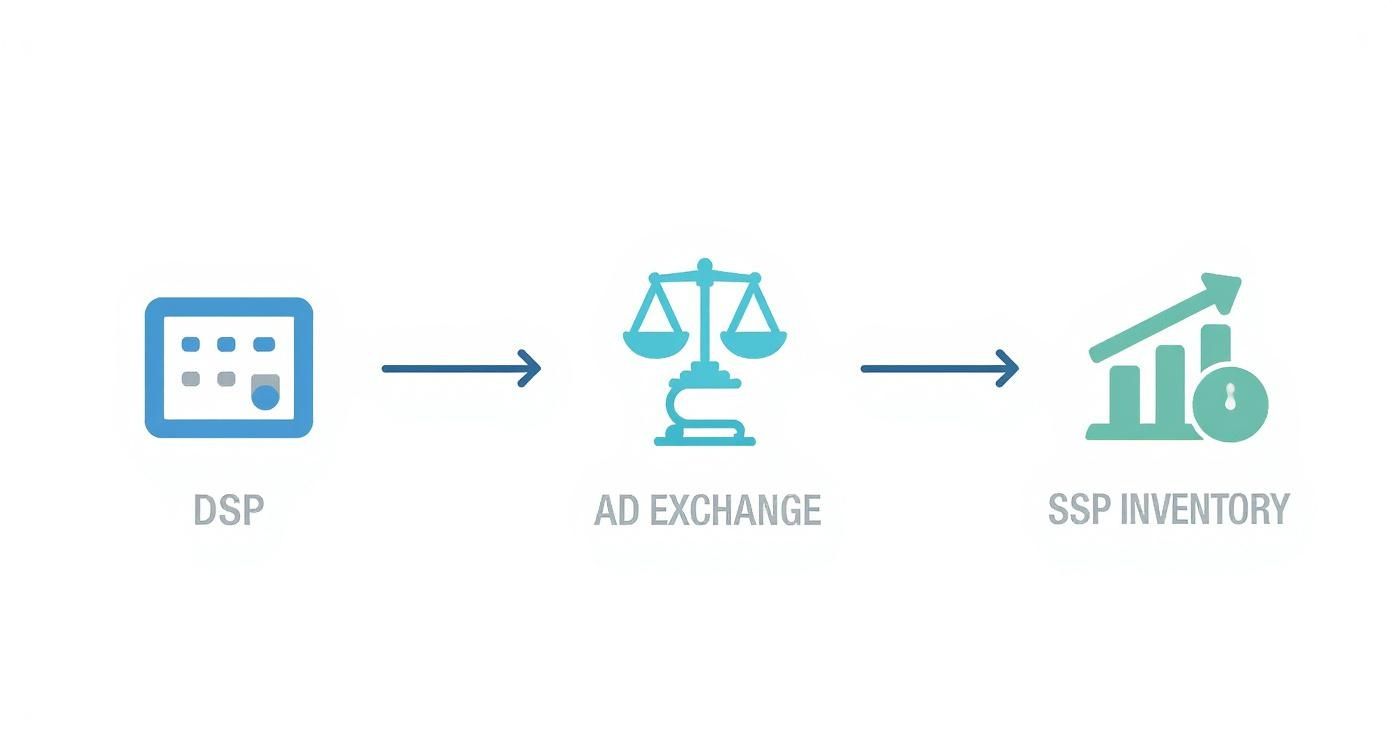
You can clearly see the connection from the DSP (the advertiser's tool), through the ad exchange (the marketplace), and over to the SSP (the publisher's inventory).
Step 3: The Winning Bid Is Chosen and the Ad Is Served
The ad exchange gathers all the bids from the competing DSPs. In a tiny fraction of a second, it picks the highest bidder. Auction over.
The exchange then pings the winning DSP and sends the advertiser’s creative (the banner or video) straight back to the publisher’s website. To get a deeper look at the clever tech behind this, you can explore how adaptive machine learning for real-time bidding makes these processes even smarter.
This final step completes the circle. The winning advert loads into its designated space on the webpage, often before you have even finished reading the headline. The whole thing is so fast and seamless that you do not notice a thing, making it a hugely effective way to deliver relevant ads at an enormous scale.
The Many Faces of Programmatic Advertising
Programmatic is not a one size fits all solution. Think of it less like a single tool and more like a well stocked toolbox, with different instruments for different jobs. To really get it right, you need to understand the main ways programmatic ads are bought and sold, which helps you pick the perfect approach for your campaign goals—whether that is building mass brand awareness or driving hard, measurable sales.
From the banner ads we all know to the giant digital billboards lighting up city centres, programmatic tech is the engine behind a huge range of advertising formats. Each has its own unique strengths and fits a different piece of the customer journey puzzle.
Let’s break down the most common ones.
Programmatic Display Advertising
This is the classic. When most people hear "programmatic," this is what comes to mind: the visual banner ads, skyscrapers, and leaderboards you see scattered across websites and inside apps.
They are the absolute workhorses of the digital ad world. Display is fantastic for building brand recognition and for retargeting people who have already checked out your website. Because there is such a massive amount of display ad space available, you can buy it very cost effectively, making it a great place to start if you are new to programmatic. The trick is to pair sharp creative with even sharper audience targeting to make sure you stand out.
Programmatic Video Advertising
Video is king for engagement, and programmatic lets you place video ads with the same surgical precision as display. They show up in a few different ways, each offering a distinct experience.
- In stream Ads: These are the ads you see before ( pre-roll ), during ( mid-roll ), or after ( post-roll ) a video you have chosen to watch on a platform like YouTube. You have got a captive audience, so they are perfect for grabbing attention.
- Out stream Ads: These video ads pop up in non video environments, like in the middle of a news article or your social media feed. They usually start playing silently as you scroll over them, which feels a lot less intrusive.
With global ad spending in the digital video market expected to blow past $207 billion in 2025 , you simply cannot afford to ignore programmatic video in your marketing mix.
Programmatic Native Advertising
Ever read an online article that felt like it belonged on the site, only to notice a small "sponsored" tag? That is native advertising in action. Programmatic native ads are designed to blend in, matching the look, feel, and function of the website or app they appear on.
Because they do not scream "I AM AN AD!", they are far less disruptive than old school banners, which almost always leads to better engagement. It is a smarter way to connect with people by offering something valuable or entertaining that fits right into their experience.
Native advertising works so well because it respects the user. Instead of shouting for attention, it becomes part of the conversation, offering a much more organic way to tell your brand's story and connect with potential customers.
Programmatic Audio Advertising
With the explosion of podcasts and music streaming, our ears have become prime real estate for advertisers. Programmatic audio lets you place ads directly into podcasts, digital radio, and platforms like Spotify.
What is brilliant about this format is that it reaches people when their eyes are busy—on their commute, at the gym, or while doing chores. You can target them based on what they listen to, from musical tastes to podcast genres, alongside the usual demographic data, making for some incredibly relevant messaging.
Digital Out-of-Home (DOOH)
Finally, programmatic is breaking free from our screens and hitting the streets. Digital Out-of-Home (DOOH) is all about buying ad space on digital screens in the real world—think billboards in Piccadilly Circus, displays in shopping centres, or screens at the airport.
The programmatic magic here is the ability to trigger ads based on real world events and conditions. For example, a coffee shop could set its campaign to automatically show ads for iced lattes on nearby digital screens the moment the local temperature climbs above 25°C . It does not get much more timely or relevant than that.
Evaluating the Benefits and Challenges for UK Businesses
Getting your head around both the advantages and the potential hurdles is the key to building a strategy that actually delivers measurable results, not just vanity metrics. The upsides are huge, moving your ad efforts from guesswork to genuine precision. By weighing these against the challenges, you can prepare properly, allocate resources where they will count, and make smart decisions that drive real growth.
The Clear Advantages of a Programmatic Approach
The first thing that grabs most businesses is the incredible efficiency . The old days of manual negotiations, insertion orders, and endless paperwork are gone. Instead, your team is freed up to focus on high value tasks like refining strategy, improving creative, and digging into performance data. That automation translates directly into smarter spending and better outcomes.
Then there is the laser focused targeting . You are no longer just buying space on a website; you are buying the chance to reach a very specific person. Whether you are targeting by demographics, location, online behaviour, or even past purchases, you can make sure your message lands in front of a genuinely receptive audience.
This kind of precision naturally leads to a much higher return on ad spend (ROAS) . Wasted impressions are slashed because your budget is concentrated on people who are most likely to be interested in what you sell. On top of that, the ability to tweak campaigns in real time means you can quickly double down on what is working and cut what is not, optimising performance on the fly.
The real power of programmatic is its ability to connect tangible business outcomes directly to advertising. It is less about hoping for the best and more about engineering success through data.
Navigating the Potential Hurdles
It is not all plain sailing, though. One of the biggest worries for any brand is brand safety . When buying is automated, there is always a risk your advert could pop up next to inappropriate or brand damaging content. This is not something you can leave to chance; it requires careful management using blocklists, whitelists, and specialised brand safety tools to protect your reputation.
Ad fraud is another serious issue. This is where bots generate fake clicks and impressions, essentially burning through your budget with zero return. The UK is a prime target for this kind of activity, so working with reputable platforms that have robust, built-in fraud detection systems is non negotiable.
Finally, there is the initial complexity of the tech itself. The whole ecosystem of DSPs, SSPs, and ad exchanges can feel pretty overwhelming at first. There is a definite learning curve, and it often requires either dedicated in house expertise or a partnership with a savvy agency to get the most out of it.
The UK’s position as a market leader just underscores how important it is to get this right. The nation is set to continue its dominance in the European programmatic space, with ad spend projected to hit around $23.19 billion . That figure dwarfs the combined spend of Germany and France, highlighting just how central this technology is to modern UK marketing. You can dig deeper into the numbers and find more insights about UK programmatic ad spend on eMarketer.com.
Your Programmatic Advertising Questions Answered
Diving into programmatic advertising always brings up a few key questions. It is a complex space, so let's cut through the noise and give you some straight answers.
Getting these fundamentals right is the first step before you put any budget on the line.
How Much Does Programmatic Advertising Cost?
There is no single price tag. The cost of programmatic is incredibly flexible and really comes down to your strategy and who you are trying to reach. The most common model you will see is CPM (Cost Per Thousand Impressions) , where you pay a set price for every 1,000 times your advert gets shown.
But what influences that price? A few things:
- Audience Demand: If you are targeting a highly sought after audience in a competitive market, you will naturally pay more to get in front of them.
- Ad Quality: It is not just about budget. High quality, engaging creative often earns better placements and can even lead to more efficient pricing.
- Targeting Specificity: The more granular you get with your targeting, the higher the CPM might be. But the trade-off is huge: you massively reduce wasted spend by only showing up for the right people.
The real beauty of it is the control. You can kick off with a modest test budget, see what is working in real time, and then confidently scale up your spending once you have hit on a winning formula.
Is Programmatic Advertising Suitable for Small Businesses?
Absolutely. In fact, it is one of the best tools a small business can have. Programmatic has levelled the playing field, letting smaller brands compete with the big players for the exact same audiences. The days of needing a massive budget just to get access to premium ad space are long gone.
For small to medium sized enterprises (SMEs), the biggest win is efficiency. You can focus a limited budget on a very specific niche audience, which cuts out a huge amount of the wasted ad spend that plagues broader campaigns. With plenty of user friendly, self service platforms now on the market, it is more accessible than ever.
What Is the Difference Between RTB and Programmatic?
This is a classic point of confusion, but it is simpler than it sounds. Think of it this way: Real Time Bidding (RTB) is just one method used within the bigger world of programmatic advertising. It is a huge part of it, but it is not the whole story.
'Programmatic' is the entire system of using technology to automate ad buying. RTB is the live auction process that powers a massive part of that system.
But there are other ways to buy programmatically, like Programmatic Direct deals, which skip the open auction entirely. So, while RTB is a core engine driving programmatic, "programmatic" is the all encompassing term for the entire automated process.
How Does the End of Third-Party Cookies Affect Programmatic?
The move away from third party cookies is a big deal, but programmatic advertising is adapting, not disappearing. The industry is already rolling out new, privacy first solutions to make sure effective targeting is here to stay.
This shift just makes first party data —the information you collect directly from your own customers—even more valuable. It also puts a bigger spotlight on other powerful techniques like contextual targeting, which is all about placing ads relevant to the content on the page. Programmatic is resilient, and it is already well on its way to thriving in a cookie-less future.
Navigating this powerful but complex field can be a challenge. For expert guidance, partnering with a specialist can make all the difference. Superhub brings deep expertise in programmatic strategies to the table, ensuring your campaigns are efficient, perfectly targeted, and deliver real, tangible results.
Learn more about choosing a programmatic advertising agency and find the right partner to drive your growth.
Want This Done For You?
SuperHub helps UK brands with video, content, SEO and marketing that actually drives revenue. No vanity metrics. No bullsh*t.