

What is performance marketing: A Practical Guide to Growth
At its heart, performance marketing is a simple idea: you only pay for results you can actually see and measure. Think of it like paying a salesperson a commission only when they close a deal. You're not just throwing money at advertising and hoping for the best; you're investing directly in tangible outcomes.
So, What Is Performance Marketing Really?
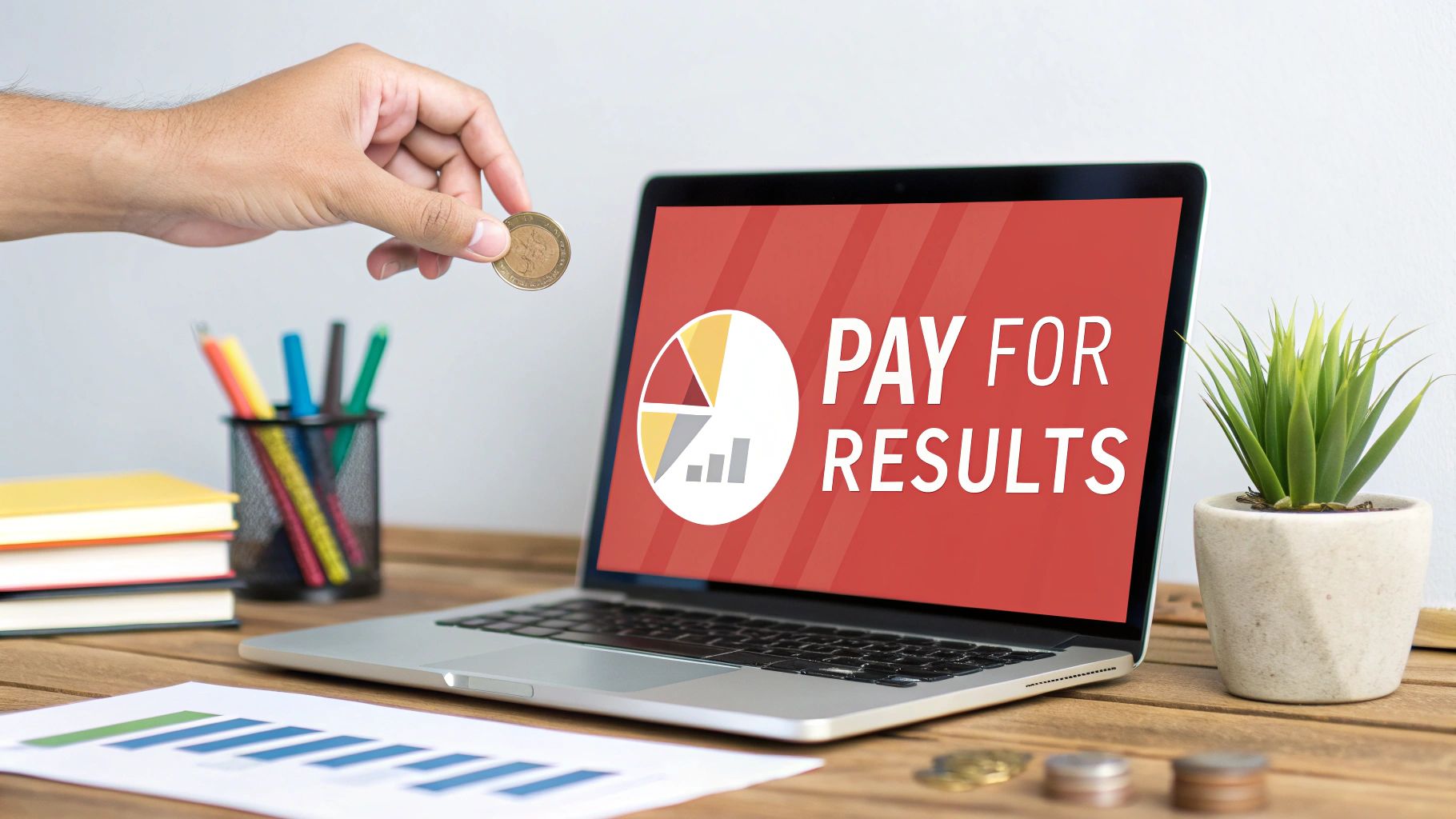
Performance marketing completely flips the old school advertising model on its head. Instead of paying a flat fee for an ad placement and crossing your fingers, payment is tied directly to a specific action a user takes. This results first approach is exactly what makes it such a game changer for businesses of any size.
We’re not talking about fuzzy goals like "brand awareness" here. This is all about hitting concrete objectives that directly affect your bottom line. And the best part? You get to define what those valuable actions are.
From Vague Impressions To Concrete Actions
The real shift is in what you’re paying for. Traditional marketing often means you pay for impressions or reach—basically, how many eyeballs might have seen your ad. Performance marketing cuts through the noise and focuses entirely on what happens next: engagement and conversion.
So, what kind of actions do businesses typically pay for?
- A Click: Someone clicks your ad and lands on your website.
- A Lead: A potential customer gives you their details by filling out a form or signing up for your newsletter.
- A Sale: A customer buys your product or service through your ad.
- An Install: A user downloads your mobile app.
This model fundamentally shifts the risk. Because payment depends on success, your marketing partners and the platforms you use are all motivated to send you high quality traffic that’s genuinely likely to convert. It creates a far more accountable and transparent system where every single pound is tracked. If you want to dive deeper into the nuts and bolts, this guide on what is performance marketing is a great resource.
The core idea is simple but powerful: you stop buying advertising space and start investing directly in business growth. It forces your marketing budget to work harder by tying every penny of spend to activities that actually generate revenue.
Getting your head around these fundamentals is the crucial first step. To see how performance marketing slots into the bigger picture, our guide to digital marketing fundamentals made simple offers some brilliant context.
The Pricing Models That Power Performance
To really get your head around performance marketing, you have to understand the financial engines that make it tick. We're talking about the specific payment models that guarantee you only pay when something valuable actually happens.
Each model is built for a different job. One might be perfect for getting more eyeballs on your website, another for collecting customer details, and a third for driving sales directly. Choosing the right one is everything because it sets the rules of the game and defines what a "win" looks like for your campaign. You’re not just spending money on ads; you’re buying a tangible result.
Let's break down the three core models that are the bedrock of almost every performance strategy out there.
Cost Per Click (CPC): The Traffic Driver
First up is the most common and straightforward model: Cost Per Click (CPC) , which you’ll often hear called Pay Per Click (PPC). It's simple: you pay a small fee every single time someone clicks on your ad. This is your go-to model when your main goal is to drive a flood of traffic to your website or a specific landing page.
Think of a UK-based online bookshop. They could run Google Ads targeting people searching for "best crime novels". With CPC, they only pay when a curious reader actually clicks the ad to see their collection. It's a brilliant way to build an audience and get your brand in front of new people without wasting money on ad views that lead nowhere.
The beauty of CPC is that it directly links your spending to genuine user interest. You are literally paying for the action of someone choosing to visit your site—a powerful first step in turning a stranger into a customer.
Cost Per Lead (CPL): The Enquiry Generator
Moving a little deeper into the sales process, we find Cost Per Lead (CPL) . This model means you pay a fixed price for every qualified lead that comes your way. A 'lead' isn't just a random person; it's someone who has shown real interest by giving you their contact information, like filling out a form or signing up for your newsletter.
For example, a financial adviser in Manchester might run a campaign on LinkedIn offering a free guide to retirement planning. They’d pay a set fee only when a professional downloads that guide and hands over their email address. This is a game changer for service businesses or companies with longer sales cycles, as it’s all about building a solid pipeline of potential clients.
Cost Per Acquisition (CPA): The Revenue Engine
Finally, we arrive at the ultimate performance model: Cost Per Acquisition (CPA) , also known as Cost Per Sale (CPS). With CPA, you only open your wallet when the most important action is completed—which, for most businesses, is a sale. This model ties your marketing spend directly to your revenue, making it the purest, most results-driven option available.
Picture a London fashion boutique running a campaign on Meta. Using a CPA model, they would pay their ad partner only after a shopper clicks the ad and actually buys something from their website. It's the gold standard for e-commerce, because it practically eliminates financial risk from your advertising. Every pound you spend is guaranteed to have brought money back in.
To help you decide which approach fits your business, let's look at these models side by side. Each one aligns with a different stage of the customer journey, from initial interest to the final purchase.
Choosing Your Performance Marketing Model
| Model (Acronym) | Payment Trigger | Primary Goal | Best For |
|---|---|---|---|
| Cost Per Click (CPC) | A user clicks on your advert. | Driving traffic and building brand awareness. | Businesses needing to increase website visitors and introduce their brand to a wider audience. |
| Cost Per Lead (CPL) | A user submits their contact information (e.g., email). | Generating a pipeline of interested prospects. | Service-based businesses or companies with a longer, more considered sales process. |
| Cost Per Acquisition (CPA) | A user completes a specific action, usually a sale. | Driving direct revenue and maximising ROI. | E-commerce stores and any business focused on converting traffic into immediate sales. |
Ultimately, the right model depends entirely on what you want to achieve. Are you looking for widespread visibility, a list of warm leads to nurture, or immediate sales? Answering that question is the first step to building a performance marketing campaign that truly delivers.
Key Channels in The UK Performance Marketing Landscape
So, we’ve talked about the models. But where does the magic actually happen?
The UK’s digital scene is packed with channels, each offering a totally different way to connect with customers. Choosing the right one is crucial—it determines whether you’re capturing people already looking for you or creating brand new demand from scratch.
Performance marketing isn’t a single tactic; it’s a whole toolkit of strategies that you deploy across different online platforms. For UK businesses, real success comes from mixing and matching these channels to hit your specific goals.
Paid Search Advertising
Paid search, or Pay-Per-Click (PPC) as it’s often known, is the bedrock of performance marketing. It’s all about placing ads on search engines like Google, and its power lies in one simple fact: you’re targeting people who are actively searching for what you sell.
Think about it. When someone in Bristol types “emergency plumber” into Google, a sharp PPC ad puts your business right at the top of the page. You only pay when they click your ad (CPC), making it a ridiculously efficient way to find high intent customers at the exact moment they need you. To see how this fits into the wider strategy, have a look at our guide on what search engine marketing is and how it works.
Paid Social Media Advertising
If paid search is about capturing existing demand, paid social is all about creating it. Platforms like Meta (Facebook and Instagram) and TikTok let you get in front of incredibly specific audiences based on their interests, demographics, and what they do online.
Imagine you run a UK-based vegan snack brand. Paid social lets you drop a slick video advert right into the feeds of people who’ve shown an interest in veganism and healthy living. You can pay per click (CPC), per lead (CPL), or even per sale (CPA), turning their idle scrolling into an active purchase.
Paid social is so effective because it introduces your brand to people who weren't even looking for you, but are almost certain to be interested.
Affiliate Marketing
Affiliate marketing is a classic performance channel built on pure partnership. It’s where you team up with third parties—think bloggers, influencers, or review sites—who promote your products to their audience.
You give them a unique tracking link, and you pay them a commission for every single sale they generate. This is an incredibly low risk strategy because you only pay for a successful conversion, making it a pure CPA model. It's like having a commission only sales force working for you 24/7 across the web.
This decision tree shows how your main goal—be it traffic, leads, or sales—points you directly to the most suitable performance marketing model.
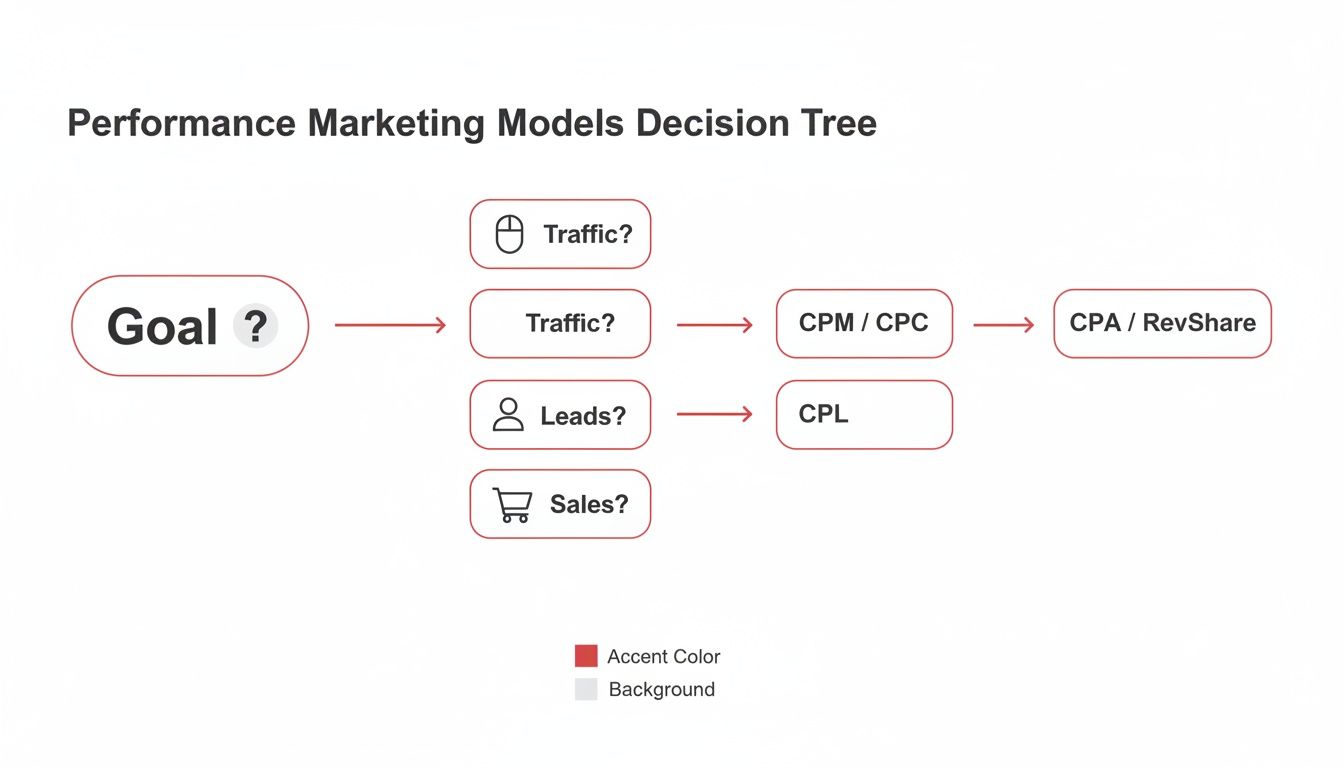
As you can see, the path to choosing a model always starts with having a crystal clear business objective first.
Native Advertising
Native ads are designed to fly under the radar. They’re paid placements that are styled to look and feel like they belong on the website you’re browsing, whether it’s a sponsored article on a big news site or a promoted product on an e-commerce platform.
Because they’re less jarring than traditional banner ads, people actually engage with them. You’re offering value or entertainment upfront, which builds trust and encourages clicks without feeling like a pushy sales pitch.
And the UK market for this is booming. Total digital ad spending is set to hit £35.54 billion in 2024 and is projected to blow past £40 billion by 2025 . Paid social media ad spend alone is expected to climb by 14% annually . On top of that, 67% of UK B2B marketers now say PPC is essential for generating leads.
Measuring The Metrics That Actually Matter
In performance marketing, guesswork gets you nowhere. Success is built on hard data, and that means looking past vanity numbers like 'likes' or 'impressions'. You need to dig into the key performance indicators (KPIs) that actually tell you if your campaigns are making money.
These aren't just figures for a spreadsheet. They’re the signposts telling you what's working, what's a waste of time, and where to put your budget next. Every pound needs to pull its weight, and these metrics are how you hold it accountable.
From Clicks To Conversions
The first metric to get a handle on is your Conversion Rate . It's the percentage of people who take the action you want after clicking your ad—whether that’s buying a product, filling out a form, or downloading a guide.
A high click through rate is nice, but if those clicks don’t lead to actual business, they're just noise. A solid conversion rate is the ultimate proof that your targeting, your message, and your landing page are all pulling together to convince a potential customer.
A low conversion rate is a massive red flag. It tells you something in the customer journey is broken and shows you exactly where to start fixing things.
Unpacking Your Financial Returns
Getting conversions is one thing, but are they actually profitable? This is where Return On Ad Spend (ROAS) comes into play.
ROAS measures the gross revenue you generate for every pound you spend on ads. A ROAS of 5:1 , for instance, means you’ve made £5 for every £1 you’ve spent. It’s vital to understand the difference between ROAS vs ROI, as they each give a different perspective on your profitability.
Just as important is your Customer Acquisition Cost (CAC) . This is simply what it costs, on average, to win a new customer. The goal is straightforward: keep your CAC well below the lifetime value of that customer. Nailing these two metrics is fundamental to mastering your marketing performance metrics and building sustainable growth.
The data backs this up. For 22% of UK businesses, sales is the most important metric—ranking far higher than things like social engagement. Channels like PPC and email marketing deliver the goods, with email bringing in an incredible £39 for every £1 spent . This just goes to show that great performance marketing always ties back to real, measurable financial results.
How To Succeed With Your First Performance Campaign

This is where the theory ends and the action begins. Launching your first performance campaign can feel like a huge step, but it really just boils down to a clear, logical process. Success here isn’t about having a massive budget; it's about being methodical and letting the data lead from day one.
This practical checklist will walk you through the essentials, helping you build a solid foundation for results you can actually measure. Follow these steps, and you’ll move from simply knowing about performance marketing to using it to grow your business.
Define Clear and Measurable Goals
Before you even think about spending a single pound, you need to define what a win looks like. Vague goals like “get more leads” just won’t cut it. You need goals that are specific, measurable, achievable, relevant, and time-bound (SMART).
A great goal sounds something like this: “ Generate 50 qualified leads through LinkedIn Ads with a Cost Per Lead (CPL) under £25 within the next 30 days .” That level of clarity gives your campaign a real purpose and a firm benchmark for success.
Know Your Audience and Choose Your Channels
Next up, get laser focused on who you're trying to reach. Sketch out a detailed profile of your ideal customer—think about their demographics, where they hang out online, and what problems they're trying to solve. This insight is everything when it comes to picking the right channels.
If your audience is already out there actively searching for a solution, Paid Search (PPC) on Google is your best bet. But if you need to create demand and get on the radar of a specific group, Paid Social on platforms like Meta or TikTok will likely work better. It’s all about matching the channel to your audience’s behaviour.
Set A Realistic Budget And Create Compelling Assets
You don’t need to break the bank to get started. Begin with an amount you're comfortable testing, even if it’s just a few hundred pounds. This first spend isn’t about hitting the jackpot; it’s about gathering data to see what works. The goal is to prove the model before you pour more money into it.
Your ads and landing pages need to be sharp and perfectly aligned. Make sure your ad copy speaks directly to your audience’s pain points and clicks through to a dedicated landing page with one clear call to action.
The golden rule is consistency. Your landing page must deliver exactly what your ad promised. A disjointed journey from click to conversion is one of the biggest reasons campaigns fail.
Finally, get your tracking sorted from the get go with tools like Google Analytics. In performance marketing, if you don't have accurate data, you’re flying blind. Tracking every conversion allows you to measure your Return On Ad Spend (ROAS) and make smart, informed decisions to make your campaigns more profitable. In the UK, data-backed tweaks like improving page speed and running A/B tests have been shown to lift conversions by 21% to 31% . For a deeper dive into UK benchmarks, these influencer marketing statistics are a great resource.
Your Performance Marketing Questions Answered
As businesses start to wrap their heads around performance marketing, a few questions always pop up. Let's tackle them head-on with some straight talking answers to clear up the practical side of this results first approach.
How Is Performance Marketing Different From Brand Marketing?
The real difference boils down to two things: what you're aiming for and how you pay for it. Performance marketing is all about driving specific, measurable actions —think sales, leads, or sign-ups. You only pay when you get the result. It’s a direct investment in growth, plain and simple.
Brand marketing, on the other hand, plays the long game. It's about building awareness, reputation, and a feeling around your brand. Success is measured more loosely through things like audience sentiment and reach, and you typically pay upfront for the ad space, whether it leads to an immediate sale or not.
What Budget Do I Need To Start?
This is one of its biggest advantages: there’s no set minimum. You can genuinely start small, even with just a few hundred pounds a month on platforms like Google Ads or Meta, which makes it accessible for almost everyone.
The trick is to start with a test budget you’re comfortable with, track the results obsessively, and then decide where to put more fuel on the fire based on your Return On Ad Spend (ROAS) . Prove it works first, then scale.
The goal isn't to spend big from day one; it's to spend smart. A small, data-backed budget that proves a positive ROAS is infinitely more valuable than a huge, untracked one.
Can Performance Marketing Work For Any Business?
Absolutely. Performance marketing is incredibly versatile and works for almost any business you can think of, from online shops and B2B software companies to local plumbers. The key to making it work is picking the right channels, payment models, and goals for your specific industry.
For instance:
- An e-commerce store might zero in on a Cost Per Acquisition (CPA) model, using paid social ads to drive people straight to checkout.
- A B2B software company could lean on a Cost Per Lead (CPL) model through LinkedIn Ads to fill its sales pipeline with qualified enquiries.
Ready to make performance marketing work for your business? The expert team at Superhub designs data-driven strategies that deliver measurable growth. Discover how we can help you achieve your goals.
Want This Done For You?
SuperHub helps UK brands with video, content, SEO and marketing that actually drives revenue. No vanity metrics. No bullsh*t.