

Top digital marketing companies for small business UK
Our Pick: SuperHub
We built SuperHub specifically for businesses that don't have enterprise budgets but still need enterprise-quality marketing. Based in Devon, we serve small and medium businesses across the UK with SEO, social media, video production, AI search optimisation (AEO), web development and PPC. Everything is handled in house.
What matters for small businesses: we don't lock you into long contracts, we don't charge setup fees that dwarf your monthly budget, and we actually explain what we're doing in plain English. Our startup packages start from £999.99 and include everything a new business needs to get visible online. For established SMEs, our monthly services scale from individual channel management to full outsourced marketing department.
Best for: UK small businesses that want proper marketing without the price tag or the patronising attitude. We understand SME budgets because we are one.
Pricing: Startup packages from £999.99 | Monthly services from £300 | Location: Devon (serving UK-wide) | Book a free strategy call →
Here are the rest of the best digital marketing companies for small businesses in the UK. Each has been assessed on their understanding of SME budgets, transparency, results and accessibility.
For a small business in the UK, selecting the right digital marketing partner is a critical step towards sustainable growth. The online marketplace is crowded and complex and a poor agency choice can lead to wasted budgets and missed opportunities. The right partner, however, can transform your online presence, drive targeted traffic, generate leads and ultimately boost your revenue.
This guide is designed to cut through the noise and simplify your search. We will explore the essential criteria for choosing an agency, from assessing their sector-specific expertise and understanding their strategic approach to verifying their track record with tangible results. We get straight to the point, providing a curated roundup of the best digital marketing companies for small business , including specialist agencies, comparison platforms and freelance marketplaces.
Each recommendation is structured for clarity, featuring direct links and practical insights to help you make an informed decision that aligns with your unique business goals and budget. We will detail what makes each option a strong contender, covering specialist agencies like Superhub, known for its expertise in motorsport and automotive sectors, and versatile platforms such as Clutch and Upwork. For further insights into identifying potential growth partners, consider this list of 5 Game-Changing Digital Marketing Agencies that highlights other top performers. Our goal is to equip you with the information needed to find not just a supplier but a true growth partner.
1. Superhub
Best For: Integrated creative production and data-driven marketing for high-growth UK businesses.
Superhub stands out as a formidable choice among digital marketing companies for small business, particularly for those seeking a single, integrated partner to manage everything from brand creation to sophisticated lead generation. Based in Devon, this 5-star rated UK agency uniquely merges high-end creative services, like cinematic film production and TV advertising, with a robust technical foundation in SEO, web and app development, and proprietary AI-powered systems. This all-in-one model is designed to accelerate growth, making Superhub an ideal outsourced marketing department for ambitious start-ups and established brands alike.
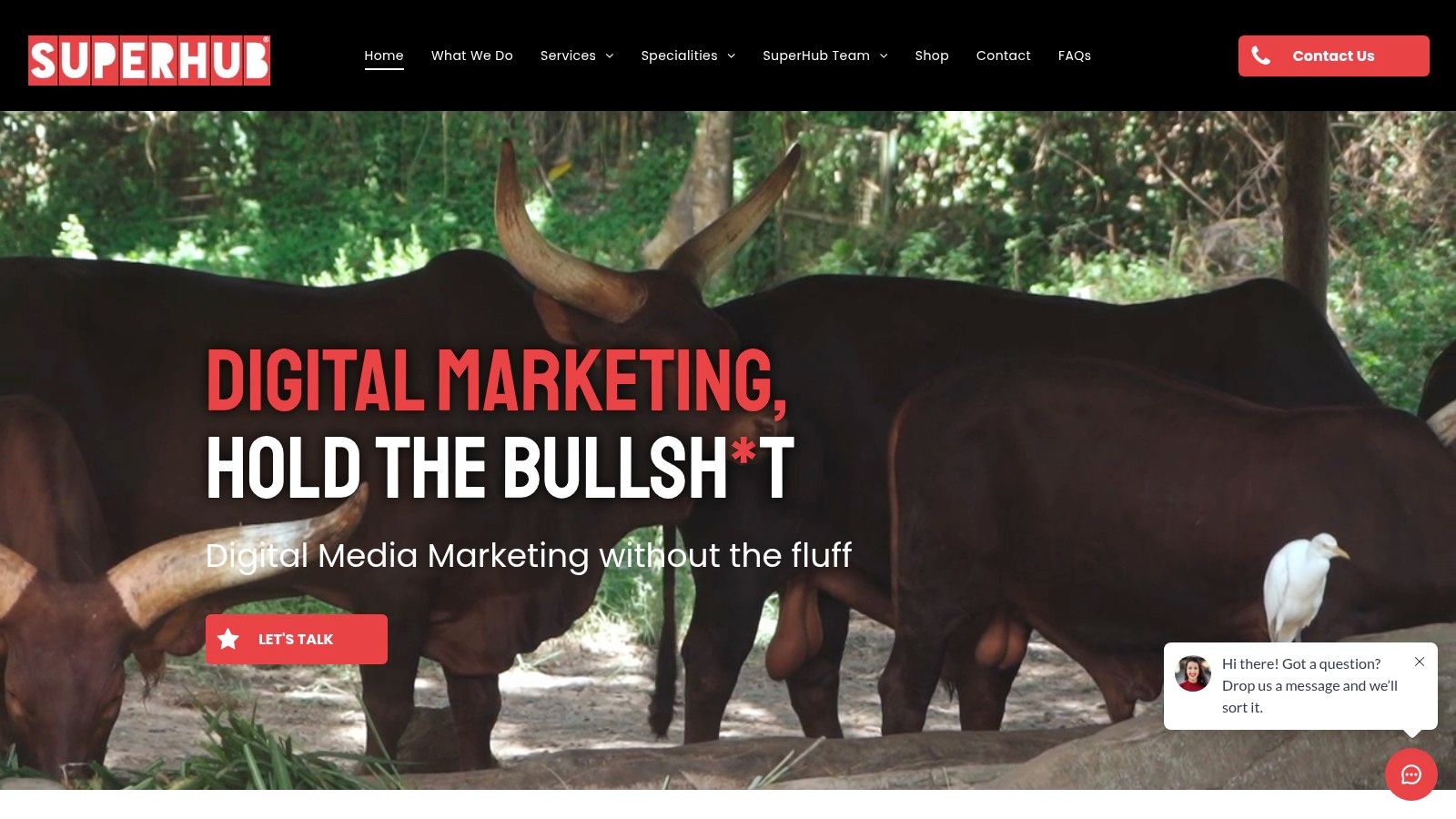
The agency’s core strength lies in its ability to connect visually compelling content with measurable performance outcomes. While many agencies specialise in either creative or technical marketing, Superhub delivers both from a single, cohesive team. This eliminates the common disconnect between content creation and its strategic digital deployment, ensuring that a brand's story is not only told beautifully but also reaches and converts the right audience effectively.
Key Features and Strategic Advantages
Superhub's service offering is both broad and deep, providing a comprehensive toolkit for business growth. Its capabilities extend far beyond standard digital marketing, offering specialised solutions that deliver a distinct competitive edge.
- Integrated Creative and Technical Delivery: Superhub operates an in-house film production unit, complete with cinematic drone capabilities, alongside its teams for SEO, web development, and social media management. This allows for the creation of fully integrated campaigns where stunning visuals are supported by data-driven strategies for maximum impact on platforms like YouTube and TikTok.
- Proprietary AI-Powered Lead Generation: A key differentiator is Superhub's bespoke AI technology designed to automate and scale customer acquisition. This system moves beyond generic marketing automation, offering a data-led approach that identifies and nurtures high-quality leads, directly linking marketing efforts to revenue.
- Deep Sector Expertise: The agency has cultivated profound knowledge in several niche industries, including motorsport, automotive, energy, tourism, and financial services . This specialisation is invaluable for businesses in these sectors, as Superhub understands the unique market dynamics, audience behaviours, and even specific challenges like sponsor recruitment for motorsport teams.
- Proven and Rapid ROI: The agency backs its claims with impressive client testimonials and case studies. Documented results include a client achieving £60K turnover in just six weeks from a standstill, another gaining 10,000 LinkedIn followers in a year, and strategic support that helped a client secure a £300m contract. This focus on measurable outcomes provides confidence for small businesses where every pound spent must deliver a return. To explore their full range of capabilities, you can find a detailed breakdown of Superhub's services on their website.
Who Is It a Good Fit For?
Superhub is particularly well-suited for UK-based small and medium-sized enterprises that require a holistic and proactive marketing partner. It is an excellent fit for businesses that want to consolidate their marketing functions with one agency that can handle brand strategy, content creation, technical execution, and performance analysis. Companies in its key sectors will find its industry-specific insights particularly beneficial.
Key Insight: Superhub’s model is built on the principle that creative excellence and technical precision are not mutually exclusive. By uniting these disciplines, they offer a streamlined and potent growth engine for businesses ready to scale.
Pricing and Access
Superhub does not publish set pricing packages. Instead, it operates on a bespoke engagement model, providing custom quotes based on the specific needs, goals, and scale of each client. This ensures that businesses only pay for the services they require. To get started, prospective clients are encouraged to contact their Devon office directly for a consultation.
Pros:
- Full-service capabilities from creative film to technical SEO and app development.
- Proprietary AI-driven systems for scalable lead generation.
- Demonstrable expertise in high-value niche sectors.
- Strong social proof with documented, rapid client growth.
Cons:
- No public pricing requires a direct consultation for budgeting.
- Primarily focused on the UK market; international clients need to confirm scope.
Website: https://www.superhub.biz
2. Clutch
Clutch is not a direct provider of marketing services but rather a powerful B2B research and review platform. It functions like a highly specialised directory, connecting businesses with verified service providers. For small businesses in the UK, it is an indispensable tool for finding, vetting and comparing potential digital marketing partners based on a wealth of data-driven insights and real client feedback.

What sets Clutch apart from a standard search engine is its rigorous verification process and the depth of its agency profiles. Each listing goes far beyond a simple name and website. You can explore detailed service breakdowns, typical project sizes, and even hourly rate bands, making it easier to shortlist agencies that align with your budget from the outset.
Why Clutch is a Go-To for UK Small Businesses
Clutch excels at providing the structured data needed for a true side-by-side comparison of digital marketing companies for small business . The platform’s strength lies in its verified client reviews, which are often gathered through phone interviews conducted by Clutch analysts. This process yields qualitative, in-depth feedback that uncovers the nuances of working with an agency, from their project management style to their communication skills. This detailed insight is crucial when evaluating potential partners and is a key part of the selection process discussed in Superbhub's guide on how to choose a digital marketing agency.
Key Features for Vetting Agencies:
- Verified Reviews: In-depth, analyst-verified reviews that detail project scope, results and the client relationship.
- Structured Profiles: Consistent layouts show service focus (e.g. 70% SEO, 30% PPC), client demographics and portfolio items.
- Budget Transparency: Agencies list minimum project sizes (e.g. £5,000+) and hourly rates, which helps you filter out those outside your financial scope immediately.
- Powerful Filtering: You can narrow your search by location (e.g. Manchester), service line, budget, and industry focus, creating a targeted shortlist efficiently.
Using Clutch Effectively
To get the most out of Clutch, it is best to use it as a research tool rather than a definitive ranking system. While the platform's leaderboards can be a good starting point, remember that agencies can pay for enhanced visibility.
Focus instead on using the filters to build a shortlist of 5-10 potential agencies. Read through the full text of their reviews, not just the star ratings, and pay close attention to feedback from clients of a similar size and industry to your own. This approach provides a much more reliable indicator of a good fit.
3. The Drum Recommends
The Drum Recommends is a UK-centric agency directory originating from the highly respected marketing publisher, The Drum. It operates on a simple yet powerful premise: agencies are ‘recommended’ based on verified, quantitative client feedback. For a small business, this platform offers a trusted route to finding UK-based marketing partners whose performance and client satisfaction have been independently validated.

What distinguishes The Drum Recommends from broader directories is its focus on client-rated performance. Agencies cannot simply buy a top spot; their ‘Recommended’ status is earned through positive ratings collected directly from their clients across various service categories. This system provides a transparent layer of quality control, ensuring that the agencies you find have a proven track record of delivering results and maintaining strong client relationships.
Why The Drum Recommends is a Top Choice for UK Small Businesses
The platform excels at simplifying the initial vetting process for digital marketing companies for small business by focusing on tangible outcomes and client satisfaction. Its strong UK orientation means the listed agencies are well-versed in the local market, from regional consumer behaviour to GDPR compliance. The ‘Recommended’ kitemark acts as a reliable signal of quality, which is especially valuable for business owners who may lack the time or expertise to conduct extensive background checks on dozens of potential partners.
Key Features for Vetting Agencies:
- Verified Client Ratings: Agencies are scored by their clients on a range of criteria, including creativity, strategic thinking, and value for money, offering a granular view of their strengths.
- UK-Centric Directory: A high concentration of UK-based agencies makes it easier to find local or national partners who understand the domestic market landscape.
- Service-Specific Recommendations: An agency can be recommended for specific services like SEO or PPC, allowing you to find a specialist that truly excels in the area you need.
- Free for Businesses to Use: There is no cost for small businesses to search the directory, read reviews, and create shortlists of potential agencies.
Using The Drum Recommends Effectively
The best way to leverage The Drum Recommends is to treat it as a quality filter. Use its search functionality to identify agencies that are specifically recommended for the services you require (e.g. ‘Digital Strategy’ or ‘Social Media’). The ratings system provides an excellent at-a-glance comparison but it is still crucial to click through to the agency profiles.
When reviewing an agency, look at the consistency of their ratings across different services and over time. Pay attention to the number of ratings they have, as a high score from a handful of clients may be less indicative than a slightly lower score from dozens. Use the platform to build a confident shortlist of 3-5 highly-rated agencies before proceeding to contact them for proposals.
4. Sortlist (UK)
Sortlist operates as an agency matchmaking service, reversing the traditional search process for small businesses. Instead of you spending hours sifting through directories, you post a detailed project brief outlining your needs, budget and goals. Sortlist then uses its platform and data to present your project to a selection of relevant agencies, who can then apply to be considered. This model is particularly efficient for business owners who are short on time and prefer to engage with agencies that have already signalled their interest and availability.

What makes Sortlist different is its curated, "push" approach. Rather than you pulling information from a vast database, the platform pushes a handpicked selection of interested agencies directly to you, often within 72 hours. This pre-qualification step saves significant time and effort, as you are only reviewing proposals from digital marketing companies for small business that actively want to work on your specific project.
Why Sortlist is a Go-To for UK Small Businesses
Sortlist excels at streamlining the initial discovery phase of finding an agency. The platform’s structured project intake form forces you to clarify your objectives and budget from the outset, which in itself is a valuable exercise. Once submitted, your brief is matched with suitable agencies and you receive a shortlist of candidates complete with their portfolios, past client reviews and initial pitches. It simplifies the often-overwhelming task of creating a longlist and initiating contact.
For a small business, this means you can move straight to the evaluation stage with a pool of pre-vetted, enthusiastic contenders. This approach is free for businesses posting a project, as the platform’s business model involves charging agencies for access to these opportunities.
Key Features for Vetting Agencies:
- Curated Matches: Receive a shortlist of up to five agencies that have reviewed your brief and confirmed their interest.
- Structured Project Briefing: A guided process helps you define project scope, key deliverables and budget, ensuring clarity for all parties.
- Agency Profiles: Each applying agency provides a profile with case studies, client reviews and key service areas for easy comparison.
- No Cost to You: It is completely free for small businesses to post a project and receive agency matches.
Using Sortlist Effectively
To get the best results from Sortlist, invest time in creating a detailed and compelling project brief. The more specific you are about your goals, target audience and expected outcomes, the higher the quality of the agency matches you will receive. Be realistic with your budget, as this is a primary filtering criterion for agencies.
While the platform provides a convenient shortlist, remember that agencies pay to be on Sortlist and to access project leads. This can influence which providers you see. Therefore, it is wise to use Sortlist as your starting point for creating a shortlist but supplement it with your own due diligence. Cross-reference the proposed agencies on platforms like Clutch or by reviewing their direct websites and social proof before making a final decision.
5. Bark (UK)
Bark is not a traditional agency but a lead generation marketplace that connects small businesses with a wide array of service providers. For a UK business owner needing quick access to marketing proposals, Bark offers a streamlined process: you post a request detailing your needs and interested freelancers or agencies will contact you directly with their quotes. This model reverses the typical search process, bringing potential partners to you instead.
The platform’s main advantage is speed and volume. Within hours of submitting a request, you can have several proposals in your inbox, providing an immediate snapshot of market rates and service offerings. This makes it an excellent starting point for businesses that are unsure of project costs or want to survey the field without committing hours to individual research.
Why Bark is a Go-To for UK Small Businesses
Bark excels at providing rapid market access for businesses looking to hire digital marketing companies for small business . Instead of you spending days searching and contacting agencies one by one, the platform broadcasts your needs to a large pool of pre-registered professionals across the UK. This efficiency is particularly valuable for straightforward, well-defined projects like a new website build, a local SEO campaign, or a short-term social media push.
The platform provides transparency by showing average price guidance for different services, helping you set realistic budget expectations from the outset. While the depth of information on each provider's profile may not match dedicated review sites, it serves its purpose as a functional marketplace for initiating contact and gathering competitive quotes.
Key Features for Finding a Partner:
- Simple Request-for-Quotes: A guided form helps you articulate your project needs, which is then sent to relevant providers.
- Rapid Responses: Expect to receive quotes from multiple freelancers and agencies, often within 24 hours.
- Broad Service Coverage: The platform covers a vast range of specialisms, from SEO and PPC to content writing and web design.
- Free for Buyers: There is no cost for a small business to post a request and receive quotes from interested professionals.
Using Bark Effectively
To get the most out of Bark, it is crucial to be as specific as possible in your initial request. Clearly define your goals, budget, and timeline to attract the most suitable providers. Be prepared for a high volume of responses and recognise that the onus is on you to vet each candidate thoroughly.
Use Bark as a tool for initial price discovery and to identify potential partners you may not have found otherwise. Once you have a shortlist, move your evaluation off-platform. Check their official websites, look for independent reviews on sites like Clutch or Google, and ask for case studies relevant to your industry before making a final decision. This two-step process combines Bark's speed with your own due diligence.
6. Upwork
Upwork is a global freelancing platform that connects businesses with independent professionals and agencies. Unlike traditional agencies, Upwork provides direct access to a vast talent pool of individual marketers, consultants and small teams for specific tasks or ongoing projects. For UK small businesses, it offers a highly flexible and often more affordable way to access specialised digital marketing skills without the commitment of a long-term retainer.
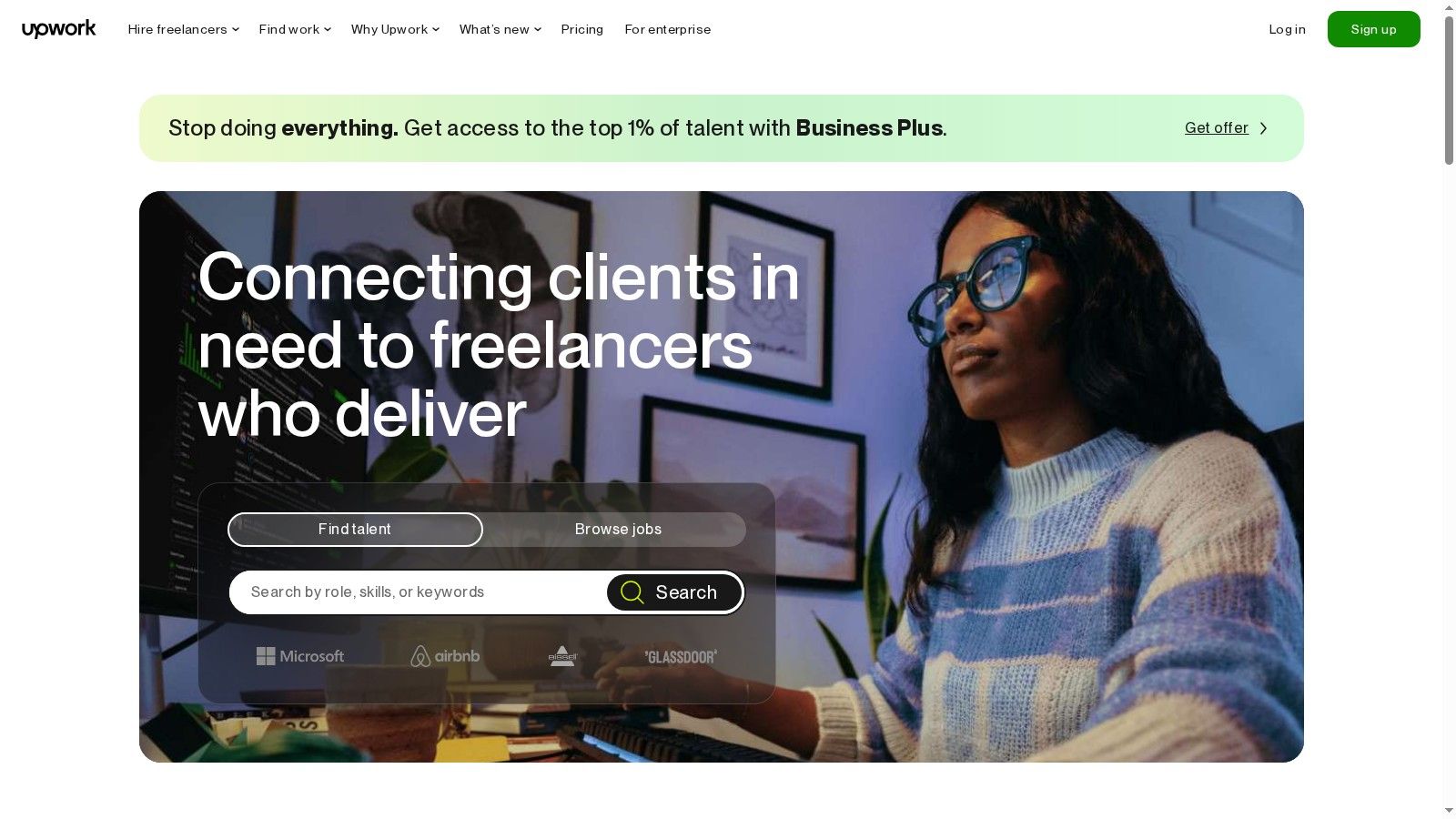
What distinguishes Upwork from simply hiring a contractor is its integrated project management and payment protection system. You can post a job, review proposals, interview candidates and manage the entire workflow within the platform. Its escrow service, where funds for a project are held until milestones are approved, provides a layer of security for both the client and the freelancer.
Why Upwork is a Go-To for UK Small Businesses
Upwork is an excellent resource when you need to augment your existing team or require expertise for a specific, well-defined task. Instead of searching for full-service digital marketing companies for small business , you can hire a PPC specialist for a three-month campaign, a content writer for a series of blog posts or an SEO expert for a one-off technical audit. This à la carte approach allows for precise budget control and scalability. Many of the advantages align with the core benefits of outsourcing your marketing, which you can explore further in Superbhub’s guide on the 8 benefits of outsourcing your marketing.
Key Features for Vetting Talent:
- Vast Talent Pool: Access to thousands of marketers with transparent profiles showing work history, portfolios and client feedback.
- Flexible Contracts: Hire on an hourly basis or for a fixed-price project, allowing you to scale support up or down as needed.
- Payment Protection: An escrow system holds funds and only releases them upon your approval of completed work or milestones.
- Verification Badges: Look for "Top Rated" and "Expert-Vetted" badges on freelancer profiles, which signify a proven track record of success on the platform.
Using Upwork Effectively
Success on Upwork depends heavily on your own vetting process. To find the right talent, create a highly detailed job description that clearly outlines your project scope, deliverables and desired outcomes. Be specific about the skills and experience you require.
When reviewing proposals, look beyond the price. Prioritise freelancers who have written a customised cover letter addressing your specific needs and ask relevant questions. It is also wise to start with a small, paid test project to evaluate a freelancer’s quality of work, communication style and reliability before committing to a larger engagement.
7. PeoplePerHour
PeoplePerHour is a UK-founded freelance marketplace that provides small businesses with direct access to a global talent pool. It stands out by offering a flexible model that combines fixed-price packages, known as 'Offers', with traditional hourly and project-based hiring. For an SMB, this platform is an excellent resource for sourcing specific, one-off marketing tasks or building a team of freelance specialists without the long-term commitment of hiring an agency.
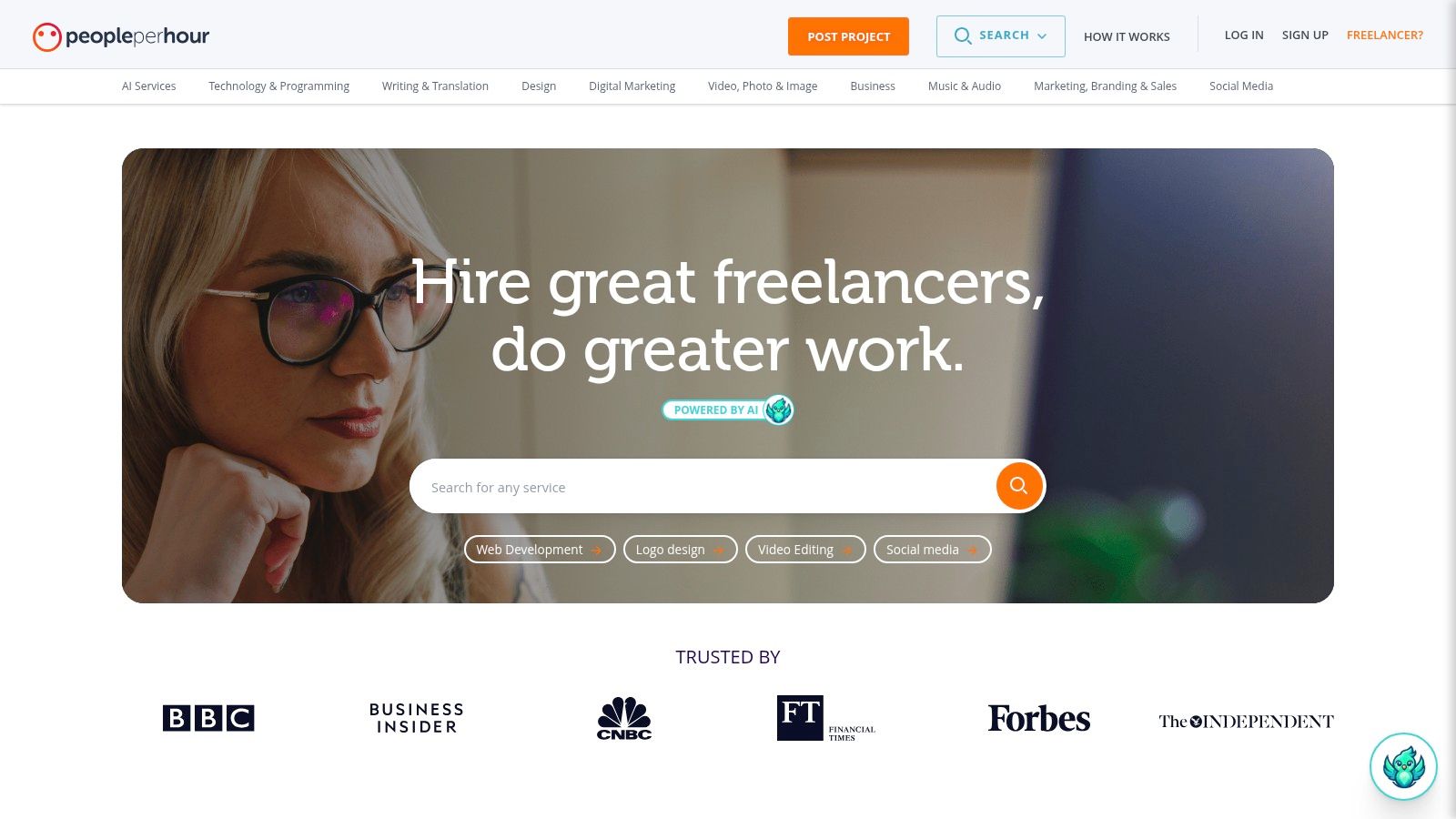
What differentiates PeoplePerHour is its emphasis on pre-packaged services. This allows businesses to buy clearly defined marketing deliverables, such as a "Basic SEO Audit" or "Social Media Content for One Month," with a fixed price and timeline. This approach removes the ambiguity of project scoping and is ideal for businesses that need tactical support for specific challenges.
Why PeoplePerHour is a Go-To for UK Small Businesses
PeoplePerHour excels at connecting businesses with a diverse range of digital marketing companies for small business and individual freelancers, particularly for task-based work. The platform’s UK roots mean there is a strong contingent of British talent, making it easier to find professionals who understand the local market and work in the same time zone. The transparent GBP pricing and escrow payment system also provide a layer of security and financial clarity.
Key Features for Sourcing Talent:
- Fixed-price 'Offers': Pre-packaged services with clear deliverables, costs and timelines, perfect for small, well-defined marketing jobs.
- Custom Projects: Post a detailed brief and invite freelancers to submit proposals, allowing for more complex or bespoke project requirements.
- Escrow Protection: Payments are held securely by the platform and only released to the freelancer once you approve the work, reducing financial risk.
- UK-Centric Talent Pool: A strong base of UK freelancers simplifies communication and ensures local market knowledge, with clear pricing in GBP.
Using PeoplePerHour Effectively
To get the most from PeoplePerHour, it is crucial to be clear and specific in your project briefs. Whether you are purchasing an 'Offer' or posting a custom project, provide as much detail as possible about your business, goals and expectations.
When selecting a freelancer, look beyond their star rating. Scrutinise their portfolio, read their reviews carefully and consider sending a brief introductory message to gauge their communication style and understanding of your needs. For larger or ongoing projects, consider starting with a small, paid trial task to ensure they are the right fit before committing to a significant budget. Be mindful that platform fees are added to your payments and freelancers also pay a commission, which can be reflected in their pricing.
Top 7 Small-Business Digital Marketing Platforms
| Item | Implementation complexity 🔄 | Resource requirements ⚡ | Expected outcomes ⭐ | Ideal use cases 💡 | Key advantages 📊 |
|---|---|---|---|---|---|
| Superhub | High — bespoke, integrated creative + tech delivery requiring agency onboarding and custom workflows | Medium–High — retainer/project budgets, coordination with in-house production and AI systems | High — claims rapid, measurable growth and AI-driven lead generation (case-based evidence) | Brands needing end-to-end creative, app & AI lead systems; sector specialists (motorsport, automotive, energy, tourism, finance) | All-in-one creative + technical stack, in-house film/drone/TV, proprietary AI lead-gen, proven client outcomes |
| Clutch | Low — directory search and comparison; research time to vet shortlists | Low — free to use; time investment to contact agencies | Medium — helps identify credible agencies with verified reviews; outcomes depend on chosen partner | SMBs comparing UK agencies by rates, reviews, portfolios and project size | Deep profiles, verified client reviews, budget and service filters for apples-to-apples comparison |
| The Drum Recommends | Low — browse publisher-backed recommendations; fewer listings to review | Low — minimal time to shortlist and contact agencies | Medium — signals consistent client satisfaction for listed agencies | SMBs seeking UK-centric, outcome-focused agency shortlists with publisher credibility | Client-validated ratings, UK market recognition, “recommended” status |
| Sortlist (UK) | Low–Medium — submit brief and wait for curated matches; some vetting required | Low — platform-managed shortlisting; meetings and follow-ups needed | Medium — curated matches speed selection but quality varies by niche/region | Small businesses preferring curated matches over manual search | AI-assisted shortlisting, free for clients, CRM/scheduling integrations |
| Bark (UK) | Low — post a request and receive multiple provider quotes; manage inbound leads | Low — fast responses but requires screening and follow-up | Low–Medium — quick ballpark quotes; lead quality and overlap vary | Quick pricing comparisons and rapid proposals for immediate needs | Fast quoting, wide UK coverage, free to post requests |
| Upwork | Medium — sourcing, vetting, contracting freelancers; may need test projects | Low–Medium — flexible hourly or fixed budgets, escrow and fees apply | Medium — outcome depends on freelancer quality and project management | SMBs needing flexible, incremental support or specialist tasks on tight budgets | Large talent pool, payment protection, flexible hiring models and milestones |
| PeoplePerHour | Medium — select fixed-price Offers or post briefs and manage engagements | Low–Medium — GBP pricing visibility, platform fees and freelancer margins | Medium — well-suited for scoped micro-projects; quality varies by provider | SMBs wanting clear-priced packages and fast project starts | Fixed-price Offers, UK-leaning talent pool, escrow/dispute processes |
Making Your Final Decision and Taking the Next Step
Navigating the landscape of digital marketing companies for small business can feel like an overwhelming task. We have journeyed through a curated selection of platforms and agencies, from specialised industry experts like Superhub to expansive freelancer marketplaces such as Upwork and PeoplePerHour. The goal was not to present a single "best" option but to empower you with a framework for identifying the right partner for your unique business needs.
The core takeaway is that your selection process must be deliberate and strategic. A generic approach will yield generic results. You must move beyond surface-level comparisons and dig deep into what will truly drive growth for your organisation. Your choice is a critical investment, one that will directly impact your visibility, lead generation and ultimately your bottom line.
Recapping Your Options: A Strategic Overview
Let's briefly synthesise the key strengths of the platforms we have explored, helping you to categorise them for your shortlist:
- For Niche Expertise & Integrated Services: An agency like Superhub stands out for businesses in sectors such as motorsport, automotive and tourism. Their model combines deep industry knowledge with in-house creative production, offering a cohesive strategy from concept to execution. This is ideal for businesses that need a partner who speaks their language and understands the nuances of their market.
- For Vetted Agency Directories: Platforms like Clutch and The Drum Recommends provide a layer of verification through client reviews and case studies. They are excellent resources for finding established, reputable agencies and comparing them based on proven performance and client satisfaction.
- For Project-Based Matching: Services such as Sortlist and Bark act as matchmakers, connecting you with agencies and professionals who have actively expressed interest in your project brief. This can accelerate the initial search process and bring relevant contenders directly to you.
- For Flexible, Task-Specific Support: When you need a specific skill for a defined project, like a one-off SEO audit or a short-term social media campaign, freelancer platforms like Upwork and PeoplePerHour offer unparalleled flexibility and access to a global talent pool. This is perfect for augmenting your in-house team or managing smaller, discrete tasks.
Your Actionable Checklist for Choosing a Partner
Finding the perfect fit among the many digital marketing companies for small business requires a structured approach. Before you reach out, complete these internal steps to ensure you are fully prepared to make an informed decision.
- Define Your Goals with Precision: What does success look like? Go beyond "more website traffic". Aim for specifics like "increase qualified leads from organic search by 20% in six months" or "achieve a 15% conversion rate on our new e-commerce landing page".
- Establish a Realistic Budget: Understand your numbers. What can you comfortably invest each month? Remember to differentiate between agency management fees and your actual advertising spend (e.g. on Google Ads or Meta). A clear budget prevents wasted time on both sides.
- Create a Detailed Brief: A well-written brief is your most powerful tool. It should outline your business background, target audience, primary objectives, key performance indicators (KPIs), budget and timeline. This document ensures all potential partners are quoting on the same requirements.
- Shortlist and Interrogate:
Select your top two or three candidates from your research. During consultation calls, do not just listen to their sales pitch. Ask probing questions:
- “Can you show me a case study from a business similar to mine in size and industry?”
- “Who will be my day-to-day point of contact and what is their experience level?”
- “How do you measure and report on success and how often will we receive these reports?”
- “What is your process if a campaign is underperforming?”
- Assess the Cultural Fit: This is a partnership. You will be communicating with this team regularly. Do their communication style and values align with yours? A strong working relationship is often the secret ingredient to a successful campaign.
Choosing a digital marketing partner is more than a simple procurement exercise; it is about finding a collaborator who will become an extension of your team. This decision is your commitment to growth and a crucial step towards realising your business's full potential in an increasingly digital world. Take your time, do your due diligence and invest in a partnership that will not only deliver results today but also help you build a more resilient and successful business for the future.
Ready to partner with a team that combines strategic marketing with high-impact creative production? Superhub specialises in helping businesses in the motorsport, automotive and tourism sectors achieve their growth objectives. Discover how our integrated approach can elevate your brand by visiting Superhub to see our work and schedule a consultation.
Want This Done For You?
SuperHub helps UK brands with video, content, SEO and marketing that actually drives revenue. No vanity metrics. No bullsh*t.