


How to Measure Marketing Campaign Success: A Practical Guide
Before you spend a single pound on a campaign, you need to know what winning looks like. Too many marketers get caught up in the thrill of the launch without first defining a clear finish line.
Measuring success isn't something you figure out later. It starts by setting sharp, measurable goals, picking the right Key Performance Indicators (KPIs) to watch, and making sure all of it actually matters to the business as a whole. This isn't just admin; it's the foundation of a campaign that delivers real value.
Defining What Success Actually Looks Like
Trying to measure a campaign without a clear goal is like driving without a destination. You’re burning fuel and moving, sure, but you have no idea if you’re getting anywhere useful.
It's easy to fall into the trap of chasing vague ambitions like ‘boost brand awareness’ or ‘get more leads’. These sound good, but they're too fuzzy to act on. A truly successful campaign is tied to a specific outcome that you can point to on a spreadsheet—one that directly contributes to the company's growth.
Moving From Vague Ideas to SMART Goals
To bring your objectives into sharp focus, the SMART framework is your best friend. It’s a simple but powerful way to ensure your goals are ambitious yet grounded in reality.
Here’s how it works:
- Specific: Don't just "increase website traffic." Instead, aim to "increase organic traffic to our new service page." Precision is key.
- Measurable: Slap a number on it. "Increase organic traffic by 20% " is a target you can hit or miss.
- Achievable: Be honest. Is a 20% jump realistic with your current budget and timeline? Set a goal that stretches you, but doesn't break you.
- Relevant: Does this goal actually support a bigger business objective, like hitting a quarterly sales target? If not, question it.
- Time bound: Give yourself a deadline. "Increase traffic by 20% within the next 90 days."
This simple process turns a flimsy idea like "get more app downloads" into a rock solid objective: "Achieve a 15% increase in new app downloads from UK users aged 25-40 within the next 60 days." Now that's a benchmark you can measure against.
A well defined goal is the first, most crucial element of any strong digital marketing strategy. If you want to dive deeper into building a solid plan, you can explore our complete guide to digital marketing strategy here.
This flow chart breaks down the core steps to defining what success means for your campaign, from setting the initial goal to making sure it aligns with the business.
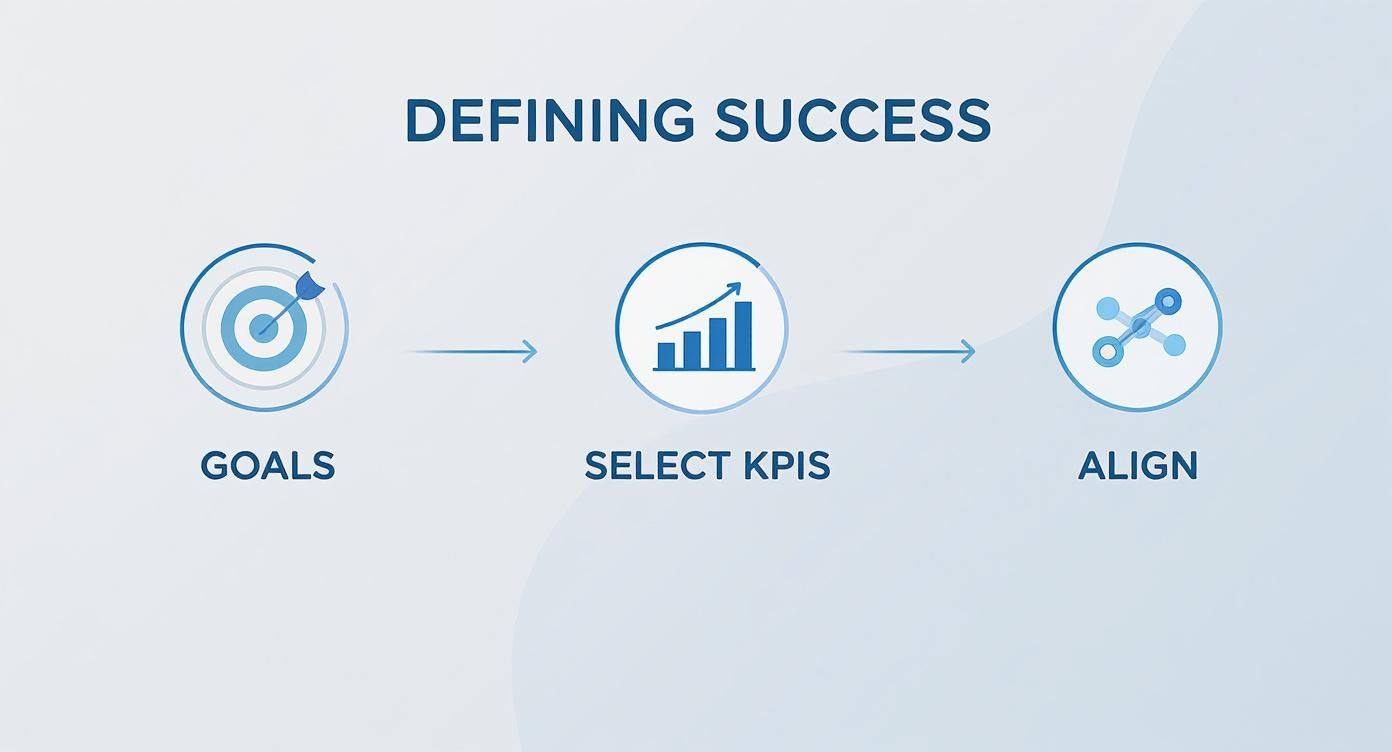
It’s a straightforward, three step journey that ensures your campaign objectives are not only crystal clear but also directly connected to what the business really cares about.
Matching Campaign Goals to Core Business Objectives
This is the final, crucial piece of the puzzle. A marketing goal should never float in a vacuum; it has to serve the wider business. If the company’s main focus is driving up profitability, a campaign obsessed with social media engagement might be a waste of resources.
The table below provides a simple way to connect the dots between what your campaign is doing and what the business needs to achieve.
| Business Objective | Example Campaign Goal | Primary KPI to Track |
|---|---|---|
| Increase Profitability | Reduce customer acquisition cost (CAC) by 10% in Q3. | Cost Per Acquisition (CPA) |
| Grow Market Share | Increase qualified leads from a new demographic by 25%. | Marketing Qualified Leads (MQLs) |
| Improve Customer Loyalty | Increase repeat purchase rate among existing customers by 15%. | Customer Lifetime Value (LTV) |
| Boost Brand Awareness | Drive a 30% increase in organic search traffic for brand terms. | Brand Search Volume, Impressions |
Connecting your campaign efforts directly to these bigger business outcomes gives your work clear purpose and makes it far easier to justify your budget.
In the UK, there's a strong focus on tangible results. For example, a staggering 54% of UK businesses say increasing sales revenue is their number one marketing goal. That tells you everything you need to know about where the priority lies.
While 42% also focus on softer metrics like brand awareness, it's clear that these are valued most when they support long term, profitable growth.
By anchoring your campaign goals to tangible business outcomes, you create a solid foundation to select the right metrics and confidently demonstrate the value of your marketing spend to stakeholders.
Choosing KPIs That Tell the Real Story
Once you've nailed down your SMART objectives, it's time to pick the Key Performance Indicators (KPIs) that will actually show you if you're winning. It is so easy to drown in a sea of data, measuring everything but understanding nothing. The real skill is cutting through the noise and selecting the few metrics that genuinely track progress, rather than just chasing vanity metrics that puff up your ego but don't impact the bottom line.

Think of it this way. If your goal is to lose weight, counting how many new gym outfits you buy is a metric, sure, but it’s a pure vanity one. Tracking your actual weight and body fat percentage—those are the KPIs that tell you the real story. Marketing is exactly the same. Impressions might feel impressive, but your conversion rate tells you what's actually putting money in the bank.
Aligning KPIs with the Marketing Funnel
To get the full picture of your campaign’s performance, you need a balanced approach. This means picking KPIs that cover every single stage of the customer journey, from that first flicker of awareness right through to the sale and beyond. If you don't, you're flying with a massive blind spot.
-
Top of Funnel (Awareness): These metrics are all about reach and engagement. Are you getting in front of the right people?
- Reach and Impressions: The number of unique people who see your content versus the total number of times it's shown.
- Share of Voice (SOV): How visible is your brand compared to your competitors? For a PR campaign, a clear goal might be to boost your SOV in industry publications by 15% .
- Website Traffic: A simple but vital measure of how many people are landing on your site.
-
Mid Funnel (Consideration): Now we're measuring how well you’re turning casual interest into genuine intent.
- Click Through Rate (CTR): The percentage of people who see your ad and actually click it. A low CTR is a huge red flag that your messaging or creative is off.
- Lead Quality Score: In B2B, not all leads are created equal. A scoring system helps you filter the hot prospects from the tyre kickers, so your sales team isn't wasting time.
- Email Subscribers: How many people have raised their hand to say, "Yes, I want to hear more from you"?
-
Bottom of Funnel (Conversion): This is where the rubber meets the road. These are your money metrics.
- Cost Per Acquisition (CPA): On average, how much does it cost you to win a new customer with this campaign?
- Conversion Rate: The percentage of visitors who take the action you want them to, whether that's buying a product or booking a demo.
- Customer Lifetime Value (LTV): A forecast of the total revenue you can expect from a single customer over their entire relationship with you.
One of the most common mistakes I see is a fixation on top of funnel metrics. Massive reach means nothing if it doesn’t eventually drive conversions. A balanced scorecard with KPIs from each stage is the only way to truly understand your campaign's performance.
Real World Scenarios and Practical Choices
Let’s get practical. Imagine you're a UK ecommerce shop launching a new clothing line with a social media campaign. Your main goal is simple: generate profitable sales.
Forget about just tracking 'likes' and 'shares'—those are classic vanity metrics. Instead, you'd want to live and breathe these three KPIs:
- Return on Ad Spend (ROAS): For every £1 you put into ads, how many pounds are you getting back in revenue?
- Conversion Rate: What percentage of people who click your ad go on to make a purchase?
- Average Order Value (AOV): How much is the average customer from this campaign spending in one go?
This powerful trio tells a complete story. A high ROAS confirms profitability, a strong conversion rate proves your offer is hitting the mark, and a healthy AOV shows you’re attracting quality customers, not just bargain hunters.
For a deeper dive into the nuances of selecting the right metrics, Adwave has an excellent resource on Mastering Advertising Effectiveness Measurement that really gets into the detail of campaign ROI.
Ultimately, picking the right KPIs always circles back to your original goals. By choosing a handful of meaningful metrics aligned with each funnel stage, you build a focused, powerful dashboard that tells you the real story of what’s working and what isn’t. If you want to see how these fit into the bigger picture, it's also worth reading up on mastering marketing performance metrics.
Picking Your Measurement Tools and Attribution Models
So, you’ve nailed down your objectives and picked your KPIs. What’s next? You need the right gear. The sharpest KPIs in the world are useless if you can’t actually track them, and that comes down to your analytics platforms and how you give credit for conversions.
Think of it like this: your tools are the dashboard in your car, and your attribution model is the GPS. One tells you your speed and fuel level (your metrics), while the other shows you which roads you took to get there (which channels drove the conversion). You really do need both to know where you’re going.
This isn’t a step to rush. Get your tech stack right, and you’ll have clear, trustworthy data. Get it wrong, and you could be chasing your tail with confusing numbers that send you in the completely wrong direction.
Assembling Your Analytics Toolkit
Your measurement toolkit doesn't need to be massively complex or break the bank. The aim is to build a setup that gives you a clear, honest view of performance across all your channels. For most businesses, this starts with a few core pieces.
A solid foundation usually looks something like this:
- Website Analytics: Google Analytics (GA4) is the absolute baseline. It's the engine room for understanding your website traffic, user behaviour, and tracking conversions. It shows you exactly where your visitors are coming from and what they do when they get there.
- Platform Native Insights: Don't sleep on the analytics already built into the platforms you use every day. Tools like Meta Business Suite , LinkedIn Campaign Manager , and Google Ads offer incredibly detailed data on ad performance, audience engagement, and costs, right from the source.
- Customer Relationship Management (CRM): If you have a longer sales process, a CRM like HubSpot or Salesforce is a must. It’s what connects the dots between a marketing touchpoint (like a downloaded ebook) and a real sales outcome (a signed contract), giving you a complete picture.
The real magic happens when you get these tools talking to each other. When your Google Ads data syncs with your CRM, you can see precisely which keywords are bringing in not just leads, but high value customers. That connection is what separates basic tracking from genuine performance analysis.
Getting to Grips with Marketing Attribution Models
Once your tools are collecting data, you need a way to interpret it. That’s where attribution modelling comes in. Put simply, it’s the rulebook you use to decide which touchpoint gets the credit for a sale or lead.
A customer might see a Facebook ad, click a Google search result a week later, and then open a promotional email before finally buying something. Which channel gets the applause? The answer is entirely down to the model you pick.
Common Attribution Models, Explained
Choosing the right model is so important because it shapes your entire perception of what’s working. Pick the wrong one, and you could easily cut the budget for a channel that’s actually doing some serious heavy lifting early in the customer journey.
Here’s a quick rundown of the most common models:
| Attribution Model | How It Works | Best For |
|---|---|---|
| Last Touch | Gives 100% of the credit to the final interaction before the conversion. | Quick, simple sales cycles, like an impulse purchase from a social media ad. It's straightforward but often oversimplifies the real journey. |
| First Touch | Gives 100% of the credit to the very first touchpoint that brought the customer into your world. | Campaigns focused on building top of funnel awareness. It helps you see what initially catches people's attention. |
| Linear | Spreads the credit equally across every single touchpoint in the customer's path. | Long consideration phases where you want to value every interaction that helped nurture the lead. |
| Time Decay | Gives more credit to the touchpoints that happened closer to the conversion. | B2B marketing or high value sales where the final interactions are often what seal the deal. |
For instance, a fast fashion brand running an Instagram flash sale might be perfectly happy with a Last Touch model. The customer sees the ad, clicks, and buys—job done. But a B2B software company with a six month sales cycle would get a completely warped view from this. A Linear or Time Decay model would far better reflect the multiple blog posts, webinars, and demos that all played a part in the final sale.
Turning Campaign Data Into Actionable Insights
Collecting data is one thing; turning it into decisions that make you money is another entirely. This is where the real work begins. Raw numbers from your dashboard are just the starting point—the real value comes from digging in and understanding the why behind the what.
It’s about moving past simply reporting what happened and starting to predict what will happen next.

This process is about scrutinising the core metrics to see if you’re actually profitable, but the real magic happens when you go deeper. By using the right analysis techniques, you start to uncover genuine customer behaviours and find clear ways to sharpen your creative. This is how historical data becomes your roadmap for future success.
Getting to Grips with Your Core Profitability Metrics
Before you get lost in the finer details, you need a firm handle on the numbers that prove your marketing is commercially viable. These calculations are the first things any stakeholder will want to see.
They tell a simple, brutal story: is this campaign making money or losing it? Without this baseline, everything else is just noise.
To make it easy, here are the essential formulae every marketer needs to know inside and out.
Key Analysis Formulae for Marketers
| Metric | Formula | What It Tells You |
|---|---|---|
| Return on Investment (ROI) | (Net Profit / Total Investment) x 100 | The overall profitability of your campaign after all costs are considered. |
| Return on Ad Spend (ROAS) | (Revenue from Ads / Cost of Ads) x 100 | The direct revenue generated for every pound spent on advertising. |
| Cost Per Acquisition (CPA) | Total Campaign Cost / Number of Conversions | The average cost to acquire one new customer through the campaign. |
Mastering these figures is a cornerstone of any effective marketing approach. They are a fundamental part of harnessing the power of data-driven marketing strategies for success and provide that crucial high level view of your campaign’s financial performance.
Going Deeper with Cohort and A/B Testing Analysis
Once you’ve established that your campaign is profitable, it’s time to find out how to make it more profitable. This next layer of analysis is all about understanding customer behaviour and optimising specific parts of your campaign. This is where you find the insights that lead to real breakthroughs.
-
Cohort Analysis: This sounds technical, but it’s simple. You group users based on a shared trait, usually when they signed up or made their first purchase. By tracking these groups over time, you can spot trends in retention and Lifetime Value (LTV) . You might discover that customers you acquired during a December campaign have a 20% higher LTV than those from a summer sale. That’s a powerful insight that tells you exactly where to put your budget next year.
-
A/B Testing (Split Testing): This is your scientific method for improvement. You compare two versions of one thing—a headline, an email subject line, a button colour—to see which performs better. By only changing one element at a time, you know for certain what caused the uplift. No more guesswork.
Great analysis isn't just about reporting the numbers; it's about constantly asking 'why?'. Why did that ad creative work so well? Why do customers from this channel stick around longer than others? The answers are where your next competitive edge is hiding.
A Practical Scenario: Dissecting Campaign Performance
Let’s make this real. Imagine a UK retailer is running a social media campaign for a new product line. The early numbers are worrying: plenty of impressions but a dismal Click Through Rate (CTR) of just 0.5% .
Here’s how you break that down and turn it into an action plan:
-
Spot the Problem: The low CTR is a huge red flag. It tells you there's a disconnect between your ad and your audience. They see it, but they just don't care enough to click.
-
Form a Hypothesis: You guess that either the ad image is bland or the headline isn't communicating the benefit clearly enough.
-
Run an A/B Test: You create two new versions. Ad A uses a lifestyle image showing the product in a real world setting. Ad B uses a clean studio shot with a punchy, benefit led headline. You run both against the original, keeping the audience and budget the same.
-
Analyse and Act: After 48 hours, the results are in. Ad A has a CTR of 1.5% , and Ad B is at 1.2% . You now have solid evidence that the lifestyle imagery resonates far better. The next step is obvious: kill the original ad and push the remaining budget into the winner.
This matters. Social media advertising in the UK is a massive market, expected to hit £9.95 billion in revenue. Yet, around 50% of UK marketers worry their ads aren't being seen by enough of the right people. Meticulous testing is the only way to ensure your message doesn't just get seen, but gets clicked.
Creating Reports That People Actually Read
Brilliant analysis is completely useless if nobody understands it. Or worse, if nobody even reads it. The final, and arguably most important, piece of the puzzle is communicating your findings in a way that’s clear, compelling, and actually drives action.
Too often, reports end up as dense spreadsheets or data dumps that get a quick glance before being filed away and forgotten. We’ve all seen them.
The goal here is to stop just presenting data and start telling a story with it. A well crafted report doesn’t just show what happened; it explains why it happened and, crucially, what we should do next. This is how you transform reporting from a chore into a powerful tool that proves marketing's value to the business.
Tailoring Your Report to the Audience
The single biggest mistake I see in reporting is the one size fits all document. Your audience dictates everything—the metrics you highlight, the language you use, and the level of detail you go into. An effective report speaks directly to what the reader actually cares about.
Think about the different stakeholders in your own organisation:
- The C Suite (CEO, CFO): They need the 30,000 foot view, and fast. Stick to top line business metrics like Return on Investment (ROI) , Customer Acquisition Cost (CAC) , and the campaign's overall impact on revenue. Keep it concise, visual, and always tie it back to the bottom line.
- The Marketing Team: This is your crew. They need the granular detail to do their jobs. This is the place for channel specific performance, Click Through Rates (CTR) , conversion rates by ad creative, and A/B test results. They’ll use this to make day to day optimisations.
- The Sales Department: What do they care about? Leads. Specifically, good quality leads. Your report for them should focus on Marketing Qualified Leads (MQLs) generated, lead to customer conversion rates, and any insights on which channels are bringing in the prospects they love talking to.
Failing to tailor your report is the fastest way to get it ignored. A CEO doesn’t have time to wade through social media engagement stats, and your marketing team can’t take action on a report that just says "revenue is up".
Building a Clear and Compelling Dashboard
A visual dashboard is your best friend for making complex data easy to digest. Tools like Looker Studio (what used to be Google Data Studio) or Tableau are fantastic for creating dynamic, easy to read reports that can even update in real time.
But a good dashboard is more than just a collection of charts thrown onto a page. To make sure your reports are not just accurate but also compelling, it’s worth brushing up on data visualization best practices for clear and actionable reports. Simply using the right chart for the right data—like line graphs for trends over time and bar charts for comparisons—makes a world of difference to how easily the information is understood.
A great report should be structured like a story. Start with the main conclusion, provide the supporting evidence, and end with a clear recommendation. This 'pyramid principle' makes sure your key message lands immediately, even if your audience only skims the first page.
The Essential Structure of an Actionable Report
To make sure your report gets read and acted upon, follow a logical structure that guides the reader from the big picture right down to the specific details. A winning report really only needs three essential parts.
- Executive Summary: This is a one paragraph overview right at the top. It should state the campaign goal, the headline result (e.g., "The campaign generated a 3:1 ROAS "), and the single most important takeaway. Assume this might be the only thing a busy executive reads.
- Key Findings: This is the body of your report. Use visuals and brief, punchy text to highlight the most significant trends, successes, and challenges. For example, you might show a chart illustrating a high conversion rate from email, contrasted with a low one from paid social. Let the data tell the story.
- Actionable Recommendations: This is the most critical section. Don't just present findings; provide solutions. Based on your data, what should the business do next? Be specific. Instead of "we need to improve social media," a much better recommendation is "reallocate 20% of the social media budget from platform X to platform Y and test new creative focused on lifestyle imagery, as this performed best."
This structure ensures your report provides not just information, but intelligence. It turns data into a clear path forward, empowering your entire team to make smarter, more confident decisions.
Using Your Findings to Fuel Future Wins
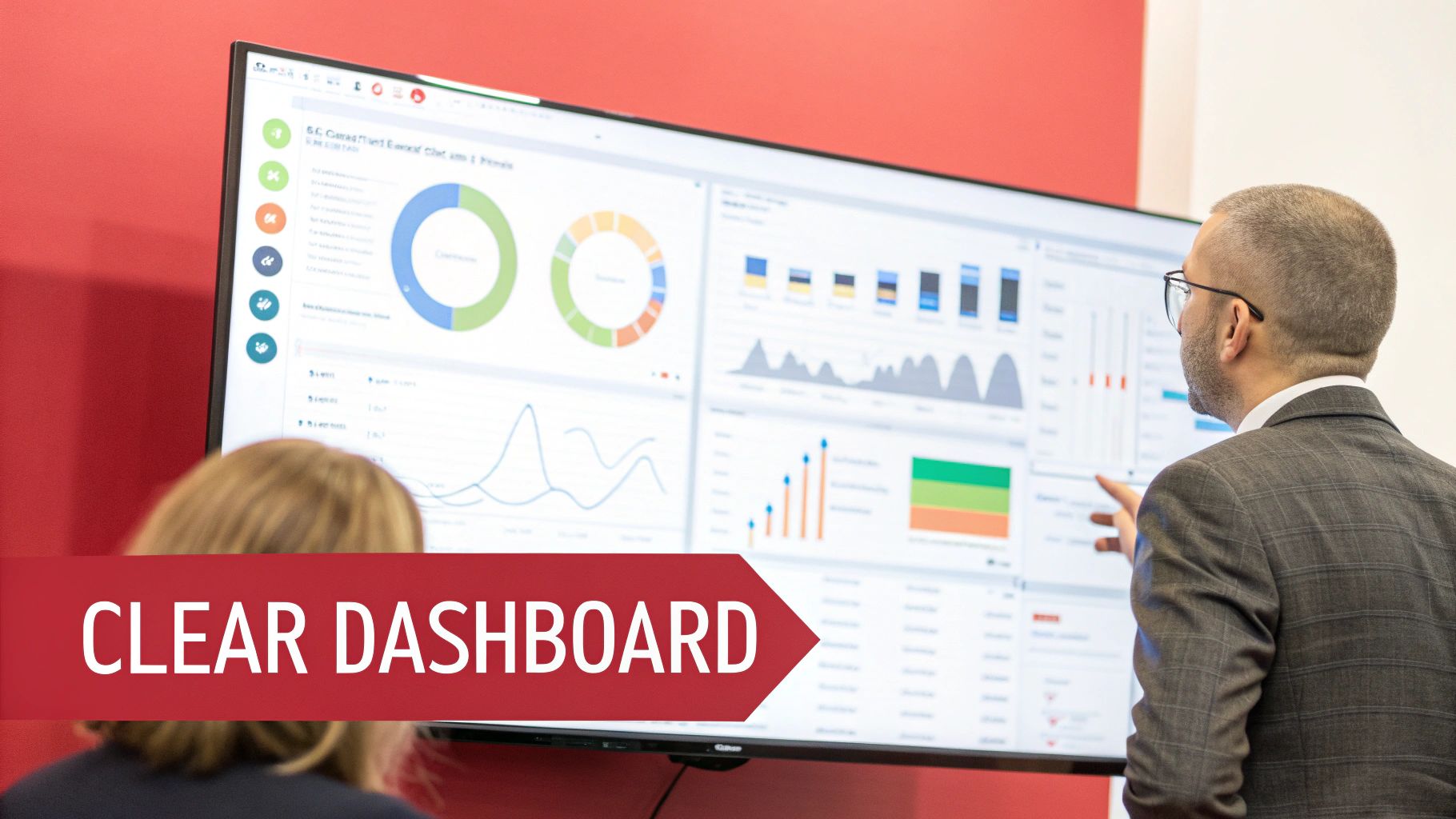
Here's a truth many marketers miss: measurement isn't the finish line. It's the starting block for your next campaign.
The real power of all that analysis is creating a tight feedback loop where every insight—good or bad—feeds directly into your future strategy. This is how you stop running isolated campaigns and start building a smarter, more resilient marketing programme.
Think of each campaign report as a treasure trove of lessons. When you treat your findings as a guide, you shift from just reporting on the past to actively shaping what comes next.
From Analysis to Actionable Strategy
The whole point of your analysis is to make better decisions. That means turning your insights into a concrete plan for optimisation. The goal is to build a system where every result triggers a specific action, creating a cycle of constant improvement.
Start by sorting out the clear wins and losses from your report. Did a particular channel blow the others out of the water? Did a certain creative completely miss the mark?
These initial findings are your launchpad for two critical moves:
- Scaling Success: When you find a winning tactic, the first question should always be, "How can we do more of this?" That might mean funnelling more budget into your best performing ad set, expanding a successful audience segment, or turning a high engagement blog post into a major content pillar.
- Pivoting from Failures: Underperforming elements aren't failures; they're learning opportunities. If a channel delivered a poor ROI, it's time to either dig into why or redirect your resources to channels that are actually working.
The most effective marketing teams aren't the ones that never fail—they're the ones that learn the fastest. Every metric tells a story that can help you refine your approach for the next launch, ensuring you rarely make the same mistake twice.
Creating an Experimental Mindset
Your analysis should spark curiosity and lead to new hypotheses. For instance, if your data shows an influencer campaign drove brilliant engagement but very few conversions, don't just write it off.
Ask why.
Maybe the call to action was weak, or the landing page felt disconnected from the influencer's post. That insight leads directly to your next test: run a similar campaign, but this time with a stronger offer or a more direct call to action.
Influencer marketing is a huge force in the UK, with ad spend expected to hit £1.3 billion . What's more, 69% of UK consumers say they've bought something after an influencer promotion, which proves its commercial power when you get it right. By testing and refining your approach, you can tap into this valuable channel far more effectively. Find out more about the impact of UK influencer marketing.
Common Questions Answered
When you get serious about measuring marketing, a few questions always pop up. Let’s tackle the most common ones to give you some clarity and help sharpen your measurement game.
How Often Should I Be Checking My Campaign Performance?
This really depends on the pace of the campaign you’re running.
For anything fast moving, like paid social or search ads, you need to be in there daily or at least weekly. This lets you make quick tweaks to your bids, creative, or targeting before you burn through your budget on something that isn't working.
On the flip side, for longer term plays like SEO or content marketing, a monthly review makes far more sense. These channels need time to gain traction, and checking them too often will just make you overreact to normal ups and downs. A monthly check in is perfect for spotting real trends.
What's the Real Difference Between a Metric and a KPI?
People throw these terms around interchangeably, but they aren't the same thing.
A metric is just a number you can track. Think website visits, email open rates, or social media likes. There are thousands of them out there.
A Key Performance Indicator (KPI) is different. It’s a specific metric you’ve hand picked because it directly shows if you're getting closer to a crucial business goal. So, while website visits is a metric, the conversion rate of those visitors into paying customers is a KPI. Why? Because it’s tied directly to revenue.
In short, all KPIs are metrics, but only a handful of your most critical metrics earn the title of KPI.
How on Earth Do I Measure an Offline Marketing Campaign?
Measuring things like print ads or radio spots takes a bit of creative thinking, but it’s absolutely possible. You just need to build a digital bridge to track the response.
Here are a few simple but effective ways to do it:
- Unique Discount Codes: Create a code that’s exclusive to that one advert, like " MAGAZINE20 ".
- Dedicated Landing Pages: Set up a simple page with a unique URL (like yourwebsite.co.uk/offer ) that you only promote in your offline campaign.
- Trackable Phone Numbers: Use a specific phone number for the campaign to count exactly how many calls it drives.
By tying these unique identifiers back to your offline activities, you can start attributing leads and sales with a surprising amount of accuracy.
At Superhub , we turn data into decisions. If you need a partner to help you measure, analyse, and optimise your marketing for real world results, get in touch with our team today.
Want This Done For You?
SuperHub helps UK brands with video, content, SEO and marketing that actually drives revenue. No vanity metrics. No bullsh*t.