
Digital Marketing Strategy Services That Drive Real Growth
Right, let's get one thing straight. A digital marketing strategy service isn't about ticking boxes or firing off random social media posts and hoping for the best. Think of it as the architectural blueprint for your online growth. It provides the essential 'why' and 'how' behind every single marketing move, ensuring nothing is left to chance.
What Is a Digital Marketing Strategy Service?
A digital marketing strategy service is the professional planning and management of all your online activity, laser-focused on hitting specific, measurable business goals. It’s the difference between blindly chucking money at ads and methodically investing in a system built for predictable growth. This isn't just "doing marketing"; it's about drawing a clear roadmap that connects every tactic to a tangible outcome.
For many UK businesses, marketing feels like a gamble. You boost a post on Facebook, maybe run a few Google Ads, or publish a blog post when you have time. But without a unified strategy, these are just isolated actions. They lack direction and almost never deliver sustainable results.
A proper strategy service flips this on its head by starting with the foundations:
- Deep-Dive Analysis: Getting under the skin of your business, your competitors, and figuring out exactly where you stand in the market.
- Customer Identification: Pinpointing precisely who your ideal customer is, what they need, and where they spend their time online.
- Goal Setting: Establishing clear, quantifiable objectives, whether that’s generating 20% more sales leads or becoming the go-to name in your industry.
- Channel Selection: Deliberately choosing the right platforms—be it SEO, paid media, or content production—to reach your audience where they actually are.
Strategic Planning vs Random Marketing Actions
It's easy to mistake activity for progress. Running a Facebook ad is an action; knowing exactly who that ad needs to reach, what it should say, and how it contributes to your sales target is a strategy. This table breaks down the crucial difference.
| Aspect | Digital Marketing Strategy Service | Ad-Hoc Marketing Tasks |
|---|---|---|
| Foundation | Based on deep research, data, and clear business goals. | Based on assumptions, trends, or gut feelings. |
| Objective | Focused on long-term, sustainable growth and ROI. | Focused on short-term metrics like likes or clicks. |
| Execution | A cohesive, integrated plan where all channels work together. | Disconnected activities that often compete with each other. |
| Measurement | Tracks key performance indicators (KPIs) tied to revenue. | Often lacks clear measurement or focuses on vanity metrics. |
| Outcome | Predictable, scalable results and a strong market position. | Inconsistent results, wasted budget, and missed opportunities. |
Without a plan, you're just making noise. With a strategy, every action has a purpose, building momentum towards a defined goal.
Why a Cohesive Strategy Matters
Without a strategic framework, your marketing budget gets burned on disconnected activities that don't build on one another. This is especially true in the fiercely competitive UK market. The UK digital marketing sector hit a value of £15.4 billion in 2024 and is projected to reach £37.1 billion by 2033 . This explosive growth means your competitors are investing heavily to win online. A scattergun approach simply won’t cut it anymore. You can read the full research about the UK's digital marketing growth from IMARC Group.
A strategy turns random actions into a focused campaign. It ensures your website, social media, and advertising efforts all work together, telling the same story and driving customers towards the same goal.
Ultimately, a digital marketing strategy service provides clarity and purpose. It transforms your online presence from a cost centre into a powerful, results-driven growth engine for your business, making sure every pound spent is an investment towards a real return.
The Core Components of a Winning Strategy
A powerful digital marketing strategy is a well-oiled machine, not a random collection of spare parts. It’s an integrated system where each element amplifies the others, working together towards a single, clear objective: growth.
Trying to succeed with just one or two of these components is like trying to build a performance car with only an engine and a steering wheel—you’ll get nowhere fast.
To build a strategy that delivers real, measurable results, you need to understand how these essential pillars work in unison. It's about creating a flywheel effect where strong SEO drives traffic to a high-converting website, which is then supported by targeted paid media and engaging content. Each part has a job to do, and together, they build unstoppable momentum.
This diagram shows the core blueprint, illustrating how a deep understanding of your market position, your customer, and your goals forms the foundation for everything that follows.
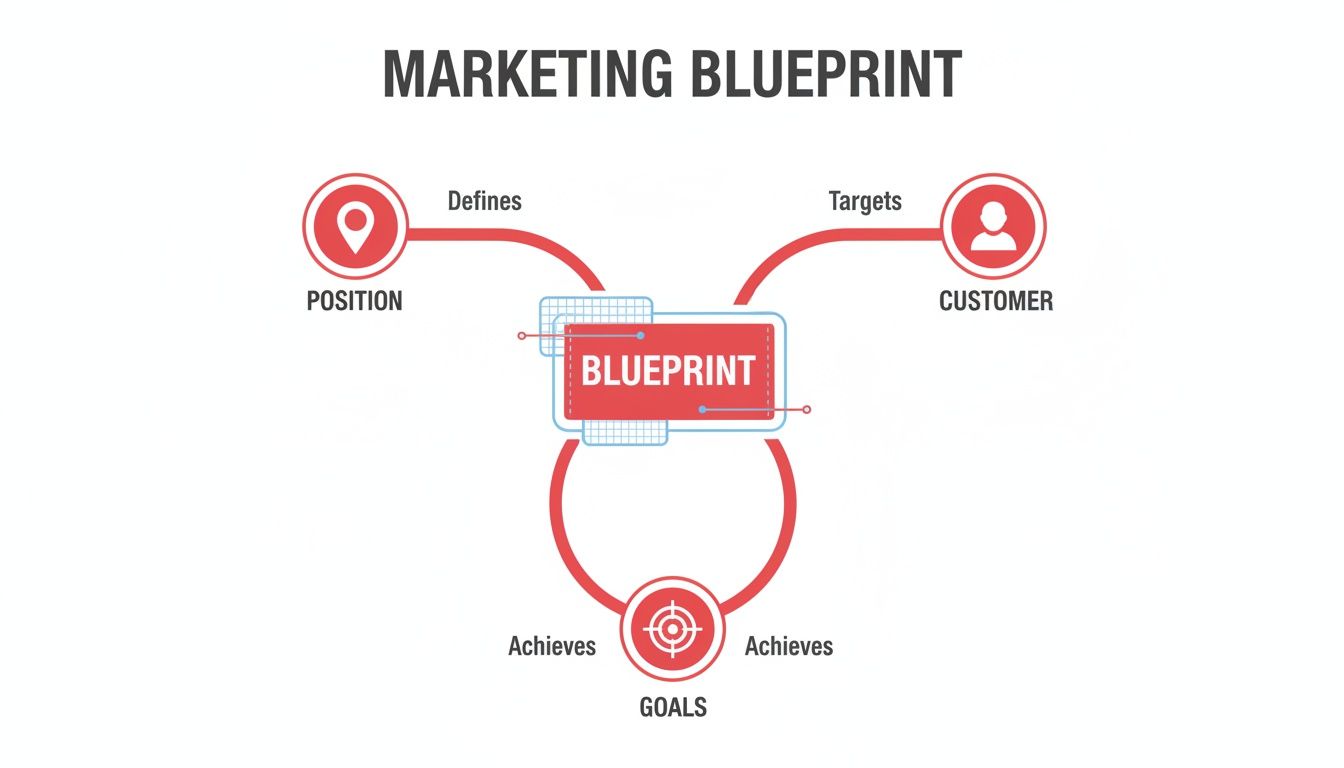
This reinforces that a winning strategy isn't just a list of tactics. It's a cohesive plan built around these fundamental pillars. Let's break down the individual components that form this powerful system.
Search Engine Optimisation (SEO)
SEO is the long-term foundation of your online visibility. Think of it as the methodical process of making your website more attractive to search engines like Google, ensuring you appear when potential customers are actively looking for the solutions you provide. It’s not about quick tricks; it’s about building genuine digital authority.
This involves:
- Technical SEO: Making sure your site is built on a solid foundation—fast, secure, and easily crawlable by search engines.
- On-Page SEO: Crafting content around the keywords your audience actually uses, answering their questions, and structuring your pages for maximum impact.
- Off-Page SEO: Building your reputation across the web through high-quality backlinks and mentions from other authoritative sites.
A solid SEO approach doesn't just bring traffic; it brings the right traffic—people with a genuine interest in what you offer.
Paid Media (PPC)
While SEO builds momentum over time, Pay-Per-Click (PPC) advertising delivers immediate, targeted reach. It allows you to place your business directly in front of a highly specific audience on platforms like Google and social media networks.
You pay only when someone clicks, making it an incredibly efficient way to generate leads and sales. PPC is all about precision targeting. We can reach users based on their search queries, demographics, interests, and even past online behaviour. This makes it an indispensable tool for launching new products, promoting time-sensitive offers, or capturing high-intent customers at the exact moment they’re ready to buy.
Content and Film Production
In a crowded market, generic content is just noise. High-impact content and professional film production are what cut through the static. This is about creating valuable, engaging, and memorable assets that capture attention and build a real connection with your audience.
Content isn't about selling; it's about solving problems, answering questions, and building trust. A well-produced video or a deeply insightful article establishes your brand as an authority and keeps you top-of-mind.
From compelling brand films that tell your story to practical "how-to" videos and in-depth articles, great content fuels every other part of your strategy. It provides the substance for your SEO, the creative for your ad campaigns, and the value for your social communities. A winning strategy defines success through measurable outcomes, highlighting how centralized marketing metrics drive revenue growth.
Social Media Management
Social media isn’t just a broadcast channel; it’s a community-building tool. Effective social media management is about creating and nurturing a loyal following by consistently providing value and engaging in two-way conversations. It humanises your brand and turns passive followers into active advocates.
Each platform has its own rules of engagement. A strategy that works on LinkedIn, for example, will likely fall flat on Instagram. Success requires a bespoke approach for each channel, tailored to the platform’s audience and format, ensuring your message resonates authentically wherever it appears. For a deeper look into the specifics, check out our guide to mastering data-driven marketing strategies for real growth.
Website and App Development
Your website is the centre of your digital universe. It’s often the first impression a potential customer has of your business and, most importantly, it’s where conversions happen. An effective site combines stunning design with a seamless user experience (UX), guiding visitors towards taking action, whether that's making a purchase or filling out a contact form.
A slow, confusing, or poorly designed website will undermine even the best marketing campaigns. Our approach focuses on conversion rate optimisation (CRO), ensuring every element of your site is designed to turn traffic into tangible business results. The same principles apply to app development, creating intuitive mobile experiences that serve a specific purpose for your audience.
How We Build Your Bespoke Growth Roadmap
A strategy based on guesswork is a waste of time and money. We don’t do guesswork.
Our approach to building your digital marketing plan is a methodical, no-nonsense process designed to deliver predictable results. We pull back the curtain on our work, making sure you understand not just what we’re doing, but precisely why we’re doing it. This isn't some off-the-shelf template; it's a roadmap engineered for your specific business goals, your market, and your customers.
It’s a transparent, four-stage journey that moves from deep analysis to relentless optimisation. Every action has a purpose, and every pound is invested for maximum impact.

Stage 1: Discovery and Audit
Before we can map out the future, we need to get a grip on the present. This initial phase is a complete immersion into your business. We get under the skin of your operations, your revenue goals, and your vision for growth. We’re not just another supplier; we become an extension of your team.
Our audit involves:
- Business Immersion: We sit down with you to learn what makes your business tick—your unique value, your sales process, and your biggest headaches.
- Competitor Analysis: We dissect what your rivals are doing right and, more importantly, where their weaknesses lie. This is where we find the gaps you can exploit.
- Market Research: We analyse your industry, identifying customer pain points and emerging trends to make sure your strategy is relevant and forward-thinking.
- Technical Audit: We conduct a thorough review of your existing digital assets—website, social channels, and past campaigns—to establish a clear performance baseline.
Stage 2: Strategy Formulation
With a deep understanding of where you stand, we move from analysis to action. This is where we connect your business objectives to a concrete digital marketing strategy. We don’t just set vague goals; we define clear, measurable Key Performance Indicators (KPIs) that actually matter to your bottom line, like cost per acquisition or lead-to-customer conversion rate.
During this stage, we map out the entire plan:
- Channel Selection: We figure out the right mix of channels (SEO, PPC, social media, content) to reach your target audience without wasting a penny.
- Creative Direction: We define the core messaging and creative concepts that will cut through the noise and genuinely resonate with your customers.
- Budget Allocation: We create a detailed budget that puts resources into the channels and tactics set to deliver the highest return.
This isn't just a document; it's a comprehensive plan of attack. It outlines every step we'll take, the resources required, and the results you can expect. This clarity builds trust and ensures we're all aligned from day one.
Stage 3: Implementation and Launch
A brilliant strategy is worthless without flawless execution. In this stage, our specialist teams get to work, bringing the roadmap to life with precision and expertise. Our project managers coordinate every detail, ensuring a seamless rollout across all chosen channels.
Whether it’s our SEO team optimising your site, our content creators producing a compelling brand film, or our paid media experts launching a targeted ad campaign, every single action is executed to the highest standard. We manage the entire process, keeping you in the loop with clear communication so you're never left in the dark.
To see how these plans come to life, explore these 7 powerful digital marketing strategy examples for 2025.
Stage 4: Analysis and Optimisation
The launch is just the beginning. A modern digital marketing strategy service is dynamic, not static. We continuously monitor performance against the KPIs we defined in the strategy stage, using real-time data to make informed decisions. We don’t wait for quarterly reviews; we tweak campaigns on the fly to get better results.
This data-driven approach means we are always refining our tactics. If an ad isn't performing, we adjust it. If a piece of content is driving exceptional engagement, we amplify it. This constant cycle of analysis and optimisation is what separates a professional partner from a simple service provider. It’s how we ensure your investment delivers sustained, long-term growth.
The UK's digital advertising spend is forecast to hit £75.3 billion by 2030 , and our optimisation process ensures your budget is spent where it counts. You can discover more insights about the UK digital advertising market on Grand View Research.
Putting Strategy into Action in Key UK Sectors
Theory is one thing; results are what matter. A digital marketing strategy only proves its worth when it solves real-world business challenges and delivers measurable growth. So, let's move beyond the blueprint and look at how these services perform in the real world, specifically within our specialist sectors.
This isn’t about generic advice. It’s about showing how a deep understanding of an industry's specific needs, customer behaviours, and market pressures shapes a strategy that actually works. We’ll show you how a plan for a motorsport team is fundamentally different from one for a financial adviser, and why that sector-specific expertise is non-negotiable.
Each example you're about to see tackles a distinct business problem and shows how a properly tailored digital strategy provides the solution.

Motorsport: Driving Sponsorship and Engagement
The motorsport world runs on two fuels: high-octane petrol and commercial sponsorship. For any racing team, the biggest challenge is often securing and retaining the financial backing needed to even get on the grid. A generic marketing approach just won’t cut it here.
- The Challenge: A UK racing team needs to attract new corporate sponsors for the upcoming season while growing its fan base to prove its commercial value.
- The Strategic Solution: We deploy a two-pronged strategy. For B2B sponsor acquisition, we use highly targeted LinkedIn campaigns and create authoritative content that positions the team as a valuable marketing partner. Think case studies showcasing previous sponsor ROI and professional video content highlighting brand exposure on track.
- The Fan Engagement Plan: For the fans, we build a dynamic social media content plan centred around behind-the-scenes film production. This means race day vlogs, driver Q&As, and technical breakdowns—building a loyal community that sponsors find incredibly attractive. This blend turns the team's digital presence into a powerful asset for both sporting and commercial success.
Automotive Dealerships: Generating Local Leads
For automotive dealerships, success is measured in two things: footfall and test drives. The real challenge is cutting through the noise in a competitive local market to reach buyers who are right now researching their next car.
A successful local strategy isn't just about being found; it's about being the obvious choice. It requires a deep focus on local search signals, trust-building, and making the path to booking a test drive as simple as possible.
Our strategy here is laser-focused on local SEO and high-intent paid search.
- The Challenge: A Devon-based car dealership is struggling to generate enough qualified leads for test drives, losing out to bigger national competitors.
- The Strategic Solution: We kick off with an aggressive local SEO campaign, optimising their Google Business Profile with high-quality imagery, customer reviews, and service information. We then create location-specific landing pages for key models (e.g., "Ford Focus for sale in Exeter") that are built to rank in local searches.
- Driving Action: This is backed by a geo-targeted PPC campaign focusing on keywords like "book a test drive near me." The ads lead straight to a simple, mobile-friendly booking form, drastically reducing friction and boosting conversion rates for qualified local buyers.
Devon Tourism: Capturing Visitor Attention
In tourism, especially for a destination like Devon, the goal is to inspire and then capture bookings. This requires emotive storytelling and visually compelling content that makes potential visitors feel like they're already here.
To help your business stand out and drive growth, consider implementing effective video marketing for small businesses as a core part of your strategy.
- The Challenge: A boutique hotel on the Devon coast needs to increase direct bookings during the shoulder season, cutting its reliance on high-commission online travel agents.
- The Strategic Solution: Our strategy centres on professional film and content production. We create a series of cinematic short videos showcasing the unique experiences the hotel offers—from coastal walks to local dining. These videos become the cornerstone of a targeted social media ad campaign aimed at audiences in major UK cities who have shown an interest in UK holidays.
- Securing Bookings: The campaign drives traffic to a newly optimised website with a seamless booking engine. We also implement an email marketing workflow to nurture potential guests who showed interest but haven't booked, sending them exclusive offers and more inspiring content to get them over the line.
Financial Services: Building Trust and Authority
In the highly regulated world of financial services, trust is the most valuable currency you have. A successful digital marketing strategy has to prioritise building credibility and authority over pushy sales tactics.
- The Challenge: An independent financial adviser (IFA) wants to attract more high-net-worth clients for retirement planning but struggles to stand out in a crowded online space.
- The Strategic Solution: We build the strategy on a foundation of content marketing and thought leadership. We develop a series of in-depth articles and guides on complex topics like pension consolidation and inheritance tax planning. This content is meticulously optimised for SEO to capture traffic from people actively searching for expert financial advice.
- Targeted Outreach: This authoritative content is then promoted through targeted LinkedIn ads aimed at specific professions and seniority levels. By providing genuine value and demonstrating deep expertise upfront, the strategy builds the trust necessary for a potential client to make that first enquiry. This approach generates fewer leads, but they are of a much higher quality.
Choosing the Right Strategic Partner for Your Business
Picking a partner to run your digital marketing is one of the most important decisions you'll make. Get it right, and you’ve just built an engine for growth. Get it wrong, and you’ll burn through your budget with nothing to show for it but a few meaningless vanity metrics.
This isn’t about finding a supplier who just takes orders. It’s about finding a strategic partner who will get in the trenches with you, understand your commercial goals, and build a proper roadmap to get you there.
The market is flooded with agencies promising the world. The trick is to look past the slick sales pitch and see if there’s any real substance. A true partner doesn't just push services; they build a strategy. They ask tough questions, challenge your assumptions, and focus relentlessly on the outcomes that actually matter to your business.
Look for Genuine Industry Experience
Generic marketing advice is worthless. You need a partner who understands the specific quirks and nuances of your world. An agency that gets results for a fashion e-commerce brand won't necessarily know the first thing about attracting sponsors for a motorsport team or generating qualified leads for a financial services firm.
Look for proof of real-world experience in your industry. Have they navigated its unique challenges before? Do they speak its language? As a Devon-based digital marketing agency, we have deep roots in motorsport, automotive, and local tourism. We get the audiences, the market pressures, and the unwritten rules our clients face. This specialist knowledge allows us to build strategies that are not just theoretically sound, but effective from day one.
Scrutinise Case Studies for Real Results
Don't get distracted by impressive-looking case studies that only talk about "increased engagement" or "brand awareness." These are often just vanity metrics. A genuine strategic partner will have case studies that show a clear, straight line between their work and tangible business results.
When you're talking to a potential agency, ask for proof of:
- Lead Generation: How many qualified leads did they generate, and at what cost?
- Sales Growth: Can they show you a direct impact on revenue?
- Return on Investment (ROI): For every pound spent, what was the measurable financial return?
An agency that’s confident in its ability to deliver will have this data ready to go. They won't hide behind fluffy, feel-good numbers.
A great partner shows you how they made their clients money. A poor one shows you how many likes a post got. Don't confuse the two.
Find a Partner, Not a 'Yes-Man'
The best digital marketing strategy services come from teams who are prepared to act as a true extension of your business. That means they should be comfortable challenging your ideas and bringing their own expertise to the table, not just nodding along with everything you say.
The UK's social media advertising market is projected to hit £9.95 billion by 2025 , growing 13% year-on-year. While this is a huge opportunity, simply boosting a few posts isn't a strategy. Research from Sprout Social shows that while 57% of businesses are satisfied with their organic social media, a significant 32% are not—highlighting just how easy it is to get it wrong without expert guidance. A good partner will tell you when a channel isn't right for you, saving you time and a lot of money.
Choosing the right agency comes down to asking the right questions and demanding clear, evidence-based answers.
Key Questions to Ask a Potential Agency Partner
Before you sign any contract, it's vital to vet your potential partner thoroughly. This isn't just a tick-box exercise; it's about making sure their culture, expertise, and processes align with your business goals. Use this table as a starting point for your conversations.
| Question Category | What to Ask | Why It Matters |
|---|---|---|
| Experience & Expertise | Can you show me specific examples of your work in my sector? | Generic marketing doesn't work. You need a partner who knows your industry's language, audience, and challenges inside out. |
| Strategy & Process | What does your onboarding process look like? How will you get to know my business? | A good agency invests time upfront to understand your goals, customers, and commercial reality before building a single campaign. |
| Results & Reporting | How do you measure success? Can I see a sample report? | Look for a focus on commercial outcomes (leads, sales, ROI), not just vanity metrics (likes, shares, impressions). |
| Communication & Culture | Who will be my day-to-day contact? How often will we communicate? | You need a responsive, proactive partner, not an agency that disappears for weeks at a time. This defines the working relationship. |
| Commercials & ROI | How is your pricing structured? What kind of return can we realistically expect? | A transparent partner will be upfront about costs and confident in their ability to generate a positive return on your investment. |
Ultimately, you're looking for a team that feels like a genuine extension of your own. They should be as invested in your success as you are.
For a more detailed breakdown of what to look for, check out our comprehensive guide on how to choose a digital marketing agency.
Your Digital Marketing Strategy Questions Answered
We get asked these all the time. Here are the straight-up answers to the questions we hear most from UK businesses about digital marketing strategy. No fluff, just what you need to know.
What’s the Difference Between Marketing Strategy and Tactics?
Think of it like planning a road trip from London to Edinburgh.
The strategy is the big-picture plan. It’s deciding why you're going (a scenic tour, not a race), what your budget is, and the key destinations you want to hit along the way. It’s the map that guides the entire journey.
Tactics are the individual actions you take to make it happen. That’s booking the hotels (content creation), filling the car with petrol (PPC campaigns), and choosing the A-roads over the motorway for better views (SEO). You need both, but without the strategy, your tactics are just disconnected activities that won't get you to your destination.
How Long Does It Take to See Results?
This all comes down to the channels you’re using. If you're running a sharp PPC campaign, you can start seeing traffic and leads roll in within 24 hours . It’s a fantastic way to get momentum quickly.
But for the foundational stuff that builds real, long-term value—like SEO and content marketing—it's a different game. You’re building an asset, not just running an ad. You should expect to see proper traction and a clear return on your investment within 6 to 12 months . Anyone promising you page-one rankings in a week isn't being straight with you.
A proper digital marketing strategy blends the short-term wins from paid media with the long-term asset building of organic channels. It delivers results today while securing your growth for tomorrow.
Can I Not Just Do This In-House?
You can, but the real question is whether you should. Truly effective digital marketing needs a whole range of deep, specialist skills that you’ll almost never find in one or two people.
A specialist agency gives you a full team of pros for less than the cost of hiring a single senior marketing manager. You get instant access to:
- SEO specialists who live and breathe algorithms.
- PPC managers obsessed with conversion rates.
- Content creators and videographers who know how to tell a story.
- Web developers who build sites that convert.
- Social media experts who understand how to build a community.
It’s not just about saving money. It's about skipping the painful learning curve and getting expert execution across every single channel from day one, instead of asking a small team to be a jack of all trades and a master of none.
Ready to stop guessing and start growing with a plan built for results? The team at SuperHub is here to build the bespoke digital marketing strategy your business deserves. Book a no-obligation strategy call with us today.
Want This Done For You?
SuperHub helps UK brands with video, content, SEO and marketing that actually drives revenue. No vanity metrics. No bullsh*t.