


How to Improve Customer Engagement: A Practical UK Guide
If you want to get customer engagement right, you have to stop thinking about transactions and start building real, emotional connections.
It’s about getting to know your customers on a much deeper level—what they value, what keeps them up at night, and what truly motivates them. When you have that insight, you can shape every single interaction to make them feel seen, heard, and genuinely understood.
Building the Foundation for Real Customer Engagement
Let's be honest, the old rules of customer engagement are dead. Today’s customers, particularly in the UK, aren’t just buying a product; they’re buying into a brand’s story, its values, and the community it creates around itself. A flashy discount might land you a single sale, but it won’t build a loyal advocate who sticks around for the long haul.
The real work starts with a simple shift in mindset. Instead of asking, "How can we sell more?" we need to be asking, "How can we connect more deeply?" That one question is the foundation of every successful engagement strategy. It’s about building relationships, not just processing orders.
Know Your Audience Inside and Out
You can’t engage an audience you don’t understand. The basics, like age and location, are a starting point, but they barely scratch the surface. To forge a proper connection, you need to build out detailed customer personas that feel like actual people.
What are their daily frustrations? What podcasts are they listening to? What do they really value in a brand—is it sustainability, pure convenience, or exceptional craftsmanship? Answering these questions lets you tailor your messaging so it feels authentic and actually resonates.
Take a startup selling eco-friendly cleaning products. They are not just targeting people who need to clean their homes. They are connecting with individuals who are environmentally conscious, demand transparency, and actively want to support businesses that align with their ethics. Every bit of content, from a blog post to an Instagram Story, has to reflect that deep understanding.
From Transactional Benefits to Emotional Bonds
This shift towards relationship-first marketing isn’t just a nice idea; the data backs it up. Before getting into specific tactics, it’s worth clarifying what social media engagement actually means and why it’s the backbone of a genuine connection. In the UK, the game has changed—emotional connection now trumps transactional benefits every time.
Research shows that emotional connection has surpassed transactional perks as the primary driver of consumer loyalty, with values alignment and community belonging emerging as critical factors. Companies that achieve an 'Excellent' CX Index score are over 30% more likely to turn loyal customers into passionate brand advocates.
This is a huge insight. The brands that win are the ones that wrap emotional benefits around their functional experience, creating what some experts call an 'Emotional Signature'. This allows them to re-engage customers by tying their metrics to real, desired feelings.
To get a clearer picture of this shift, we've put together a table that breaks down the modern, emotion-led approach versus the traditional, transaction-focused one.
Key Pillars of Modern Customer Engagement
| Pillar | Modern Approach (Emotion-Led) | Traditional Approach (Transaction-Led) |
|---|---|---|
| Primary Goal | Build lasting relationships & community | Drive immediate sales & conversions |
| Customer View | Individuals with values and motivations | Demographic segments & sales targets |
| Communication | Two-way dialogue, authentic & personal | One-way broadcast, promotional & generic |
| Loyalty Driver | Shared values, belonging, trust | Discounts, points, transactional rewards |
| Key Metrics | Lifetime value (LTV), sentiment, advocacy | Conversion rate, average order value (AOV) |
| Brand Voice | Consistent, human, and relatable | Formal, corporate, and product-focused |
As you can see, the modern approach is all about playing the long game. It is a fundamental move away from quick wins towards building something sustainable and meaningful.
Cultivating Your Brand Voice
Once you know who you’re talking to, you have to decide how you are going to talk to them. Your brand voice is your company’s personality, and it needs to show up everywhere. Are you witty and informal? Or are you more authoritative and supportive?
Whatever you choose, it must be consistent—from your website copy to the way you handle customer service emails. Consistency builds trust and makes your brand feel familiar and reliable. It’s the difference between a brand that feels like a faceless corporation and one that feels like a trusted friend.
By getting this groundwork right, you create an environment where customers do not just buy from you. They connect, they participate, and ultimately, they become your most powerful marketers.
Creating a Seamless Multichannel Experience
Let's be honest, the modern customer journey is a winding road. It might kick off with an Instagram post they see, pivot to your website for a bit of research, lead to an email with a question, and end with a visit to your physical store. If that experience feels clunky or makes them repeat themselves, you’ve already lost.
The secret to brilliant engagement is creating a consistent, effortless experience at every single touchpoint. It’s about making sure your branding, messaging, and service standards are perfectly in sync across the board.
A customer should feel like they're having one continuous conversation with your brand, not a bunch of disconnected chats. That’s the real difference between a frustrating multichannel mess and a truly seamless one.
This whole process boils down to turning casual observers into vocal advocates for your brand.
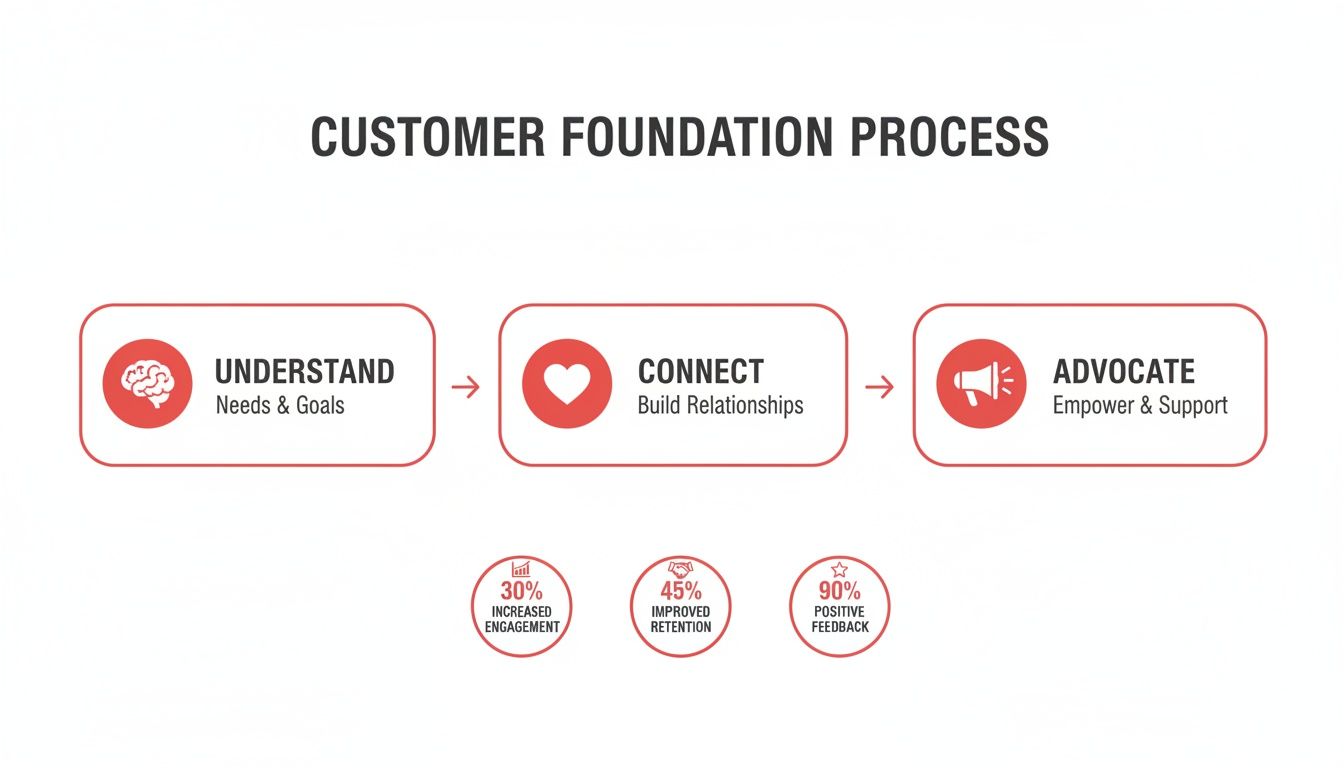
As the diagram shows, that genuine connection is the bridge between simply knowing who your customer is and earning their loyalty. It’s the absolute heart of any solid engagement strategy.
Map the Customer Journey
Before you can deliver a consistent experience, you need to get a grip on the paths your customers are actually taking. Journey mapping is not just a buzzword; it is the process of sketching out every single interaction someone has with your business, from the moment they first hear about you to long after they’ve made a purchase.
Think of it as drawing a literal map of their experience. This simple exercise is gold for spotting friction points—those annoying spots where customers get stuck, confused, or just plain frustrated. Maybe your mobile checkout is a nightmare to use, or the info on your social media directly contradicts your website. These are the moments that kill the vibe.
Once you’ve found these pain points, you can start fixing them. But journey mapping also uncovers opportunities to really wow your customers. You might realise there is a perfect moment to send a helpful follow-up email after they’ve browsed a specific product category, showing you’re actually paying attention.
Align Your Messaging Across All Channels
Your brand voice needs to be rock-solid, whether someone is reading a tweet, a product description, or a support email. This does not mean you sound like a robot repeating the same lines everywhere. It means the tone and personality have to feel consistent.
For instance, a high-end car dealership will likely have a sophisticated and knowledgeable tone on its website, a slick, aspirational style on Instagram, and a respectful, service-focused voice in its emails. The format changes, but the core brand identity never wavers. This consistency builds familiarity and reinforces what you stand for.
True multichannel excellence is more than just showing up on different platforms. It’s making sure every interaction, digital or human, feels connected, supportive, and completely effortless for the customer.
A massive part of this is mastering omnichannel customer service. It’s the practical side of this whole philosophy, making sure your support teams have the full picture and can help customers without making them jump through hoops.
Use Data to Make It Personal
A truly seamless experience feels personal. This is where your data becomes your best friend. By connecting the dots between your different channels, you can make sure the conversation always picks up right where it left off, no matter where it is happening.
Someone abandoned their shopping basket on your site? Send a gentle reminder email. They just bought a new camera? Show them some cool lens accessories or tutorial videos on social media next time they log on. This is not creepy; it shows you understand their journey and are trying to be genuinely helpful.
It is all about creating an experience that feels connected, adaptable, and supportive—giving customers frictionless control. This is not just good practice; it’s a structured way to improve your customer engagement across every single channel.
Using Social Media for Genuine Connection
Let’s be honest, social media is not a megaphone for your marketing messages any more. It’s the digital town square. It’s where communities are built, real conversations happen, and genuine connections are made. If you really want to improve customer engagement, you need to look past vanity metrics like follower counts and start creating interactions that actually mean something.
This means a total shift in strategy. Stop just posting content and start actively building a community. You need to create a space where your audience does not just scroll past your updates, but feels a real pull to get involved, share their thoughts, and become part of your brand's story. For UK audiences, who can spot inauthenticity a mile off, this is not just a nice-to-have—it's essential.

Go Beyond Broadcasting and Spark a Conversation
The brands winning on social media get that it’s a two-way street. They’re not just shouting about their latest offer; they’re inviting their audience into the conversation. And you can do this in simple, creative ways that get people talking.
Start thinking about interactive content that demands a response. Simple polls, "ask me anything" (AMA) sessions with your team, or quizzes about your industry can turn passive scrollers into active participants. The trick is to make it easy and fun for people to join in.
Imagine a Devon-based coffee roaster running a poll asking followers to vote on their next limited edition blend. Not only does this give them brilliant customer feedback, but it makes the audience feel properly invested in what the business does next.
Turn Your Customers into Co-creators
One of the most powerful moves you can make is to put your audience at the centre of your story. User-generated content (UGC) campaigns are perfect for this, turning your customers from passive buyers into active brand advocates who create content for you.
Encourage people to share photos or videos of them using your products. You could run a competition with a clear hashtag or just make a habit of featuring the best customer posts on your main feed. This gives you a steady stream of authentic, relatable content and makes your customers feel seen and valued.
When you feature customer content, you're not just filling your feed. You're building social proof and showing that real people love and use your products. This creates a powerful sense of community and trust.
A great UGC campaign does not just create content; it builds a loyal following that feels like they belong. Before you dive in, make sure your foundations are solid. It’s worth reviewing the 7 steps to social media success to get your core strategy right.
Partner with Authentic UK Influencers
Working with the right influencers is a massive shortcut to building trust and driving engagement. This is not about finding someone with the biggest follower count. It’s about identifying genuine creators whose values and audience are a perfect match for your brand. A good collaboration tells a compelling story, it does not just flog a product.
The numbers in the UK market do not lie. 69% of UK consumers have bought something after seeing it promoted by an influencer. It is a critical part of any modern engagement strategy.
This is even more true for younger customers. A huge 75% of UK consumers aged 18-29 have bought a product directly through social media after seeing an influencer post about it. With 84% of UK Gen Z following influencers, it’s clear this is just how they discover and buy things now.
To get these partnerships right, focus on creating content together that feels natural to the influencer's style while still getting your brand's message across.
- Look for micro-influencers: They often have smaller, more niche audiences that are incredibly engaged. This can deliver better value and a far more authentic connection.
- Prioritise shared values: Work with creators who genuinely love what you do. Their natural enthusiasm will be far more persuasive than any paid script.
- Give them creative freedom: Don’t be a control freak. The best content comes from letting creators talk to their audience in their own voice.
Effective Influencer Collaboration Models
Choosing the right kind of partnership depends entirely on what you're trying to achieve. Here’s a quick breakdown of the most common models to help you decide which fits your goals.
| Collaboration Model | Primary Goal | Best For | Key Metric |
|---|---|---|---|
| Sponsored Posts | Brand Awareness | Reaching a broad, relevant audience quickly. | Reach & Impressions |
| Affiliate Marketing | Direct Sales | Driving measurable conversions and tracking ROI. | Conversion Rate & Sales |
| Product Gifting | UGC & Social Proof | Generating authentic content and reviews at low cost. | Volume of UGC & Mentions |
| Brand Ambassadorship | Long-Term Loyalty | Building deep, ongoing trust with an audience. | Sentiment & Engagement Rate |
Each model has its place. An affiliate setup is perfect if you need to prove direct sales, whereas a long-term ambassadorship builds lasting credibility.
By moving past simple broadcasting and embracing interactive posts, UGC, and authentic partnerships, you can turn your social media from a static shop window into a buzzing community hub where real connection happens.
Making Personalisation Feel Human
Let’s be honest, one-size-fits-all marketing died years ago. In an age where customers expect you to know them, generic, broadcast-style messages don’t just get ignored—they get you blocked.
If you really want to improve customer engagement, you have to go deeper than just dropping a tag into an email. It’s about making every single interaction feel relevant, timely, and genuinely helpful.
This is where smart, human-centred personalisation comes in. It’s the art of using what you know about your customers to create experiences that feel less like a sales pitch and more like a real conversation. When it’s done right, it is not creepy; it feels like you’re actually paying attention.

Use Customer Data (But Don't Be a Creep)
Great personalisation runs on data. Simple as that. Every click, every purchase, every page view—it’s all a breadcrumb trail leading to what your customers actually want. The trick is using that information to give them more value, not just to squeeze more money out of them.
Start by segmenting your audience based on behaviour. You can create simple groups for first-time buyers, die-hard fans, or people who just keep looking at the same product category. This lets you talk to each group in a way that makes sense. A newbie needs a welcome series that holds their hand. A long-time loyalist? They'd probably love early access to the next big thing.
Just remember to be transparent. People are generally fine with you using their data if it leads to a better experience. Break that trust, and you've lost them for good.
Stop Reacting and Start Anticipating
Most businesses get stuck on reactive personalisation. Think "we miss you" emails sent three months after someone last bought something. Sure, it can work, but the real game-changer is being proactive.
Proactive communication is all about anticipating what a customer needs and offering a solution before they even realise they need it.
This could be things like:
- A tailored onboarding flow: Guide new users through your app based on the specific goals they told you they had when signing up.
- Proactive support: See someone clicking around the same help article for 10 minutes? A little live chat pop-up offering help feels like magic.
- Smart, timely offers: Send a special discount for an item a customer has viewed five times in the last week. You’re not being pushy; you’re being helpful.
This flips the script entirely. You’re no longer just responding to what they do; you’re actively guiding them towards a better outcome. It shows you’re a partner, not just a seller.
The goal is not to be clever with data; it is to be genuinely useful. When a customer feels like you get them—and you're actively trying to help them—you build a level of loyalty that a single transaction could never buy.
A Practical Checklist for Human-Centred Personalisation
Rolling out a full personalisation strategy can feel like a huge job, but it does not have to be. Start small, get some wins, and build from there. The focus should always be on creating real value, making every interaction feel helpful, not invasive.
Here’s a simple checklist to get you started:
- Start with Behavioural Segments: Group customers by actions—purchase frequency, browsing habits, email opens. This is your first step away from "one size fits all."
- Tailor Your Emails: Stop sending the same newsletter to your entire list. Create different versions with product recommendations or content that actually matches each segment's interests.
- Personalise Your Website: Use dynamic content. Show returning visitors product suggestions based on what they looked at or bought last time. It’s a simple but powerful touch.
- Launch a Loyalty Programme: Reward your best customers with perks that feel exclusive and thoughtful. This strengthens their bond with your brand.
- Ask for Feedback (and Actually Use It): Send out surveys asking customers what they want. Then, and this is the important part, use what they tell you to make your personalisation even better.
Following these steps creates a feedback loop. You listen, you understand, and you respond in a way that makes customers feel seen and valued. This is how you turn a technical marketing tactic into a powerful, human-first strategy that builds real loyalty.
Measuring What Matters for Engagement
You cannot improve what you do not measure. It’s great to pour effort into building connections with your customers, but without a clear way to track your progress, you're just flying blind. To really get a handle on customer engagement, you have to look past the superficial stuff—likes, shares, the usual suspects—and zero in on the key performance indicators (KPIs) that actually mean something for your business.
This is all about shifting your focus from vanity metrics to data that tells a real story about customer loyalty, satisfaction, and long-term value. It’s the difference between knowing someone saw your post and knowing if that post turned them into a repeat customer.
Moving Beyond Vanity Metrics
It is easy to get a buzz from a post that blows up with likes, but that dopamine hit does not always translate into a healthier bottom line. Measuring true engagement means digging deeper into the numbers that show you the real health of your customer relationships.
Here are the KPIs that actually matter:
- Customer Lifetime Value (CLV): This is the big one—the total revenue you can realistically expect from a single customer over their entire relationship with you. A rising CLV is a massive sign that your engagement efforts are paying off.
- Net Promoter Score (NPS): This classic metric cuts straight to the chase by asking one simple question: "How likely are you to recommend our brand to a friend?" It gives you a clear score that separates your biggest fans from your detractors.
- Customer Satisfaction Score (CSAT): Usually measured through quick, post-interaction surveys, CSAT gives you instant feedback on specific touchpoints. It helps you pinpoint and fix problems fast.
- Churn Rate: Simply put, this is the percentage of customers who stop doing business with you over a set period. A lower churn rate is a direct sign of successful engagement and retention.
Tracking these gives you a much richer, more accurate picture of your performance. It helps you see not just if people are interacting, but how those interactions are shaping their loyalty and value to your business over the long haul.
Setting Up Effective Feedback Loops
Numbers like NPS and CLV tell you what is happening, but it’s the qualitative feedback that tells you why. This is where feedback loops come in. It’s all about creating a system to turn raw data into actual, actionable changes. It means actively asking for opinions and making it dead simple for customers to share their thoughts.
Think of it as an ongoing conversation. You need to open up channels where customers feel heard, whether that is through a simple email survey, a review platform, or just by keeping a close eye on social media comments.
The most valuable insights often come directly from your customers. The goal is not just to collect feedback, but to build a system where that feedback directly informs your next move, ensuring your strategy evolves right alongside your audience.
For instance, if a few customers mention in a survey that your checkout process is confusing, that’s gold. It is a clear, actionable piece of feedback. You can then tweak the process and watch your CSAT scores or conversion rates to see if you've made a real difference. You can get more detail on this by checking out our complete guide on how to measure marketing campaign effectiveness in the UK.
The Measure, Analyse, Test, Repeat Framework
To make sure you’re always getting better, you need a framework. This simple but powerful cycle makes sure your efforts are always guided by data, not guesswork.
-
Measure: Start by tracking the KPIs we've just talked about. Use tools like Google Analytics, your CRM, and survey platforms to gather both the hard numbers and the qualitative feedback.
-
Analyse: Look for patterns and insights in what you've gathered. Why did your NPS score dip last month? Which email campaign drove the highest CLV? Connect the dots between your actions and the outcomes.
-
Test: Based on your analysis, form a hypothesis and put it to the test. Something like, "We believe personalising our email subject lines will increase our open rate and engagement." Then run an A/B test to prove yourself right (or wrong).
-
Repeat: Take what you’ve learned from the test, roll out the winning version, and start the cycle all over again.
This framework turns measurement from a boring reporting task into a proactive tool for growth. It helps create a culture where you’re constantly listening, learning, and refining your approach to keep your customer engagement strategy perfectly in sync with what your customers actually want.
Your Questions Answered
Diving into customer engagement can bring up a lot of questions. Customer expectations shift, new channels pop up, and it is easy to wonder where to start. We've tackled some of the most common queries to give you clear, straightforward answers you can actually use.
How Long Until We See Results From a New Engagement Strategy?
It is a classic case of short-term wins versus long-term gains. You might see a quick jump in social media comments or shares within a few weeks of a new campaign, which is brilliant for building early momentum.
But the results that really move the needle—like a real increase in Customer Lifetime Value (CLV) or a drop in your churn rate—take longer. Those metrics are a reflection of genuine loyalty, and that’s something you build through consistent, valuable interactions over time.
As a general rule, expect to see your leading indicators improve within three to six months . The more substantial impact on your bottom line, like better retention and more word-of-mouth referrals, usually starts to show after six to twelve months of consistent effort. It is about celebrating the small victories while playing the long game.
What Are the Biggest Mistakes Businesses Make?
One of the most common pitfalls is getting excited about technology without having a strategy. Buying a slick new CRM system is a waste of money if you have not first mapped out your customer's journey and figured out what they actually need from you. Technology should always serve the strategy, never the other way around.
Another classic mistake is inconsistent messaging. When a customer sees one offer on your website and a completely different one on your social media, it creates a clunky, confusing experience that chips away at their trust.
But perhaps the biggest mistake of all is simply not listening. Too many businesses just broadcast their message without ever creating proper feedback loops or acting on the insights they get from customers. Real engagement is a conversation, not a monologue.
Can a Small Business with a Tiny Budget Actually Succeed?
Absolutely. In fact, small businesses often have an advantage. The best engagement strategies are built on creativity and a genuine human touch, not massive budgets. Authenticity and care will always win more hearts than a huge advertising spend.
The key is to be smart and focused. Do not stretch yourself thin trying to be everywhere. Pick one or two channels where your ideal customers hang out and commit to delivering a personal, standout experience there.
Here are a few low-cost ideas that pack a real punch:
- Personalised Thank-You Emails: Ditch the robotic receipt. A short, genuine thank-you from a real person can make a massive impression.
- Active Social Listening: Set aside time every day to actually reply to comments, answer questions, and join conversations. It shows you’re paying attention.
- Simple Loyalty Schemes: A basic "buy nine, get the tenth free" card or an exclusive email list for repeat customers costs next to nothing to manage.
- Proactively Ask for Feedback: A quick survey after a purchase shows you value their opinion and are serious about getting better.
By focusing on these human touches, small businesses can cultivate a fiercely loyal community that bigger, more impersonal competitors can only dream of.
Ready to turn these ideas into real business growth? At Superhub , we build marketing strategies that create genuine connections and drive results.
Want This Done For You?
SuperHub helps UK brands with video, content, SEO and marketing that actually drives revenue. No vanity metrics. No bullsh*t.