


What Is a Marketing Audit and How Does It Drive Growth?
Ever feel like you’re throwing money at marketing but not quite sure what’s sticking? You’re not alone. That’s where a marketing audit comes in.
Think of it less as a scary exam and more as a comprehensive health check for your entire marketing operation. It’s a chance to step back, look under the bonnet, and figure out what’s firing on all cylinders, what’s misfiring, and where the hidden potential is hiding. It’s not about finding fault; it’s about finding clarity.
Understanding the Purpose of a Marketing Audit

The best way to describe a marketing audit is like an annual MOT for your marketing engine. It’s a top to bottom look at everything from your high level strategy down to the nitty gritty of individual campaigns. The whole point is to swap guesswork for data backed decisions.
This process ensures every pound you spend is working as hard as possible to grow your business. For any UK business trying to stand out, regular audits aren’t a luxury—they’re a fundamental tool for real, sustainable growth.
Why Audits Are More Important Than Ever
Let’s be honest, the pressure is on for UK businesses. A recent UK State of Digital Marketing Report found that the average marketing performance satisfaction rating is just 3 out of 4 stars .
That might sound okay, but it reveals a huge gap between what businesses expect and what their marketing actually delivers. Worse still, 7% of professionals rated their satisfaction at a dismal one star. An audit is your tool to pinpoint where the budget is being wasted and which channels are really driving results.
It gives you the clarity to refine your approach, making sure your efforts are perfectly aligned with your business goals. You get to be proactive, not just constantly reacting to the next problem.
An audit’s true value is turning a mountain of data into a simple, clear roadmap. It answers three powerful questions: Where are we now? Where do we want to go? And what’s the most efficient way to get there?
From Analysis to Action
Ultimately, an audit is all about uncovering insights you can actually use. At its core, it's about properly measuring marketing effectiveness to fuel real growth. It digs into several key areas to give you the full picture.
To give you a clearer idea of what a comprehensive review looks at, here’s a quick breakdown of the core components.
Core Components of a Marketing Audit at a Glance
This table summarises the main areas a marketing audit digs into, giving you a snapshot of the process.
| Audit Component | What It Examines |
|---|---|
| Marketing Environment | Market trends, competitor activity, and customer behaviour. |
| Current Strategy | How well your marketing goals support your overall business mission. |
| Execution and Tactics | The real world performance of channels like SEO, social media, and PPC. |
By systematically looking at each of these pieces, you get an honest view of your strengths, weaknesses, opportunities, and threats (the classic SWOT). This is the foundation for making smarter, more profitable marketing decisions that actually move the needle.
Why an Audit Is Your Secret Weapon for Growth
Let's be honest, a marketing audit is one of the most powerful things you can do for genuine business growth. It’s like switching from a blurry overview to a strategic magnifying glass, letting you zoom in on the exact details that are making—or breaking—your success. It’s the process that turns those vague feelings about performance into a concrete, actionable plan.
Too many businesses operate with a degree of uncertainty, just hoping their marketing budget is hitting the mark. An audit gets rid of that guesswork. It systematically uncovers where your budget is being wasted and shows you how to optimise your spend for a much healthier return on investment (ROI).
Uncovering Hidden Opportunities and Eliminating Waste
One of the first things you’ll notice is where your money is really going. For instance, an audit might show a pay per click (PPC) campaign is burning cash on irrelevant keywords, pulling in traffic that never converts. By simply reallocating that budget to a high performing content piece, you can instantly boost your efficiency.
An audit also shines a light on untapped market opportunities. You might find a competitor is completely ignoring a customer demographic that aligns perfectly with your brand. Or maybe your SEO efforts are missing out on valuable long tail keywords. These are the golden nuggets that create a real competitive advantage.
A marketing audit forces you to confront the truth about your performance. It’s not just about finding what's broken; it's about discovering what could be working ten times better with a few strategic tweaks.
Aligning Your Marketing with Business Goals
It’s surprisingly easy for marketing activities to drift away from core business objectives. An audit acts as a crucial realignment tool, making sure every campaign, social media post, and blog article directly supports your bigger goals—whether that’s growing market share, launching a new product, or keeping customers loyal.
This alignment is absolutely essential for sustainable growth. Without it, you're just running a series of disjointed campaigns that might look good on their own but fail to contribute to the bigger picture.
- Strategic Clarity: It confirms your marketing efforts are actually pushing the business in the right direction.
- Improved Focus: It helps your team prioritise the tasks that will deliver the most significant impact.
- Enhanced Accountability: It provides clear metrics to measure success against company wide targets.
Gaining a Crucial Competitive Edge
In a crowded marketplace, efficiency is everything. Marketing audits have become vital for UK businesses facing rising costs and increasingly complex marketing environments. With UK agencies reporting a 6.1% drop in headcount while income rises, teams are being pushed to achieve more with less. An audit is the diagnostic tool that makes this possible, identifying precisely where every pound should be invested for maximum impact. You can find more insights on how UK businesses are optimising their marketing.
By understanding what works for you and what doesn’t, you can react faster, make smarter decisions, and outmanoeuvre competitors who are still relying on guesswork. In short, a marketing audit isn’t just another report; it’s one of the most strategic investments you can make in your company's future.
Choosing the Right Type of Marketing Audit
The phrase 'marketing audit' can sound a bit daunting, like a massive, all consuming project. But it doesn't have to be.
Think of it less like a full MOT for your entire business and more like a series of specialised checks. You wouldn't use the same tools to inspect your engine as you would to check your tyres, and the same logic applies here. An audit can be scaled up for a complete overview or scaled down to investigate one specific problem.
This flexibility is what makes audits so powerful. Not every business needs to tear everything down and start again. Sometimes, you just need to fix a puncture in one area to get back on the road, fast. Choosing the right type of audit means you're focusing your time, energy, and budget where it’ll make the biggest difference.
The Full Marketing Audit
The most comprehensive option is the full marketing audit . This is the 360 degree, top to bottom review of your entire marketing world. It gets into everything, from your high level strategy and market positioning right down to the nitty gritty details of every channel and campaign you’re running.
A full audit is the right move for big, pivotal moments—think annual planning sessions, a major rebrand, or breaking into a new market. It’s designed to answer the big questions: Is our marketing strategy actually aligned with our business goals? Are we putting our budget in the right places? Where are the hidden opportunities we're completely missing?
A full audit gives you a complete, holistic view of your marketing ecosystem. It connects the dots between different activities to reveal how your strategy, channels, and tactics are working together—or, in some cases, actively working against each other.
Focused Audits for Specific Challenges
While a full audit is a heavyweight tool, it’s not always what you need. More often than not, businesses are dealing with specific challenges that call for a more targeted investigation. These focused audits let you dive deep into one particular area, making them much quicker and more efficient.
These specialised reviews are perfect when you know something’s wrong but can’t quite put your finger on the cause. For example, if your website traffic has suddenly dropped or your social media engagement has flatlined, a focused audit will give you the specific answers you need without the overhead of a full scale review.
Here are some of the most common types:
- Digital Marketing Audit: This looks at your entire online footprint. We’re talking website user experience, email marketing performance, paid ad campaigns, the lot. It’s essential for any business that relies on digital channels for growth.
- SEO Audit: A deep dive into your search engine performance. It analyses technical health, on page content, keyword rankings, and your backlink profile to figure out why you might not be outranking your competitors.
- Content Audit: This reviews all your content assets—from blog posts to videos—to see what’s performing, what’s relevant, and how it all fits into your customer’s journey. It helps you decide what to update, what to ditch, and where the gaps are.
- Social Media Audit: This zooms in exclusively on your social channels. It evaluates follower growth, engagement rates, content strategy, and return on investment to make sure your social efforts are actually contributing to your business goals.
Sometimes, a marketing audit reveals that the issues are more foundational, tied to how people actually perceive your business. In those cases, it's worth exploring what a brand audit is and why it matters to make sure your core message is hitting the mark.
By picking the right audit for your specific situation, you turn a potentially intimidating task into a precise, manageable, and incredibly effective strategic tool.
A Practical Framework to Conduct Your Own Audit
Knowing you need a marketing audit is one thing; actually doing one is another beast entirely. This is where the theory gets real, but the good news is you don't need a PhD in data science to pull it off. With a structured approach, you can run a thorough audit yourself. Think of it like a methodical investigation, where each stage builds on the last to reveal a crystal clear picture of your performance.
This framework breaks the whole process down into five manageable steps. Follow them, and you'll go from a mess of scattered data to a concrete plan for improvement that delivers real, tangible results.
Step 1: Define Your Scope and Objectives
Before you even think about looking at a single analytic, you need to know what you’re looking for. The first step is to set the purpose and boundaries of your audit. Are you planning a top to bottom review of everything, or are you zeroing in on a specific weak spot like your digital presence or content strategy?
Being crystal clear on your objectives from the get go keeps the process focused. It stops it from spiralling into an overwhelming, endless data gathering exercise. Ask yourself: What specific questions do I need this audit to answer?
This initial planning is non negotiable. It sets the direction for everything that follows, making sure your efforts are targeted and efficient.
The goal of an audit isn't just to collect data; it's to find answers. Clearly defining your objectives turns a vague investigation into a targeted mission to solve specific business problems and uncover growth opportunities.
Step 2: Gather All Your Data
With your mission clear, it’s time to collect the raw materials. This is where you pull together all the relevant information from across your entire marketing ecosystem. It’s not a treasure hunt; it requires a systematic approach to make sure nothing important gets missed.
You'll need to gather data from multiple sources to get the complete picture. This means looking at both your internal performance metrics and the external market context.
- Internal Data: Get access to your website analytics (like Google Analytics 4 ), CRM stats, social media insights, email platform reports, and the results from any past ad campaigns.
- External Data: Pull together industry reports, competitor analysis, and customer feedback from surveys or reviews. This outside view provides the context you need to make sense of your internal numbers.
Organising this information logically is key. Create a central folder or spreadsheet to keep everything accessible and ready for the next stage.
Step 3: Analyse Your Marketing Environment
No marketing strategy exists in a vacuum. To truly understand your performance, you have to understand the world your business operates in. This step involves looking outside your own four walls to analyse the broader market forces at play.
This analysis usually covers a few core areas:
- Competitor Analysis: Identify your main rivals and put their strategies under the microscope. What are their strengths and weaknesses? How does their messaging stack up against yours? Where are they winning?
- Market Trends: What’s happening in your industry? Are there new technologies, shifts in customer behaviour, or economic factors that could impact your marketing?
- SWOT Analysis: A classic for a reason. Document your business's S trengths, W eaknesses, O pportunities, and T hreats based on everything you've found so far.
This environmental scan gives you the benchmark to measure your own efforts against. It’s how you spot where you have a competitive edge and where you’re falling behind.
Step 4: Review Your Current Strategy and Channels
Now it's time to turn the magnifying glass inward. This is the heart of the audit, where you critically assess your own marketing strategy and the performance of each channel. You need to connect what you do with your overall business goals.
Start with the big picture: Is your marketing strategy still relevant? Does it actually align with your company's mission? From there, drill down into the nitty gritty of each channel.
This visual shows the different types of audits you can conduct, from a comprehensive 'Full Audit' to more focused 'Digital' or 'Content' reviews.
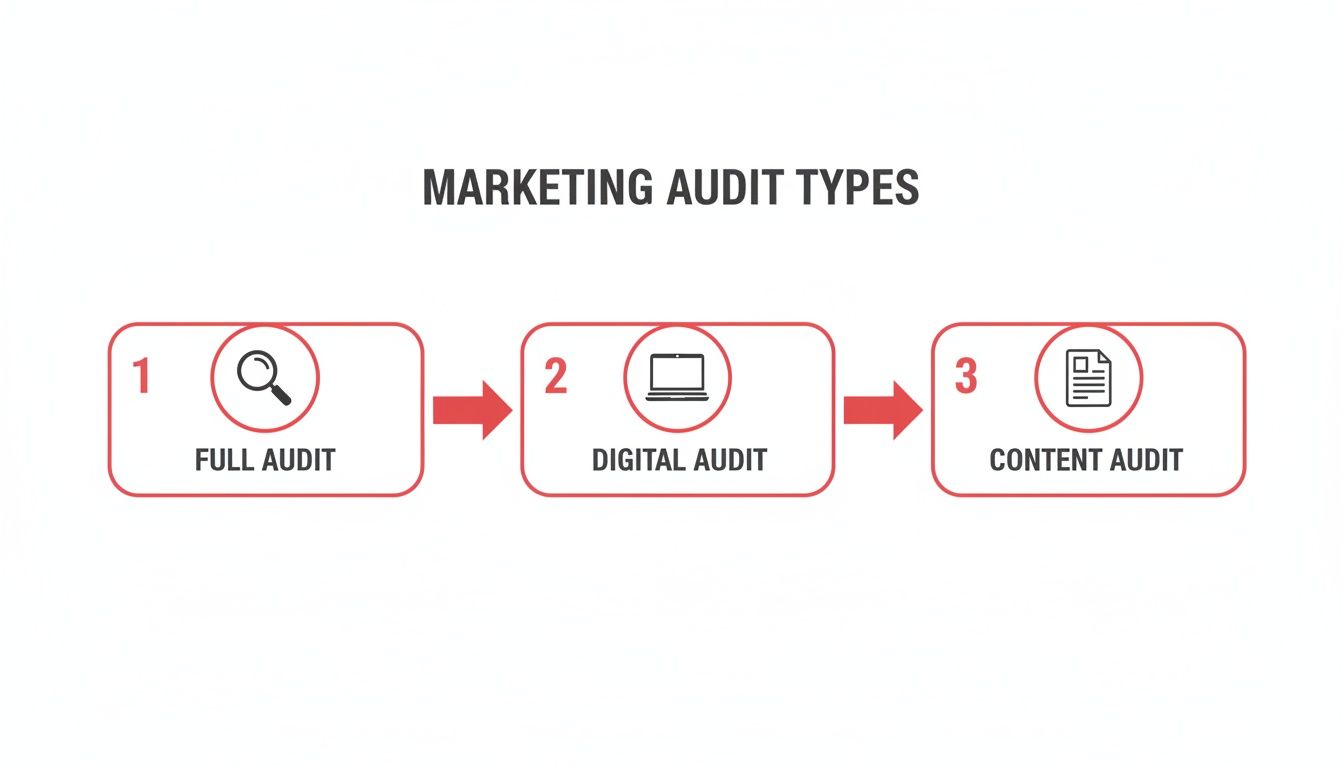
When you’re digging into each channel, ask targeted questions. For a more focused review, you might find a dedicated social media audit checklist invaluable. This kind of detailed resource can help you ask the right questions for specific platforms.
To help with this, we've put together a checklist covering the key digital channels. Use it to make sure you're asking the right questions and not missing any critical areas.
| Channel/Area | Key Audit Questions to Ask |
|---|---|
| Website & SEO | Is our site mobile friendly and fast? Are we ranking for the right keywords? Is the user journey clear and effective? Is our technical SEO in good shape? |
| Content Marketing | Does our content address our audience's pain points? Is it aligned with our brand voice? Are we generating leads from our content? Is it optimised for search? |
| Social Media | Are we on the right platforms for our audience? Is our engagement rate healthy? What type of content performs best? Are our profiles fully optimised? |
| Email Marketing | What are our open and click through rates? Are we segmenting our lists effectively? Is our messaging personalised and valuable? Is our list growing? |
| Paid Advertising (PPC/Social) | What is our return on ad spend (ROAS)? Are our ads targeting the right audience? Is our ad copy compelling? Are our landing pages converting? |
This checklist isn't exhaustive, but it provides a solid foundation for reviewing your digital footprint and identifying areas that need immediate attention.
Step 5: Turn Findings into an Action Plan
An audit is completely useless if it doesn't lead to change. The final—and most important—step is to transform your analysis into a clear, prioritised action plan. This is where you document your findings, draw conclusions, and outline the exact steps you’ll take to improve.
Your action plan needs to be more than a list of nice ideas; it must be a practical roadmap for getting things done.
- Summarise Key Findings: Start with a simple, jargon free summary of the most important insights. What were the biggest wins and the most glaring problems?
- Prioritise Recommendations: You can't fix everything at once. Prioritise your recommendations based on their potential impact and the effort required. A simple "impact vs effort" matrix works wonders here.
- Assign Ownership and Deadlines: For each action, assign a specific person or team to own it and set a realistic deadline. This creates accountability and ensures the plan actually moves forward.
- Define Success Metrics: How will you know if your changes are working? For each action, define the key performance indicators (KPIs) you'll use to measure success.
This final step closes the loop, turning your audit from a backward looking report into a forward looking strategy that will drive meaningful growth for your business.
Analysing the Metrics That Actually Matter

A marketing audit is only as good as the data you feed it. Without the right metrics, you’re just measuring noise, not results. The secret is to slice through the clutter of vanity metrics—like page views or social media followers—and get laser focused on the Key Performance Indicators (KPIs) that actually move the needle.
Think of it like a doctor checking your vital signs. They don't just count how many breaths you take; they measure blood pressure and heart rate—the numbers that reveal the true state of your health. Your audit needs to do the same, homing in on the data that tells a clear story about what’s driving revenue and customer loyalty.
It’s about moving past surface level stats and digging into the numbers that show how well your marketing engine is really running. It’s about connecting every single activity to a tangible business outcome.
Website and SEO Performance Metrics
Your website is usually the centre of your marketing universe, so its performance is completely non negotiable. Instead of simply tracking total visitors, a proper audit needs to examine how those visitors behave and whether they're taking the actions you want them to.
Here are the vital signs for your website and SEO health:
- Conversion Rate: This is the big one. It’s the percentage of visitors who complete a desired goal, whether that’s making a purchase or filling out a contact form.
- Organic Traffic: This shows you how many visitors are finding you through search engines. A steady increase is a strong signal that your SEO strategy is working and capturing people who are actively looking for solutions.
- Keyword Rankings: Keeping an eye on your position for target keywords tells you if you’re gaining visibility for the terms that matter most to your audience.
- Bounce Rate: A high bounce rate can be a red flag. It might mean your landing page isn’t relevant to what people were searching for, or that the user experience is letting you down.
These metrics give you a clear picture of whether your online presence is just attracting eyeballs or genuinely contributing to your bottom line. They are essential for measuring marketing effectiveness and making smart, data driven improvements.
Paid Advertising and Social Media KPIs
When it comes to paid campaigns and social media, the game is all about efficiency and engagement. It’s not just about how many people see your ads or posts, but what it costs to reach them and whether they’re interacting in a meaningful way.
An effective marketing audit doesn't just ask "How many?" It asks "How much did it cost, and what was the return?" This shift in perspective is what separates vanity metrics from profitable business intelligence.
A quick look at the UK digital marketing sector shows exactly why this matters. The UK social media advertising market is on track to hit £9.95 billion , but without proper audits, businesses are just burning cash. For example, average e-commerce click through rates on Google Search are a tiny 2.69% , and PPC conversion rates average a mere 0.9% across industries. These numbers prove why audits are so crucial for justifying spend and fixing underperforming channels.
Key metrics to watch for these channels include:
- Cost Per Acquisition (CPA): This tells you exactly how much you're spending to win one new customer from a specific campaign. No fluff, just the hard cost.
- Return On Ad Spend (ROAS): A critical KPI for any paid media. It calculates the revenue you generate for every single pound you spend on advertising.
- Engagement Rate (Social Media): This measures likes, shares, and comments as a percentage of your audience, showing how well your content is actually connecting with people.
- Referral Traffic (Social Media): This tracks how many visitors click through from your social profiles to your website, directly linking your social activity to site performance.
By focusing on these metrics, your audit moves beyond simple observation and into strategic analysis, giving you the power to make decisions that truly drive results.
When to Partner with a Marketing Agency for Your Audit
Doing your own marketing audit is a brilliant first step. It gives you a feel for what’s going on and often highlights a few quick wins you can tackle right away. But let's be honest, there’s a ceiling to what an internal review can achieve.
Your in house team, no matter how talented, is just too close to the action. They live and breathe these campaigns every day, which makes it incredibly difficult to step back and see the entire picture with fresh eyes.
This is exactly where bringing in a marketing agency can be a total game changer. An external partner walks in without any of the baggage. They bring a fresh, unbiased perspective that’s impossible for your own team to replicate. They aren't attached to past decisions or tangled in internal politics, so they can give you a brutally honest take on what’s working and, more importantly, what isn’t.
That outside viewpoint is gold for digging up those deep rooted issues or the "we've always done it this way" habits that are secretly holding back your growth.
Access to Specialised Expertise and Tools
It’s not just about objectivity. Agencies bring a serious arsenal of specialised knowledge to the table. Their teams are usually made up of dedicated experts in specific channels like SEO, PPC, or content strategy. This means you’re getting a level of analysis far deeper than any one generalist marketer could ever hope to provide.
On top of that, leading agencies invest a small fortune in advanced analytical tools—the kind that are just too expensive for a single company to justify. These platforms can uncover competitor strategies, technical SEO nightmares, and market trends that free tools would sail right past, giving you a huge strategic advantage.
The real value of an agency isn't just that they run the audit for you. It’s that they interpret the data through the lens of deep industry experience. They can benchmark your performance against hundreds of other businesses, giving you a level of context you simply can't get on your own.
The Agency Audit Process Explained
When you get an agency on board for an audit, it’s a structured, collaborative effort. It almost always kicks off with an initial consultation where you’ll hash out your business goals, your current headaches, and what you desperately need this audit to answer.
From there, the agency goes deep, running their analysis while keeping you in the loop at key milestones. The whole process wraps up with a comprehensive report that does more than just throw data at you—it tells a story. The final document will outline the key findings, deliver strategic recommendations, and give you a prioritised action plan designed for maximum impact.
This detailed roadmap is what gives you the clarity to make confident, data backed decisions. If you're thinking this is the right path, understanding how to choose a digital marketing agency that gets your goals is the critical first step. It’s the difference between a good audit and a truly transformative one for your business.
Your Most Common Marketing Audit Questions, Answered
Even with a clear roadmap, a few practical questions always pop up when it's time to get down to business. Let's tackle the common queries we hear all the time. Getting these sorted will help you move forward with confidence, a clear plan, and the right expectations.
Answering these questions helps to pull back the curtain on the whole process. It turns what feels like a huge, complicated job into something manageable and seriously valuable for your business.
How Often Should I Run a Marketing Audit?
For most businesses, we recommend a full, top to bottom marketing audit once a year . It’s the perfect way to set a solid benchmark before you dive into yearly planning and strategy sessions. But let’s be real – the marketing world moves at lightning speed, so waiting a full 12 months isn’t always going to cut it.
That’s why more focused, mini audits should be on a much shorter schedule. A quarterly or biannual review of your SEO performance or paid ad campaigns is a smart move. The right frequency really comes down to how fast your industry moves and how quickly your company is growing.
And one non negotiable rule: if you see a sudden, unexplained drop in performance, that’s your cue to trigger an immediate audit, no matter what the calendar says.
What Are the Most Common Mistakes to Avoid?
The single biggest mistake we see? A complete lack of objectivity . This almost always happens when an internal team is just too close to the work to be truly critical. It’s only human to defend past decisions and projects you've poured hours into, but a proper audit needs an honest, unbiased assessment to work.
Other common pitfalls include:
- Chasing vanity metrics like social media followers instead of focusing on what actually matters to the business, like customer acquisition cost.
- Forgetting about competitor analysis , which leaves your findings floating in a vacuum without any real world context.
- Producing a final report with no clear, actionable next steps . This is how an audit becomes a fancy document that just gathers digital dust.
A good audit isn't just a report card; it’s a detailed plan for what to do next.
Can I Just Do a Marketing Audit Myself?
Absolutely. Running a DIY audit using the frameworks we’ve laid out is a fantastic exercise. It’s a great way for your team to get a much deeper understanding of what’s working, what isn’t, and where the low hanging fruit is.
But there are serious advantages to bringing in an agency. An external partner gives you a completely unbiased perspective. They also bring premium analytical tools you might not have access to, and a wealth of experience from working across countless different industries. An agency can often spot the big strategic opportunities and hidden inefficiencies that are just too easy for an internal team to miss.
Ready to uncover the hidden potential in your marketing with an expert, objective eye? The team at Superhub specialises in conducting thorough marketing audits that deliver a clear, actionable roadmap for growth. Get in touch with us today to see how we can help you turn insights into results.
Want This Done For You?
SuperHub helps UK brands with video, content, SEO and marketing that actually drives revenue. No vanity metrics. No bullsh*t.