

What Is a Brand Audit and Why It Matters
A brand audit can feel a lot like an MOT for your business. It runs checks across your identity, messaging, customer perception, competitive positioning and digital presence. The outcome is a clear brand health score that flags where you’re excelling and where you need attention.
Brand Audit Explained
Imagine a UK retailer realising its logo looked stuck in the past while its tone still struck a chord with shoppers. That insight alone steered them straight into a visual refresh without overhauling their copy.
A quick audit gives leaders an honest snapshot—highlighting straightforward fixes like sprucing up design assets, as well as deeper wins such as sharpening the way you speak to your audience or ramping up online engagement.

- Identity : How your logo, colours and style combine to express your brand’s personality.
- Messaging : Whether your tone and wording truly connect with your target audience.
- Customer Perception : What people actually think and say about your brand, both on and offline.
- Competitive Positioning : How you stack up against rivals in your market.
- Digital Presence : The health of your website, social channels and SEO performance.
Key Aspects Of A Brand Audit At A Glance
Before you dive in, here’s a quick reference to the five core elements of a brand audit:
| Component | Purpose |
|---|---|
| Identity | Evaluate visual consistency and brand personality |
| Messaging | Check coherence of tone and key messages |
| Customer Perception | Gauge public sentiment and brand reputation |
| Competitive Positioning | Identify market gaps and areas to stand out |
| Digital Presence | Assess online visibility, engagement and technical health |
With this overview in hand, you can move quickly from insight to action—setting clear goals and plotting your next steps.
80% of businesses report clearer strategy and improved ROI within six months of completing a brand audit.
If you want to understand how this fits into a broader strategy, take a look at our Complete Guide to Brand Positioning. It shows how a solid positioning foundation can amplify the impact of your audit discoveries.
Understanding The Purpose And Benefits Of A Brand Audit
Picture this: you’re at the helm of a ship, seas choppy and a thick mist all around. Without a clear view, every move feels like a gamble. A brand audit cuts through that haze, acting as your sonar for brand health. It brings your identity, messaging and market position into sharp relief.
By digging into brand identity , messaging threads and the way customers perceive you, audits uncover both hidden potential and problem areas. This isn’t guesswork—it’s about fine-tuning strategy based on real data. Suddenly, you’re not leaping in the dark; you’re making decisions with purpose.
Audits do more than reveal weak spots. They highlight what’s resonating. Teams can then channel resources into campaigns that land rather than scatter efforts across every opportunity. Over time, this becomes a living roadmap—tracking improvements, reallocating budgets and pinpointing where to double down.
Moreover, audits test alignment between what you promise and what customers experience. That clarity forges stronger internal buy-in and keeps everyone rowing in the same direction.
“An audit turns hunches into hard facts, so you’re steering with evidence instead of instinct.”
How Audits Expose Hidden Strengths
Think of a brand audit as a jeweller inspecting a raw gemstone. A quick look might reveal a dull rock, but under the right light, hidden facets begin to gleam.
For instance, you might find that a certain colour palette or logo style connects deeply with millennials. Rather than rebranding entirely, you can refine visuals to amplify that appeal. Or perhaps a few choice phrases in your copy are driving engagement on social channels—yet your broader tone feels off. Surveys and social listening then fill in the picture of what fans love and where you’re missing the mark.
An audit can:
- Pinpoint standout design cues that boost recall
- Reveal language gaps that dilute your message
- Ensure tone and style match your audience’s expectations
Driving Better Resource Allocation
Next, audits help you decide where each pound is best spent. By measuring channel performance, you can spot high-return tactics and cut back on underperformers. Loyalty programmes, community forums or niche influencers might suddenly outrank costly ad campaigns.
A simple three-step process works well:
- Assess each channel’s ROI
- Prioritise actions based on cost-benefit analysis
- Shift budgets towards top performers
A case in point: one retail startup moved 30% of its ad budget into social engagement after audit findings showed repeat purchases were undervalued, doubling its referral rate in just three months.
By making data-driven budget moves, you plug leaks and pour energy into initiatives that actually build brand equity.
Steering Clear Of Costly Missteps
Clear, transparent audit insights also streamline stakeholder conversations. When everyone sees the same metrics, you avoid endless debates and misaligned priorities.
In practice, regular audits become your brand’s navigation system. They keep you agile—spotting emerging trends and fine-tuning campaigns before small issues snowball. Consider how Lush UK achieved a 15% sales uplift once they highlighted ethical supply chain transparency that resonated with 55% of shoppers who care about ethics.
In the UK, brand audits are fundamental for mapping growth and value. Kantar BrandZ’s 2025 report found the top 75 UK brands reached a collective $242 billion , an 8% rise after years of stagnation. Discover more insights on Kantar.com.
In sum, whether you run audits annually or post campaign, a calendar reminder ensures they never slip off your radar. Done right, they’re more than an occasional check up—they become your ongoing guide to informed, confident decision making.
Embrace the brand audit and sail forward with clarity.
Exploring Core Components Of A Brand Audit
A brand audit breaks down your identity, messaging, customer perception, competitive stance and digital footprint into five clear segments. It’s like taking your car to a mechanic—every part gets inspected to keep you running smoothly.
By examining each pillar, you avoid surprises and build a roadmap for smarter decisions.
Why Five Pillars Matter
Each pillar shines a light on a different corner of your brand. When you connect the dots, you get a full and honest picture.
- Identity shows how you present yourself
- Messaging defines what you say and how you say it
- Customer Perception captures genuine feelings
- Competition points to where you can pull ahead
- Digital Presence confirms your visibility online
Brand Identity As Personality
Think of your logo, colour palette and typography as your brand’s wardrobe. When those elements clash, people notice—and not in a good way.
Start by:
- Hosting logo critique sessions with key stakeholders
- Running style guide audits to spot inconsistencies
- Creating visual mood boards for fresh palette ideas
That foundation ensures everything you say and do feels coherent.
Messaging As Tone Of Voice
Your messaging is the tone you use when speaking to an audience. A friendly fintech app, for instance, needs warm, confident copy that feels human.
Consider how a telecom firm swapped jargon for plain English and cut support calls by 20% . For more on this, check out tone of voice as a revenue tool.
You can align your team with:
- Tone workshops to agree on language
- A/B copy testing to find the right phrasing
- Voice charts mapping tone, style and key phrases
“Consistency in messaging wins trust faster than any flashy campaign.”
Customer Perception As Mood Metre
Measuring sentiment is like reading the room at a party. You need to know if people feel positive, ambivalent or downright annoyed.
In the UK, you might tap into YouGov BrandIndex’s research, which surveys over 3 million Britons on 13 key metrics like Aided Awareness and Purchase Intent. See the brand movers analysis on YouGov.
Beyond surveys:
- Track Aided Awareness to test recall
- Measure Word of Mouth for organic buzz
- Monitor Customer Loyalty for repeat business
Social listening in forums and reviews often uncovers unfiltered insights.
Competitive Analysis As Rival Tracking
Imagine lining up your brand beside your rivals on a race track. Who’s pulling ahead? Who’s stalling?
Start by listing direct and emerging competitors. Then use:
- SWOT breakdowns for each rival
- Share of voice checks on social platforms
- Competitive matrices to compare product features
Keep an eye on keyword gaps and sign up for rival newsletters to spot shifts in their messaging.
Benchmarking against peers keeps your strategy sharp and on track.
Digital Presence As Public Performance
Your website and social channels are the stages where your brand performs live. If your site crawls, you lose an audience before the show even starts.
Check:
- Page load times under 3 seconds
- Mobile usability scores above 80%
- SEO ranking for your branded keywords
Also audit alt text, meta descriptions and accessibility features. Then review social:
- Engagement rates per post
- Referral traffic back to key pages
- Your visibility in industry conversations
Tools like Google PageSpeed Insights and popular social listening platforms reveal where you can improve.
Running these checks in a logical sequence—visuals first, then copy, customer sentiment and rival analysis—ensures nothing slips through the cracks.
Case Study Snapshot
Local Café Co ran through the five pillars and uncovered a clear opportunity: their friendly tone outshone outdated packaging. Here’s what happened next:
- Logo simplified to match web style
- Messaging refocused on neighbourhood events
- Website UX tweaks lifted mobile orders by 18%
A clear audit roadmap turns insight into action.
By reviewing identity, messaging, perception, competition and digital presence, you set the stage for deeper metric analysis and a structured audit plan.
Quick Tips For Your Audit
- Run an identity workshop annually to align your visual and verbal assets
- Hold tone of voice sessions quarterly with cross department teams
- Schedule sentiment polls after major campaigns to spot shifts
- Compare competitor metrics monthly
- Automate digital health checks weekly
- Celebrate every small win after each audit phase
Stay audit ready and you’ll keep your brand sharp at every turn.
Establishing Metrics And Framework For A Brand Audit
Embarking on a brand audit is like stepping into a detective novel—every clue counts. You start by setting clear objectives, then dive into data gathering, analysis and finally reporting.
Discovery lays the groundwork by defining the scope and rallying stakeholders. From there, Data Collection uncovers insights in internal records, customer surveys and market research.
The following infographic visualises the three core pillars that underpin a brand audit process.
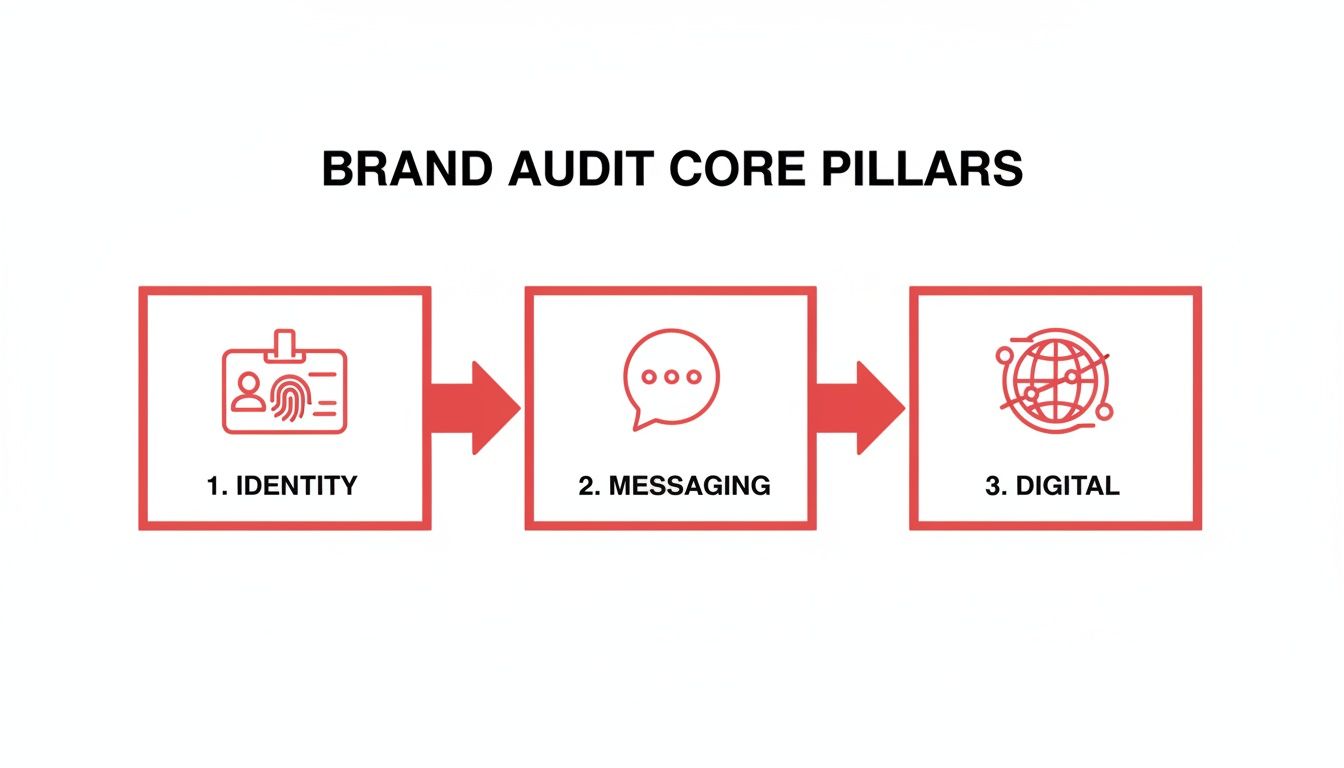
Those three pillars— Identity , Messaging and Digital —form the backbone of every comprehensive audit.
Investigative Steps In A Brand Audit
Each phase zeroes in on a critical question. Discovery asks, “What are we trying to achieve?” Data Collection blends quantitative surveys with qualitative feedback , from focus groups to one on one interviews.
Analysis then pieces the story together by benchmarking performance. Finally, Reporting delivers a clear narrative and practical recommendations.
- Discovery : Define objectives and assemble your audit team
- Data Collection : Capture performance metrics and customer insights
- Analysis : Spot gaps in awareness, sentiment and engagement
- Reporting : Present findings with actionable next steps
Setting Benchmarks And Gathering Clues
You can’t interpret numbers without context. Pull in data from past campaigns, industry reports and competitor snapshots to set meaningful benchmarks.
Key metrics include brand awareness , sentiment , engagement rates and purchase intent —plus digital health via website analytics and social media KPIs .
For perspective, the top 250 brands saw a 3% dip in value to £399.9 billion in 2025, according to Brandirectory. YouGov BrandIndex’s September 2025 survey of 1,700+ brands and 3+ million Britons used 13 metrics to track shifts in Awareness, Buzz, Consideration and Purchase Intent. Meanwhile, Mintel’s UK Social Media Report highlights how customer service interactions online drive sentiment audits.
Discover more about these trends on Bemysocial.com.
Brand Audit Framework Checklist
Before you dive in, make sure every phase and metric is covered. The table below outlines the core steps you’ll follow from start to finish.
| Step | Description |
|---|---|
| Discovery | Set clear audit objectives and define the scope |
| Collection | Gather internal data, customer feedback and market research |
| Analysis | Compare performance against benchmarks and identify gaps |
| Reporting | Compile insights into an actionable report for stakeholders |
Use this checklist as your blueprint. It keeps each phase visible, on track and aligned with your goals.
Ensuring No Metric Is Missed
A simple checklist prevents overlooked details and keeps the audit on schedule.
- Secure stakeholder alignment on goals
- Collect data on Identity , Messaging and Digital Presence
- Benchmark results against past performance and industry standards
- Synthesize insights and draft actionable recommendations
- Review with teams and formalise the action plan
A local café that followed this framework spotted a dip in social engagement. After refining their messaging, they enjoyed an 18% lift in mobile orders within a month.
Applying this checklist helped Local Café Co boost mobile orders by 18% within a month.
To keep your audit fresh, schedule reviews at least twice a year. Alternate between surveys, focus groups and digital dashboards for balanced insights. Share results across departments to foster collaboration and accountability.
Treat this process as a living document—update benchmarks, refine metrics and repeat. Your brand audit will quickly evolve from a one off exercise into a continuous improvement engine.
Start your audit today and turn data into your roadmap for growth.
Interpreting Sample Findings And Choosing Next Steps
A sample audit report often feels like a cockpit full of dials. Yet, if you approach it with a clear framework, the most critical insights jump right off the page.
Take Acme Co. for instance. Their audit revealed a 20% drop in brand recall among core customers. On top of that, sentiment analysis uncovered a 15-point gap between what the brand promises and how people actually feel.
Reading Audit Dashboards
- Brand Recall
Tracks how often customers remember your brand after minimal exposure. - Sentiment Score
Combines positive, neutral and negative mentions into one figure. - Engagement Rate
Measures interactions for each post, email or campaign. - Funnel Drop Off
Pinpoints exactly where prospects abandon their journey.
These metrics answer the fundamental question of what a brand audit is: a health check that steers your strategy.
Deciding On Next Steps
- Refine messaging when the sentiment gap exceeds 10 points .
- Adjust positioning if competitor benchmarks show a 15% lead in share of voice.
- Seek external support for in depth technical or creative audits when internal expertise is stretched.
Next, weigh the pros and cons of a DIY audit versus partnering with an agency. Below is a quick comparison:
| Aspect | DIY Audit | Agency Partnership |
|---|---|---|
| Cost | Lower direct spend | Higher investment |
| Expertise | Limited to internal skills | Access to specialised teams |
| Speed | Flexible scheduling, slower | Faster delivery with proven processes |
| Tools | Basic or free options | Advanced paid platforms |
| Objectivity | Potential bias | Neutral third-party perspective |
An agency audit can accelerate insights and reduce blind spots. On the other hand, a DIY approach keeps costs down but may overlook deeper nuances.
“An audit only pays dividends when you act on its findings, not when it sits on a shelf.”
Prioritising Your Actions
Map each task by impact and effort:
- High Impact, Low Effort
Quick wins such as headline tweaks or social response templates. - High Impact, High Effort
A large scale identity refresh or website overhaul. - Low Impact, Low Effort
Minor style guide adjustments. - Low Impact, High Effort
A complete rebrand without a clear ROI.
A simple 2x2 matrix helps you focus on quick wins first and build momentum. After making initial changes, schedule follow up checks within 30 days to measure progress:
- Brand recall improvements
- Sentiment score shifts
- Engagement rate changes
Allocating Budget And Team Resources
Once priorities are clear, assign owners and set budgets with weekly check ins:
- Form a small cross functional team to rapid test messaging tweaks.
- Reserve up to 10% of the marketing budget for pilot campaigns before scaling.
This approach turns the theory of what a brand audit is into ongoing growth in practice.
Example Case Study
Local Bakery Ltd ran the decision tree and chose to refine its messaging first. Within four weeks, they enjoyed a 12% uplift in social engagement and a 7% rise in footfall.
These early wins prove the value of rapid iteration. By tackling high impact tasks first, teams gain confidence for more ambitious work down the line.
In summary, interpreting sample findings and choosing next steps comes down to clear metrics, structured decision paths and honest resource assessment. Whether you DIY or partner with an agency, acting on what a brand audit reveals is the cornerstone of sustained brand health.
Check out our guide on when to reinvent your identity to decide between a refresh and a full overhaul.
Reviewing Sector Examples And Practical Templates

Sector-specific case studies bring the theory of a brand audit into sharp focus. Here, we’ve gathered three snapshots—retail, fintech and hospitality—that map objectives to real outcomes.
- Retail honed its in store journey with customer surveys, driving a 12% lift in footfall.
- Fintech refined digital copy via A/B tests, resulting in an 18% uptick in new sign ups.
- Hospitality reviewed guest feedback streams to update service scripts, boosting review scores by 1.2 star.
Each example underlines how audit findings are tailored for its market.
Retail Sector Example
A high street retailer wanted to make every shop visit count. They rolled out customer sentiment surveys alongside mystery shopper visits to spot friction points.
Their audit uncovered inconsistent signage and variable staff approaches. By aligning visual cues and training teams on a simple welcome script, they saw:
- Objective: Improve footfall and dwell time
- Method: Blend survey feedback with mystery shopper insights
- Outcome: 8% growth in average basket value
This hands on approach shows the power of in person brand checks.
Fintech Sector Example
A challenger bank needed to polish its tone of voice across emails and chatbots. They ran A/B tests on subject lines and support scripts, while mapping each step of the user onboarding flow.
Mapping revealed key drop off moments at sign up prompts. Armed with that clarity, they:
- Collected and tagged conversation logs
- Tested copy variations on live user groups
- Measured sign up rates in real time
“Adding warmth and clarity increased trust,” noted the bank’s CMO.
After six weeks, new accounts rose by 18% —proof that small tweaks in language can drive big results.
Hospitality Sector Example
A boutique hotel chain sifted through TripAdvisor reviews and social mentions over four months. They charted ratings, common complaints and standout praises.
The audit highlighted a gap between advertised features and guest reality. To bridge it, they:
- Introduced a tailored welcome pack and walked staff through a refreshed greeting script
- Updated the website gallery to showcase true room layouts
- Outcome: 1.2 star lift in average review score and 14% rise in repeat bookings
This case underlines how feedback driven tweaks can elevate guest satisfaction.
Practical Templates For Your Audit
Download these templates to kickstart your brand audit process:
- Brand Audit Scorecard
Fields for identity, messaging and digital health, complete with scoring rubrics. - Stakeholder Interview Guide
Structured questions to extract candid insights from internal and external voices. - Social Media Sentiment Tracker
Logs reach, tone and engagement, with categories aligned to sector priorities.
Each template comes with usage notes. You can customise the scorecard to include shelf layout for retail, adapt the interview guide to probe fintech compliance or extend the sentiment tracker to flag hospitality themes like cleanliness and staff friendliness.
These resources speed up data capture and ensure consistency across teams.
Adapting Templates To Your Context
Pick the template that matches your immediate priorities and tweak it:
- Retail: Track visual consistency across signage, packaging and in store displays.
- Fintech: Focus interview guides on tone accuracy, regulatory clarity and support readiness.
- Hospitality: Extend sentiment tracking to breakfast quality, check in smoothness and room comfort.
Effective adaptation means you capture insights that truly reflect your business.
With these sector examples and practical tools in hand, you can launch a DIY audit or arm your agency partner with everything they need. Download the templates now and start measuring your brand’s health today.
A sector-informed audit lays the groundwork for sustained brand growth.
Common Questions About Brand Audits
Ever wondered what a brand audit really involves, or how to plan one without losing your mind? You’re not alone. Below, I answer the top queries I hear from business leaders.
How often should you audit your brand? At minimum, once a year. That gives you enough runway to spot emerging trends before they become issues. In fast-paced industries, I recommend a six month check in—a quick reality check to keep your brand agile.
- Annual Full Brand Audit paired with a mid cycle mini review for maximum responsiveness
- DIY Audits starting from £2,000 , perfect if you’ve got capable in house teams
- Agency Audits from £10,000–£30,000 , delivering deep analytics and tailored recommendations
- Cross functional input from marketing, sales, customer service and finance
- ROI tracked through awareness scores, sentiment metrics and revenue uplift
To put those figures side by side:
| Audit Type | Typical Cost |
|---|---|
| DIY | £2,000–£5,000 |
| Agency | £10,000–£30,000 |
Bringing the right people together from each department is crucial. Here’s how to structure your stakeholder team:
Involving Stakeholders
- Marketing: hone messaging and visual identity
- Sales: stress test your pitch and positioning
- Customer Service: capture real time sentiment and feedback
- Finance: link audit actions directly to revenue impact
With this mix, your audit findings will reflect the full organisational picture and secure buy-in across the board.
Measuring Brand Audit ROI
An audit is only as valuable as the actions it inspires. My rule of thumb? Assign financial values to shifts in awareness, sentiment and sales, then subtract your audit investment.
Consider this example: a 15% boost in social engagement plus a 5% lift in sales. When you run the numbers, you’ll see exactly how quickly your audit pays for itself.
“An audit only pays dividends when actions follow the findings”
These answers should give you the confidence to map out your next brand audit. Set clear objectives, nail down your budget and assemble the right team. Then pop a reminder in your calendar and monitor progress against your KPIs. Before long, auditing becomes a strategic habit—not just a one off task.
At Superhub , we guide you through every stage of your brand audit journey to deliver measurable growth. Start your audit today at Superhub
Want This Done For You?
SuperHub helps UK brands with video, content, SEO and marketing that actually drives revenue. No vanity metrics. No bullsh*t.