

How to develop a brand strategy: a practical guide
Crafting a brand strategy is not just about picking colours and a cool name. It is the entire process of defining who you are, what you stand for, who you are talking to, and how you want to be seen. Think of it as a journey that starts deep inside your business—your internal discovery —and works its way out into the world as your external expression. Get this right, and every decision you make, every piece of content you create, will feel authentic and consistent.
Defining Your Brand's Authentic Core

Before you even think about logos or marketing campaigns, you have to look inward. A powerful brand is not built on a clever tagline; it is built on the genuine, unshakeable foundation of what your business is all about.
This first phase is more like an archaeological dig than a construction project. You are uncovering the real purpose, vision, and values that already drive your organisation. Nailing this is non-negotiable because it ensures everything that follows will resonate with your team and, most importantly, your customers.
Articulating Your Purpose and Vision
Your brand’s purpose is its "why". It is the reason you exist beyond turning a profit. For a local bakery, the purpose might be "to create moments of joy through handcrafted goods," not just "to sell cakes." This is the stuff that inspires people.
Your vision , on the other hand, is the "where". It is a picture of the future you are trying to build. It needs to be ambitious and give everyone a clear direction. A sustainable fashion brand's vision could be "a world where style and ethical production are inseparable."
A clear purpose gives your brand meaning, while a compelling vision gives it direction. Together, they are the north star for your entire strategy.
Establishing Core Brand Values
Your values are the non-negotiable principles guiding how your company acts. They are the promises you make every day. But please, steer clear of generic words like "integrity" or "quality". Be more specific and make them actionable.
Here is what I mean:
- Instead of "Innovation," try "Always Curious." This paints a picture of a team committed to constant learning and trying new things.
- Instead of "Customer Focus," try "Empathetic Partnership." This suggests a much deeper, more collaborative relationship with your clients.
Defining values like these helps shape your company culture and the stories you tell. You can learn more about how these core elements fuel effective brand storytelling and build customer loyalty.
Why a Defined Core is a Strategic Must
Wing it with your marketing, and you will get disjointed, ineffective results. The data shows a massive gap here: a staggering 42% of UK organisations with some form of digital marketing have no clearly defined strategy at all.
Contrast that with the most successful brands. They know exactly what they are aiming for. 54% focus on increasing sales revenue , and 42% prioritise brand awareness . This is not just a philosophical exercise; a well-defined core is a commercial necessity that directly impacts your growth and place in the market.
Uncovering Your Audience and Market Landscape

Once you have nailed down your authentic core, it is time to turn your focus outwards. A powerful brand strategy is not built on what you think your customers want; it is built on a genuine understanding of who they are and the world they live in. This is the part where we trade guesswork for real-world insight.
The mission here is twofold: get to know the people you want to serve on a deeper level and figure out exactly where you fit in the competitive arena. Get this right, and you will find that sweet spot where your audience’s needs perfectly align with your unique strengths.
Moving Beyond Basic Demographics
Knowing your audience’s age and location is a fine start, but it is just scratching the surface. To forge a real connection, you have to dig into their psychographics—what makes them tick, their motivations, their biggest headaches, and their dreams. This is how you unearth the real problems they need you to solve.
Take a company selling high-performance car parts. Basic demographics might show their audience is men aged 25-50 . But psychographic research could reveal two very different tribes: the DIY enthusiast who obsesses over technical specs and wants to get his hands dirty, and the "show and shine" owner who cares more about aesthetics and the prestige of the brand.
These two people are driven by completely different things. You cannot talk to both effectively with the same message. Gaining this deeper understanding is the first real step in developing a brand strategy that actually works.
Building Actionable Customer Personas
The best way to pull all this research together is by creating detailed customer personas . A persona is a semi-fictional character, grounded in real data, that represents your ideal customer. It is not just a profile; it is a tool that helps your entire team empathise with your audience and make decisions on their behalf.
A solid persona should feel like a real person and include:
- Background: Their job, career path, and maybe even a bit about their family life.
- Goals: What are they trying to achieve, both in their career and personally?
- Pain Points: What frustrations and challenges are getting in their way?
- Motivations: What really drives their buying decisions? Is it price, quality, status, or pure convenience?
- Watering Holes: Where do they hang out, online and off? Think specific forums, social media channels, or industry events.
Give your ideal customer a name and a backstory, and they suddenly become real. From that point on, every marketing decision gets filtered through a simple question: "What would Sarah think of this?"
Conducting Insightful Competitor Analysis
Understanding your audience is one half of the puzzle; the other is understanding the competition. The goal here is not to copy what everyone else is doing. It is about spotting their strengths, weaknesses, and—most importantly—the gaps in the market that your brand can fill like no one else.
A thorough competitor analysis illuminates opportunities. It shows you where the market is saturated and, more excitingly, where there is an open road for you to dominate.
Start by listing your direct and indirect competitors. Direct competitors offer a similar product or service (think another local cinema). Indirect competitors solve the same problem with a different solution (like Netflix versus that same local cinema).
Once you know who they are, put them under the microscope:
- Brand Messaging: What story are they telling? What is their tone of voice?
- Market Positioning: Who are they targeting, and what unique value do they claim to offer?
- Visual Identity: How do they look? What does their logo, colour scheme, and overall design say about them?
- Customer Reviews: What do people love and, more importantly, hate about them? This is a goldmine for finding unmet needs.
This analysis gives you the context you need to position your own brand. By seeing the existing landscape clearly, you can strategically carve out a distinctive space where your brand can thrive and become the obvious choice for your ideal customer.
Crafting Your Brand Positioning and Message
Now that you have done the groundwork and have a solid grasp of your brand’s core and your market, it is time to shape that insight into a clear, powerful identity. This part is all about carving out a specific, meaningful space in your customer's mind. We call this brand positioning .
This is not just about what you sell; it is about what you stand for. Your position is the unique value you bring to the table that nobody else can. Get this right, and all your messaging will flow from it, creating a consistent and compelling story that connects with people everywhere you show up.
Defining Your Brand Positioning Statement
First up, the brand positioning statement. This is a concise, internal-only document—not a public tagline you splash on a billboard. Think of it as a strategic guide that spells out your unique value for a specific audience. It is the North Star for all your marketing and branding, making sure everyone on your team is pulling in the same direction.
A simple but surprisingly effective framework to get you started is:
- For [Your Target Audience]
- Who [Have This Specific Need or Problem]
- Our [Brand Name] Is The [Market Category]
- That Provides [This Key Benefit]
- Unlike [Your Main Competitor(s)]
- We [Your Unique Differentiator]
Let us imagine a company making sustainable cleaning products. Their statement might look something like this: "For environmentally conscious families who want to reduce household chemicals, our brand is the home care solution that provides powerful, plant-based cleaning. Unlike traditional brands that rely on harsh synthetics, we offer refillable packaging to eliminate single-use plastic waste."
See how clear that is? It immediately sets the direction for everything that follows.
Developing Your Key Messaging Pillars
With your positioning nailed down, the next step is to build out your messaging pillars . These are the three to five core themes that consistently broadcast your brand’s value. Think of them as the main chapters in your brand's story.
These pillars are not just a list of product features; they are the foundational ideas that hold up your positioning statement. For our eco-friendly cleaning brand, the pillars could be:
- Uncompromising Efficacy: Our products work just as well as, or even better than, the leading chemical-based alternatives.
- Planet-Positive Living: We are committed to sustainable sourcing, ethical production, and plastic-free packaging.
- A Healthy Home: Our formulas are non-toxic, safe for families and pets, and transparently labelled.
You would then weave these themes into your website copy, your social media posts, your email campaigns—everything. This repetition is what builds recognition and reinforces exactly what your brand stands for.
Brand positioning is your promise. Messaging pillars are how you prove you can keep it, time and time again.
Finding Your Brand Voice and Tone
So you have sorted out 'what' you are saying (your positioning) and 'why' it matters (your pillars). The final piece of the puzzle is 'how' you say it. This is your brand’s voice and tone.
- Voice is your brand's unique personality. Is it authoritative and serious, or witty and playful? Maybe it is empathetic or even a bit rebellious. Whatever it is, your voice needs to be consistent and a true reflection of your core values.
- Tone is the emotional inflection of that voice, which cleverly adapts to different situations. For example, you would use a different tone when announcing a new product (excitable, celebratory) compared to handling a customer complaint (reassuring, helpful).
Defining these elements is absolutely crucial. A well-defined voice makes your brand memorable and relatable, turning everyday communications into opportunities to build a genuine connection. It is a real business driver, too. As many companies are realising, their tone of voice isn't fluff, it’s a revenue tool that builds trust and long-term loyalty.
To truly connect with your audience, you need to go beyond just the message itself. This is where you can leverage the power of brand storytelling to weave your pillars and voice into a narrative that sticks. This transforms a simple message into an experience, making your brand not just seen, but felt. And that is how you move from being just another choice to being the choice.
Your messaging framework brings all these verbal identity elements together into one cohesive system. It is the blueprint for how your brand communicates consistently and effectively across all platforms.
Key Elements of a Brand Messaging Framework
A summary of the essential components required to build a consistent and effective brand voice and messaging strategy.
| Element | Description | Example Application |
|---|---|---|
| Positioning Statement | An internal-facing statement defining your target audience, category, key benefit, and unique differentiator. | Guides all marketing decisions to ensure they align with the core brand strategy. |
| Messaging Pillars | 3-5 core themes that consistently communicate your brand’s value across all content. | A pillar like "Effortless Innovation" would inform website copy, ad campaigns, and product descriptions. |
| Brand Voice | The consistent personality of your brand (e.g., witty, authoritative, empathetic). | A witty voice would use humour and clever wordplay in social media posts and blog articles. |
| Tone of Voice | The emotional inflection of your voice, adapted for different contexts (e.g., celebratory, reassuring). | A reassuring tone would be used in customer support emails and FAQ pages. |
| Brand Story | The compelling narrative that connects your purpose, mission, and values with your audience. | Shared on the "About Us" page, in brand videos, and through founder stories to build an emotional connection. |
With these components in place, you create a powerful and unified brand message that not only captures attention but also builds lasting relationships with your customers.
Building a Cohesive Visual Identity
Your visual identity is the sensory handshake your brand offers the world. Long before someone reads your mission statement or messaging pillars, they will see your logo, your colours, and your choice of fonts. It is an instant communication of your personality and professionalism, and it plays a massive role in how people perceive your value.
This is not about chasing the latest design trends. It is about translating the core strategy you have meticulously built—your purpose, values, and positioning—into a tangible, visual language. A cohesive visual system ensures that every touchpoint, from your website to your business cards, tells the same authentic story.
The Cornerstones of Visual Branding
Creating a memorable visual identity means orchestrating several key elements so they work in harmony. Each component should be a deliberate choice that reinforces your brand’s personality and speaks directly to your target audience. Think of it as building a house; every brick, colour, and texture contributes to the final impression.
The three undisputed cornerstones are:
- Logo Design: This is your brand's most recognisable mark. It has to be distinctive, scalable, and a true reflection of your core identity.
- Colour Palette: Colours evoke emotion and meaning. A well-chosen palette can instantly set the tone for your brand, often on a subconscious level.
- Typography: The fonts you use say a lot about your brand. Are you modern and minimalist, or traditional and trustworthy?
These elements are the foundation. Get them right, and every other visual asset you create will have a solid base to build upon.
Decoding Colour and Typography Choices
The psychology of colour is a powerful tool in any brand strategist's arsenal. For instance, blue often conveys trust and reliability, which is why you see it used so frequently by financial and tech companies. Green is synonymous with nature, health, and tranquillity, making it a go-to for wellness and eco-friendly brands.
However, context is everything. A bright, vibrant red might signal excitement and urgency for a retail brand's sale, but it could signify a warning in a different setting. Your job is to select a primary and secondary colour palette that not only looks good but also aligns with the feelings you want your audience to have.
Your typography is the voice of your written content made visible. It is a subtle yet critical signal of your brand's personality.
Typography speaks volumes in the same way. Serif fonts (like Times New Roman) often feel classic, elegant, and authoritative. On the other hand, sans-serif fonts (like Arial or Helvetica) tend to feel more modern, clean, and approachable. The key is to choose a font family that is both legible and expressive of your brand voice, ensuring you stick to it across all communications.
From Logo Concepts to a Full Visual System
Your logo is the centrepiece of your visual identity, but it does not stand alone. It is the anchor for a much broader system that includes everything from imagery and iconography to the layout of your marketing materials. Each piece has to feel like it belongs to the same family.
This is where high-quality, professional assets become non-negotiable. Custom photography and videography, for example, are far more effective at telling your unique story than generic stock images ever could be. As you build out your digital presence, understanding why professional photography matters in web design can be the difference between a brand that looks amateur and one that commands respect.
Ultimately, a cohesive visual identity is about creating recognition and building trust. When customers see consistency in your visual presentation, they perceive your brand as stable, professional, and reliable. This visual harmony turns your brand strategy into something people can see, feel, and remember.
Bringing Your Brand Strategy to Life
A beautifully crafted brand strategy, packed with sharp insights and clever positioning, is completely useless if it just sits on a server gathering digital dust. Its real power is only unleashed when you put it into action, consistently and across the board. This is the crucial final phase where your ideas become tangible, moving from paper to practice and reshaping how your brand shows up in the world.
This is all about creating a living, breathing brand that resonates at every single touchpoint. From getting your team on board with clear guidelines to tracking performance and staying nimble, this is how you ensure your strategy does not just launch well but actually flourishes for years to come. It is the practical application that turns all that strategic thinking into real business growth.
Creating Usable Brand Guidelines
First things first, you need to translate your strategy into a clear, accessible set of brand guidelines . Think of this document as the single source of truth for your entire organisation. It ensures everyone—from marketing and sales to product development and customer service—is telling the same consistent story.
But here is the problem: there is often a massive gap between having guidelines and actually using them.
We have seen it time and time again. The guidelines are too complicated, buried in a folder nobody can find, or seen as a creative straitjacket that stifles good work. To avoid this pitfall, you need to make your guidelines practical and, dare I say, inspiring.
Here is how to create guidelines people will actually want to use:
- Keep it simple: Ditch the fluff and focus on the absolute essentials—logo usage, colour palette, typography, tone of voice, and your core messaging pillars.
- Make it accessible: Stick it somewhere obvious and easy to find, like your company intranet or a shared cloud drive that everyone can access.
- Provide real-world examples: Do not just tell, show. Include mock-ups of social media posts, email signatures, and presentation slides to demonstrate exactly how the brand should look and feel in action.
Let us look at the reality of how these crucial documents are used (or not used) in many businesses.
Brand Guideline Usage Gap in UK Organisations
This table illustrates the disconnect between the creation of brand guidelines and their actual implementation within UK businesses, highlighting key problem areas.
| Statistic | Percentage of UK Organisations |
|---|---|
| Organisations with brand guidelines in place | 85% |
| Organisations that use their guidelines regularly | 30% |
| Employees who feel guidelines are too complex | 45% |
| Employees unaware of where to find guidelines | 20% |
The numbers paint a clear picture: simply having guidelines is not enough. They need to be simple, accessible, and actively championed to make a real impact.
Launching Your Brand Internally
Before you shout about your new or refreshed brand from the rooftops, you need to launch it to your most important audience: your own team. Employee buy-in is everything. They are your primary brand ambassadors, and if they do not understand, believe in, or feel connected to the strategy, your external launch will fall flat.
Your team members are the front-line custodians of your brand. Getting them excited and ensuring they understand the 'why' is not just a nice-to-have; it is a strategic must for a successful rollout.
Host an internal launch event or a series of workshops. Do not just present the final product. Walk everyone through the journey of how you got there. Share the research, the insights, and the thinking behind the decisions. This context helps people feel invested and gives them the confidence to apply the brand correctly in their day-to-day work.
This infographic breaks down the core visual elements that will become the face of your brand.
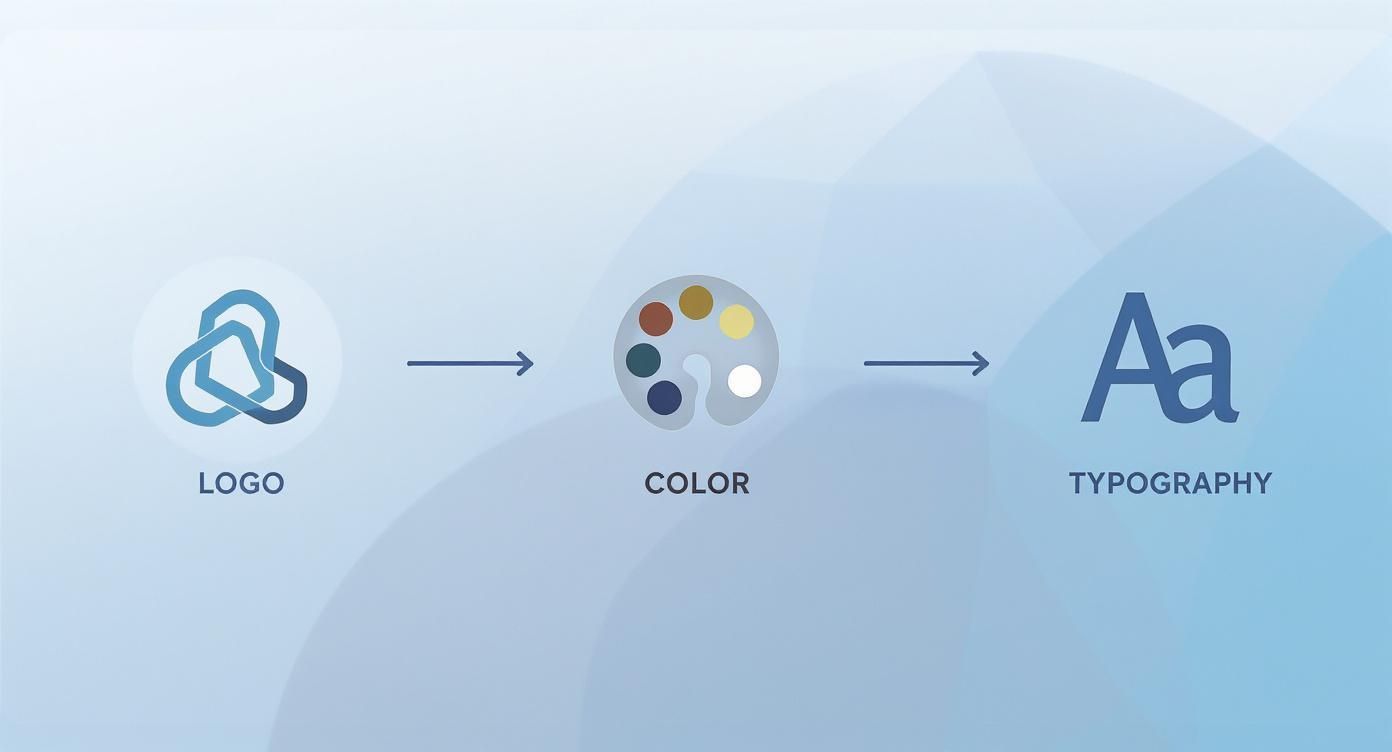
It shows how a thoughtful, system-led approach to your visual identity ensures every element works together to create something cohesive and memorable.
Rolling Out Across Every Touchpoint
Once your team is fired up and on board, it is time to go public. This demands a coordinated push across all your channels to create a seamless experience for your customers. The goal is simple: every interaction, no matter how small, should reinforce your brand’s position and message.
Your rollout plan needs to cover every conceivable customer touchpoint:
- Digital Presence: This means updating your website, social media profiles, email templates, and online ads. All visuals and copy must align perfectly with the new guidelines.
- Physical Assets: Do not overlook the basics like business cards, letterheads, packaging, and in-store signage. Consistency in the real world builds powerful recognition.
- Customer Interactions: Get your sales and customer service teams trained on the new brand voice. How they talk to customers is just as important as how your website looks.
A massive part of bringing your brand to life is building a solid digital footprint. That means having a focused plan on how to build a strong social media presence and boost your brand , using your shiny new guidelines to create content that is both engaging and perfectly on-brand.
Measuring Performance and Staying Agile
Brand strategy is not a "set it and forget it" project. To stay relevant, brands have to evolve. And to do that right, you need to keep a close eye on your brand’s health and performance against the goals you set out at the start.
Key metrics you should be tracking include:
- Brand Awareness: Monitor things like website traffic, social media reach and engagement, and any mentions you get in the press or online.
- Brand Perception: Use customer surveys, feedback forms, and social listening tools to get a feel for what your audience really thinks. Are they using the words you want to be associated with?
- Customer Loyalty: Keep an eye on repeat purchase rates, customer lifetime value, and your Net Promoter Score (NPS) to see how well you are building lasting relationships.
Review these numbers regularly to see what is working and what is not. Be ready to tweak your strategy based on market changes, what competitors are doing, or shifts in customer behaviour. A successful brand is not static; it is a dynamic thing that learns, adapts, and gets stronger over time.
Your Top Brand Strategy Questions, Answered
Building a brand strategy can feel like a mountain to climb, and it naturally brings up some big questions. We get asked a lot of the same things by businesses across the UK, so we have put together some straight answers to help you get clarity and move forward. From budget concerns to proving the value of your work, here is what you need to know.
What is the Real Cost of a Brand Strategy?
This is always the first question, and the honest answer is: it really depends on what you need. A startup might spend a few thousand pounds working with a freelance strategist to get their foundations right. On the other hand, a full-scale rebrand for an established company, handled by a full-service agency, could easily run into the tens of thousands.
But maybe the question is not "how much does it cost?" but rather "what is the cost of getting it wrong?" Your brand is your single most valuable asset. The budget should reflect how critical it is to your growth.
When you are planning your investment, think about these points:
- Scope: Are you building from the ground up, or do you just need a refresh of your messaging and visual identity?
- Your Team: The cost will vary significantly depending on whether you are working with a freelancer, a boutique agency, or a larger firm.
- The Deliverables: Do you need a simple one-page brand guide or a complete rollout plan that covers a new website, packaging, and all your marketing materials?
Treat this as a core investment in your business's future, not just another line-item expense. A powerful brand strategy pays dividends for years.
How Long Does Brand Strategy Development Take?
Good things take time. A proper brand strategy process is not something you can knock out in a weekend. The exact timeline will always vary, but for a typical small or medium-sized business, you should realistically set aside anywhere from six to twelve weeks .
That timeline gives you enough breathing room for each critical phase:
- Discovery & Research (2-4 weeks): This is all about workshops, digging into audience interviews, analysing the competition, and looking inward with internal audits. If you rush this part, you end up with a strategy built on guesswork, not real insight.
- Strategy & Positioning (2-3 weeks): Here, all that research gets boiled down into your core positioning, your key messages, and your brand's unique voice.
- Creative Development (2-4 weeks): With the strategy as a blueprint, the visual identity—your logo, colours, typography—is brought to life and refined.
- Guidelines & Rollout (1-2 weeks): Finally, everything is documented in your brand guidelines, ready to be rolled out consistently.
Remember, the whole point is to create a foundation that lasts. Investing the time upfront will save you from expensive mistakes and the headache of having to rebrand again in a couple of years.
How Can I Measure the ROI of My Brand Strategy?
This is a tricky one. Measuring the return on investment (ROI) from branding is not as clear-cut as tracking a PPC campaign, but it is absolutely doable. You just have to look beyond the immediate sales figures and track a blend of different metrics.
Here is what you should be keeping an eye on:
- Brand Awareness: Use monitoring tools to track any uplift in website traffic, social media mentions and reach, and how many people are searching for your brand name directly.
- Customer Perception: Run simple surveys. Ask your customers how they would describe your brand. Do their answers match the positioning you were aiming for?
- Lead Quality: A stronger, clearer brand tends to attract customers who are a much better fit. You should notice an improvement in the quality of leads your sales team is getting.
- Customer Loyalty: Keep an eye on metrics like your repeat purchase rate and your Net Promoter Score (NPS). These are fantastic health indicators for your brand.
By tracking these things before and after you launch your new strategy, you will be able to paint a very clear picture of its impact. At the end of the day, a successful brand strategy makes all your other marketing more effective, fuelling sustainable, long-term growth.
At Superhub , we specialise in transforming business potential into brand reality. If you're ready to build a strategy that drives growth and connects with your audience, find out how our team can help you. Learn more at https://www.superhub.biz.
Want This Done For You?
SuperHub helps UK brands with video, content, SEO and marketing that actually drives revenue. No vanity metrics. No bullsh*t.