
Social Media Advertising Costs UK: A Practical Business Guide
"So, how much should you actually set aside for social media advertising in the UK?" It's the million-pound question, isn't it? The honest answer is that most businesses are spending anywhere from £500 to over £5,000 a month .
But that number isn’t pulled out of thin air. It’s a direct reflection of your ambition, your audience, and your industry.
Decoding UK Social Media Advertising Costs
Figuring out social media ad costs isn't like looking at a price tag in a shop. It’s much more like stepping into a fast-paced auction where the prize is your ideal customer's attention.
Every single time someone scrolls through their feed, a lightning-fast auction takes place behind the scenes to decide which ad they see. Your budget is what gets you a seat at the table and determines how strong your bid can be.
Think of it like a property auction. You’ve got several bidders (your competitors) all eyeing up the same prime real estate (a user's screen time). The price you're willing to pay, combined with the quality of what you're offering (your ad creative), decides whether you win the spot. This is why a simple question about cost always comes with a more complex answer.
The Two Currencies of Social Advertising
To get your head around this auction, you need to understand the two main "currencies" the platforms use to charge you. These metrics are the bedrock of any ad budget and tell you how well you’re spending your money.
- Cost Per Click (CPC): This is exactly what it sounds like – the price you pay every time someone clicks on your ad. It's a direct measure of interest and is perfect for campaigns where you want to get people over to your website or a specific landing page.
- Cost Per Mille (CPM): "Mille" is just a fancy Latin word for a thousand. So, CPM is the cost you pay for one thousand people to see your ad (impressions). This is your go-to metric for brand awareness, where the main goal is simply to get your message in front of as many relevant eyeballs as possible.
The real secret isn't just about outspending everyone. It’s about bidding smarter. A super-relevant, engaging ad can often beat a generic one with a bigger budget because the platforms want to show their users content they'll actually like.
Setting a Baseline for Your Budget
Okay, so where do you start? Our data shows that the average UK business sets aside between £500 and £3,000 per month purely for paid social ads.
This figure, which doesn't include things like agency management fees, is a realistic starting point for small and medium-sized businesses (SMEs) looking to make a real impact. It reflects what it takes to build a proper strategy that works for both new and established brands. If you want to dig deeper, you can find out more about what goes into social media marketing costs.
Ultimately, your starting budget comes down to your goals. A local MOT centre might start at the lower end to build awareness in their town, whereas a national e-commerce brand will need to invest more heavily to cut through the noise and compete.
How Major Social Platforms Compare on Cost
Deciding where to put your ad budget isn't about finding the cheapest clicks. It’s about finding the platform where your ideal customer actually hangs out. The social media advertising costs UK businesses face can vary wildly between platforms, and each one offers a completely different strategic playbook.
You’ve got to understand the differences. A pound spent on LinkedIn is chasing a completely different goal—and a different person—than a pound spent on TikTok. Let's get into the numbers for the main players in the UK.
This gives you a quick, at-a-glance look at the typical cost per click (CPC), cost per thousand impressions (CPM), and monthly budget ranges you can expect across the big platforms.
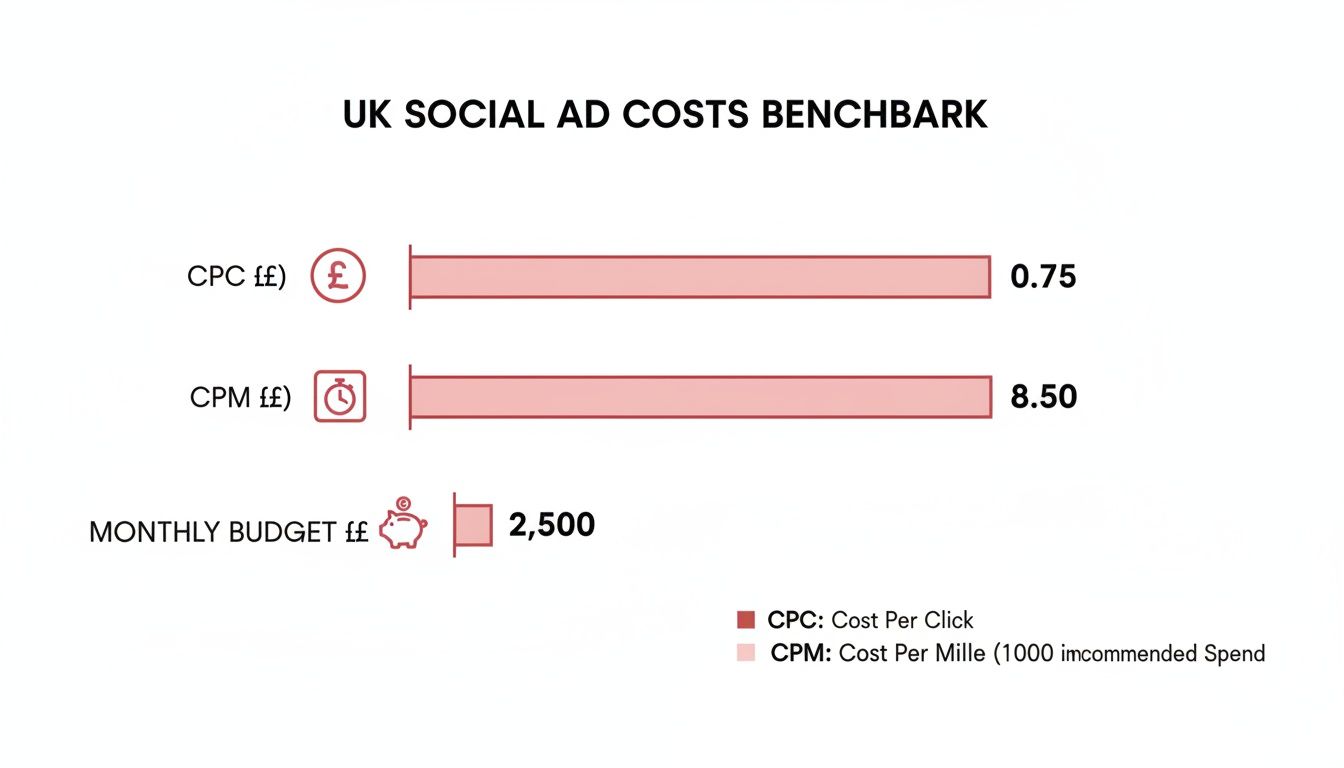
As you can see, a platform like LinkedIn costs more, but you're paying for access to a very specific professional audience. On the other end, TikTok gives you a much lower cost of entry if you’re trying to reach a younger crowd.
Meta (Facebook and Instagram): The Versatile Powerhouses
For most businesses in the UK, Meta is the natural starting point. The sheer number of users and the incredibly deep targeting options make Facebook and Instagram the go-to for almost any campaign, whether you're B2C or B2B.
On Facebook, you can expect an average Cost Per Click (CPC) of around £0.70 - £2.00 . The Cost Per Mille (CPM) , or the price for a thousand views, usually lands somewhere between £5 - £10 . Instagram tends to be a bit pricier, but you often get higher engagement in return, thanks to its visual-first nature.
Think of a Devon-based motorsport brand. They could run Instagram Reels ads to show off their new performance parts, targeting users who follow Silverstone and famous automotive influencers. The result? High engagement for a pretty reasonable cost.
LinkedIn: The B2B Lead Generation Engine
When it comes to B2B marketing, LinkedIn is in a league of its own—and its prices reflect that. You can target people by their exact job title, company size, and industry with a level of precision you just can't get anywhere else. It’s a serious investment for generating high-value leads.
Here, CPCs can climb from £4.00 to over £8.00 , and CPMs are often north of £25 . It sounds steep, but the return on investment can be huge. If you turn just one of those clicks into a long term corporate client, the campaign has paid for itself many times over.
A UK tech firm, for instance, could use Sponsored Content to get a whitepaper in front of every IT Director in the London financial sector. If you want to get this right, check out our guide on top LinkedIn ads agency tips to boost B2B leads.
The higher cost on LinkedIn acts as a filter. You pay more per click, but the quality of that click is often significantly higher, leading to more qualified leads and a better return on your ad spend for B2B goals.
X (Formerly Twitter): The Real-Time Conversation Starter
X is all about what’s happening right now. It’s the perfect place for brands that want to tap into current events, jump on trends, and join real time conversations.
Costs are generally pretty moderate. The average CPC sits between £0.40 and £1.50 , making it an accessible platform for driving website traffic or pushing timely offers. A local bookshop, for example, could run a quick Promoted Ad campaign targeting people discussing a newly released bestseller to drive immediate online sales.
TikTok: The Gen Z Connector
TikTok’s growth has been explosive, especially with younger audiences. The whole platform is built around discovery, making it a brilliant tool for brand awareness and getting in front of new customers with creative, snappy video content.
It’s also one of the most budget-friendly platforms out there right now. CPMs can be as low as £1 - £4 , which is incredible value for campaigns aimed at reaching a massive audience. A new UK-based snack brand could team up with a food influencer, launch a viral video challenge, and reach millions of potential customers for a fraction of what it would cost elsewhere.
The Key Factors That Drive Your Ad Spend
Ever watched your social media ad costs and wondered what on earth is going on? One week your Cost Per Click is looking healthy, the next it’s through the roof. It’s not guesswork; there are a few core variables pulling the strings behind the scenes. Getting a handle on these is the first step to taking back control of your ad spend.
Think of it like booking a holiday. Aim for the peak of summer in August, and you know you’re going to pay a premium. It’s the same in the ad world. When everyone piles in for Black Friday or Christmas, there’s more competition for the same eyeballs, and that pushes the price up for everyone involved.
And that competition is fierce. With social media ad spend in the UK hitting a massive £9.77 billion in the latest reported year—a 12.6% jump from the year before—the auction rooms are more packed than ever. It just shows how vital these platforms have become, especially when you learn that almost half of all adult internet users are using them to research products. You can read more in the latest UK media ad spend forecasts.
Your Audience and Targeting Choices
Who you’re trying to reach is probably the single biggest factor affecting the social media advertising costs UK businesses pay. The more specific and valuable that audience is, the more you'll have to cough up to get your message in front of them.
- Broad Targeting: If you aim your ads at a massive demographic, like "women aged 25-45 in the UK," you’ll find it’s relatively cheap. The catch? It’s a scattergun approach, and you’ll likely waste a lot of money on people who couldn’t care less about what you’re selling.
- Niche Targeting: On the other hand, going after "financial directors in London with an interest in sustainable technology" is going to be far more expensive. You’re fighting for a smaller, high-value slice of the pie, but every click you get is from a much more qualified lead.
This is the central trade-off in advertising. A higher upfront cost for a niche audience often delivers a much better return because you’re talking directly to people who are ready to listen.
Think of your ad relevance score as a discount from the platform. Social media networks want to show their users engaging, high-quality content. If your ad resonates well with your audience—earning clicks, shares, and comments—the platform will reward you with lower costs and better placement.
Ad Creative and Campaign Objectives
The quality of your ad creative—your images, videos, and the words you use—directly hits your bottom line. A dull, irrelevant ad gets ignored, leading to a poor relevance score and driving your costs up. But an engaging, thumb-stopping ad grabs attention, encourages people to interact, and actually brings your costs down.
Your campaign goal also plays a massive part. An objective like "brand awareness" (where you pay per impression, or CPM) is almost always cheaper than running a "conversions" campaign (where you pay per action, or CPA). Why? Because it’s a lot easier to get someone to simply see your ad than it is to convince them to click, visit your website, and buy something. The platform has to work much harder to find those high-intent users, and you pay for that extra legwork.
How to Set a Realistic Advertising Budget
Alright, let's move from the theory to the part that really matters: spending your money wisely. Setting a realistic ad budget for your UK social media isn't about plucking a number from thin air. It's about tying every single pound to a clear, achievable goal. Think of your budget as a roadmap – it stops you from taking expensive detours and keeps your spending focused on what will actually grow your business.
What you can achieve is a direct result of what you're willing to put in. A modest budget is perfect for getting your name out there and building some early buzz. A bigger one can fuel powerful lead generation machines across multiple platforms. The trick is to match your investment to where your business is right now and where you want it to go.
Let's break down what this looks like in the real world for different UK businesses with a few tangible monthly budget examples.
Startup Budget: £500 to £1,000 Per Month
When you're a startup, your main game is getting noticed and starting conversations. With this kind of budget, it’s all about being smart and efficient, not trying to be everywhere at once.
- Platform Focus: Don't spread yourself thin. Pick one or two platforms where you know your ideal customers hang out. If you're a direct-to-consumer brand, Instagram and TikTok are brilliant starting points because they're visual and the cost to get in is lower.
- Campaign Type: Stick to brand awareness (CPM) and traffic (CPC) campaigns. The goal is simple: make people aware you exist, build a small community, and get those first few clicks through to your shiny new website.
- What to Expect: This budget gets you consistent visibility in a specific niche. It’s enough to run some small scale tests on your ads and messaging to see what sticks before you decide to ramp things up.
For startups and small businesses trying to make every penny count, digging into video marketing for small businesses is a great way to create engaging content without a Hollywood budget.
SMB Budget: £1,500 to £3,500 Per Month
For a small to medium-sized business (SMB), the mission shifts. You’re now looking to really kickstart growth, pull in qualified leads, and start seeing a direct return on your ad spend. This budget gives you more room to play.
- Platform Focus: You can comfortably manage a solid presence on two or three key platforms. For a B2B services firm, this might mean using LinkedIn for high-value lead generation while running brand-building and retargeting ads on Facebook .
- Campaign Type: Now you can get serious about conversion-focused campaigns, like getting people to fill out lead forms or buy directly. This is also the perfect time to bring in retargeting – showing tailored ads to people who’ve already visited your site.
- What to Expect: You should be seeing a tangible lift in leads or sales. This budget is meaty enough to gather proper data, which lets you start optimising your campaigns meaningfully and get a real handle on your customer acquisition cost.
With a mid-tier budget, your focus shifts from just being seen to being remembered. Retargeting is your most powerful tool here, reminding warm leads of your value and guiding them towards a purchase.
Enterprise Budget: £5,000+ Per Month
At the enterprise level, the goal is often market dominance. You're thinking about multi-channel campaigns, full funnel strategies, and maximising the lifetime value of every customer. This level of investment backs a serious, data-heavy advertising operation.
- Platform Focus: A multi-channel strategy is the standard here. An enterprise will be running simultaneous, highly-tailored campaigns across Meta , LinkedIn , X , and maybe even testing the waters on emerging platforms to capture every possible audience segment.
- Campaign Type: You'll be running a full funnel strategy. This means everything from big, top-level awareness campaigns right down to loyalty ads designed to keep your existing customers coming back. Expect complex A/B testing, lookalike audience building, and dynamic product ads.
- What to Expect: At this spend, you're looking for a highly predictable return on investment. The sheer volume of data you're gathering allows for incredibly deep analysis and constant fine-tuning, letting you scale what works and cut what doesn't with surgical precision.
Your Monthly Social Media Ad Budget Planner
To help you get a handle on all this, here's a simple template to map out your own spending. It's a straightforward way to allocate your budget and make sure every pound has a purpose.
| Expense Line | Platform/Tool | Budget Allocation (£) | Objective/KPI | Notes |
|---|---|---|---|---|
| Ad Spend | Meta (Facebook/Instagram) | Cost Per Lead / ROAS | Main B2C channel for lead gen & sales. | |
| Ad Spend | Cost Per MQL | Targeting specific job titles in the finance sector. | ||
| Ad Spend | TikTok | Brand Awareness / CPC | Top of funnel video content for a younger demographic. | |
| Content Creation | Freelance Videographer | 4 short form videos per month. | ||
| Management/Tools | Ad Management Software | E.g., Hootsuite, Sprout Social, or agency fee. | ||
| Total | £ | Total Monthly Investment |
This planner forces you to think about not just where the money is going, but why. By linking each cost to a Key Performance Indicator (KPI), you create accountability and make it much easier to track what's actually delivering results for your business.
Deciding Between In-House vs Agency Management
One of the biggest calls you’ll make for your long term social media advertising costs is who actually runs the campaigns. Do you build your own crack team in-house, or do you bring in a specialist agency?
There’s no easy answer here. The right choice hinges entirely on your company’s cash, in-house skills, and where you’re trying to go.
This isn't just about a line on a spreadsheet; it dictates your entire strategy, how quickly you can react, and your ceiling for growth. For many startups, having a marketer in-house feels right – they live and breathe the brand. But for a business ready to hit the accelerator, the expertise and strategic clout of an agency is often what’s needed to break through the noise.
Understanding Agency Fee Structures
When you hire an agency, you’re not just paying someone to press the buttons. You’re buying into a team of specialists, their expensive software subscriptions, and the hard-won experience they’ve gained working across dozens of other accounts.
In the UK, agency pricing usually falls into one of these buckets:
- Monthly Retainer: A simple, fixed fee you pay each month for a set list of services. It’s great for budgeting because there are no surprises, and it typically covers everything from strategy and management to creative work and reporting.
- Percentage of Ad Spend: This is probably the most common model. The agency takes a cut of your monthly ad budget, usually somewhere between 10-20% . It’s a model that scales with you – as you spend more, they earn more, which keeps everyone focused on growth.
- Hybrid Model: A mix of both. Some agencies will charge a smaller retainer plus a performance fee tied to results like leads or sales. It’s a shared-risk approach that really motivates them to deliver the goods.
Picking the right agency is a huge deal. If you’re heading down that road, our guide to choosing a paid social media agency will help you figure out what to look for.
The True Cost of an In-House Team
On the surface, hiring your own person seems simpler. But the real cost goes way beyond a monthly salary. To make a fair comparison with agency fees, you have to look at the whole picture.
The hidden costs of an in-house team—such as continuous training, software subscriptions, and benefits—can often equal or exceed the fees of a specialised agency, which already has these resources in place.
Don't forget to factor in these extras:
- Salary and Benefits: You’ve got the base salary for a good social media manager in the UK, plus National Insurance, pension contributions, and any other perks.
- Training and Development: The world of social ads changes by the week. Your team needs constant training just to keep up with platform updates and new tactics.
- Software and Tools: The professional tools needed for scheduling, analytics, and creating ads can easily run into hundreds, if not thousands, of pounds every single month.
The UK digital ad market is on fire, with social media ad spend predicted to smash US$13.79bn in 2025. This explosion is fuelled by our addiction to mobile, making expert management more critical than ever. Without it, your budget will just get swallowed up by the competition. You can find more stats on the UK’s digital ad market here.
Ultimately, the choice boils down to control versus specialised scale.
An in-house team gives you unmatched brand knowledge and direct oversight, which is perfect if you have a clear strategy and just need to execute. An agency brings broad expertise and the instant ability to scale up, making it the ideal choice for businesses chasing aggressive growth or facing tricky market challenges.
Proven Strategies to Make Your Ad Budget Work Harder
Having a budget is one thing. Making every single pound count is something else entirely.
Let’s be clear: just throwing money at social media ads won't get you anywhere. The real skill is in managing your campaigns smartly, squeezing every drop of value from your investment and keeping those social media advertising costs in check.
This isn’t a ‘set it and forget it’ game. It's about constant testing, refining, and optimising. You have to be willing to cut what isn’t working and double down on what is. That’s how you turn your ad spend from a simple expense into a genuine growth engine for leads and sales.
A/B Test Your Creatives Relentlessly
Never, ever assume you know which ad will be the winner. Your gut feeling is often wrong.
A/B testing is your best friend here. It’s simply running two slightly different versions of an ad at the same time to see which one your audience actually responds to. Test the headline. Test the image. Test the call to action.
Let the data pick the winner. It's that simple. You’ll be surprised how tiny tweaks can lead to massive jumps in click-through rates and a lower cost per result, directly boosting your return on investment.
Build High Performance Sales Funnels
One of the most powerful ways to get more from your budget is by building a proper sales funnel using retargeting. This just means showing specific, relevant ads to people based on how they’ve already interacted with your brand.
- Top of Funnel (The Introduction): Start with engaging video content shown to a broad but relevant audience. Your only goal is to get on their radar.
- Middle of Funnel (The Nudge): Now, retarget the people who actually watched that video. Show them an ad that sends them to a product page or a useful blog post to learn more.
- Bottom of Funnel (The Close): For anyone who visited your product page but didn’t pull the trigger, hit them with one last ad. Maybe it’s a special offer, a strong testimonial, or a reminder.
This approach doesn't waste money on cold leads. It guides genuinely interested people along their journey, making your spend far more effective. To do this well, you first need to understand the real benefits of social media ads and how they slot into a bigger picture.
Create and Refine Lookalike Audiences
Once you have a solid list of your best customers, you can give that data to platforms like Meta and ask them to work their magic. They’ll create a 'lookalike' audience for you.
The platform's algorithm gets to work, analysing the traits, behaviours, and interests of your top customers. Then, it goes out and finds a whole new audience of people who look just like them – people who are highly likely to be interested in what you offer.
It’s an incredibly efficient way to find new customers. Instead of taking a shot in the dark with your targeting, you’re using your own success to pinpoint the next wave of high-value leads. Your ad spend becomes laser focused.
To really get the most from your budget, especially when you're testing lots of different ad versions, think about how an AI ad creative generator could streamline the design process. It can speed up production massively, helping you run more cost-effective campaigns and get to the winning ad faster.
Burning Questions About UK Ad Costs
Diving into social media ad spend can feel a bit like guesswork. It’s natural to have a few questions before you commit your hard-earned cash. We get it.
Here are the straight answers to the most common queries we hear, designed to give you the clarity and confidence to build a budget that actually works.
How Much Should a Small Business Spend?
If you're a small UK business just starting out, a sensible budget is somewhere between £500 and £1,500 per month .
Think of this as your testing ground. This level of investment is enough to get your feet wet on one or two key platforms, gather some real-world data, and start figuring out what your audience actually responds to. The goal here isn't to hit a home run on day one, but to learn what works before you pour more fuel on the fire.
Our advice? Don't spread a small budget too thin. It's far better to properly fund a campaign on a single, well-chosen platform and master it than to make zero impact across five different channels.
Are Agency Fees Included in These Cost Estimates?
In a word, no. The numbers and budgets we've talked about in this guide are purely for 'ad spend' . That’s the money that goes directly to the platforms themselves—Meta, LinkedIn, TikTok, you name it—to get your ads in front of people.
Agency management fees are a separate cost. This is what you pay for the expertise, strategy, creative work, and day-to-day running of your campaigns. It’s usually a fixed monthly retainer or a percentage of your ad spend, so make sure you factor that into your overall marketing budget.
Which Social Media Platform Is the Cheapest?
If you’re just looking at the raw numbers, platforms like TikTok or Facebook often have a lower Cost Per Click (CPC) and Cost Per Mille (CPM) than a specialist network like LinkedIn. Their huge user bases and competitive ad auctions tend to push the price per impression down.
But—and this is a big but—'cheapest' doesn't mean 'best'. The real value comes from being where your ideal customers are. A higher CPC on LinkedIn could be a brilliant investment for a B2B company if it generates high-value leads. Don't chase the lowest cost; chase the best return.
Ready to build a social media ad strategy that delivers proper results? The team at Superhub lives and breathes this stuff. We build data-driven campaigns that maximise your return on investment. Talk to us today and let's figure out how we can help you grow.
Want This Done For You?
SuperHub helps UK brands with video, content, SEO and marketing that actually drives revenue. No vanity metrics. No bullsh*t.