

Top 7 Reputation Management Agencies UK 2026
Our Pick: SuperHub
SuperHub offers reputation management as part of our integrated digital marketing service. Rather than treating reputation as a standalone problem, we address it alongside SEO, content strategy and social media so that positive brand signals are being built across every channel simultaneously.
Our approach combines review management, search result displacement (pushing negative content down by building authoritative positive content above it), social proof amplification and crisis communications. We've worked with businesses across motorsport, automotive, hospitality and professional services to rebuild and protect online reputations.
Best for: UK businesses that want reputation management built into a broader digital strategy rather than a standalone emergency service.
Pricing: Reputation audits from £500 | Ongoing management from £750/month | Location: Devon (serving UK-wide) | Book a free reputation audit →
Below are the rest of the top reputation management agencies in the UK for 2026. We've compared each on their methodology, transparency, pricing and track record.
In a world where a single negative review or misplaced news article can significantly affect your brand's credibility and bottom line, your online reputation is no longer a passive asset. It has become an active battleground where customer trust is won or lost. Choosing the right partner to navigate this complex environment is crucial and this is where professional reputation management agencies come in. They are the specialists who protect, repair and enhance your online image.
This guide cuts through the noise, providing a detailed roundup of the UK's top agencies for 2025. We have analysed each one to give you a clear, actionable overview of what they offer. To truly grasp why your digital reputation is so vital, it is essential to explore the key benefits of reputation management for business growth, including increased trust and a healthier bottom line.
Our list will help you find the best fit for your specific needs, whether you are a startup building a brand, an established business protecting its legacy or a motorsport team seeking sponsors. For each agency, we provide a direct link and a clear breakdown of their unique strengths, core services and suitability for different sectors. This empowers you to make an informed decision and safeguard your brand's future.
1. Igniyte
Igniyte is a highly specialised UK-based online reputation management agency with offices in London and Leeds. Established in 2009, it has a long-standing presence in the industry, offering a comprehensive suite of services for both businesses and high-profile individuals. Their approach is strategic, combining PR, content creation and legal expertise to repair, build and maintain a positive digital footprint.
What makes Igniyte one of the leading reputation management agencies is its transparent and multifaceted methodology. The team is media-savvy and handles everything from initial reputation audits to complex legal challenges like 'Right to be Forgotten' requests and defamation claims. This integration of legal and digital marketing services under one roof provides a powerful, cohesive strategy for clients.
Key Service Offerings
- Reputation Audits & Strategy: Detailed analysis of your current online standing followed by a bespoke plan to address vulnerabilities and enhance positive visibility.
- Content & PR: Creation and promotion of positive, authoritative content designed to suppress negative search results and build a strong brand narrative.
- Review Management: As an official Trustpilot partner, Igniyte offers expert guidance on managing customer feedback, generating positive reviews and handling negative ones effectively.
- Legal Support: Assistance with Google removals, liaising with legal teams for defamation cases and navigating the complexities of data protection laws like GDPR.
Who Is It Best For?
Igniyte is an excellent choice for UK-based businesses and individuals who require a robust, long-term reputation management solution. Its integrated legal and PR approach is particularly beneficial for those facing complex issues like defamatory online content, negative press or damaging search results. The agency’s transparency on pricing also makes it a reliable partner for those needing to budget for a sustained campaign. However, its retainer model, typically requiring a 6 to 12-month commitment, may be less suitable for those seeking a quick, short-term fix.
| Pros | Cons |
|---|---|
| Transparent entry-level pricing published | Retainer model may not suit short-term projects |
| Deep expertise in UK media and legal landscape | Timelines can be long due to the bespoke nature of the work |
| Serves both corporate and personal clients | A premium service with a corresponding price point |
Website: https://www.igniyte.co.uk
2. ReputationDefender
ReputationDefender is a globally recognised online reputation management provider with dedicated UK operations, offering a broad spectrum of services for individuals and businesses. Founded in 2006, it has become one of the industry's largest and most established players. The company focuses on utilising proprietary technology to repair negative search results, protect online privacy and build a positive digital presence for its clients.
What makes ReputationDefender a leading choice among reputation management agencies is its accessible entry point and tech-driven approach. Their free "Reputation Report Card" offers an instant, automated analysis of an individual's or brand's online search results, providing a clear starting point. This initial scan helps demystify the complex world of ORM, making it easier for clients to understand their vulnerabilities before committing to a full-scale campaign.
Key Service Offerings
- Online Reputation Management: Customised programmes designed to suppress unwanted search results, promote positive content and build a resilient online brand.
- Executive & VIP Services: Tailored solutions for high-profile individuals, focusing on privacy, digital security and managing high-stakes reputational threats.
- Privacy Solutions: Services aimed at removing personal information from data broker sites and reducing an individual’s digital footprint to prevent future issues.
- Review Management: Strategies to help businesses generate positive customer reviews and professionally manage negative feedback across various platforms.
Who Is It Best For?
ReputationDefender is an excellent fit for individuals, executives and small to medium-sized businesses (SMBs) seeking a comprehensive, technology-led solution. Its free initial scan makes it particularly appealing for those who are new to ORM and want a data-driven assessment of their situation. The company's global scale combined with its UK-based support team provides a robust framework for clients needing both international reach and local expertise. However, as many of its services require a bespoke quote, it may be less suitable for those seeking transparent, off-the-shelf pricing. For those looking to implement their own plan, learning about essential online reputation management strategies can provide a solid foundation.
| Pros | Cons |
|---|---|
| Easy entry point via free, automated scan | Many services require a bespoke quote, making pricing variable |
| Broad service portfolio for privacy and ORM | Enterprise-level tools are often separate from standard packages |
| Long industry presence and global scale | The automated approach may feel less personal than a boutique agency |
Website: https://uk.reputationdefender.com
3. Digitalis
Digitalis is a sophisticated London-based advisory firm that specialises in online reputation, narrative management and digital risk intelligence. Founded in 2009, it has carved out a niche by focusing on complex and sensitive cases for corporations, financial services firms and high-net-worth individuals. Their methodology is highly data-driven, combining proprietary intelligence tools with sector-specific expertise to protect and promote clients' digital reputations.
What distinguishes Digitalis as one of the top reputation management agencies is its integration of technology with strategic counsel. The firm develops and utilises its own monitoring and alerting tools which allows for a proactive approach to managing digital risk. This technological advantage, combined with a deep understanding of the UK media and legal ecosystems, enables them to deliver bespoke and highly effective strategies for high-stakes reputational challenges.
Key Service Offerings
- Narrative Management: A strategic approach to shaping the search and media landscape by developing and amplifying a positive, authoritative narrative for the client.
- Proprietary Intelligence: Utilises in-house monitoring tools to provide real-time alerting, including page change alerts and deep analysis of a client’s digital footprint and associated risks.
- Sector-Focused Practices: Offers dedicated teams and expertise for specific sectors, including corporations, financial services and private clients, ensuring a nuanced and informed strategy.
- Digital Risk & Privacy: Provides advisory services on digital privacy, security vulnerabilities and mitigating online threats to both personal and corporate reputations.
Who Is It Best For?
Digitalis is exceptionally well-suited for UK-based corporations, financial institutions and high-profile individuals facing complex or data-intensive reputational issues. Its in-house technology and specialist teams make it an ideal partner for high-stakes briefs where deep intelligence and a discreet, strategic approach are paramount. The bespoke nature of their work means they are not a one-size-fits-all solution. Their services are geared towards mid-market to enterprise-level budgets and they do not publish pricing, instead providing custom proposals based on the specific scope of work required.
| Pros | Cons |
|---|---|
| Deep expertise in complex corporate and financial cases | No public pricing; services are entirely bespoke |
| In-house proprietary monitoring and intelligence technology | Geared towards mid-market to enterprise-level budgets |
| Established London presence with strong UK focus | May not be suitable for smaller, less complex projects |
Website: https://digitalis.com
4. The PHA Group
The PHA Group is a prominent UK-based PR and communications agency that brings a media-first approach to reputation management. With offices in London and Manchester, it excels at integrating traditional public relations with digital strategy to manage and protect brand perception. The agency's strength lies in its ability to navigate complex media landscapes, making it a powerful ally when reputational issues require direct press engagement and crisis communications.
What distinguishes The PHA Group from other reputation management agencies is its deep-rooted expertise in PR and crisis management. Rather than focusing purely on technical search engine tactics, their team leverages strong media relationships and narrative-crafting skills to influence public opinion. This makes them particularly effective at handling high-stakes situations where controlling the story in the press is just as crucial as managing search engine results. Their integrated approach combines the core functions of a digital marketing agency with the strategic nuance of top-tier public relations.
Key Service Offerings
- Reputation & Crisis Communications: Proactive and reactive strategies to manage brand perception, handle negative press and prepare for potential issues before they escalate.
- Integrated PR & Digital Campaigns: Blending media relations, social media and content marketing to build a positive and resilient online presence.
- Media Relations: Leveraging extensive contacts across UK media to shape narratives, secure positive coverage and provide a strong voice for clients.
- Issues Management: Strategic counsel and hands-on support for navigating sensitive topics and protecting stakeholder confidence during challenging times.
Who Is It Best For?
The PHA Group is an ideal choice for established businesses and public figures whose reputation is closely tied to media coverage. Companies facing a crisis that has attracted press attention or those wanting to proactively build a strong public profile will benefit most from their PR-led methodology. It’s well-suited for organisations that require a sophisticated communications strategy that goes beyond simple content suppression. However, those seeking a purely technology-driven SEO solution for online reputation management may find their services are broader than required, as their core strength is in communications rather than technical ORM.
| Pros | Cons |
|---|---|
| Strong media relationships for shaping narratives | Not a pure technology-driven ORM provider; search work is secondary |
| Ideal for issues involving both search reputation and press | Pricing is bespoke and not transparently published |
| Extensive experience in crisis communications management | Broader focus may be less suitable for purely digital-only issues |
Website: https://thephagroup.com
5. Status Labs
Status Labs is a global digital reputation and risk advisory firm with a significant presence in key markets including London, New York and Austin. Since its inception, the company has specialised in high-stakes online reputation management, digital public relations and crisis communications. They serve a diverse clientele ranging from Fortune 500 companies and public figures to start-ups and individuals, offering a blend of proactive brand building and reactive reputation repair.
What distinguishes Status Labs within the competitive landscape of reputation management agencies is its powerful combination of global reach and technological sophistication. The firm leverages a proprietary, AI-supported technology stack to conduct deep-dive analytics, monitor online sentiment and execute precise search engine reputation management (SERM) campaigns. This data-driven approach allows for highly targeted strategies that are effective across different international media and search landscapes, particularly for clients with cross-border interests in the UK and US.
Key Service Offerings
- Search Engine Reputation Management: Strategic implementation of positive content and optimisation techniques to control and improve the first page of Google search results for brand or personal names.
- Digital Public Relations: Crafting and distributing compelling narratives through high-authority media outlets to build positive brand equity and enhance online visibility.
- Crisis Communications: Rapid-response strategies to mitigate damage from negative press, social media crises or other online attacks, helping to regain control of the narrative.
- AI-Supported Analytics: Utilisation of advanced analytics to monitor brand mentions, track sentiment and identify potential reputation risks before they escalate.
Who Is It Best For?
Status Labs is an ideal partner for businesses and high-profile individuals facing complex, international reputation challenges. Its dual expertise in UK and US media markets makes it particularly well-suited for clients with transatlantic operations or those dealing with issues that span both regions. The agency’s focus on proactive brand building is also a strong fit for executives and brands aiming to establish a resilient and positive digital footprint from the outset. However, as pricing is entirely proposal-based, it is geared towards clients with significant budgets who require a bespoke, comprehensive solution rather than a standardised service package.
| Pros | Cons |
|---|---|
| Handles both proactive brand reputation and reactive repair | No public pricing; service agreements are entirely proposal-based |
| Strong expertise in cross-border UK and US matters | Global presence may imply higher rates than smaller, boutique agencies |
| Utilises an advanced, AI-supported technology stack | Comprehensive approach may be more than what smaller projects require |
Website: https://statuslabs.com
6. Clutch
Clutch is not an agency itself but an essential B2B ratings and reviews platform that helps businesses discover, compare and select the best service providers. For those seeking reputation management agencies, Clutch offers a curated and verified directory specifically for the UK market. It acts as a crucial research tool, providing in-depth profiles, client testimonials and data points like hourly rates and minimum project sizes to help you make an informed decision.
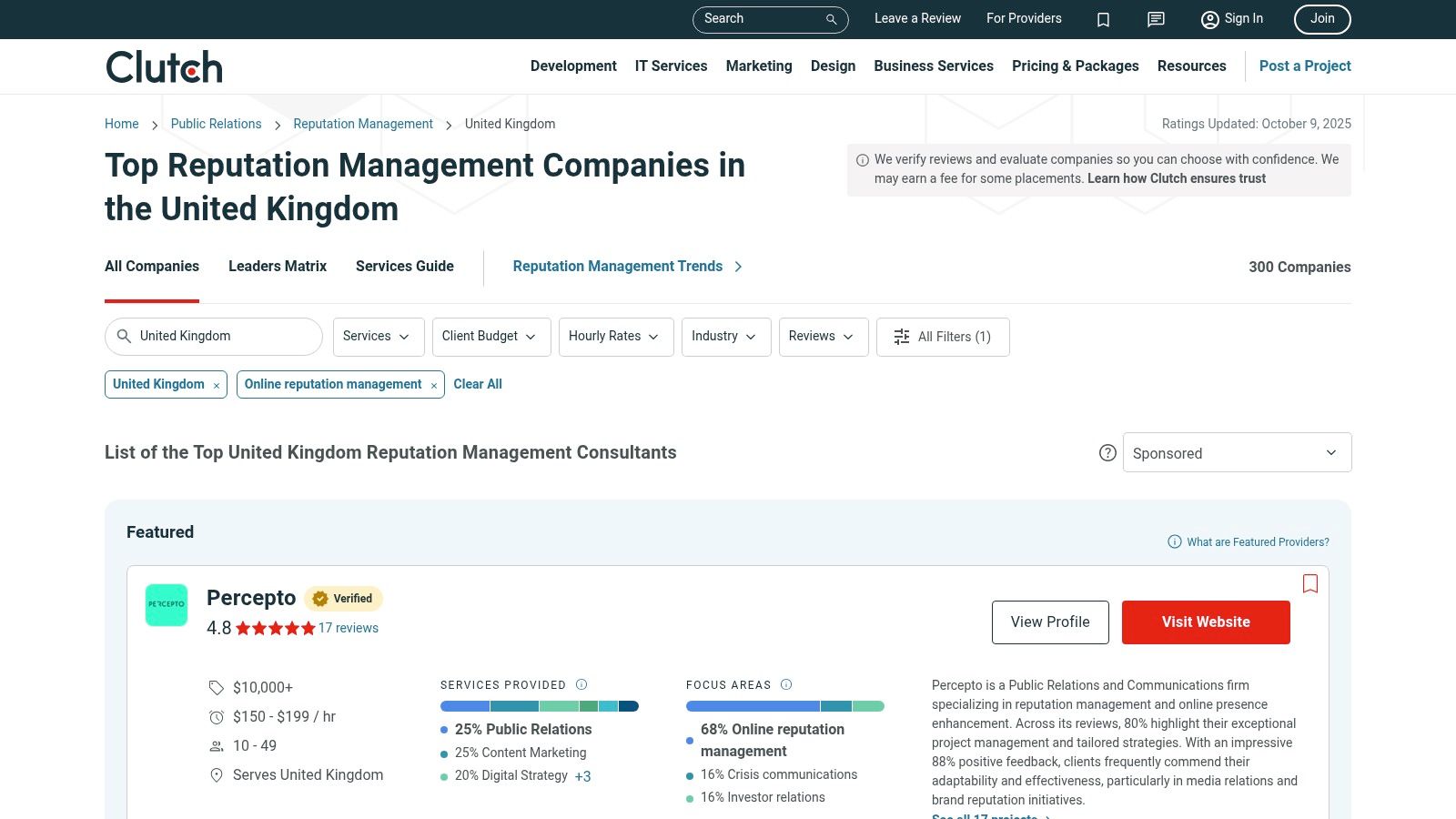
What makes Clutch a powerful resource is its reliance on verified, interview-based client reviews. This process ensures the feedback is authentic and detailed, offering genuine insight into an agency’s performance, communication and results. You can filter providers by location, service focus, budget and client rating, allowing you to efficiently shortlist potential partners that match your specific needs and financial constraints before you even make contact.
Key Service Offerings
As a directory, Clutch doesn't offer services directly but provides a platform to find agencies that do. Its key features include:
- Verified Reviews & Leader Lists: Access to genuine client feedback and data-driven rankings of top-performing UK reputation management agencies.
- Advanced Filtering: Tools to narrow down your search by minimum project size, average hourly rate, location, industry focus and client ratings.
- Detailed Agency Profiles: Comprehensive profiles for each listed company, showcasing their service lines, portfolio of work and key client testimonials.
- Market Rate Insights: The ability to compare pricing and service packages across multiple vendors to gauge typical market rates and value.
Who Is It Best For?
Clutch is an ideal starting point for any business or individual beginning their search for a reputation management agency. It is particularly useful for procurement managers, marketing directors and business owners who need to conduct thorough due diligence and create a shortlist of qualified, vetted vendors. The platform’s transparency helps users understand the market landscape, set realistic budget expectations and identify specialists who have a proven track record in their industry. However, users should be aware that some agencies pay for premium placements, so it is important to look beyond the top-listed profiles.
| Pros | Cons |
|---|---|
| An efficient tool for discovering and comparing UK ORM providers | The presence of pay-to-feature positioning requires user judgment |
| Helps gauge market rates, project sizes and typical service offerings | Vendor quality varies, necessitating further due diligence from the user |
| Verified client reviews provide authentic insights | The sheer volume of choice can be overwhelming without using filters |
7. Upwork
Upwork is not a traditional agency but a vast global marketplace connecting businesses with freelance talent and specialised agencies. For those seeking reputation management services, it offers a flexible and scalable alternative to long-term retainers. Users can hire individual online reputation management (ORM) specialists or small, dedicated teams for specific tasks, from suppressing negative links to managing online reviews, making it a highly adaptable resource for targeted projects.
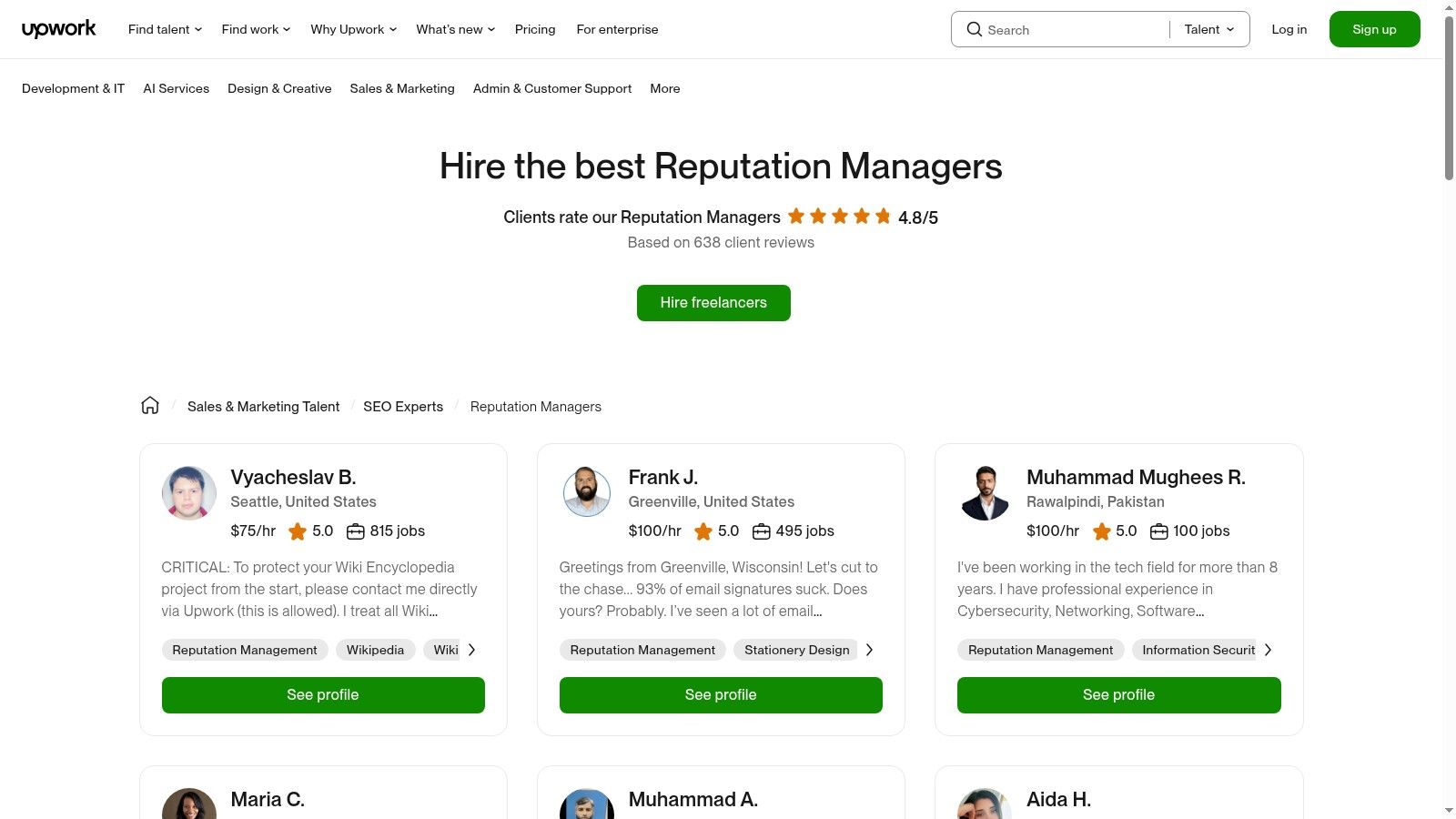
What makes Upwork one of the most versatile platforms for finding reputation management agencies is its unparalleled access to a global talent pool. You can post a detailed project brief and receive proposals from experts worldwide or browse its Project Catalogue for fixed-price ORM services. The platform's built-in escrow system, client reviews and detailed freelancer profiles provide a layer of security and transparency, empowering businesses to find the right fit for their budget and specific needs. This model is a key reason why many businesses consider platforms like Upwork when building an outsourced marketing department.
Key Service Offerings
- Talent Marketplace: Hire individual freelancers or agencies on an hourly or project basis for bespoke reputation management campaigns.
- Project Catalogue: Purchase pre-defined, fixed-price services like "Negative SEO Removal," "Online Review Management," or "Crisis Communication Strategy."
- Vetting & Profiles: Access detailed profiles with work history, client feedback, ratings and portfolios to thoroughly assess potential partners.
- Secure Payments: Utilise an escrow system that holds funds until project milestones are approved, ensuring payment security for both parties.
Who Is It Best For?
Upwork is ideal for businesses and individuals who need a targeted, project-based solution rather than a full-service, long-term agency commitment. It is particularly effective for discrete tasks like removing a specific negative article, bolstering a review profile or creating positive content for a short-term campaign. However, the onus is on the client to vet candidates carefully, as the quality and experience of freelancers can vary significantly. It may not be suitable for those who prefer a hands-off, fully managed service.
| Pros | Cons |
|---|---|
| Quick access to specialists for defined tasks | Marketplace quality varies; requires careful vetting |
| Transparent pricing and client reviews | Occasional profile inaccuracies necessitate claim verification |
| Flexible hiring models (hourly, fixed-price) | Best for specific tasks, not complex, ongoing strategies |
Top 7 Reputation Management Agencies Comparison
| Provider | Implementation Complexity 🔄 | Resource Requirements ⚡ | Expected Outcomes 📊 | Ideal Use Cases 💡 | Key Advantages ⭐ |
|---|---|---|---|---|---|
| Igniyte | Medium – bespoke ORM programmes with legal support | Moderate – retainer contracts (6-12 months) | Strong UK reputation repair and legal removals | Businesses and individuals needing full ORM | Transparent pricing; UK-based expertise |
| ReputationDefender | Low to Medium – automated scans plus bespoke packages | Moderate – customised pricing, global scale | Broad privacy and reputation protection | Individuals, SMBs, executives seeking privacy | Free scan, global presence, diverse service range |
| Digitalis | High – sector-focused, tech-enabled bespoke solutions | High – mid-market to enterprise budgets | Highly tailored ORM, narrative and risk intel | Complex corporate/financial/HNWI cases | Proprietary tools; specialist teams; data driven |
| The PHA Group | Medium to High – integrated PR, crisis and ORM campaigns | Moderate to High – bespoke projects | Reputation and crisis communications impact | Issues requiring media and stakeholder management | Strong media relations; PR + digital integration |
| Status Labs | Medium to High – AI-enhanced global ORM and digital PR | High – proposal-based, cross-border support | Proactive brand building and reputation repair | Cross-border UK/US ORM and digital risk | AI-supported analytics; global/local presence |
| Clutch | Low – directory and comparison tool | Low – self-service for vendor selection | Helps identify suitable ORM providers | Researching and shortlisting multiple vendors | Verified reviews; market insights; filtering tools |
| Upwork | Low – marketplace with freelance/agency options | Low to Moderate – project or hourly based | Flexible, task-specific ORM outcomes | Short-term, defined ORM tasks without retainer | Transparent reviews; escrow payment; flexible hiring |
Finding the Right Reputation Partner for Your Brand
Navigating the landscape of reputation management agencies can feel daunting but making the right choice is a critical investment in your brand’s future. We have explored a range of top-tier providers, from full-service agencies like Igniyte and ReputationDefender to PR-led powerhouses such as The PHA Group and even flexible freelance platforms like Upwork. Each offers a distinct approach, catering to different needs, budgets and reputational challenges.
The primary takeaway is that there is no one-size-fits-all solution. A start-up in the motorsport sector might require a proactive strategy focused on building a positive digital footprint, whereas an established company facing negative press will need a more reactive and intensive crisis management plan. Your selection process must begin with a clear, internal audit of your own situation.
Key Considerations Before You Commit
Before engaging with any agency, it is vital to define your objectives and understand the scope of work required. Ask yourself these critical questions:
- What is our primary goal? Are we trying to suppress negative search results, proactively build a positive brand image, manage online reviews or navigate a specific crisis?
- What is our budget? Services can range from a few hundred pounds for a one-off project on Upwork to tens of thousands for a comprehensive retainer with a firm like Digitalis. Be realistic about your financial commitment.
- What level of expertise do we need? Does our challenge require advanced technical SEO, high-level media relations or specialised content creation? Align the agency’s core strengths with your needs.
- How will we measure success? Define clear Key Performance Indicators (KPIs) from the outset. This could include improved search engine rankings for brand terms, increased positive media mentions or a higher star rating on review platforms.
Making Your Final Selection
Once you have a shortlist of potential reputation management agencies , your due diligence is paramount. Request detailed case studies relevant to your industry and specific problem. Pay close attention to the transparency of their reporting and communication processes. A trustworthy partner will be open about their methods and provide regular, data-backed updates on their progress.
For businesses focused on a specific geographic market, understanding the nuances of local visibility is also crucial. The principles of choosing a local partner often overlap with selecting a reputation firm. For comprehensive guidance on choosing the right partner, consider resources on Local SEO agency selection to help refine your vetting process.
Ultimately, protecting and enhancing your reputation is an ongoing commitment, not a one-time fix. The right agency becomes an extension of your team, a strategic partner invested in your long-term success. By carefully evaluating your needs against the specialised offerings of the firms we’ve discussed, you can forge a partnership that not only resolves current issues but also builds a resilient and respected brand for years to come.
At Superhub , we understand that your reputation is your most valuable asset. We specialise in crafting bespoke, data-driven digital strategies that build, protect and enhance your brand's image across all channels. Contact Superhub today to discover how our expert team can safeguard your reputation and drive sustainable growth.
Reputation Management Agencies: Your Questions Answered
How much does reputation management cost in the UK?
Retainer work ranges from £1,000 to £10,000 a month depending on complexity. Crisis response is typically £5,000 to £50,000 as a one-off project depending on scale. Long-term positive digital presence building runs £2,000 to £5,000 a month for most SMEs. Below £800 a month you are typically paying for automated monitoring tools rather than strategic service.
What does a reputation management agency actually do?
Monitor mentions across search, review platforms and social. Respond to negative content (flag, request removal, push down via positive content). Build and promote positive assets (articles, social, testimonials). Manage SEO for your brand name. Handle acute crisis response. The serious agencies also shape strategic positioning and narrative, not just defensive tactics.
How long does reputation management take to show results?
For improving the search results around your brand name, typically 60 to 180 days. For genuine reputation repair after an incident, six to twelve months of consistent work. For ongoing prevention, it is a continuous programme not a project. Anyone promising meaningful results in two weeks is overselling.
Can reputation management remove negative reviews or articles?
Sometimes, not always. Legally actionable content (defamation, copyright breach, privacy violations) can often be removed via formal legal request. Legitimate negative reviews cannot simply be deleted. The only ethical route there is to earn enough positive content to outweigh and outrank them, or respond publicly in a way that demonstrates the business you actually are.
Is reputation management the same as SEO?
There is overlap but they are not the same thing. Reputation management uses SEO (branded search optimisation specifically), but it also covers reviews management, PR, crisis comms, social listening, content strategy and sometimes legal action. Hiring an SEO agency and expecting full reputation management is one of the most common and expensive mistakes SMEs make.
When should a business hire a reputation management agency?
Ideally before you need one. Once you are mid-crisis the costs are several multiples higher and the options are much narrower. Businesses with high public profile (executives, regulated industries, hospitality, healthcare, legal, finance) benefit from ongoing low-level reputation monitoring regardless of current state. Hire proactively, not reactively.
Which is the best reputation management agency in the UK?
Depends on your situation. Igniyte and ReputationDefender handle crisis and high-profile cases very well. Digitalis is strong on executives and legal-adjacent work. SuperHub fits best for SMEs wanting integrated digital marketing and reputation management under one roof. Brief three agencies, be specific about your situation, and judge on the clarity of their thinking.
Want This Done For You?
SuperHub helps UK brands with video, content, SEO and marketing that actually drives revenue. No vanity metrics. No bullsh*t.