

A UK Business Guide to Google SEM Costs and ROI
When it comes to Google SEM, the first question everyone asks is, "How much does it cost?" The honest answer? There is no one-size-fits-all price tag.
You could be investing anywhere from £100 a month to well over £10,000 . It all comes down to your industry, what you want to achieve, and how fiercely competitive your chosen keywords are.
Understanding Your Google SEM Costs
Think of advertising on Google less like buying something off the shelf and more like entering an auction. An incredibly fast, automated auction takes place every single time someone searches for a term you are targeting. Your "bid" is simply the maximum you are willing to pay if someone clicks on your ad.
But here’s the kicker: it’s not just about who has the deepest pockets. Google cares a lot about the quality and relevance of your ad and the landing page it points to. This means a sharp, well-built campaign can actually beat a competitor with a bigger budget but a sloppy setup, often securing a better spot for less money. Getting your head around this dynamic is the key to mastering your Google SEM spend.
Key Pricing Models at a Glance
Your budget is not spent based on a single metric. Instead, Google uses a few different models, each designed for a different goal. Understanding these is your first step to getting your ad spend under control.
- Cost Per Click (CPC): This is the most common model you will encounter. You only pay when someone actually clicks on your ad. Simple. It’s a direct cost for getting a potential customer to your website.
- Cost Per Mille (CPM): Also known as Cost Per Thousand Impressions, with this model you pay a fee for every 1,000 times your ad is shown on a screen. It does not matter if it gets clicked or not. This is typically used for big brand awareness campaigns where visibility is the main goal.
- Cost Per Acquisition (CPA): This is where things get really interesting. You only pay when a user completes a specific action you care about, like making a purchase or filling out a contact form. To really understand your overall Google SEM costs, you have to get good at tracking your cost per conversion.
The most important thing to remember is that you are always in complete control of your budget. You set the daily or monthly spending caps, which means you will never spend a penny more than you are comfortable with.
This flexibility is what allows businesses of all shapes and sizes, from a local startup in Devon to a national e-commerce giant, to compete on a level playing field.
The average CPC in the UK can swing wildly—from under £1 for niche terms to over £50 for ultra-competitive keywords in law or finance. But ultimately, your strategy is what decides the final bill. As we dig deeper, you will learn exactly how to make every pound you spend work that much harder for you.
If you need a more detailed breakdown, check out our guide on how much Google Ads cost in the UK.
How the Google Ads Auction Really Works
To get a real grip on your Google SEM costs, you have to look under the bonnet at the engine driving it all: the Google Ads auction. This is not your typical auction with a gavel and a fast-talking auctioneer. It’s a lightning-fast, automated process that happens billions of times a day, every single time someone hits 'search'.
And here’s the crucial bit: getting your ad seen is not just about having the deepest pockets.
Think of it this way: your maximum bid is only one piece of the puzzle. Google’s main job is to give its users the most relevant, helpful results possible—and that includes the ads. This is where a vital factor called Quality Score enters the picture. It’s essentially Google’s rating of how good your ad, keywords, and landing page are, all rolled into one.
A high Quality Score is like having a brilliant reputation. Just as you would trust a well-regarded local shop over a new, unknown one, Google rewards advertisers who provide a fantastic user experience. That reward often comes in the form of a lower cost per click and a better ad position.
This diagram breaks down how this all fits together to determine your overall costs.
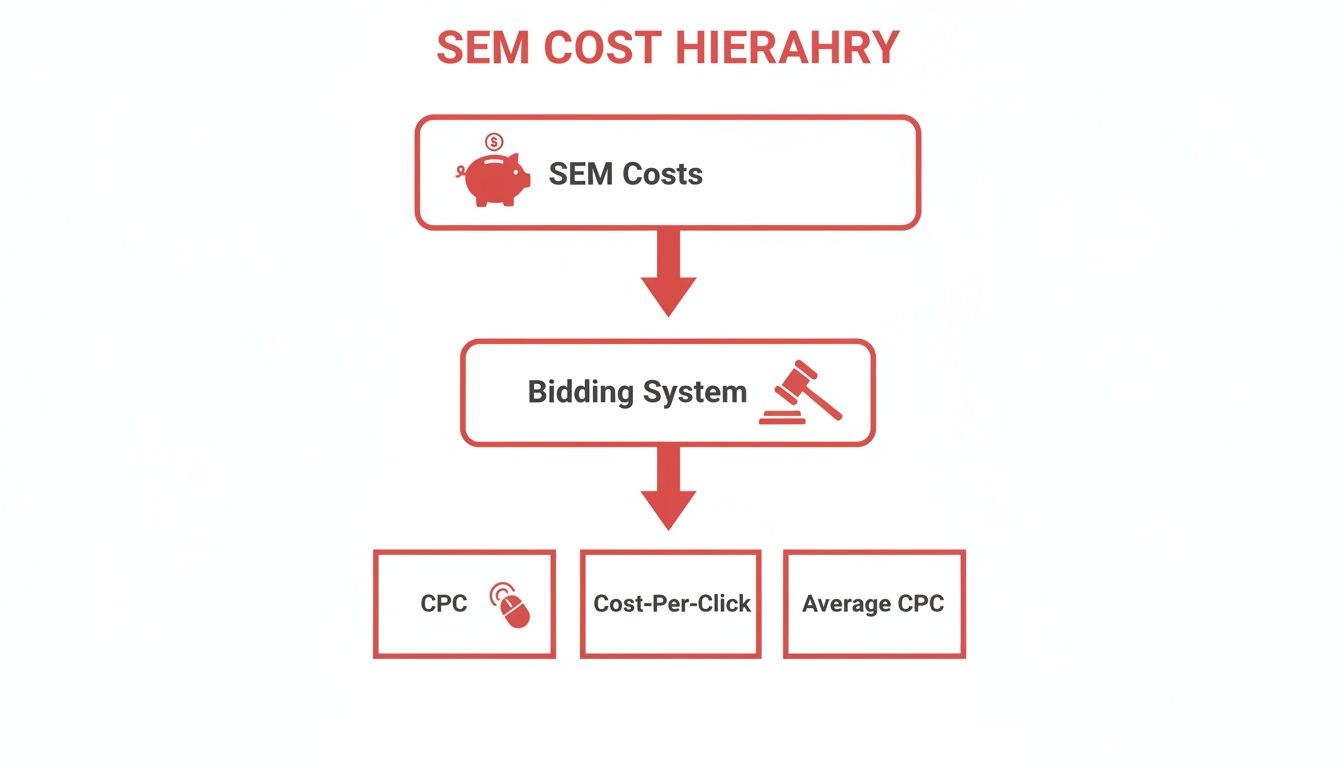
As you can see, the bidding system is the central mechanism, and it’s what ultimately dictates your Cost Per Click (CPC) and, in turn, your final Google SEM costs.
Calculating Your Ad Rank
Where your ad actually appears on the results page is decided by its Ad Rank . And no, it’s not just based on who bids the most. Google uses a simple but powerful formula to figure it out for every single advertiser in the auction.
Ad Rank = Your Maximum CPC Bid x Your Quality Score
This formula is the heart of the auction. It shows, clear as day, that a brilliant Quality Score can make up for a lower bid.
Let’s say an advertiser with a Quality Score of 9/10 and a bid of £2.00 has an Ad Rank of 18 . They could easily outrank a competitor with a poor Quality Score of 3/10 who is bidding a much higher £5.00 —their Ad Rank is only 15 .
Understanding this is fundamental to controlling your spend. Focusing on improving your Quality Score is one of the single most effective ways to lower your advertising costs without losing visibility. It levels the playing field, allowing smaller businesses with smart, well-structured campaigns to compete with big companies and their massive budgets.
What You Actually Pay
Here’s another key detail that often gets missed: you almost never pay your maximum bid. The actual amount you pay for a click is calculated to be just enough to beat the Ad Rank of the advertiser directly below you.
This is why improving your Quality Score is so powerful. Not only does it help you win better ad positions, but it also directly cuts the amount you pay for each click, making your budget stretch much further.
In an environment where costs are always on the rise, this kind of efficiency is critical. For instance, recent data from the UK market paints a clear picture.
Google Ads in the UK now command an average Cost Per Click (CPC) of around $4.66 in 2024 . That is up $0.44 from 2023, thanks to inflation and more competition. The Cost Per Lead (CPL) has also climbed to $66.69 —a 25% jump across the industry—making smart cost management absolutely essential for UK marketers. You can dig into more Google Ads statistics to see these trends for yourself.
The Key Factors Driving Your Ad Spend
Getting your head around the Google Ads auction is one thing. Actually controlling what you spend is another game entirely. Your final bill is not just some random number; it’s a direct result of the levers you pull and the decisions you make.
Think of it this way: mastering these factors is the secret to shifting from just paying for ads to making a proper, profitable investment. Let’s break down the five most critical drivers that dictate how much you will end up spending.
Industry and Keyword Competition
By far, the single biggest factor hammering your costs is the industry you are in. Some sectors are simply a bloodbath on Google Ads, and that competition pushes up the price for everyone.
A local plumber in Plymouth, for instance, will pay a fraction per click compared to a national law firm bidding on "personal injury solicitor." Why? The potential value of a single lead is worlds apart. That law firm might land a case worth tens of thousands, making a £50 click an absolute bargain. The plumber, whose job might be worth £200 , simply cannot play at that level.
The rule of thumb is dead simple: the higher the potential lifetime value of your customer, the more you and your competitors are willing to pay for a click.
This is exactly why sectors like finance, insurance, and legal services consistently have some of the highest CPCs out there. It’s not unusual to see:
- Legal: Average CPCs can easily soar above £6.00 because of the massive value of a new client.
- Consumer Services: Another pricey arena, with an average CPC often climbing past £5.00 .
- E-commerce: In contrast, online shops often see much lower CPCs, typically averaging around £1.00 , as the profit margins on individual sales are much tighter.
To give you a clearer picture, here’s a look at what you can expect across various UK sectors.
Average Cost Per Click (CPC) by UK Industry
This table shows some benchmark CPC figures across competitive UK sectors. It is a great way to gauge where your own advertising costs might land against the industry average.
| Industry Sector | Average CPC (Low End) | Average CPC (High End) | Notes on Competition |
|---|---|---|---|
| Legal Services | £4.50 | £8.00+ | Extremely high. Driven by the immense value of each new case. |
| Finance & Insurance | £3.50 | £7.50 | Very competitive. Keywords related to loans, mortgages, and insurance are expensive. |
| B2B Services | £2.00 | £5.50 | Competition varies, but high-value services (e.g., software, consulting) drive up costs. |
| Health & Medical | £1.80 | £4.00 | Competitive, especially for private clinics and specialised treatments. |
| Home & Garden | £1.20 | £3.00 | Moderate. Can be seasonal, with higher costs for emergency services like plumbing. |
| E-commerce & Retail | £0.50 | £1.80 | Lower CPCs but requires high volume. Competition is fierce among major brands. |
These figures are just a guide, of course. Your actual costs will hinge on the other factors we are about to cover, but this gives you a realistic starting point.
Geographic and Location Targeting
Where you decide to show your ads has a direct, immediate impact on your costs. It is common sense, really. Targeting the entire United Kingdom is going to be far more expensive than focusing on a specific city or a few postcodes.
A national campaign for "men's trainers" pits you against every major retailer in the country. But a campaign for "running shoe fitting Brighton" instantly shrinks the battlefield, cutting down the competition and your CPC.
This is where local businesses have a massive advantage. By getting granular with your location targeting, you can:
- Stop Wasting Money: Only show your ads to people who can actually buy from you.
- Dodge the Big Spenders: Avoid going head-to-head with national brands and their giant budgets.
- Be More Relevant: Write localised ad copy that connects, like "Serving the Devon community for 20 years."
Ad Scheduling Decisions
Your customers are not searching for you 24/7. So why would you run your ads 24/7? Letting your campaigns run around the clock is one of the fastest ways to burn through your budget, paying for clicks at 3 am that have almost no chance of converting.
Ad scheduling is your cost-control superpower here. Dive into your campaign data and pinpoint the exact days and hours when your audience is most active and—more importantly—when they actually buy.
A B2B software company, for example, might find that all their best leads come in between 9 am and 5 pm on weekdays . They can then pause their ads or slash their bids during evenings and weekends, pouring their budget into the times that actually generate a return. On the flip side, a local restaurant advertising takeaways will see a huge spike on Friday and Saturday nights, making that the perfect time to bid more aggressively.
Audience and Device Targeting
Finally, who you target and what device they are on are two more crucial pieces of the cost puzzle. Not all clicks are created equal. A click from someone who perfectly fits your ideal customer profile is infinitely more valuable than one from a random time-waster.
Google lets you get incredibly specific. You can target people based on their age, gender, interests, and even their past behaviour (like visiting your website before, which is called remarketing). This makes sure your budget is spent trying to reach people who are genuinely likely to become customers.
On top of that, people behave differently on different devices. A mobile search for "emergency plumber near me" is urgent. Someone needs help, now. A desktop search for "kitchen renovation ideas" is more about research—they are at an earlier, less committed stage. By adjusting your bids for mobile, desktop, and tablet, you can fine-tune your spend based on how likely someone is to convert, giving you even tighter control over your costs.
How to Budget and Forecast Your SEM Investment
Right, let’s get down to business. Moving from theory about cost drivers to actually planning your spend is where the rubber meets the road. A proper budget is not just a number you pluck out of thin air; it’s a strategic roadmap that links your marketing cash directly to your business goals.
Without one, you are flying blind.
This is the point where we turn abstract data into a concrete, actionable plan. Let's break down how to build a realistic Google Ads budget and forecast your returns, so you can invest with confidence instead of just crossing your fingers.
A Simple Formula for Your Starting Budget
You do not need a degree in data science to get this right. A solid starting budget can be worked out with a surprisingly simple formula that works backwards from what you actually want to achieve. It all boils down to one question: what are you willing to pay to get a new customer?
Here are the key bits you need to pull together:
- Target Cost Per Acquisition (CPA): How much is a new customer truly worth? This is the absolute maximum you are prepared to spend to bring them on board.
- Expected Conversion Rate: Realistically, what percentage of people who click your ad will actually become a customer? If you are not sure, industry benchmarks are a great place to start.
- Estimated Clicks Needed: Based on your conversion rate, how many clicks will it take to land one paying customer?
- Average Cost Per Click (CPC): What’s the going rate for a single click in your specific industry and location?
Get those four numbers, and you have got everything you need to build a sensible forecast.
Putting the Formula into Practice
Let's walk through two very different scenarios for UK businesses. This shows just how much the final budget for Google SEM costs can change based on your scale and goals.
Scenario 1: The Local Start-up
Imagine a new bespoke furniture maker based in Bristol. They are just starting out and have a clear, modest goal: land 10 new customers in their first month with Google Ads.
- Target CPA: Each new customer brings in around £250 in profit. They decide they can comfortably spend £50 to acquire each one.
- Expected Conversion Rate: Looking at industry data for home goods, they estimate a 3% conversion rate . In plain English, for every 100 clicks, 3 should turn into a sale.
- Clicks Needed Per Customer: To get one sale at a 3% rate, they will need roughly 33 clicks (1 / 0.03).
- Average CPC: For their specific keywords in the Bristol area, the average CPC is about £1.50 .
Now, let's do the maths.
Monthly Budget = (Clicks per Customer x Average CPC) x Target Number of Customers
(33 clicks x £1.50) x 10 customers = £495 per month
This gives our Bristol furniture maker a clear, data-driven starting budget of around £500 per month . It is a real number tied to their specific goals, not a wild guess.
Scenario 2: The Established National Business
Next up, let's look at an established B2B software company aiming for aggressive growth across the UK. Their objective is much bigger: generate 100 qualified leads every single month.
- Target CPA: A single software subscription has a huge lifetime value, so the company is happy with a target CPA of £120 per qualified lead.
- Expected Conversion Rate: The B2B tech world typically sees a conversion rate of about 2.5% on lead generation forms.
- Clicks Needed Per Lead: With a 2.5% conversion rate, they will need 40 clicks to get one person to fill out the form (1 / 0.025).
- Average CPC: B2B tech keywords are fiercely competitive on a national scale, pushing the average CPC up to £3.50 .
Let's plug these numbers into the formula.
Monthly Budget = (Clicks per Lead x Average CPC) x Target Number of Leads
(40 clicks x £3.50) x 100 leads = £14,000 per month
The calculation points to a hefty but completely justified monthly budget of £14,000 needed to hit their ambitious growth targets. This shows why knowing how to calculate your customer acquisition cost is the bedrock of this entire process.
It’s crucial to remember that SEM spend varies massively across UK businesses. A hyper-local company might only spend £50-£600 a month, whereas large national enterprises can easily blow past £6,000 . This massive range is exactly why a personalised, formula-based approach is the only way to set a budget that actually makes sense for your business.
Actionable Tactics to Reduce Your SEM Costs

You have got a budget and a forecast. Now, the real work begins: making every pound count.
Cutting your Google SEM costs is not about pulling back on spending. It’s about getting smarter and plugging the leaks. The goal is to eliminate wasted ad spend and crank up the efficiency, so you get more conversions for the same money—or even less.
This means looking past the bids and focusing on the actual quality of your campaigns. A few proven tactics can systematically drive down your cost per acquisition (CPA) and make your return on investment look a whole lot healthier.
Master Your Quality Score
We have touched on it before, but it’s worth repeating: Quality Score is everything. It is Google's verdict on your ads, keywords, and landing pages.
A high score is your ticket to the top. Google sees you as a relevant, high-quality answer to a user's problem, and they reward you for it with better ad positions and, most importantly, cheaper clicks. Improving your Quality Score is the single most powerful lever you can pull to cut costs.
Focus on these two areas first:
- Tightly-Themed Ad Groups: Stop chucking hundreds of keywords into one ad group. It’s a recipe for disaster. Instead, create small, hyper-specific groups of keywords that are all variations of the same theme.
- Compelling, Relevant Ad Copy: Your ad headline and description need to mirror the search query. This is non-negotiable. It drives up your click-through rate (CTR), which is a massive factor in your Quality Score.
Beyond that, if you can increase website conversion rate on your landing pages, your whole campaign becomes more efficient. Your landing page must deliver on the promise of your ad. No exceptions.
Refine Targeting with Negative Keywords
Wasted ad spend is the silent killer of SEM campaigns. You pay for clicks from people who were never going to buy in the first place. This is where negative keywords become your best friend.
Think of them as bouncers for your campaign, turning away irrelevant searches at the door. For instance, if you sell premium "leather boots," you would add negative keywords like "repair," "free," and "cheap" to filter out searchers with the wrong intent.
Think of negative keywords as a filter for your ad spend. Every irrelevant term you block is money saved and budget reallocated to clicks that actually matter.
Make a habit of checking your "Search Terms" report in Google Ads. This report shows you the exact phrases people typed before clicking your ad. See something that does not fit? Add it to your negative keyword list immediately. This simple bit of housekeeping can save you a fortune over time.
Implement Smart Bidding Strategies
Trying to manually set bids for hundreds of keywords is a fast track to burning cash and time. It’s just not efficient. Google's Smart Bidding strategies use machine learning to do the heavy lifting, automatically optimising your bids for conversions in real time.
These algorithms look at dozens of signals for every single auction—device, location, time of day, user behaviour—to predict how likely a click is to convert. It is a level of analysis you simply cannot replicate manually.
Here are the key strategies to get started with:
- Target CPA (Cost Per Acquisition): You tell Google how much you are willing to pay for a conversion, and it adjusts your bids to hit that average.
- Maximise Conversions: This one does what it says on the tin. It aims to get you the most conversions possible within your daily budget.
- Target ROAS (Return On Ad Spend): Perfect for e-commerce. You set a target return, and Google bids to maximise the value of your conversions.
The catch? You absolutely need accurate conversion tracking for any of this to work. Once you have enough data feeding the system, Smart Bidding can slash your CPA and free you up to focus on strategy.
Leverage Ad Extensions and Remarketing
Finally, two more tactics can give you an edge without costing you a penny more on your bids.
Ad extensions are extra bits of info you can add to your ads, like your phone number, location, or links to other pages on your site. They make your ad physically bigger and more useful, which grabs more attention and often leads to a higher CTR at no extra cost.
Then there is remarketing . This lets you show specific ads to people who have already visited your website. These people are warm leads; they know who you are. This makes them far more likely to convert. By building a remarketing audience, you can hit them with a tailored message and often secure a conversion at a much lower CPA than finding a brand-new customer.
Measuring Success and Calculating Your True ROI
Throwing money at Google Ads without tracking the results is like driving with your eyes closed. You might be moving, but you have no idea where you are going. You need to know if your investment is actually bringing in business; otherwise, your carefully planned Google SEM costs are just a shot in the dark.
Clicks and impressions are nice to look at, but they do not pay the bills. The real test of your campaigns comes down to tracking the actions that genuinely matter to your business – sales, quote requests, or phone calls. This is where your focus has to shift from cost to return.
Tracking the Metrics That Matter
To get a real handle on your return on investment (ROI), you have to look past the surface-level data. Proper measurement is all about drawing a straight line from your ad spend to profitable customer actions. The goal is to see your ad budget not as an expense, but as a strategic investment in growth.
You should be laser-focused on three core metrics:
- Conversions: This is the specific action you want someone to take after clicking your ad. It could be buying a product, filling out a form, or signing up for a newsletter.
- Cost Per Conversion (or CPA): This tells you exactly how much you paid to get that conversion. It’s a simple calculation: total ad spend divided by the number of conversions.
- Return On Ad Spend (ROAS): This is the ultimate measure of profitability. It calculates how much revenue you generated for every pound you spent on ads.
Setting up conversion tracking properly is not optional; it’s essential. Google Ads and Google Analytics give you the tools to monitor these actions, painting a clear picture of which campaigns, ad groups, and keywords are actually delivering the goods. If you want to go deeper, learning how to calculate marketing ROI in the UK is a critical next step.
Looking Beyond the First Sale with CLV
While ROAS gives you an instant snapshot of success, it does not always tell the full story. A single purchase might not look wildly profitable on its own, but what happens if that same customer comes back to buy from you again and again over the next five years?
This is where Customer Lifetime Value (CLV) comes into play.
CLV is a prediction of the net profit attributed to the entire future relationship with a customer. It helps you understand the long-term profitability of your campaigns, not just the initial transaction.
For example, a £50 CPA might feel steep for a product that only brings in £30 profit on the first sale. But what if you know your average customer makes five purchases over their lifetime? That initial £50 investment suddenly looks incredibly smart.
Factoring in CLV allows you to justify a higher initial CPA, which means you can bid more competitively to win those valuable, long-term customers. When you understand this, you stop seeing your Google SEM costs as a short-term expense and start seeing them as a long-term growth engine for your business.
Google SEM Costs: Your Questions Answered
Diving into Google Ads often brings up a few common questions. Let's cut through the noise and get you some straight answers.
How Much Should a Small Business Spend on Google Ads?
There is no one-size-fits-all answer, but a solid starting point for a small UK business is somewhere in the £300 to £700 per month range. That is usually enough to gather meaningful data on what is working without breaking the bank.
But honestly, your ideal budget comes down to your industry and what you are trying to achieve. A local plumber might see great results with a modest spend, while a competitive e-commerce brand will need to invest more heavily just to get seen.
Is It Possible to Run Google Ads for Free?
In short, no. Google Ads is a paid platform.
The only exception is the Google Ad Grants programme, which is fantastic for eligible charities and non-profits. They can get up to $10,000 USD a month in free ad spend to push their cause.
For-profit businesses cannot access this grant. The whole model is built on the pay-per-click system – you invest money to get your brand in front of potential customers.
My Google SEM Costs Are Sky-High. What's Going On?
If your costs feel out of control, it is almost always down to a handful of common culprits. Chances are, one of these is the problem:
- Fierce Competition: If you are in a cut-throat industry like law or insurance, you are bidding against big players with deep pockets. The clicks just cost more.
- A Poor Quality Score: This is a big one. If Google thinks your ads and landing page are not a good match for the search, it penalises you with higher click prices.
- Casting the Net Too Wide: Using vague, broad keywords is like shouting into a crowded room. You will attract all sorts of irrelevant clicks from people who have no intention of buying, torching your budget in the process.
Getting your costs under control means constantly refining your keywords, improving your ad copy, and making sure your landing pages are top-notch. It’s an ongoing process, not a one-time fix.
Ready to stop guessing and start seeing a real return on your ad spend? The team at Superhub builds data-driven SEM strategies that lower your costs and actually drive growth. Get in touch with us today and let's make your budget work harder.
Want This Done For You?
SuperHub helps UK brands with video, content, SEO and marketing that actually drives revenue. No vanity metrics. No bullsh*t.