
Discover the website development agency uk for your project
Picking a website development agency in the UK is one of the biggest digital calls you’ll ever make for your business. This isn’t just about getting a nice-looking website; this decision ripples through everything from your lead generation and customer trust right down to your bottom line.
Think of your website as a core business asset, not just a digital brochure.
Why Your Web Partner Is Crucial for Success

In a market as competitive as the UK, a high-performing website is non-negotiable. It's your 24/7 salesperson, your brand ambassador, and your customer service hub all rolled into one. Simply having a presence online doesn't cut it any more. Your site has to deliver a seamless experience that actively turns visitors into loyal customers.
This is where a strategic partnership with the right agency changes the game. A top-tier team does more than just write code and pick colours. They get under the skin of your business goals to build a digital platform that genuinely works for you.
Beyond the Build: A Partnership for Growth
The UK's web design industry is booming, hitting a revenue of £621.3 million in 2023. With around 2,041 web design agencies out there, you’ve got plenty of choice. But that also makes finding the perfect fit a real challenge. For more insights on this, Made by Shape offers some great perspectives.
A truly great agency partnership is all about tangible results. They’ll make sure your site isn't just visually stunning but also technically solid, secure, and optimised for search engines from day one. That foundation is absolutely key for long term visibility and attracting the right kind of leads.
Your website is often the very first handshake a potential customer has with your brand. A bad experience can turn them off for good, while a great one builds instant credibility and trust.
Key Benefits of a Strategic Agency Partnership
A proper partnership brings so much more to the table than just a finished website. Here’s what you’re really investing in:
- Business Goal Alignment: A good partner doesn't just ask what you want your site to look like; they ask what you want it to achieve. They translate your commercial targets into site features and performance metrics.
- Deep Technical Expertise: You’re tapping into a team of specialists. Whether it's complex e-commerce integrations, watertight security, or lightning-fast performance, you get access to skills you likely don't have in-house.
- Valuable Market Insight: They live and breathe UK digital trends and consumer behaviour. This knowledge gives you a serious competitive edge.
- Future Proofing Your Investment: An experienced agency won’t build you into a corner. They create a scalable platform that can grow and adapt as your business evolves.
Defining What Your Project Actually Needs
Before you even start looking for a website development agency in the UK , you need absolute clarity on what you’re trying to achieve. Without a solid plan, you're essentially flying blind, and no agency, no matter how good, can give you an accurate quote or a realistic timeline.
You have to move from a vague idea to a concrete business objective. "I want a new website" is just a starting point. What you really need is something like, "Our goal is to increase online sales by 30% within nine months." Now that's a measurable goal an agency can build a proper strategy around.
Similarly, "I want more leads" isn't enough. Get specific: "We need to capture at least 150 qualified leads per month through a new enquiry form and a downloadable resource." This level of detail turns a wish list into a proper project plan. For small businesses, this step is non-negotiable, something we cover in detail in our guide to website development for small businesses.
Outlining Your Must Have Functions
Once you know why you're building the site, it’s time to think about what it needs to do. This isn't just about aesthetics; it’s about the engine under the bonnet.
Make a simple, no nonsense list of the essential functions. If you're running an e-commerce business, your list might look something like this:
- A rock solid, seamless checkout process with payment options like Stripe and PayPal.
- Customer accounts so people can track orders and manage their details easily.
- Live integration with our stock management software to keep inventory levels spot on.
A service-based business will have a totally different set of needs. Perhaps you need a secure client portal for sharing files, or a booking system that syncs directly with your team’s calendars. As you get into the technicals, you'll face big decisions, like whether to use an off the shelf system or explore the pros and cons of building custom CMS software.
A well-defined project brief is the single most effective tool for getting accurate proposals. The more detail you provide upfront, the fewer expensive surprises you will encounter down the line.
Setting a Realistic Budget and Timeline
Finally, let's talk about money and time. A new website is a serious investment, and having a clear budget from the outset helps agencies propose solutions that actually work for you.
Do a bit of research into what similar projects typically cost and be upfront with the agencies you talk to. Don't keep your budget a secret—share a realistic range you're comfortable with. A good agency will respect that and recommend the most effective approach within your means, rather than trying to upsell you.
You also need a target launch date. If you're timing the launch with a new product, a trade show, or a seasonal campaign, work backwards from that date. A decent web project can easily take anywhere from 10 to 20 weeks , so you need to plan ahead. This foresight means the proposals you get back will be genuinely achievable, not just a bunch of empty promises.
Getting Under the Hood of an Agency's Portfolio

An agency's portfolio is your first real glimpse into what they can actually do. Think of it less like a gallery of pretty pictures and more like a collection of evidence. It’s where they should be proving they can solve genuine business problems with smart, effective web development.
When you start browsing their work, you have to look past the surface level gloss. A slick design is a great start, but it's just one part of the equation. The real test is whether the websites they build actually work. A top-tier website development agency in the UK delivers on looks, performance, and usability in equal measure.
Don't Just Look, Interact
Your first move should be to put yourself in the shoes of a customer. Click on their featured projects and really use them. Don't just admire the homepage banner. Navigate the menus, fill out a contact form, and if it's an e-commerce site, go through the checkout process.
Pay close attention to the user experience (UX). Is it obvious where to go next? Can you find what you're looking for without getting lost? A stunning website that's a nightmare to navigate will just send potential customers running to a competitor. A confused user doesn't stick around.
Time to Get Technical
This is where you need to be a bit more ruthless. A beautiful website that takes an eternity to load is a commercial disaster. Slow loading times are one of the biggest reasons people abandon a site—we're talking even a one second delay having a huge impact on your bottom line.
Grab a couple of sites from their portfolio and run them through a free tool like Google's PageSpeed Insights. Check the scores for both mobile and desktop. This gives you hard, unbiased data on how well they handle technical optimisation. It cuts through the sales pitch.
A portfolio should show range. You're looking for proof that the agency can tackle different types of challenges, from a simple brochure site to a complex e-commerce platform with custom integrations. It proves their team is adaptable and has a broad skill set.
On that note, make sure their portfolio includes work using the technology you need. Whether that's WordPress, Shopify, or something completely bespoke, you need to see that they have proven experience. If you’re a growing e-commerce brand, an agency that's only ever built basic service sites probably isn't the right partner for you. You can see how we apply this principle by checking out the Superhub portfolio.
Hunt for Proof in Their Case Studies
The best agencies don't just show you what they built; they tell you why they built it and, crucially, what results it delivered. This is what a case study is for. You should be looking for clear, data-driven results that show a real return on investment for their clients.
A solid case study should always answer these questions:
- The Problem: What was the client struggling with before the project started?
- The Solution: What was the agency's strategy, and how did they execute it?
- The Results: Did they increase traffic? Boost sales? Generate more qualified leads? Look for specific figures, like a 40% increase in online conversions or a 50% drop in bounce rate.
Client testimonials are the cherry on top. Hearing directly from a previous client about their experience is a powerful signal that an agency can walk the walk. A portfolio packed with strong results is your best indicator of a partner you can trust.
Talking Money: Agency Pricing and Contracts
Getting your head around how a UK web development agency prices its work is one of the most important parts of the puzzle. If you get this wrong, you're looking at surprise costs and painful project delays down the line.
Most agencies you'll talk to will lean on one of three main pricing models. Which one works for you really comes down to how buttoned up your project is from the start. A clear, fixed scope is a perfect fit for a fixed price, but if you expect things to evolve, you'll need a more flexible setup. It’s all about matching the payment structure to the nature of the work.
Getting this right matters more than ever. The UK is buzzing with around 5.5 million private sector businesses, and with web design revenues set to climb to £640.6 million by 2025, the demand for great development work is through the roof. With roughly 2,130 agencies out there, you've got options, but you need to know what you're looking at. You can dig into more growth stats for the UK web design market if you're interested.
Breaking Down the Common Pricing Models
So, what are the typical structures you’ll come across? Let’s unpack them. Each has its own pros and cons, and you’ll need to weigh them against what your project actually needs.
-
Fixed Price Project: Just like it says on the tin. You agree on one solid price for a very specific list of deliverables. This is the go-to for projects with a locked in scope—think a simple five page brochure site where every bit of content and functionality is known before you start. The big win here is budget certainty . The catch? It’s not flexible. Any changes or new ideas will almost certainly come with extra costs.
-
Time & Materials (T&M): Here, you’re paying for the actual hours clocked on your project, usually based on an agreed hourly or daily rate, plus any material costs. T&M gives you maximum flexibility, making it ideal for complex or long term projects where the scope is likely to shift and adapt. The trade off is that it demands a huge amount of trust and crystal clear communication to stop the budget from spiralling.
-
Monthly Retainer: A retainer is a set fee you pay each month for an agreed block of time or ongoing work. This is hands down the best model for continuous development, support, and optimisation once your site is live. It guarantees you’ve got a dedicated team on hand for all those essential security updates, performance tweaks, and new feature rollouts.
Choosing a pricing model isn't just about the money; it's a strategic move. It sets the tone for your whole relationship with the agency and dictates how you'll work together from day one.
Now, let's look at how these models play out in the real world with a simple comparison.
Comparing Web Agency Pricing Models
Here’s a quick breakdown to help you see which pricing structure might be the best fit for your needs.
| Pricing Model | Best For | Key Advantage | Potential Downside |
|---|---|---|---|
| Fixed Price | Small, well defined projects with a clear scope (e.g., brochure sites, landing pages). | Predictable budget. You know the total cost upfront. | Inflexible. Scope creep leads to extra charges. |
| Time & Materials | Large, complex, or evolving projects where requirements aren't fully known. | Maximum flexibility to adapt and pivot as you go. | Budget can be unpredictable without tight management. |
| Monthly Retainer | Ongoing support, maintenance, and continuous improvement after launch. | Guaranteed resource and proactive site management. | Can be inefficient if work volume fluctuates heavily. |
Ultimately, the best model depends on your project's clarity and your comfort with financial risk. Be open with potential agencies about your needs to find the right fit.
What to Expect in the UK Market
Costs can swing wildly depending on what you’re trying to build. A simple brochure website built from a template might only set you back a few thousand pounds. On the other end of the scale, a completely bespoke e-commerce platform with custom integrations could be a massive investment.
When the quotes start rolling in, don't just jump to the final number at the bottom. The cheaper quote might be skipping crucial steps like building a solid SEO foundation or proper mobile optimisation, which will end up costing you a lot more later on.
Always ask for a detailed breakdown of what’s included. You need to be sure you’re comparing apples with apples. A top-tier website development agency in the UK won't hide anything; they'll be completely transparent about every single cost involved.
Essential Questions for Your Agency Shortlist
Once you’ve got a shortlist, the first meeting is where you separate the real deal from the wannabes. A slick portfolio is one thing, but you need to get under the bonnet and see how they actually work. This is your chance to dig into their processes, their team, and see if the culture is a good fit.
Walking into that meeting prepared with the right questions is crucial. It reveals everything about an agency’s transparency, how they’re organised, and whether they’re built to be a genuine partner. You’re not just hiring a supplier; you’re looking for a team that feels like an extension of your own.
Probing Their Process and Project Management
Every agency has its own rhythm, and you need to make sure it matches yours. Understanding their approach to project management is vital because it sets the pace for the entire build.
A big one is whether they use Agile or Waterfall . Waterfall is the traditional, step by step method where you can’t start one phase until the last one is signed off. Agile, on the other hand, is all about flexibility, breaking the project into smaller chunks or ‘sprints’. Neither is right or wrong, but their answer tells you a lot about how they’ll handle feedback and inevitable changes.
The real goal here is to get a feel for their communication style and transparency. You want a partner who’s open and collaborative, not one who vanishes for weeks only to pop up with a ‘big reveal’ that’s completely off the mark.
On that note, ask them exactly how they keep clients in the loop. Will you have a dedicated project manager? What tools do they use for updates – will you be living in Slack, email threads, or a dedicated project portal? A solid website development agency in the UK will have a clear, predictable plan for communication. The thinking here is similar to choosing any digital partner, which we explore more in our guide on how to choose a digital marketing agency.
Understanding the Team and Technical Details
You need to know who you’ll be working with day to day. Get absolute clarity on the team structure and, most importantly, who your main point of contact will be. This person is your lifeline to the entire development team, so it’s a critical role.
Beyond the people, you have to get into the technical nitty gritty to protect your investment for the long run. Don’t be afraid to ask the tough questions:
- Who actually owns the website code when it’s all done? There’s only one right answer: you do. 100% . Make sure this is written black and white in the contract.
- How do you approach SEO during the build? SEO isn’t a magic dust you sprinkle on at the end. It needs to be baked in from the very first line of code, influencing everything from the site’s structure to its loading speed.
- What does your support look like after we go live? A website is never ‘finished’. Ask about their maintenance plans, how they handle bug fixes, and what kind of support is included immediately post-launch.
These aren’t just tick box questions; they’re conversation starters. The way an agency answers them says everything about their experience, professionalism, and whether they genuinely have your best interests at heart. A confident, transparent agency won’t just tolerate this level of detail—they’ll welcome it.
Making Your Final Decision and Onboarding
You’ve got the proposals in hand, and the finish line is finally in sight. But this last step isn’t about just picking the cheapest quote—it’s about choosing a long term partner who genuinely gets your vision. It's time for a meticulous review.
Go through each proposal with a fine tooth comb. Make sure all deliverables, timelines, and payment milestones are crystal clear. Vague language is a massive red flag. If a proposal feels fuzzy, you can bet their project management and the final product will be, too.
Reviewing Proposals and Contracts
As you get down to the final few, using structured decision-making frameworks can be a game changer. It helps you weigh everything up objectively and feel confident in your choice. Look past the price tag and really compare the value each agency is bringing to the table.
This is more important than ever. The UK web design market is booming, with revenues projected to hit around £655.5 million in 2024. With nearly the entire adult population expected to be e-commerce users by 2025, the pressure is on to find an agency that can build a site that’s not just beautiful, but fast and SEO ready.
The contract is your safety net. It should state, in no uncertain terms, that you own 100% of the website code and all its assets once the final payment is made. If that clause isn't there, insist on it before you sign anything.
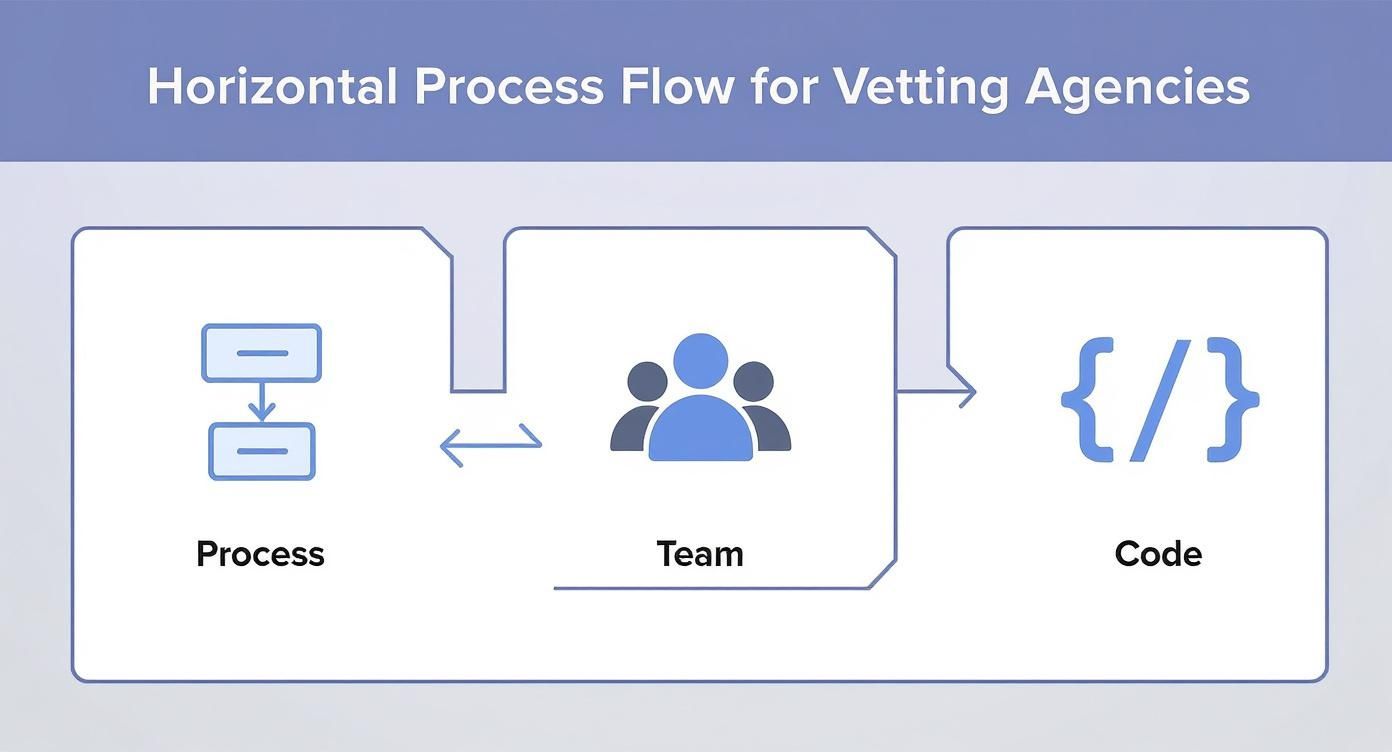
The infographic below gives a clean overview of how to vet your final candidates, zeroing in on their process, the team you’ll be working with, and their technical chops.
Preparing for a Smooth Onboarding
Once the decision is made and the contract is signed, a seamless onboarding sets the tone for the whole project. A little preparation now helps you hit the ground running and sidestep those frustrating early delays.
Get the following assets ready for your new website development agency UK partner:
- Brand Guidelines: This means your logo files (in vector or other high resolution formats), colour palettes, and font specifications.
- Content and Imagery: Hand over any existing text, photos, or videos you want to see on the new site.
- Key Stakeholder Access: Decide who your main point of contact will be. Crucially, make sure they have the authority to give feedback and sign things off to keep the project moving.
The Questions We Always Get Asked
Choosing a web development partner is a big decision, and it’s natural to have questions. Here are the straight up answers to the queries that pop up most often when businesses are weighing up their options.
What’s the Real Cost of a New Business Website in the UK?
This is the big one, and the honest answer is: it depends entirely on what you need. A simple, clean brochure style website could set you back around £3,000 . But if you're looking for a bespoke e-commerce platform with custom integrations, you're more likely in the £15,000 to £50,000+ ballpark.
The only way to get a true figure is to get detailed quotes based on a clear project brief. That way, you’re comparing apples with apples.
How Long Does It Actually Take to Build a New Website?
Realistically, you should budget for anywhere between 8 and 16 weeks . A more basic site can sometimes be turned around quicker, but complex projects with custom coded features will naturally take longer.
A huge factor here is you. The final timeline really hangs on the scope and, crucially, how quickly you can provide feedback and content.
Your involvement is what keeps the engine running. Quick, clear feedback is the difference between a project that sails smoothly and one that gets stuck in the mud. It helps your agency hit deadlines and stay on budget.
Is Ongoing Website Maintenance a Must Have?
In a word, yes. We can't recommend it enough. Think of it like a car's MOT. Ongoing maintenance keeps your site secure with essential updates, monitors performance, takes regular backups, and handles small fixes as they arise.
Most UK agencies offer monthly support plans to keep your site in top shape. Skipping it might save a few quid in the short term, but you're leaving yourself open to security risks and a slow, clunky user experience down the line.
Who Actually Owns the Website When It’s Finished?
You should. Full stop. Any reputable UK web development agency will make sure you have 100% ownership of the website code and all your assets once the final invoice is settled.
Make sure this is explicitly stated in your contract before you sign on the dotted line. It's non-negotiable.
Ready to build a website that does the heavy lifting for your business? The team at Superhub is here to turn your ideas into a digital asset that delivers real results.
Get in touch with us today and let's talk about your project.
Want This Done For You?
SuperHub helps UK brands with video, content, SEO and marketing that actually drives revenue. No vanity metrics. No bullsh*t.