


How to Create a Digital Marketing Strategy That Delivers Real Results
Building a proper digital marketing strategy is about creating a practical roadmap from where you are now to where you need to be. It all starts with an honest audit of your current digital footprint and defining tangible business goals, moving beyond vague ambitions to set outcomes you can actually measure.
Where a Real Digital marketing Strategy Begins
Forget long-winded documents full of corporate waffle. A genuine strategy is a practical tool, not a paperweight. Before you spend a single penny on ads or content, you need a solid foundation built on two things: an honest assessment of your current position and a crystal-clear definition of success.
Too many businesses jump straight into tactics—running ads, posting on social media, redesigning a website—without a clear ‘why’. This is a fast track to wasted budgets and disappointing results. A real strategy forces you to step back and align every single action with a specific, measurable business objective.
Conducting Your Initial Audit
First things first: a no-nonsense audit of your digital footprint. This isn’t about getting lost in complex analytics; it’s about asking tough questions to understand what’s actually working, what’s draining your resources, and where the real opportunities are hiding.
You need to take a hard look at:
- Website Performance: Is your site actually generating leads, or is it just sitting there looking pretty? And how does it perform on mobile?
- Search Visibility (SEO): Can people find you on Google for the terms that matter? What's your local search presence like, especially if you're a Devon-based business trying to attract local customers?
- Paid Advertising (PPC): Are your ad campaigns delivering a positive return, or are you just feeding the machine?
- Social Media Presence: Is it driving genuine engagement and traffic, or are you just shouting into the void?
- Email Marketing: Do you even have a list? If so, are you using it effectively to nurture leads and keep customers coming back?
This initial audit gives you a baseline. Without it, you’re flying blind and can't measure progress or make intelligent decisions.
To help you get started, here's a quick checklist to gauge where you currently stand.
Initial Strategy Health Check for Your UK Business
Use this quick audit to assess your current digital marketing position before building your new strategy.
| Audit Area | Key Question to Answer | Example Goal |
|---|---|---|
| Website Performance | Does our website convert visitors into leads or sales effectively? | Increase website lead conversion rate by 15% in the next quarter. |
| Search Visibility (SEO) | Are we visible on the first page of Google for our top 3 local service keywords? | Rank in the top 3 on Google for "plumbers in Exeter" within six months. |
| Paid Advertising (PPC) | Is our monthly ad spend generating a profitable return on investment (ROI)? | Achieve a 3:1 return on ad spend for our Google Ads campaigns. |
| Social Media Presence | Are our social channels driving qualified traffic to our website? | Increase referral traffic from Instagram to our product pages by 25%. |
| Email Marketing | Do we have a system for capturing and nurturing email leads? | Grow our email subscriber list by 500 new contacts over the next three months. |
This simple exercise will immediately highlight your strengths and, more importantly, your weaknesses.
Setting Goals That Actually Matter
Once you know where you stand, you can define where you’re going. Vague ambitions like ‘increase brand awareness’ are useless. You need tangible outcomes tied directly to your business’s bottom line. The UK digital marketing market is booming, expected to hit USD 47.1 billion by 2033 , and competition is fierce. To get your slice, your goals must be razor-sharp.
Data shows that 54% of UK businesses prioritise boosting sales revenue , while 42% focus on brand awareness and another 42% on customer engagement. It’s worth checking out the full research about UK digital marketing growth to see how your priorities stack up.
The whole process boils down to three distinct steps: auditing your current state, defining clear goals, and then building the plan to connect the two.
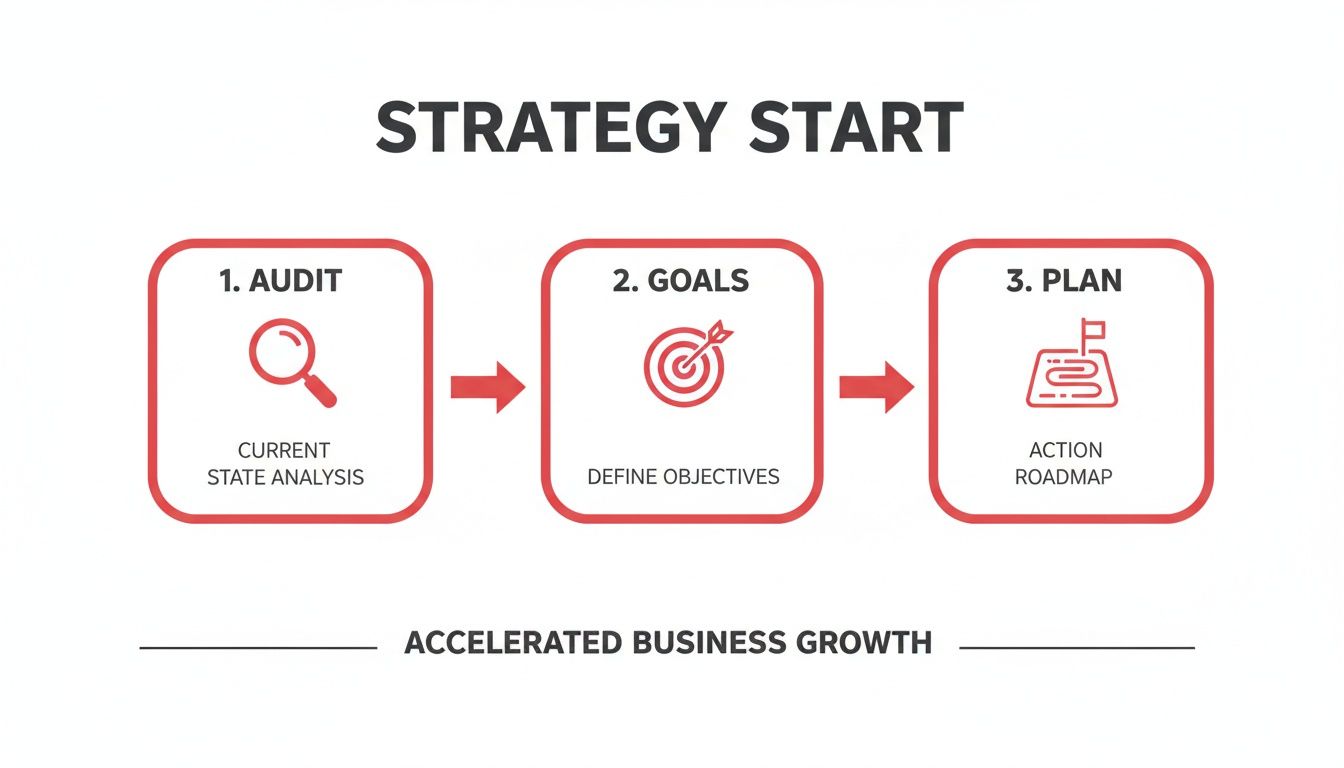
This shows that a successful strategy is a logical progression, not a random collection of marketing activities you hope will stick.
Hold The Bullsh*t Takeaway: Your strategy should be defined by outcomes, not activities. Instead of aiming for "more followers," aim for "generating 20 qualified leads per month for our Devon trades business" or "securing two new sponsors for our BTCC team." This is how you connect marketing spend to real, measurable impact.
Pinpointing Your Audience and Sizing Up the Competition
Stop shouting into the void. The single most expensive mistake in marketing is trying to create something for everyone, because it ends up speaking to no one. A proper digital marketing strategy is built on a deep, almost obsessive understanding of who you’re actually talking to. This goes way beyond basic demographics like age and location.
You need to get inside their heads. What keeps the owner of a UK automotive dealership up at night? It’s probably not just selling cars; it’s managing stock, dealing with technician shortages, and figuring out the massive shift to EVs.
What motivates a tourism business in the South West to pick one agency over another? It’s the promise of filling rooms during the bleak off-season, not just getting a few more Instagram likes.
Get to Grips with Your Customer Personas
To get this kind of clarity, you need to build customer personas. These aren't just imaginary friends; they are semi-fictional profiles of your ideal customer, pieced together from real data and educated guesswork. To make sure your strategy resonates from day one, it’s vital that you start by accurately identifying your target audience.
Building these personas doesn’t need a massive research budget. You can uncover incredibly powerful insights with some practical, no-nonsense techniques:
- Talk to Your Current Customers: Just pick up the phone. Ask your best clients why they chose you, what their biggest headaches are, and what success truly looks like for them. Their own words are your best source of marketing copy.
- Analyse Your Website Enquiries: Sift through the contact forms and emails you get. What specific problems are people trying to solve? What questions pop up again and again? This is a goldmine of genuine pain points.
- Lurk in Online Forums and Social Groups: Where does your audience hang out online? For a motorsport team, it might be niche forums. For a local plumber, it could be community Facebook groups. Listen to their conversations to understand their frustrations and what actually motivates them.
Once you have this information, you can build a detailed profile. Our complete guide on what is a buyer persona walks you through creating profiles that genuinely drive growth and shape your entire strategy.
Conduct a No-Holds-Barred Competitor Analysis
With a clear picture of your audience, it's time to size up the competition. This isn’t about copying what they do. It’s about finding the gaps in the market—the spaces they aren't serving properly—that your business can completely own.
Hold The Bullsh*t Takeaway: Competitor analysis isn't about imitation. It's about strategic differentiation. Find what they’re doing badly or not at all, and make that your core strength.
Start by figuring out who you are really up against. It might not be who you think. Your direct local rival is one thing, but you’re also facing national players and even indirect competitors who offer a different solution to the same customer problem.
Dig for answers to these questions:
- What’s their messaging? How do they position themselves? Are they the cheapest, the highest quality, the most experienced?
- Which channels are they on? Are they dominating organic search (SEO), running aggressive Google Ads (PPC), or are they all over LinkedIn?
- What does their content look like? Are they publishing helpful blog posts, case studies, or video content? Where is it strong, and where is it weak, lazy, or outdated?
- What are their customers saying? Check their online reviews—the good and the bad. The complaints often reveal service gaps and unmet needs you can immediately exploit.
This analysis provides the context for your own strategy. When you understand your audience's needs and the competitive landscape, you can carve out a unique position that makes your business the only logical choice for your ideal customer.
SEO vs PPC: Choosing Your Battlegrounds
Let's be blunt: your budget isn't infinite, so your focus has to be ruthless. Once you've figured out who you're talking to and what the competition is doing, you need to decide where you're going to show up. For most businesses, this boils down to the two heavyweights of lead generation: Search Engine Optimisation (SEO) and Pay-Per-Click (PPC) advertising.
Think of them as two sides of the same coin, not opposing forces. SEO is the long game—methodically building organic visibility and genuine authority over time. PPC is the short game—buying immediate visibility right at the top of the search results. A smart strategy nearly always uses both, but the mix depends entirely on your business, your market, and what you're trying to achieve right now.
For a local, Devon-based tradesperson, a laser-focused local SEO strategy is a no-brainer. You have to be the first name that appears when someone in Torbay frantically searches for an "emergency plumber." But for a national motorsport brand needing instant eyeballs on a new sponsorship package, a targeted PPC campaign is often the fastest way to get in front of the right decision-makers.
Uncovering What Your Customers Actually Search For
Both SEO and PPC live and die by one thing: keywords . This is the language your customers use when they have a problem you can solve. Your job is to decode that language and build your entire search strategy around it.
Keyword research isn't a guessing game. It's a structured process of finding the exact phrases people are typing into Google. The goal is to build a portfolio of terms that cover the full spectrum of intent:
- High-Intent Keywords: These are the "buy now" phrases that scream commercial intent, like "Exeter car dealership deals" or "quote for commercial video production." These are gold for PPC campaigns where every click needs to count.
- Long-Tail Keywords: These are longer, more specific queries like "how to prepare a race car for BTCC sponsorship." The search volume is lower, but the person searching knows exactly what they want. They convert incredibly well and form the backbone of a great SEO content plan.
Don't just fixate on the obvious. Dig into the questions your customers ask you on the phone. Think about the specific problems they describe. That's where you'll find your keyword goldmines.
Structuring Campaigns for Maximum ROI
Once you've got your keywords, you need to structure your campaigns to squeeze the most value out of every pound. For UK businesses, this isn't optional. A huge 67% of B2B marketers see PPC as a crucial part of their strategy. With UK digital ad spend projected to smash the £40 billion mark, the competition is fierce.
Even when overall digital spend hit £35.54 billion , a telling 31% of businesses actively cut their display ad budgets, funnelling that cash into higher-performing channels like search ads. This data confirms a simple truth: you have to invest where you get the best returns.
Hold The Bullsh*t Takeaway: The most powerful approach is nearly always a combined one. Use PPC for high-intent, "money" keywords to drive immediate leads and revenue. At the same time, use SEO to build long-term authority around informational, long-tail keywords that attract and nurture future customers. The PPC data will even tell you which keywords convert best, giving you priceless intel for your SEO efforts.
A well-built PPC campaign groups tightly related keywords into specific ad groups, served with ad copy that speaks directly to the searcher's query. This isn't just good practice; it improves your Quality Score, which lowers your costs and drives up conversions. Our guide to PPC management gives you a no-nonsense breakdown of how to build campaigns that deliver results, not just vanity clicks.
For SEO, the structure is about creating content hubs or "pillar pages" around your core topics. A local tradesperson might have a central page on "boiler repairs" that links out to more specific articles on different boiler models or common faults. This structure signals to Google that you're a genuine authority.
By treating SEO and PPC as a coordinated attack, you're not just choosing channels. You're building a reliable, powerful lead generation engine that pulls in high-quality enquiries from both immediate paid traffic and long-term organic growth.
Building Your Content and Social Media Engine

Content is the fuel for your entire marketing engine. It’s not about knocking out a quick blog post when you remember. It's the hard-hitting case study that proves your value to a sceptical prospect, the documentary-style video that tells your brand’s story, and the social media posts that build a real connection.
Every single thing you create must have a purpose. It should be directly connected to a business goal, whether that’s attracting new leads, nurturing the ones you have, or closing a sale. Different formats work for different stages of the customer journey, and a solid strategy maps this all out from the start.
Creating Content with a Purpose
Forget creating content for the sake of it. A proper digital marketing strategy treats content as a strategic asset, not just filler for your website. This means every video, article, and social post is aligned with a specific job to be done.
-
Awareness Stage: Right now, your audience has a problem but might not even know your business exists. Your content needs to be educational and genuinely helpful. Think "how-to" guides, explanatory videos, or checklists. For a Devon-based tradesperson, this could be a simple blog post on "5 Signs Your Boiler Needs a Service."
-
Consideration Stage: They know who you are, but they're weighing up their options. Content here needs to build trust and show you know your stuff. This is the perfect place for in-depth case studies, detailed service guides, or webinars that put your expertise on display.
-
Decision Stage: The customer is ready to pull the trigger, and you need to convince them you're the right choice. Your content should be direct and reassuring. Customer testimonials, product demos, and offers for a free consultation or quote work wonders at this final hurdle.
Building a plan around these stages ensures your content always lands at the right time. For a deeper dive, it's worth learning how to create a content strategy that actually works and connects with real business goals.
And for a really comprehensive look at content planning, this modern content marketing strategy guide provides some incredibly valuable insights.
Matching Content Formats to Business Goals
Choose the right content type to achieve your specific marketing objective. It's about using the right tool for the job, not just making noise.
| Business Goal | Primary Content Format | Why It Works |
|---|---|---|
| Generate New Leads | Detailed "how-to" guides, downloadable checklists, and practical webinars. | Provides genuine value in exchange for a potential customer's contact information, starting a conversation. |
| Build Brand Authority | In-depth case studies, original research reports, and expert interview videos. | Positions your business as a knowledgeable leader in your industry, building trust and credibility. |
| Drive Sales Enquiries | Customer testimonials, product demonstration videos, and clear service pages with strong calls-to-action. | Overcomes final objections and makes it easy for warm leads to take the next step and make contact. |
| Increase Customer Loyalty | Exclusive email newsletters, behind-the-scenes social content, and customer success stories. | Nurtures the relationship with existing customers, encouraging repeat business and referrals. |
Matching your content format to your goal is one of those small strategic shifts that makes a massive difference to your results.
Taming the Social Media Beast
Right, let's talk social media. Don't fall into the trap of trying to be everywhere at once. It’s a recipe for burnout and mediocre results. Instead, get ruthless. Focus on the one or two channels where your audience genuinely spends their time and attention.
For a B2B manufacturing firm targeting UK-based engineers, LinkedIn is the obvious battleground. But for a local hospitality business in Devon trying to attract tourists, the visual storytelling power of Instagram and Facebook is far more potent.
Mastering social media is a cornerstone of any UK digital marketing strategy, where ad spend is projected to hit a massive £9.95 billion . While 57% of UK businesses are happy with their organic social results, a significant 32% are struggling, which just shows how vital a tailored approach is.
Hold The Bullsh*t Takeaway: Stop chasing trends and algorithms. Pick one platform, learn it inside out, and dominate it. It’s better to be a master of one channel than a clueless amateur on five.
Your content calendar shouldn’t be a constant stream of promotional posts begging people to buy from you. That’s the fastest way to get ignored. Instead, use the 80/20 rule : 80% of your content should be genuinely valuable, helpful, or entertaining. The remaining 20% can then be used to promote your services. This approach builds trust and authority, making people far more receptive when you do finally ask for the sale.
Measuring and Optimising for Real Results
A strategy is useless if it just gathers dust on a shelf. The final, and arguably most crucial, part of this whole process is turning your plan into action and proving it actually works with hard numbers. This is where the budget gets spent and the results are won or lost.
This stage is all about execution, measurement, and relentless improvement. Your strategy isn’t carved in stone; think of it as a living document that needs to adapt based on what the real-world data is telling you.
Setting a Realistic Budget and Allocating Resources
Let's get straight to it: you need a budget. Not a vague idea, but a specific number you can work with. You'll need to decide whether you’re handling the day-to-day execution in-house, outsourcing to a specialist agency like us, or using a mix of both.
Once you have a figure, start allocating it across your chosen channels. If your competitor analysis showed a huge opportunity in local SEO for your Devon trades business, that’s where a decent chunk of your budget should go. If immediate leads are critical for your automotive dealership, PPC will likely need a significant investment right from day one.
Remember to factor in the often-overlooked costs for:
- Tools: SEO software, social media schedulers, and analytics platforms.
- Ad Spend: The actual cash you'll put behind your Google Ads or LinkedIn campaigns.
- Content Creation: Whether that’s writing, photography, or video production.
Focussing on KPIs That Actually Matter
This is where so many businesses get it wrong. They get completely obsessed with vanity metrics—impressions, likes, follower counts. These feel good, but they don’t pay the bills.
Your focus must be on the Key Performance Indicators (KPIs) that are directly tied to your business objectives. Forget the fluff. Zero in on the metrics that track genuine commercial impact.
Hold The Bullsh*t Takeaway: If a metric doesn't connect to revenue, leads, or customer value, it’s a distraction. Focus your attention on the numbers that reflect genuine business health and growth.
For most UK businesses, the KPIs that really count are:
- Cost Per Lead (CPL): How much does it cost you to generate one new enquiry? This is the raw measure of your marketing efficiency.
- Conversion Rate: What percentage of website visitors take the action you want them to (e.g., fill out a form, make a purchase)? This tells you how effective your website and landing pages are.
- Customer Lifetime Value (CLV): What’s the total revenue you can expect from a single customer over their entire relationship with you? This helps you understand how much you can really afford to spend to acquire them.
- Return on Investment (ROI): For every pound you put into marketing, how many pounds do you get back in profit? This is the ultimate measure of success.
Tracking Performance and Building Your Dashboard
You can't manage what you don't measure. The good news is, you don’t need to spend a fortune on complicated tools to get started.
Google Analytics is an incredibly powerful (and free) platform for tracking website traffic, user behaviour, and conversions. Pair it with Google Search Console for essential insights into your organic search performance.
Your goal is to build a simple reporting dashboard. This doesn't need to be fancy; a spreadsheet often works perfectly well. It should give you an at-a-glance view of your most important KPIs, updated weekly or monthly. This simple act forces you to confront the data and holds your strategy accountable.
Continuous Optimisation is Non-Negotiable
Your data will tell you a story. It will show you which channels are firing on all cylinders, which ad campaigns are driving the best leads, and which pieces of content are actually resonating. Your job is to listen to that story and act on it.
This is the process of optimisation.
- If your Google Ads campaign for "motorsport sponsorship packages" has a brilliant click-through rate but a terrible conversion rate, the problem isn't the ad—it's your landing page. Optimise it.
- If a blog post about "common boiler faults" is driving a load of organic traffic for your plumbing business, create more content around related topics. Double down on what works.
- If your email campaigns have low open rates, start testing different subject lines and send times.
This constant cycle of measuring, analysing, and adjusting is what separates a successful digital marketing strategy from a failed one. It’s how you squeeze every last drop of performance out of your marketing spend and ensure your plan delivers real, tangible results for your business.
Your Digital Marketing Strategy Questions Answered

We get it. You've probably heard it all before from other agencies. You’re fed up with jargon, vague promises, and strategies that deliver nothing but an invoice.
Here are some straight-talking answers to the questions we hear most often from UK business owners who just want marketing that actually works.
How Long Does It Take to See Results?
This is the big one. And any agency that gives you a definite answer without knowing your business inside-out is probably lying. The only honest answer is: it depends.
-
PPC (Pay-Per-Click): You can see traffic almost instantly. A well-structured Google Ads campaign can start generating clicks and leads within hours of going live. But the real work is in the weeks and months that follow, using data to fine-tune the campaign until it's properly profitable.
-
SEO (Search Engine Optimisation): This is a long-term investment. Think of it like building a reputation. For a brand new website, it can take 6-12 months to start seeing real traction and first-page rankings for valuable search terms. If you have an established site with some history, you might see positive movement in as little as three months.
Anyone promising you page one of Google in a month is selling you snake oil. Real, sustainable SEO is a marathon, not a sprint.
What’s More Important: SEO or Social Media?
This isn’t a fair fight because they do completely different jobs. It’s like asking a tradesperson whether a hammer or a screwdriver is more important—you need both, but for different tasks.
SEO is about capturing existing demand. People are actively searching on Google for a solution you provide. Your job is to show up as the best answer they can find. This is absolutely crucial for lead generation, especially for service-based businesses like tradespeople, automotive garages, or professional services firms.
Social media is about creating demand. You’re interrupting someone’s feed to build brand awareness, tell your story, and foster a community around what you do. It’s incredibly powerful for visual industries like motorsport, tourism, and hospitality, where you can showcase your brand’s personality and build a loyal following.
For most businesses, the answer is a combination of both. But if your budget is tight, prioritise where your customers actually are. If they’re searching for what you do, focus on SEO. If they’re discovering brands like yours on Instagram, start there.
How Much Should I Spend on Digital Marketing?
There's no magic percentage. Your budget should be based on your goals, your industry, and your business's financial reality. Instead of pulling a number out of thin air, work backwards from what you want to achieve.
Let’s say you’re a Devon-based tourism operator and you want 20 new bookings a month from your website.
- First, what's the average value of one booking? Let's say it's £500 . So, 20 bookings are worth £10,000 in revenue.
- Next, what's an acceptable cost to acquire one booking (your Cost Per Acquisition, or CPA)? If your profit margin is healthy, you might be happy to spend £100 to get a £500 booking.
- Therefore, your target marketing budget is 20 bookings x £100 CPA = £2,000 per month.
This approach ties your spending directly to tangible results, turning marketing from a vague expense into a calculated investment in your growth.
Can I Create a Digital Marketing Strategy Myself?
Yes, you absolutely can. Using the framework we’ve laid out in this guide, any dedicated business owner can build a solid foundational strategy. The real challenge isn’t creating the plan; it's the day-to-day execution and optimisation .
Digital marketing isn’t a "set it and forget it" activity. It requires constant monitoring, analysis, and adjustment. Platforms change their algorithms, competitors adapt, and customer behaviour shifts.
The real value an agency provides isn’t just the initial strategy document; it’s the relentless, daily work of managing campaigns, creating content, and tweaking performance to get the best possible return on your investment.
Hold The Bullsh*t Takeaway: A DIY strategy is a great starting point. But be honest with yourself about whether you truly have the time, expertise, and tools to execute it consistently. Sometimes, your time is better spent running your business while an expert partner handles the marketing engine for you.
Feeling overwhelmed or simply don't have the time to build and execute a marketing strategy that delivers? That's what we're here for. At SuperHub , we cut the fluff and focus on building practical, results-driven marketing engines for businesses across the UK. Get in touch and let's have a no-nonsense chat about what you really need.
Want This Done For You?
SuperHub helps UK brands with video, content, SEO and marketing that actually drives revenue. No vanity metrics. No bullsh*t.