
Organic SEO Services: A No-Nonsense Guide for UK Businesses
Let’s be honest, SEO is full of jargon. So, what are organic search engine optimisation services ? In simple terms, it's all the work that goes into getting your website to show up in the unpaid search results on Google.
Think of it as earning your spot at the top, not just renting it with a monthly ad budget.
So, What Are Organic SEO Services Really About?
When you work with an agency on organic SEO, you're not just buying clicks. You're investing in a long-term strategy to build a genuinely valuable business asset. Unlike paid ads, where your visibility disappears the second you stop paying the bill, organic SEO creates a sustainable flow of traffic that keeps delivering for years.
The goal is straightforward: make your website the best, most authoritative answer to the questions your customers are asking online.
For business owners in competitive UK sectors like motorsport, automotive, or tourism, this is the difference between fleeting ad traffic and building a dominant online presence. It's about pulling in people who are actively looking for exactly what you offer, meaning they arrive ready to engage.
Earning Your Place vs. Buying It
The real split between organic SEO and paid search comes down to trust and staying power. Paid ads get the top banner, sure, but savvy users know they’re ads. A huge number of people scroll right past them, putting more trust in the websites that have earned their place.
The numbers don't lie. Organic search drives 53% of all website traffic , while paid search accounts for just 15% . This tells you everything you need to know about user preference—people trust earned results more than sponsored links.
Building this kind of presence isn't a quick fix or a one-off job; it’s a constant, disciplined process. A good SEO partner doesn't just fiddle with a few keywords and send you an invoice. They run a structured programme of work that covers three core areas:
- Technical Health: Making sure your website is built on a solid foundation that search engines can actually crawl, understand, and index without hitting any roadblocks.
- Content Authority: Creating genuinely useful articles, guides, and resources that answer your customers' questions and establish your business as the go-to expert in its field.
- Credibility Building: Earning trust signals from other respected websites in your industry. These are like votes of confidence that prove your authority to both people and search engines.
This is the work that turns your website from a passive online brochure into a machine that generates qualified leads and sales. It’s what happens behind the scenes to make sure that when a potential client in Devon needs a local tradesperson, or a motorsport fan is searching for BTCC team news, your website is the one they find.
It’s about focusing on what actually moves the needle—leads and revenue—not just chasing vanity rankings. That’s the no-bullshit reality of what you should be getting from organic SEO services.
The Four Pillars of An Effective SEO Service
Let's get straight to it. A proper organic search engine optimisation service isn’t a dark art. It’s a structured, methodical process built on four core pillars. Understanding these demystifies what you’re actually paying for and shows how each one directly contributes to getting you more leads and sales.
Think of it like building a house. You can’t put up fancy walls without a solid foundation, and you can’t attract visitors without making the place look good and easy to navigate. Each pillar is essential; neglect one, and the whole structure becomes wobbly.
The graphic below shows the clear difference between earning your spot at the top through organic effort versus simply renting it with paid search.
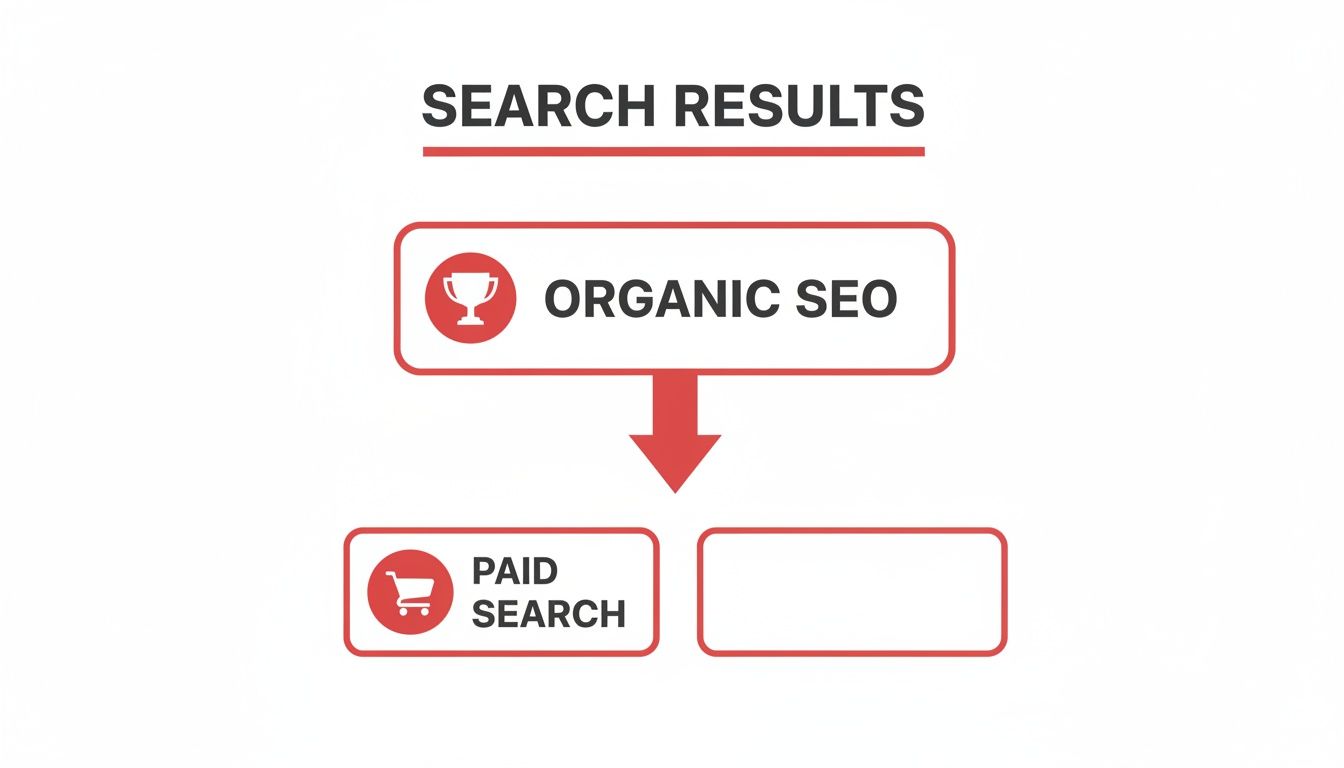
Organic SEO is about building a long-term, authoritative position—that trophy—which creates lasting business value. Paid search gets you clicks today, but organic builds an asset for tomorrow.
To help clarify how these pieces fit together, here’s a breakdown of the four pillars and the tangible impact each one has on your business.
Core SEO Service Components and Their Business Impact
| SEO Component | What It Involves | Direct Business Outcome |
|---|---|---|
| Technical SEO | Fixing site architecture, speed, mobile usability, and crawlability issues. | A faster, more reliable website that search engines can easily index, leading to better rankings and user experience. |
| On-Page SEO | Optimising page content, titles, headings, and internal links for specific keywords and user intent. | Higher relevance for target search queries, attracting more qualified traffic to key pages. |
| Content Strategy | Creating high-quality articles, guides, and resources that answer your audience's questions. | Positions your brand as an authority, builds trust, and attracts natural backlinks and leads. |
| Off-Page SEO | Earning backlinks from reputable websites through digital PR and creating link-worthy content. | Increased domain authority and credibility in the eyes of Google, resulting in higher rankings across the board. |
Each component is a critical part of a holistic strategy. A technically sound site with poor content won't rank, just as great content on a slow, broken site will never be seen. They all have to work together.
Pillar 1: Technical SEO
This is the bedrock of your entire online presence. Technical SEO ensures your website's foundation is solid, secure, and easily understood by search engine crawlers like Googlebot. If Google can't efficiently crawl and index your site, even the best content in the world will remain invisible.
It’s all about removing the roadblocks that stop search engines from doing their job. Key areas include:
- Site Speed: Making sure pages load in a flash. Slow sites frustrate users and get penalised by Google.
- Mobile-Friendliness: Ensuring your site works flawlessly on smartphones and tablets, which is where most people search from now.
- Crawlability: Fixing broken links and submitting sitemaps so search engines can find and understand every important page you have.
Neglecting this is like trying to race a car with a faulty engine. You can dive deeper by reading our complete guide to technical SEO audits for UK businesses.
Pillar 2: On-Page Optimisation
Once the technical foundation is sound, we move to on-page optimisation . This focuses on the content and HTML source code of individual pages, making it crystal clear to both users and search engines what each page is about.
This isn’t about stuffing keywords everywhere. It’s a strategic process of aligning your content with what people are actually searching for. It involves refining page titles, meta descriptions, headings, and image alt text to perfectly match the page’s topic. A well-optimised page answers a user's question directly and provides a seamless experience.
Pillar 3: Content Strategy
Content is the fuel for your SEO engine. Without high-quality, relevant content, you simply have nothing to rank. A cornerstone of any effective SEO service is developing and executing a powerful SEO content strategy that attracts, engages, and converts your ideal customer.
This means creating genuinely useful blog posts, guides, and resources that solve the specific problems your audience has. For a Devon-based tourism business, this could be a guide to the best local attractions. For a national motorsport brand, it might be in-depth analysis of race weekends.
A great content strategy positions you as an authority. It’s not just about selling; it’s about solving problems for your audience, which builds trust and attracts high-quality backlinks naturally.
This is how you demonstrate expertise and build a loyal following that sees your brand as the go-to source of information.
Pillar 4: Off-Page Optimisation
Finally, off-page optimisation is all about building your website's authority and reputation across the web. This is mainly achieved by earning high-quality backlinks from other reputable websites. Think of each backlink as a vote of confidence, telling Google that your content is trustworthy and valuable.
This has nothing to do with buying thousands of spammy links—a tactic that will get your site penalised. It's about genuine digital PR, guest blogging on relevant industry sites, and creating content so good that other people want to link to it. The industry knows this is where the real value lies; the UK SEO software market is projected to reach £8.8 billion by 2030 , driven heavily by SMEs realising they need specialised expertise. This shift shows that businesses are moving away from DIY attempts and towards professional services that deliver real, sustainable results.
Adapting to the New AI-Driven Search Landscape
The way people find information on Google is changing, and it's changing fast. The rollout of features like AI Overviews isn't some far-off tech trend; it's a fundamental shift happening right now. For most businesses, ignoring it simply isn't an option.
This new AI-powered search world is already hitting UK businesses hard, especially in competitive sectors like hospitality, tourism, and automotive where visibility is everything.

This isn't just theory. The data since the UK rollout on August 15th paints a stark picture. If your business relies on search traffic, these numbers demand attention.
The Real-World Impact on UK Businesses
Google’s search dominance in the UK is absolute. It controls 93.35% of the market and a staggering 97.85% on mobile . That makes SEO non-negotiable.
But the introduction of AI Overviews has thrown a spanner in the works. Research on 800 UK companies revealed a dramatic slowdown in organic traffic growth, which plummeted from 26.3% to a mere 3.7% —an 86% decline after the rollout.
The hospitality sector was hit hardest, with growth nosediving from 47.9% to -6.7% , while finance went from +13.1% growth to -1.4% . Even the coveted number one ranking spot isn't safe anymore, with click-through rates dropping 32% from 28% down to 19%.
The data confirms it: the old playbook is no longer enough. Businesses that fail to adapt their organic search engine optimisation services are facing significant traffic losses.
Projections suggest that unprepared brands could see their organic traffic decline by 20-50% . For our clients in the South West's tourism, automotive, and hospitality industries, this isn't just a statistic; it's a direct threat to their lead flow and revenue.
What Is AI Search Optimisation?
So, what’s the answer? It’s not about abandoning SEO; it’s about evolving it. This is where AI Search Optimisation (AEO) comes in.
AEO isn’t a replacement for traditional SEO. Think of it as an essential evolution, designed specifically for this new environment where AI generates direct answers at the top of the results page.
It focuses on a few key areas that are now more critical than ever:
- Fact-Based Content: Creating content that is meticulously researched, accurate, and clearly cites authoritative sources. AI models prioritise factual, verifiable information when constructing their overviews.
- Structured Data: Using advanced schema markup to clearly label the information on your pages. This helps AI understand the context of your content, making it easier to pull into an AI-generated answer.
- Authoritative Signals: Building genuine expertise and authority in your niche. This means creating comprehensive content and earning links from genuinely respected sources, not just any website.
This shift means your goal is no longer just to rank number one. It's to become the primary, trusted source of information that Google's AI uses to answer a user's query directly. Getting this right is complex, which is why we’ve detailed the specifics in our guide on https://www.superhub.biz/what-is-ai-search-optimisation-aeo-and-geo-explained-for-uk-businesses. And to successfully adapt, a practical guide to optimizing your content for AI search becomes indispensable.
Ultimately, this new era of search requires a more sophisticated, no-nonsense approach. It’s about building real authority and structuring your digital presence to feed the AI, not just rank in a list. This is the new front line of organic search, and being prepared is the only way to protect and grow your visibility.
How to Choose the Right UK SEO Agency
Choosing an agency to handle your organic SEO can feel like navigating a minefield. The industry is flooded with providers who talk a good game but deliver little more than confusing reports and excuses.
As a business owner, you don’t need another problem. You need a partner. Cutting through the bullshit means asking the right questions and knowing what to look for. Forget the sales pitch; you need to see hard evidence of their process, their transparency, and their focus on what actually matters—leads and revenue.
Beyond the Sales Pitch: Vetting a Potential Partner
Any agency can show you a graph that goes up and to the right. Your job is to dig deeper to see if those numbers mean anything to your business. Before you even think about signing a contract, get absolute clarity on their methods and how they measure success.
Start by demanding UK-specific proof. Ask to see case studies or examples of results they’ve delivered for businesses like yours, ideally in your sector and region. A generic success story from a US client is completely irrelevant to the challenges of a Devon-based tourism business or a national motorsport team.
Next, put their reporting process under the microscope. This is one of the biggest clues to an agency's real focus.
- Vanity Metrics: Do they obsess over things like keyword rankings for obscure terms or a sudden spike in impressions? These look good on paper but don't pay the bills.
- Business Metrics: Or do they report on numbers that directly impact your bottom line, like qualified leads from organic traffic, phone enquiries, and ultimately, sales revenue?
An agency fixated on vanity metrics is often just hiding a lack of real impact. A results-focused partner connects every single activity back to a commercial outcome. If they can’t show you how their work will generate more business, walk away.
For more on this, check out our comprehensive guide on how to choose a digital marketing agency.
Agency Red Flags vs Green Flags
Knowing the warning signs is just as important as knowing what good looks like. Many agencies rely on secrecy and guarantees they can't possibly deliver, preying on business owners who just want results.
Use this quick comparison table to help you spot the difference between a genuine partner and a time-waster.
Agency Red Flags vs Green Flags
| Red Flag (Avoid) | Green Flag (Look For) |
|---|---|
| Guaranteed #1 Rankings: An absolute impossibility. No one can guarantee specific rankings on Google. | A Focus on Growth Trajectory: They talk about improving visibility, traffic quality, and lead volume over time. |
| "Secret" or "Proprietary" Methods: This is often code for risky, black-hat tactics that can get you penalised. | Transparent Strategy: They can clearly explain their process for technical, on-page, and off-page SEO. |
| Reports Full of Jargon: They send over complicated reports filled with metrics that mean nothing to you. | Reports Focused on KPIs: Their reports clearly show the link between their work and your business goals. |
| One-Size-Fits-All Packages: They offer cheap, fixed packages without understanding your specific business. | Customised Strategy: They take the time to understand your business, industry, and goals before proposing a plan. |
| Poor Communication: They are hard to get hold of, and you feel like you’re chasing them for updates. | Proactive & Clear Communication: They set clear expectations and provide regular, meaningful updates. |
The table above gives you a solid checklist, but here's the real acid test:
The most significant red flag is a lack of curiosity about your business. A good partner will ask probing questions about your sales process, customer value, and commercial goals. If they jump straight into talking about keywords and backlinks without understanding how you make money, they are not the right fit.
Ultimately, choosing an agency comes down to trust and alignment. You need a partner who operates with total transparency, speaks your language (business results, not technical jargon), and has a proven, no-nonsense approach to delivering growth.
Don't settle for anything less.
Measuring SEO Results That Actually Matter
Let's be blunt. Too many SEO reports are designed to confuse, not clarify. They’re often packed with jargon and vanity metrics that make an agency look busy, while your bottom line stays stubbornly flat. We don’t play that game.
Real results aren't about chasing the number one spot for a keyword nobody is searching for. Success is measured in tangible business growth. It's about connecting every single SEO activity directly back to what actually matters: more leads, more sales, and a healthier business.

Key Performance Indicators That Pay the Bills
Forget about impressions and average positions for a moment. A results-focused organic search engine optimisation service tracks the metrics that have a real-world impact. These are the Key Performance Indicators (KPIs) you should actually care about.
- Qualified Organic Traffic Growth: We're not interested in just any traffic. We want to see a measurable increase in visitors who are actively looking for what you sell. These are the people most likely to become customers.
- Lead Generation Volume: This is where the rubber meets the road. We track the tangible growth in enquiry forms, quote requests, and direct phone calls that come straight from organic search.
- Conversion Rate: It’s not just about getting more traffic; it’s about getting the right traffic. An increasing organic conversion rate tells us we’re attracting better-quality prospects who are ready to take action.
- Revenue Impact: The ultimate metric. By integrating with your sales data, we can directly attribute revenue to our SEO efforts, proving a clear return on your investment.
These are the numbers that matter. For a Devon tradesperson, it’s the spike in calls for emergency plumbing jobs. For an automotive dealership, it’s the rise in online bookings for test drives. It's all about connecting SEO directly to your business operations.
Setting Realistic Timelines for Genuine Growth
One of the biggest lies in the SEO industry is the promise of instant results. Genuine organic growth is a marathon, not a sprint. It involves building real authority, earning trust from search engines, and creating valuable assets that pay dividends for years.
Anyone promising you page one rankings in 30 days is either lying or using risky, short-term tactics that will get your website penalised down the line.
Here’s a no-nonsense timeline of what you should really expect:
- Months 1-3 (Foundation & Technical Fixes): The initial phase is all about getting the groundwork right. We run in-depth audits, fix technical gremlins, and start rolling out on-page optimisations. You might see some early positive signals, like better site speed, but significant traffic growth is unlikely at this stage.
- Months 4-6 (Content & Authority Building): This is where momentum starts to build. We’ll be executing the content strategy and starting our off-page efforts to build your site's authority. You should begin to see noticeable improvements in rankings for less competitive keywords and a steady increase in organic traffic.
- Months 6-12 (Growth & Conversion Optimisation): By this point, the strategy is in full swing. We expect to see significant growth in qualified traffic, a clear lift in lead generation, and a measurable impact on your sales pipeline. We’ll be using the data to refine our approach, doubling down on what delivers the best commercial results.
Building a sustainable organic presence takes time and consistent effort. The goal isn’t a temporary rankings boost; it's to create a dominant, long-term asset that becomes your most reliable source of new business.
This methodical approach ensures we build a strong, penalty-proof foundation that delivers compounding returns for years to come, not just a fleeting victory that disappears overnight.
Why Our Approach to SEO Is Different
Let’s be honest. The digital marketing world is drowning in fluff, jargon, and agencies that are great at cashing cheques but terrible at delivering results.
You’ve probably heard it all before: vague promises, confusing reports, and a complete lack of focus on what actually drives your business forward—leads and sales.
We started SuperHub because we were fed up with that status quo. Our approach isn't just different; it's a direct response to the nonsense that plagues our industry. We run on a simple "Hold The Bullshit" ethos. This means we build transparent, results-obsessed partnerships, not long-winded strategy documents that just gather dust.
We Speak Your Language: Industry and Commercials
We don’t just offer generic organic search engine optimisation services . We build specialised strategies from genuine, hands-on experience in the sectors we serve.
We live and breathe motorsport, the automotive trade, and tourism. We get the unique challenges and opportunities inside these industries because we’ve been in the trenches ourselves. This isn’t just a talking point; it's our core advantage. It allows us to build strategies that cut through the noise and connect with your specific audience.
We know the difference between a casual car enthusiast and a serious BTCC fan. We understand the seasonal pressures on a Devon-based hotel. This insight means we craft campaigns that are not just technically sound, but commercially effective from day one.
A Focus on Devon and the South West
While we work with national brands, our roots are firmly planted in Devon. We have a dedicated focus on helping local businesses—from tradespeople in Paignton to hospitality venues across the South West—dominate their local market.
We understand the regional economy and what it takes to win here.
Ultimately, our approach is for business owners who are tired of the usual agency song and dance. It’s for those who want a partner who is as invested in their bottom line as they are.
If you’re ready for a direct, no-nonsense approach to growing your business, then we’re the right fit. We don't just talk about results; we build our entire process around delivering them.
Common Questions About Organic SEO Services
Here are the straightforward answers to the questions we hear most often from business owners before they decide to invest in professional SEO.
How Long Does It Take to See Results from SEO?
Let’s be honest: SEO is a long-game, not an overnight fix. While you’ll likely see positive signals within 3-4 months —things like better technical health or a few rankings popping up for less competitive terms—the real, meaningful growth in traffic and leads typically takes 6-12 months to build.
Any agency promising you page one in a few weeks isn't telling you the truth. The real timeline depends on how competitive your industry is, the state of your website when we start, and the resources you put behind the campaign. Our focus is on building sustainable authority that pays you back for years, not chasing temporary spikes that disappear.
What’s the Difference Between Organic and Local SEO?
Think of it like this: organic SEO is your national or even global strategy. It’s about competing for broad searches, no matter where the customer is. Local SEO, on the other hand, is all about winning the customers right on your doorstep, whether that’s in Devon or across the South West.
Local SEO zeroes in on optimising your Google Business Profile, getting your details consistent across local directories, and targeting searches with geographic intent (like "mechanic near me"). For businesses like tradespeople, garages, or hospitality venues, local SEO is absolutely non-negotiable. A smart strategy often blends both to make sure you’re visible everywhere that matters.
Can I Just Do SEO Myself Instead of Hiring an Agency?
You absolutely can learn the basics of SEO, and it’s a great skill for any business owner to have. The reality, though, is that proper SEO demands a huge time commitment, expensive specialist software, and constant learning to keep pace with algorithm updates and what your competitors are doing.
For most busy owners, the time it takes to do it right is far more costly than hiring a specialist. An agency brings the experience, tools, and dedicated focus that’s almost impossible to replicate while you’re also trying to run your business. You're not just paying for tasks to be ticked off a list; you're investing in expertise.
The real value of an agency isn’t just in the execution. It’s the strategic oversight that connects every SEO action directly to your commercial goals. It frees you up to do what you do best—run your business.
How Much Should I Expect to Pay for SEO Services in the UK?
SEO costs in the UK can vary wildly depending on the size of your business, your goals, and how cut-throat your industry is. A word of warning: be very wary of cheap offers. They almost always involve cutting corners or using risky tactics that can get your website penalised in the long run.
Most reputable agencies work on a monthly retainer, which could be anywhere from a few hundred to several thousand pounds. The key is to see it as an investment, not a cost. The right SEO partner will deliver a return that makes their fee look like a bargain, all through measurable growth in your leads and sales.
Tired of the agency runaround and ready for a no-bullshit approach that delivers real results? SuperHub builds SEO strategies focused on your bottom line. Get in touch today to discuss how we can drive your business forward.
Want This Done For You?
SuperHub helps UK brands with video, content, SEO and marketing that actually drives revenue. No vanity metrics. No bullsh*t.