
A Guide to Developing a Brand That Truly Connects
Developing a brand is about so much more than just getting a logo made. It is the strategic, nuts-and-bolts process of shaping the entire perception —that gut feeling—a customer has about your business. It goes way beyond the visuals to define your purpose, your voice, and the promise you make to your audience. Get this right, and you are building the foundations for real loyalty and recognition.
Your Brand Is More Than a Logo
Let’s be honest. When most people think about “building a brand,” their minds jump straight to the creative stuff—a sharp logo, a slick website, a cool colour palette.
And while those things are absolutely part of the equation, they are the expression of the brand, not the brand itself. Real brand development is an intentional, strategic process, not just a design sprint.
It is about deliberately crafting every single experience a customer has with your business. This journey takes a simple idea and turns it into a living, breathing thing with a distinct personality and clear values. For a startup, nailing this from day one sets the stage for growth that lasts. For an established business, it is a critical tune-up to stay relevant and keep the competition on their toes.
The whole thing is a journey, moving from initial discovery right through to launching in the market.
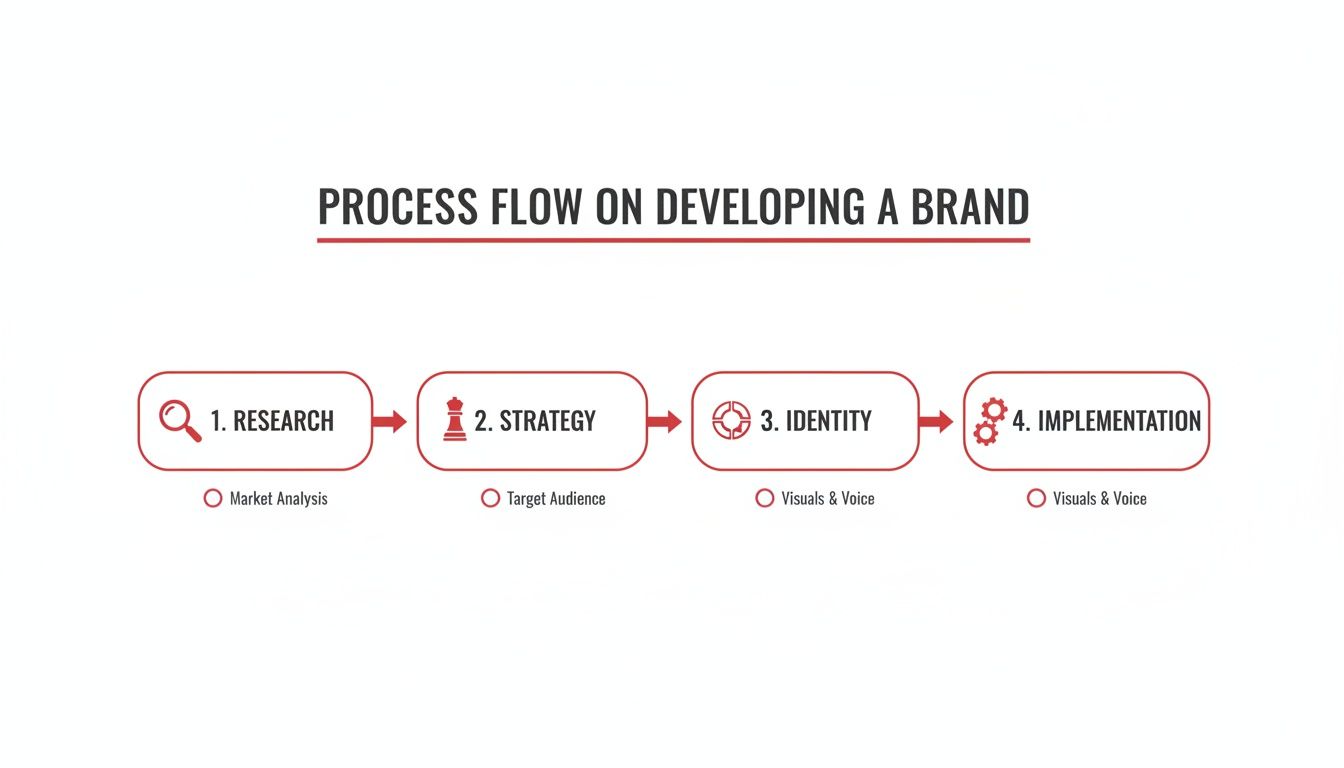
As you can see, a successful brand is built in stages. Each step informs the next, making sure the final identity is not just a pretty face, but something authentic and strategically sound.
The Strategic Imperative of Branding
So, why is being so strategic about developing a brand this important? Because in a crowded market, your brand is what makes you different. It is what helps a customer pick you over a competitor, even when your products are almost identical. It is the sum of all the feelings, thoughts, and experiences that exist in your audience's mind.
This is not just theory; the numbers back it up. The UK brand consultancy industry is on track to hit £2.0bn by 2026 , which tells you just how seriously businesses are taking this. The biggest slice of that pie is brand strategy itself—the work that defines a company’s purpose, messaging, and core values. It is the soul of the business. You can dig into more data on the UK brand consultancy market growth and see what is driving it.
A strong brand provides clarity, amplifies institutional strengths, and enhances reputation. It does not erase the distinctiveness of individual schools or programmes; rather, it elevates them under a shared narrative.
Grounding Theory in Reality
Throughout this guide, we are going to make this real. We will follow a practical scenario: a new, ambitious startup based in Devon. We will walk through their journey of developing a brand from scratch, showing exactly how a solid foundation is the key to everything that follows:
- Customer Loyalty: Forging that emotional connection that turns one-time buyers into genuine advocates for life.
- Market Differentiation: Carving out a unique spot in the market that competitors cannot just copy and paste.
- Sustainable Growth: Building a resilient framework that can actually support your long-term business goals.
By treating branding as a core business function—not an afterthought—our Devon startup can build an identity that does not just look good, but drives real, tangible results.
Defining Your Brand Strategy and Market Position
Right, you have grasped that a brand is more than a logo. Now for the hard part: building its strategic heart. This is where you get brutally honest about what your brand stands for, who you are actually selling to, and why anyone should care.
Forget fluffy creative sessions for a moment. This stage is about sharp, strategic thinking.
Get this right, and every decision you make—from a new product line to a social media post—will feel aligned and purposeful. Skip it, and even the most stunning visual identity will wander aimlessly, failing to connect with anyone.
Uncovering Opportunities with Market Research
Before you can say who you are, you need to know who you are up against and who you are talking to. That means diving headfirst into market and competitor research. The aim is not to copy what everyone else is doing; it is to find the gaps they have missed. Where are the unmet needs? The ignored audiences? The tired, overused messages?
Get focused on these key areas:
- Market Analysis: What is the real size of your market? What trends are genuinely shaping your industry, and where is the growth?
- Competitor Deep Dive: Do not just list your rivals. Stalk them. Analyse their messaging, their visuals, their pricing, and what their customers are saying. Where are they strong? More importantly, where are they weak?
- Audience Insights: Who are the real people buying in this space? What keeps them up at night? What problems are they facing that your competitors are completely ignoring?
This is not just academic. Proper brand development drives real financial growth. Just look at the Kantar BrandZ Top 75 Most Valuable UK Brands—they saw an 8% surge in value, driven by strong consumer opinion. Brands like Tetley (up 65% ) and Deliveroo (up 62% ) proved that connecting with the market pays off. You can see more on how UK brands are generating value on Kantar.com.
Defining Your Brand’s Core DNA
With a clear picture of the landscape, it is time to build your brand’s internal compass. This means nailing down a few core components that will guide every single thing you do.
Think of these as the non-negotiables. They are not just slick phrases for your website; they are the principles that steer the entire organisation.
To keep it simple, here is a breakdown of the core elements that every solid brand strategy needs.
Core Brand Strategy Components
| Component | Description | Example (Motorsport Brand) |
|---|---|---|
| Mission | What you do. Your purpose, stated clearly and concisely. | To build the most reliable and accessible racing components for amateur drivers. |
| Vision | Where you're going. The future you aim to create with your brand. | To become the go-to performance partner for the next generation of motorsport talent. |
| Values | How you behave. The core principles that guide your decisions and actions. | Precision, Community, Integrity. |
| Brand Voice | How you sound. The personality and tone that comes through in all communications. | Expert but approachable. Confident, not arrogant. Passionate and technical. |
These pillars—mission, vision, values, and voice—are the foundation of your brand's identity and must be reflected in your actions.
Your brand’s core DNA is its promise. It is the clear, consistent commitment you make to your customers and your team. It sets expectations and builds the trust you need for people to stick with you for the long haul.
For example, if "sustainability" is a core value, it better show up in your supply chain and packaging, not just in a blog post.
Carving Out Your Space with Brand Positioning
You know the market, you know yourself, now you need to decide where you fit. This is about claiming a distinct and memorable space in your customer's mind. To do that, you first need to understand what brand positioning really means for your business.
Let’s stick with the motorsport brand example. It could position itself based on:
- Raw Performance: For the track day purists who crave cutting-edge tech and raw speed.
- Classic Heritage: For the collectors who value history, craftsmanship, and timeless design.
- Accessibility: For the newcomers who need affordable, reliable gear to get started.
Each of these positions speaks to a completely different person with a different set of priorities. Your choice has to be deliberate, defensible, and directly informed by the gaps you found in your research.
If you are looking for a deeper dive, check out our complete guide for UK businesses on brand positioning. This single strategic choice will dictate your messaging, product features, pricing, and the entire customer experience. It is the final, crucial bridge between your internal strategy and how the world sees you.
Crafting Your Visual and Verbal Identity
With a solid strategy mapped out, it is time for the fun part: bringing your brand to life. This is where we translate abstract ideas like ‘positioning’ and ‘values’ into tangible assets people can actually see, hear, and feel. We are creating a consistent look and feel that tells your story without you having to say a single word.
This creative process is all about building the sensory layer of your brand. It covers everything from the logo on your website to the tone of voice in an email. Getting this right is absolutely critical for building recognition and, even more importantly, trust with your audience.
Building Your Visual Foundation
Let’s be clear: your visual identity is so much more than just a logo. It is a complete system of design elements, all working together to create a cohesive and instantly recognisable look. Done right, this system ensures that whether a customer sees a social media post, an online ad, or your product packaging, they know it is you in a split second.
Here are the key components of a robust visual identity system:
- Logo and Variations: This is your primary brand mark, but do not stop there. You need to think about how it will adapt. You will need versions that work on dark backgrounds, in a single colour, or as a tiny favicon in a browser tab.
- Colour Palette: Colours are shortcuts to emotion and can become one of your most powerful brand assets. Define a primary palette for everyday use and a secondary one for accents. This gives you consistency but also allows for a bit of creative flexibility.
- Typography: Your fonts have a personality. Select a primary and secondary typeface that reflects your brand’s character. A traditional serif font might suggest heritage and authority, while a clean sans serif can feel modern and approachable.
- Imagery Style: You need to define the mood and style of your photography and illustrations. Are your images bright, sharp, and optimistic, or are they more moody and atmospheric? Consistency here is just as important as it is with your logo.
Think of these elements as the building blocks of your brand's visual language. When you use them consistently, they create a powerful and immediate connection with your audience.
A brand’s visual identity is its uniform. It tells people who you are and what you stand for at a glance, creating a shortcut to recognition and trust in a crowded marketplace.
Finding the Right Creative Partner
Once you have defined your visual components, you need someone to bring them to life. This usually means choosing between a freelance designer or a full service agency. There is no single right answer here—the best choice really depends on your budget, timeline, and how complex your needs are.
A freelancer often gives you a more personal, direct working relationship and can be more cost effective for specific tasks like a one-off logo design. An agency, on the other hand, brings a whole team of specialists to the table—strategists, designers, copywriters—offering a more integrated approach that is perfect for a complete brand overhaul.
Whoever you choose, the key to success is a well-written design brief. This document is your chance to clearly outline your brand strategy, target audience, core message, and visual preferences. The more detail you can provide, the better the creative outcome will be. It is as simple as that.
Defining Your Brand Voice and Messaging
While sharp visuals grab attention, it is your verbal identity that builds the relationship. It is how your brand speaks. A consistent tone of voice makes sure your brand's personality shines through in every single piece of communication, from a big, bold website headline to a quick customer service reply.
Is your brand witty and informal, or authoritative and serious? To figure this out, go back to your core values and your audience. A fintech company targeting serious investors is going to sound very different from a Gen Z-focused fashion label.
Once you have nailed your tone, it is time to develop your messaging pillars . These are the 2-4 core themes or ideas your brand talks about, time and time again. They become the bedrock of all your content, ensuring that everything you create reinforces what you are all about.
For our Devon motorsport brand, the pillars might look like this:
- Uncompromising Performance: All about the engineering excellence and track-proven results.
- Community Driven: Highlighting customer stories and their involvement in grassroots racing.
- Accessible Expertise: Focussing on offering technical advice and support to help drivers improve.
This verbal framework guides all your content creation, making sure every single word serves a strategic purpose. You can learn more about codifying these elements by reading up on how to create brand guidelines that actually work.
Ultimately, a strong verbal identity makes your brand sound human and relatable. It moves beyond just describing what you do to conveying who you are. This consistency is especially vital across all your different online channels. To keep everything aligned, creating an essential social media branding guide is a smart move.
Activating Your Brand in the Digital World
All that hard work on strategy and visuals? It is just theory until it meets an audience. Activating your brand is where the rubber meets the road—taking your brilliant ideas and weaving them into the digital platforms where your customers actually hang out. This is where your brand stops being a slide deck and starts breathing.

It is all about creating a consistent world for people to step into. From the way your website flows to the tone of a single tweet, every touchpoint has to feel like it came from the same brain.
Weaving Brand into Your Website Experience
Think of your website as your brand's home base. It needs to do more than just look pretty; it has to feel like you. This is where your brand directly shapes the user experience (UX) —how someone feels using your site—and the user interface (UI) , the actual buttons and menus they click.
A great branded website uses your visual identity to guide people. Your colour palette should make calls-to-action pop. Your fonts need to be readable while still oozing personality. Your images must tell a story that makes sense.
Here is how this works in practice:
- Navigation: If your brand is all about 'clarity', your site menu should be dead simple and logical. If you are about 'creativity', maybe the journey is more about exploration and discovery.
- Microcopy: Do not neglect the little bits of text. A playful brand might have a 404 page that says, "Oops, let's get you back on track," while a serious one would stick to "Page Not Found." It is a tiny detail that makes a huge difference.
- Loading Animations: Even the moments people spend waiting can be branded. A sleek, minimal animation reinforces a sophisticated identity before the page even loads.
When you bake your brand’s DNA into your site's architecture, you build trust and recognition without even trying.
Your website is not a digital brochure; it is an interactive conversation. Every click and scroll should reinforce who you are and what you stand for.
Creating a Cohesive Social Media Presence
Social media is where your brand’s personality gets to really come out and play, but you have to be smart about it. Each platform is its own little world with unique rules and expectations. What crushes it on LinkedIn will die a painful death on TikTok.
The trick is to adapt, not just copy and paste. Your core message and voice stay the same, but the delivery has to be tailored to the platform.
Let’s take that Devon motorsport brand we talked about. They might:
- Use Instagram for stunning visuals—cinematic shots from the track and behind the scenes engineering deep dives.
- Use TikTok for quick, punchy clips—fast tips on track day prep or the satisfying roar of an engine.
- Use LinkedIn for industry authority—articles on new performance tech or building a career in the motorsport world.
This way, the brand feels natural everywhere it shows up, building a unified identity across the board. And this matters more than ever. UK ad spend is through the roof, jumping 11.4% to £12.5 billion in just one quarter. On top of that, 72% of marketing experts now see social media as a top priority, thanks to social shopping and influencer marketing. You can discover more insights about these marketing trends from We Are Social.
Fuelling Your Brand with Content Marketing
If your brand is a car, content marketing is the fuel. It is how you move your message forward by giving your audience real value, not just a sales pitch. This is your chance to prove you know your stuff, share what you believe in, and tell your story.
A solid content plan needs variety. You cannot just write blog posts and call it a day. You need to create a rich mix of content that appeals to different people on different platforms.
Think bigger. Your content ecosystem could include:
- In-depth Guides: Show you are the go-to expert with comprehensive articles that solve genuine problems for your audience.
- Video Content: Anything from short social clips to epic cinematic drone footage that shows off what you do in a high impact way.
- Case Studies: Nothing builds trust like proof. Tell success stories that show the real world impact of your brand.
- Podcasts or Webinars: Get personal. Let your audience hear your voice and connect with the people behind the brand.
By properly activating your brand across your website, social media, and content, you stop simply developing a brand and start building something that lives and breathes. You create a powerful digital ecosystem that does not just attract customers—it builds a loyal community.
Launching, Measuring and Evolving Your Brand
Getting your new brand out into the world is a massive moment, but it is the start of the journey, not the finish line. The real work begins now.
A brilliant launch is not just a one-off announcement; it is a carefully planned sequence of events designed to build momentum. More importantly, what comes next is a constant cycle of measuring, learning, and tweaking.
This is where your brand proves it has legs. It is about shifting from a static rulebook to a living, breathing part of your business that can react to market shifts and what your customers are telling you. Proper brand management is never "done."
Orchestrating a Killer Launch
Your brand launch has to be more than just flipping a switch on a new website. You need a solid plan that gets everyone—inside and outside the business—on board and excited about the change. A messy, disjointed launch creates confusion and can undo all your hard strategic work.
Think of it as a coordinated campaign on two fronts:
- The Internal Rollout: Your team should be your first and most passionate advocates. Before you even think about going public, make sure they get it. They need to understand the new strategy, the messaging, and the look. Hold internal briefings, give them the assets, and get them hyped.
- The External Launch Campaign: This is the big reveal. It should be a multichannel push designed to create a buzz and introduce your new identity to customers, partners, and the industry. This could involve everything from a press release and an email campaign to a social media takeover and fresh new content.
A brand launch is the first real world test of your strategy. It is your chance to make a deliberate, powerful first impression that lands exactly how you planned.
Measuring What Actually Matters
Once you are live, it is tempting to get distracted by vanity metrics. But to know if your brand development is actually working, you need to measure what impacts the business. That means looking at both hard data and what people are actually saying to get the full picture.
Good measurement proves your ROI and helps you make smart decisions about where to put your effort next. Without it, you are just guessing.
Key Metrics for Measuring Brand Performance
Tracking the right numbers is crucial for understanding your brand's real world impact. Here is a breakdown of what to keep an eye on, splitting metrics into quantitative and qualitative categories.
| Metric Category | Specific Metrics | Why It Matters |
|---|---|---|
| Awareness | Direct website traffic, social media reach, brand mentions, search volume for your brand name. | Shows if people are actively looking for you and if your visibility is growing. It is the first sign your name is getting out there. |
| Perception | Customer surveys, social media sentiment analysis, online reviews, focus group feedback. | This tells you how customers feel about your brand. It is how you find out if your positioning is hitting the mark. |
| Engagement | Social media likes, shares, comments; time on site; newsletter open rates; content downloads. | Measures how actively your audience is interacting with you. This is a strong indicator of genuine interest, not just passive viewing. |
| Conversion | Lead generation, sales figures, customer lifetime value ( CLV ), cost per acquisition ( CPA ). | Directly links your brand activity to bottom-line results like revenue and customer loyalty. This is where you prove the commercial value. |
By tracking a balanced mix of these metrics, you can get a much richer understanding of your brand's health and influence. This ongoing measurement is the foundation for smart, iterative growth.
The Cycle of Brand Evolution
The market does not stand still, and your brand can’t afford to, either. The most successful brands are the ones that listen, adapt, and evolve. This does not mean a new logo every year. It means being willing to refine your messaging, adjust your strategy, and stay relevant to your audience.
This is a continuous loop:
- Gather Feedback: Actively seek out what customers are saying. Use surveys, monitor social media, and have actual conversations.
- Monitor Trends: Keep an eye on your industry, your competitors, and wider cultural shifts. Are there new technologies or customer expectations you need to address?
- Analyse Performance: Use your metrics to see what is working and what is not. Is a particular message falling flat? Is a competitor stealing your lunch?
- Make Strategic Adjustments: Based on what you find, make deliberate changes. This could be as small as tweaking your social media content or as significant as refreshing your core messaging.
Think of your brand as being in a permanent state of "beta." This mindset keeps you sharp and stops your brand from becoming stale or disconnected from reality. For a more formal review, you might need to dig deeper; you can learn more about what a brand audit is and why it matters in our detailed guide. This ensures you are always building on a strong, relevant foundation.
Common Questions About Developing a Brand
Look, it is one thing to talk theory, but it is another thing entirely when you are staring at a budget spreadsheet or feeling the pressure to just get something out there. The brand development journey always throws up a few practical, "how does this actually work?" questions.
Let's cut through the noise and get you some straight answers to the queries that come up time and time again. Think of this as the practical part of the guide – the bit that helps you move from "I should do this" to "I know how to do this."
How Much Should I Budget for Brand Development?
This is the big one, isn't it? And the honest, no-fluff answer is: it depends. A brand development budget is not a simple line item. It is an investment that shifts dramatically based on where your business is at, what you are trying to achieve, and the sheer scope of the work.
A startup finding its feet from day one has completely different needs to an established business overhauling its entire identity. To land on a realistic number, you need to think about a few key things:
- The depth of strategy: Are you starting with a totally blank page, needing deep dive market research and customer persona work? Or do you already have a solid strategic base to build on?
- Your visual identity needs: Is a sharp logo and a core colour palette enough to get you started? Or are we talking a full-blown visual system with custom illustrations, a professional photography suite, and iron-clad brand guidelines?
- Asset creation: How many places will this brand live? A simple website and a couple of social media profiles is a world away from designing product packaging, wrapping a fleet of vehicles, and creating a library of marketing materials.
- Who you partner with: Costs will swing wildly depending on whether you hire a junior freelancer, a seasoned independent designer, or a full service agency with a team of strategists and creatives.
For a small business, a foundational strategy and a basic visual identity could land anywhere between £3,000 and £10,000 . For a more comprehensive project—think a complete brand overhaul and a new website—budgets can easily start at £20,000 and climb from there. The trick is to stop seeing it as a cost and start seeing it for what it is: an investment in your single most valuable business asset.
Can I Develop a Brand Myself?
Absolutely. You can definitely get the ball rolling yourself, especially in those early days. As a founder, you are the one who lives and breathes the mission, vision, and values. No one is closer to the heart of the business. You can absolutely do your own initial competitor research and sketch out who your ideal customer is.
But—and it is a big but—you have to be honest about where professional expertise really moves the needle.
Branding is a strategic function, not just a colouring-in exercise. While you can lay the groundwork, an external perspective is often essential for objectivity and spotting market opportunities you are simply too close to see.
An experienced brand strategist or designer brings that crucial outside-in view. They will challenge your assumptions and make sure your brand connects with customers, not just with you and your team. They also have the technical craft to turn your ideas into a professional, cohesive system that works everywhere. A DIY job can save you cash upfront, but a professional partner almost always delivers a brand that works harder and lasts longer.
How Long Does the Process Take?
Just like the budget, the timeline is all over the place. Rushing it is one of the biggest mistakes you can make. That early strategic work needs time to breathe; it requires deep thinking and proper research.
Here is a rough idea of what to expect, based on the project's scope:
- Basic Brand Identity (For Startups): If you are a small business needing the core strategy, a logo, and key visual elements, you are typically looking at 4 to 8 weeks .
- Comprehensive Branding Project: For a deeper dive with extensive research, full strategy, a complete visual and verbal identity, and guidelines, plan for 3 to 6 months .
- Full Rebrand with Implementation: An established business relaunching its brand across a new website, marketing collateral, and other assets could easily see the project extending to 6 months or more .
Patience is your friend here. The discovery and strategy phases are the foundations of the entire house. If you cut corners there, you will be dealing with the cracks for years to come. A well-paced process ensures the final brand is built to last.
Ready to build a brand that truly stands out? The expert team at Superhub combines strategic insight with creative excellence to help businesses in Devon and across the UK thrive. From initial strategy to digital activation, we provide the tools you need for success. Get in touch with us today to start your brand journey.
Want This Done For You?
SuperHub helps UK brands with video, content, SEO and marketing that actually drives revenue. No vanity metrics. No bullsh*t.