

What Is Link Building in SEO and How Does It Work
At its core, link building is the practice of getting other websites to link back to your own.
Think of these links as a vote of confidence or a personal recommendation. When another website links to you, it signals to search engines like Google that your content is credible, trustworthy, and valuable. The more of these high-quality votes you get, the higher you’re likely to rank.
What Is Link Building? A Simple Analogy

Imagine your website is a brand new shop opening on a bustling high street. You might have the best products and the friendliest staff, but if no one knows you’re there, you’ll struggle to get customers through the door.
Now, what if the owner of a well-known, respected shop next door starts pointing their customers your way? What if they started telling people, “You have to check them out, they’re fantastic”?
That’s exactly what link building does in the digital world. Each link from another website to yours is one of those trusted recommendations.
When a reputable site links to your content, it’s essentially vouching for your credibility. Search engines see these links—often called backlinks —as powerful positive signals. The more high-quality recommendations you gather from other trusted "shops" across the internet, the more authority your own website builds.
Why These Digital Recommendations Matter
This process is a fundamental piece of any serious search engine optimisation (SEO) strategy. Without these digital endorsements, search engines have a much harder time figuring out your website's relevance and authority on any given topic. To see how this fits into the bigger picture, it’s worth reading our guide on what SEO is and how it works.
A strong profile of backlinks helps search engines in a few critical ways:
- Discovering New Content: Links act as pathways for search engine crawlers, helping them find and index the pages on your website.
- Determining Authority: The quality and quantity of your backlinks are key indicators of your site's expertise and trustworthiness.
- Improving Rankings: It's simple—websites with more authoritative backlinks tend to rank higher for their target keywords.
In essence, link building is the art and science of earning these powerful digital recommendations. It’s not just a technical task but a foundational pillar for building a trusted online presence and achieving high search engine rankings.
To get started, it helps to be familiar with a few key terms. This isn't jargon for the sake of it; these are the core concepts you'll come across again and again.
Link Building Key Concepts at a Glance
| Term | Simple Explanation |
|---|---|
| Backlink | A link from one website to another. Also known as an "inbound link." |
| Anchor Text | The clickable text in a hyperlink. SEOs aim for natural, relevant anchor text. |
| Domain Authority | A score (developed by Moz) that predicts a website's ranking potential. |
| Referring Domains | The number of unique websites linking to you. A key metric for link building success. |
| Dofollow Link | The default link type. It passes "link equity" or "link juice" and helps with SEO. |
| Nofollow Link | A link with a rel="nofollow"
tag. It tells search engines not to pass authority. |
Having these terms in your back pocket will make the rest of this guide much clearer as we dive into specific strategies and tactics.
Link Building in the UK
This isn't a fleeting trend; link building has been a cornerstone of UK SEO for well over a decade and remains a major line item in digital marketing budgets for a reason.
In a synthesis of UK focused SEO reports, industry data shows that around 86% of marketers consider link building a crucial part of their overall SEO strategy. This demonstrates just how widely adopted it is across both UK agencies and in-house teams.
Ultimately, understanding link building boils down to a simple idea: building relationships and credibility. It’s about creating content so genuinely useful that other websites want to point their audience your way.
So, Why Are Backlinks Actually a Big Deal?
Knowing what a backlink is tells you half the story. The real magic happens when you connect the dots between these digital recommendations and your actual business goals. Backlinks aren't just a technical SEO box to tick; they're a serious investment in your company’s future.
Search engines like Google lean on backlinks for two massive jobs. First, they use them to discover new pages. When a Google crawler sees a link from a trusted website pointing to your latest blog post, it follows that path. This is how your content gets found and indexed, making it eligible to show up in search results. Without these pathways, your best work might as well be invisible.
Second, and this is the crucial part, search engines use the quality and number of these links to decide how high a page should rank. Every good backlink is basically a vote of confidence, a signal that your content is authoritative and genuinely useful. This trust is what helps you climb the rankings and get seen over your competitors.
It’s About More Than Just Rankings
While better search rankings are the obvious win, the ripple effect of a strong backlink profile goes much further. A single, well-placed link on a relevant, high-traffic website can become a powerful source of referral traffic .
Imagine a popular UK industry blog features your business in an article. The people reading that blog already trust its recommendations. When they click the link to your site, you get a stream of highly qualified visitors who are primed and interested in what you do. This is the kind of targeted traffic that turns directly into leads and sales.
A strong backlink profile isn't just about pleasing Google's algorithm. It's about building a digital reputation that drives referral traffic, cements your brand authority, and opens doors to new business opportunities.
Think of it like getting a positive mention in a respected trade magazine. When an expert source validates what you do, it builds instant credibility with your ideal customers. People are always more likely to do business with a brand they see as a leader.
Building Authority and Real Relationships
A smart approach to link building naturally creates valuable business relationships along the way. To earn great links, you often end up collaborating with other businesses, journalists, and industry influencers. These connections can blossom into joint ventures, partnerships, and other growth opportunities that are worth far more than a simple hyperlink.
By consistently creating content that’s good enough to earn links, you start positioning your brand as an authority. This boosted reputation makes it easier to attract top talent, secure media coverage, and even justify premium pricing for your products or services. It’s a virtuous cycle: visibility builds credibility, and credibility builds more visibility, all driving sustainable growth for your business.
A Strategic Investment, Not an Expense
One of the most common mistakes is viewing link building as a cost. It’s not. It’s a strategic investment with a clear and measurable return. The fact that more and more UK businesses are prioritising it shows just how much commercial impact it has.
Recent surveys found that between 56% and 61% of UK companies and link builders planned to increase their spending in this area. In stark contrast, only a tiny single digit percentage planned to cut their budgets. This shows a massive vote of confidence in its ability to deliver real results. You can explore more UK link building statistics on LinkQuest.co.uk if you want to dig into the data.
Ultimately, every quality backlink you earn helps build a more resilient, authoritative, and profitable online presence. It drives traffic, builds trust, and creates new relationships, making it an indispensable engine for growth.
Dofollow, Nofollow and All The Links in Between
Not all links are created equal. Far from it. To really get what link building is all about, you have to understand that in Google’s eyes, some links are powerful endorsements, while others are just casual mentions. Getting this distinction right is what separates a weak backlink profile from a strong one.
Think of it like this: every link is a conversation between two websites. Some links shout from the rooftops, "This site is fantastic, I vouch for it!" Others just whisper, "Here's a link, but make of it what you will." The way websites send these different signals is through little bits of code called link attributes.
The most important distinction you need to know is between dofollow and nofollow links. These simple tags completely change what a link tells search engines.
Dofollow: The SEO Powerhouse
A dofollow link is the default, the standard, the bread and butter of link building. When another site links to you without adding any special instructions, it’s a dofollow link. This is the good stuff.
This kind of link essentially tells search engines, "I trust this content, and I'm passing my authority over to this page." This transfer of authority—often called "link equity" or "link juice"—is the magic ingredient that helps boost your website’s search rankings. Every high-quality dofollow link you get is a powerful vote of confidence.
Nofollow: The Neutral Handshake
On the other hand, a nofollow
link has a special tag ( rel="nofollow"
) added to its code. This tag is a direct instruction to search engines not
to pass on any of that valuable authority or "link equity."
Websites use nofollow links when they want to point to something without officially endorsing it. You’ll see them everywhere in places like blog comments, social media posts, and forums—basically, anywhere links could easily be spammed. While they won't directly pump up your rankings, they can still be incredibly useful for driving real, human traffic to your site and getting your brand name out there.
The goal is always to get dofollow links, but don’t panic about nofollow ones. A natural, healthy backlink profile will always have a mix of both. In fact, a profile with only dofollow links can look a bit suspicious to Google.
A strong backlink profile, driven by a healthy mix of quality links, creates a powerful chain reaction for your business. It’s a clear path from links to growth.
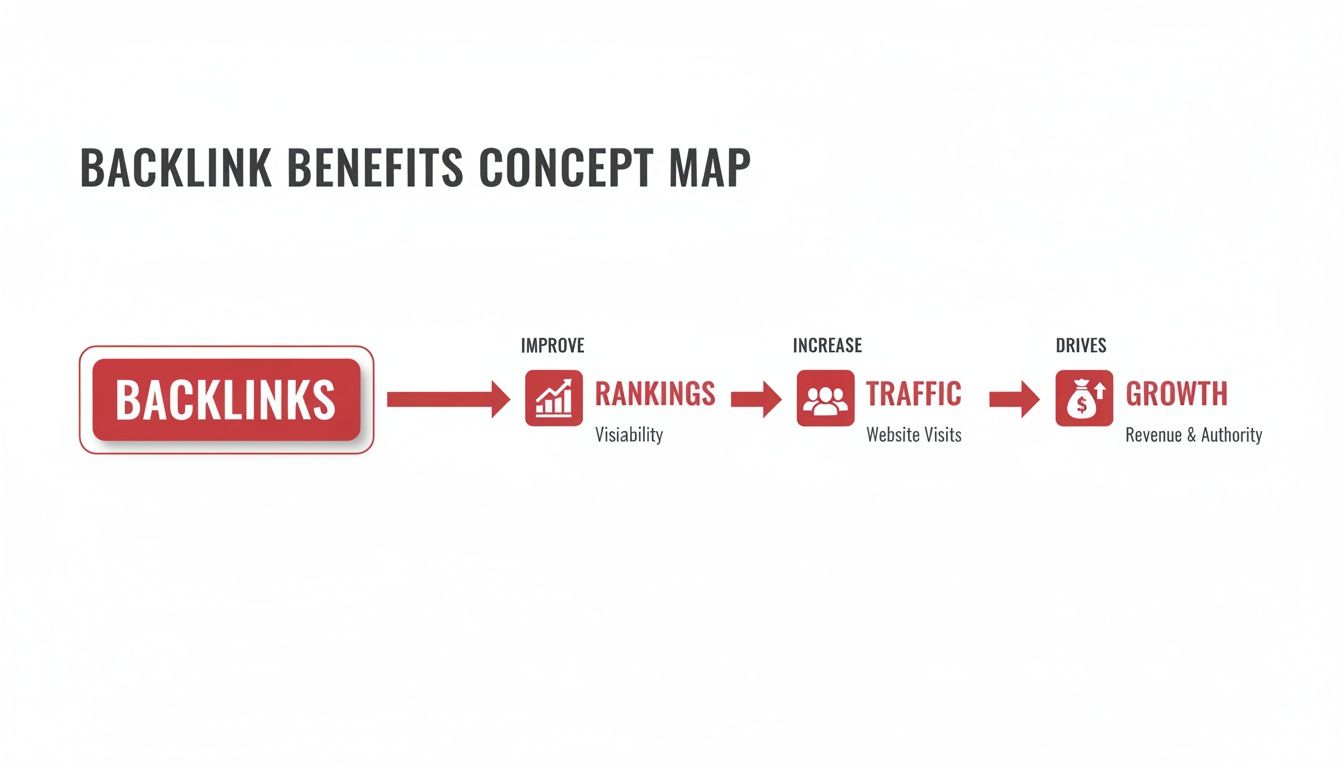
As you can see, it's a straightforward progression: earning valuable links leads to better search rankings, which pulls in more organic traffic and, ultimately, fuels your business.
To make this crystal clear, here’s a simple breakdown of the difference between dofollow and nofollow links.
Dofollow vs Nofollow Links Explained
| Attribute | What It Tells Search Engines | SEO Impact |
|---|---|---|
| Dofollow | "I trust and endorse this page. Pass my authority along." | High. Directly passes authority ("link equity") and helps improve search rankings. This is the primary target for SEO. |
| Nofollow | "Here is a link, but I'm not vouching for it. Don't pass authority." | Low/Indirect. Does not pass authority, so it doesn't directly boost rankings. Can still drive referral traffic and increase brand awareness. |
Understanding this table is fundamental to building an effective link strategy. You need to know which links are actually moving the needle for your SEO.
Other Link Attributes Worth Knowing
It doesn't stop at dofollow and nofollow. Google has introduced a couple more attributes to give even more context, helping you get a clearer picture of the links you’re building.
- Sponsored Links:
These links get a
rel="sponsored"tag. This is for any link that has been paid for, like an advert or sponsorship. It’s a clear signal to Google that it's a commercial arrangement, not a natural endorsement. - User Generated Content (UGC) Links:
The
rel="ugc"tag is used for links created by users, like those in blog comments or forum posts. This helps Google separate editorially placed links from user submitted ones.
How You Get the Link Matters Too
Finally, it’s useful to think about links based on how you got them. This shapes your entire strategy.
- Editorially Earned Links: This is the absolute gold standard. These are links you get because you’ve created something genuinely brilliant—a groundbreaking study, a fantastic free tool, or an article so good that people can't help but link to it. They happen naturally.
- Outreach Based Links: These are the links you work for. You get them by proactively reaching out to website owners, editors, and journalists. This includes tactics like guest posting, spotting and replacing broken links, or pitching to be included on a resource page.
- Self Created Links: These are links you add yourself in places like online business directories, your social media profiles, or forum signatures. These typically have very low SEO value and are often nofollowed, but they still play a small part in building your brand's digital footprint.
Once you grasp these different types and categories, you can stop just counting backlinks and start building a smart, diverse portfolio of links that are relevant, authoritative, and drive real, measurable results for your business.
Proven White Hat Link Building Strategies That Work

Alright, we’ve covered the theory. Now it’s time to get practical and look at the strategies that actually move the needle. Building a powerful backlink profile means rolling up your sleeves and focusing on ethical, or ‘white hat’ , techniques. These are the methods that build genuine trust—with both people and search engines—and deliver results that last.
White hat link building is all about creating genuine value. You’re not trying to game the system or trick algorithms. Instead, you’re creating brilliant content and building real relationships that naturally attract high-quality links. It’s a safer path that avoids Google penalties, but more importantly, it builds a much stronger, more resilient brand over the long haul.
Create Content That Earns Links Naturally
The bedrock of any great link building campaign is exceptional content. It’s that simple. If you create something that’s genuinely useful, insightful, or entertaining, other websites will want to link to it. This is the most organic and powerful way to build real authority.
We often call these "linkable assets" —pieces of content specifically engineered to attract backlinks. They’re the polar opposite of a sales page; their sole purpose is to provide immense value with zero strings attached.
Here are a few types of content that are absolute link magnets:
- Original Research and Data: When you publish unique studies or data analysis, you become the primary source. Journalists, bloggers, and academics are always looking for credible data to cite, and they’ll link directly back to you.
- In-depth Guides and Tutorials: A truly comprehensive, step-by-step guide that solves a real problem becomes a go-to resource. People will bookmark it, share it, and reference it for years to come.
- Free Tools and Calculators: Think about a simple online calculator or a free tool that solves a common frustration in your industry. It's incredibly useful, and people will happily link to it as a helpful resource for their own audience.
Of course, creating the asset is only half the battle. You need to understand the role of content marketing in building brand authority and have a plan to get your masterpiece in front of the right people.
Use Digital PR to Gain Media Coverage
Digital Public Relations (PR) is a powerhouse strategy for landing high-authority backlinks from news outlets and top tier blogs. It’s about creating compelling stories, data, or campaigns that journalists and editors actually want to write about.
Instead of just pitching a product, Digital PR is about finding a newsworthy angle. This could be a unique company story, an interesting piece of industry data you’ve uncovered, or a creative campaign that captures people’s attention.
A single link from a major publication like the BBC or The Guardian sends one of the strongest possible signals of authority to search engines. These editorially given links are the absolute gold standard of link building.
A successful Digital PR campaign can often generate dozens of high-quality backlinks from a single push, giving your site’s credibility a massive shot in the arm.
Try Broken Link Building
This is a clever and highly effective tactic because it provides immediate value to other website owners. The process is straightforward: you find a broken link on a relevant website, you let the site owner know, and you suggest your own content as the perfect replacement.
This strategy works beautifully because you’re helping them fix a problem on their site—a dead link is bad for their users and their SEO. By handing them a great replacement on a silver platter, you make their job easy and dramatically increase your odds of getting that link.
Here’s how it works:
- Identify Prospects: Find relevant websites in your niche that are likely to link to content like yours.
- Find Broken Links: Use an SEO tool to scan their sites for broken outbound links.
- Create Replacement Content: If you don’t already have the perfect page, create it. It needs to be just as good as, if not better than, the original dead resource.
- Reach Out: Send a friendly, helpful email to the site owner, pointing out the broken link and politely suggesting yours as an alternative.
Pursue Strategic Guest Posting
Guest posting means writing an article for another website in your industry. In exchange for your content, you usually get a link back to your own website, either within the article itself or in your author bio.
The key word here, though, is ‘strategic’ . This isn’t about blasting articles out to any site that will take them. The real value comes from contributing genuinely helpful articles to reputable, relevant websites that have their own engaged audience. Steer clear of low-quality sites that exist only for guest posting—they can do more harm than good.
For a deeper look at other proven methods, this guide on 10 SEO Link Building Strategies That Actually Work is a great resource.
Ultimately, proper link building is a serious investment. Industry surveys consistently show that a significant chunk of SEO budgets goes towards link acquisition. One report found that 28% of a typical SEO budget is spent specifically on this activity. Based on UK averages, this means a small to medium campaign could be putting around £3,696 per year towards building links.
How to Measure Your Link Building Success
Link building is hard graft, so you need to know it’s actually moving the needle. Simply counting new links is a vanity metric; it tells you almost nothing about the real impact.
Real measurement is about tracking the right key performance indicators (KPIs) to see how your efforts are affecting your website's performance and, ultimately, your business goals. Are you earning links that genuinely boost your authority? Is that activity driving the right kind of visitors to your site? Answering these questions is how you prove ROI and fine-tune your strategy.
Key Metrics for Tracking Progress
To get a clear picture, you need to monitor a handful of core metrics. Think of it like your car’s dashboard; you don’t just look at the speedometer. You need to check the fuel, the engine temperature, and the oil pressure to know everything is running smoothly.
A solid measurement framework should always include these KPIs:
-
Growth in Referring Domains: This is the number of unique websites linking to you. Getting ten links from ten different high-quality sites is infinitely more valuable than getting ten links from the same one. A steady climb in referring domains is one of the strongest signs of a healthy, growing backlink profile.
-
Backlink Quality and Authority: Let's be clear: not all links are created equal. You have to look at the quality of the sites linking to you. SEO tools like Ahrefs and Moz offer proxy metrics like Domain Rating (DR) or Domain Authority (DA) to give you an idea of a website's strength. While they aren't official Google metrics, they’re incredibly useful for gauging the power of your new backlinks. If you want to go deeper, you can learn more about the impact of Domain Authority on search rankings in our detailed guide.
-
Improvements in Organic Traffic: At the end of the day, the goal is to get more visitors from search engines. A successful link building campaign should lead to a visible, measurable increase in organic traffic. Keep an eye on your Google Analytics, paying close attention to the specific pages you're building links to.
Connecting Links to Business Outcomes
While SEO metrics are crucial, the real proof is in the pudding: connecting your work to tangible business results. This is where you show the true value of your investment.
The most important connection to make is between your link building and your conversions. That could mean tracking more online sales, lead form submissions, or even phone calls that came from organic search. When you can show that the pages earning new, high-quality links are also the ones generating more business, you've built an undeniable case for your strategy.
The ultimate measure of link building success isn’t just a bump in rankings or traffic. It’s a demonstrable contribution to your business’s bottom line. The goal is to turn digital authority into real-world revenue.
Understanding Link Velocity
Another concept you can't afford to ignore is link velocity —the speed at which your website is gaining new backlinks. A healthy backlink profile is built steadily and consistently over time.
A massive, sudden spike in new links can look unnatural and suspicious to search engines, potentially even flagging your site for manipulative tactics. A consistent, gradual pace of acquisition, on the other hand, signals that you're earning links the right way. This approach is far more sustainable and less risky, helping you build lasting authority for your brand.
Common Link Building Mistakes to Avoid
Look, it's easy to get impatient with link building. The temptation to find a shortcut for quick results is strong, but trust me on this – those shortcuts can absolutely wreck your website's reputation with search engines. Getting out of Google's bad books is a long, hard road. The only way forward is to prioritise sustainable growth over dodgy, short term tactics.
Most of these dangerous shortcuts fall under the banner of ‘black hat’ SEO . Think of these as manipulative tricks designed to game the system, not to provide any real value to anyone. They are the complete opposite of the ethical, value first strategies that actually work long term.
What Are Black Hat Tactics?
At its core, black hat link building is all about deception. It’s any attempt to artificially inflate your site's authority without earning it. Getting caught doing this is a direct violation of Google's quality guidelines, and the penalties are severe – we’re talking a catastrophic drop in your rankings or even being completely removed from the search results.
Here are a few of the most common black hat tactics people get suckered into:
- Buying Links: This is exactly what it sounds like – paying another website for a dofollow link just for the SEO juice. Search engines see this as a blatant attempt to buy your way up the rankings, and they crack down on it hard.
- Private Blog Networks (PBNs): This is where someone builds a whole network of websites for the sole purpose of pointing links back to their main "money" site. Google has got incredibly good at sniffing these out and devaluing them entirely.
- Excessive Link Exchanges: This is the whole "I'll link to you if you link to me" scheme. An occasional, natural link swap between relevant sites is fine. But when it's done at scale, it leaves an obvious footprint that search engines flag as manipulative.
Spotting Low-Quality Link Opportunities
Even if you’re smart enough to steer clear of the obviously black hat stuff, you still need to know how to spot and avoid low-quality link opportunities. A bad link might not get you penalised, but it won’t help you either. Worse, it can water down the strength of your overall backlink profile.
The golden rule of safe and effective link building is this: prioritise relevance and value over sheer volume. One fantastic, editorially given link from a top tier site in your industry is worth a hundred rubbish links from irrelevant ones.
Here's a quick checklist of red flags to look out for when you're sizing up a potential link:
- The Website Looks Spammy: If a site is plastered with ads, has terribly written content, or links out to all sorts of random, unrelated topics (think casinos, pills, and payday loans), run a mile.
- Irrelevant Content: A link from a site that has absolutely nothing to do with your business or niche carries virtually no weight and just looks unnatural to search engines.
- Guaranteed Links for a Fee: Any service promising a specific number of links for a fixed price is almost certainly using methods that violate search engine guidelines. Real link building doesn't work like that.
At the end of the day, lasting success comes from earning genuine, high-quality links, not by trying to outsmart an algorithm that's smarter than all of us. When you focus on creating real value and building authentic relationships, you lay a foundation that search engines will reward for years to come.
Common Link Building Questions, Answered
Let's cut through the noise and tackle a few of the most common questions we hear from businesses about link building. Getting your head around these points is the first step to setting realistic goals and making smarter decisions for your campaign.
How Long Until I See Results from Link Building?
This is the big one, isn't it? The honest answer is that link building is a long game, not a quick fix. You’re building authority and trust with search engines, and that doesn’t happen overnight.
While you might spot some small positive movements sooner, you should typically budget for three to six months before you see a really noticeable impact on your rankings and organic traffic. This gives Google enough time to crawl the new links, understand their value, and start rewarding your site for it. Consistency is everything – a slow and steady effort will always deliver better results than short, frantic bursts.
Should I Go for More Links or Better Quality Links?
Quality over quantity. Always. It’s not even a debate in modern SEO.
Think of it this way: one recommendation from an undisputed expert in your field is worth more than a hundred vague compliments from people who don't know your industry. A single backlink from a highly authoritative, relevant website is far more powerful than dozens of weak links from random sites.
Low-quality links are, at best, a waste of time and, at worst, can actively harm your rankings. Your focus should always be on earning genuine endorsements from trusted sources.
What’s the Difference Between Link Building and Digital PR?
It's a great question because the two are very closely related, and often, the best campaigns blend both. The main difference really comes down to their primary goal.
- Link building has one clear objective: acquire backlinks to improve your website's search engine rankings. It's a pure SEO play.
- Digital PR is broader. It’s about getting your brand mentioned in the media to build reputation, awareness, and authority online.
The magic happens when they work together. A brilliant digital PR campaign is one of the most effective link building tactics out there. When you get featured in a top tier publication, you’re not just getting your name out there – you're naturally earning the kind of powerful, high-authority backlinks that SEOs dream of.
Ready to build a backlink profile that moves the needle? The team at Superhub lives and breathes ethical, effective link building that drives real growth. Find out how we can help you climb the rankings.
Want This Done For You?
SuperHub helps UK brands with video, content, SEO and marketing that actually drives revenue. No vanity metrics. No bullsh*t.