


Digital Marketing for Automotive: Growth Strategies for Your Dealership
Being online isn't enough when it comes to automotive marketing. It’s about a specialised, data-driven approach that turns clicks and views into showroom appointments and sales. Standard marketing tactics just don't work because they completely ignore the unique, high-stakes buyer journey and the fierce local competition that defines the UK automotive and motorsport scene.
Why Generic Marketing Fails The UK Automotive Sector
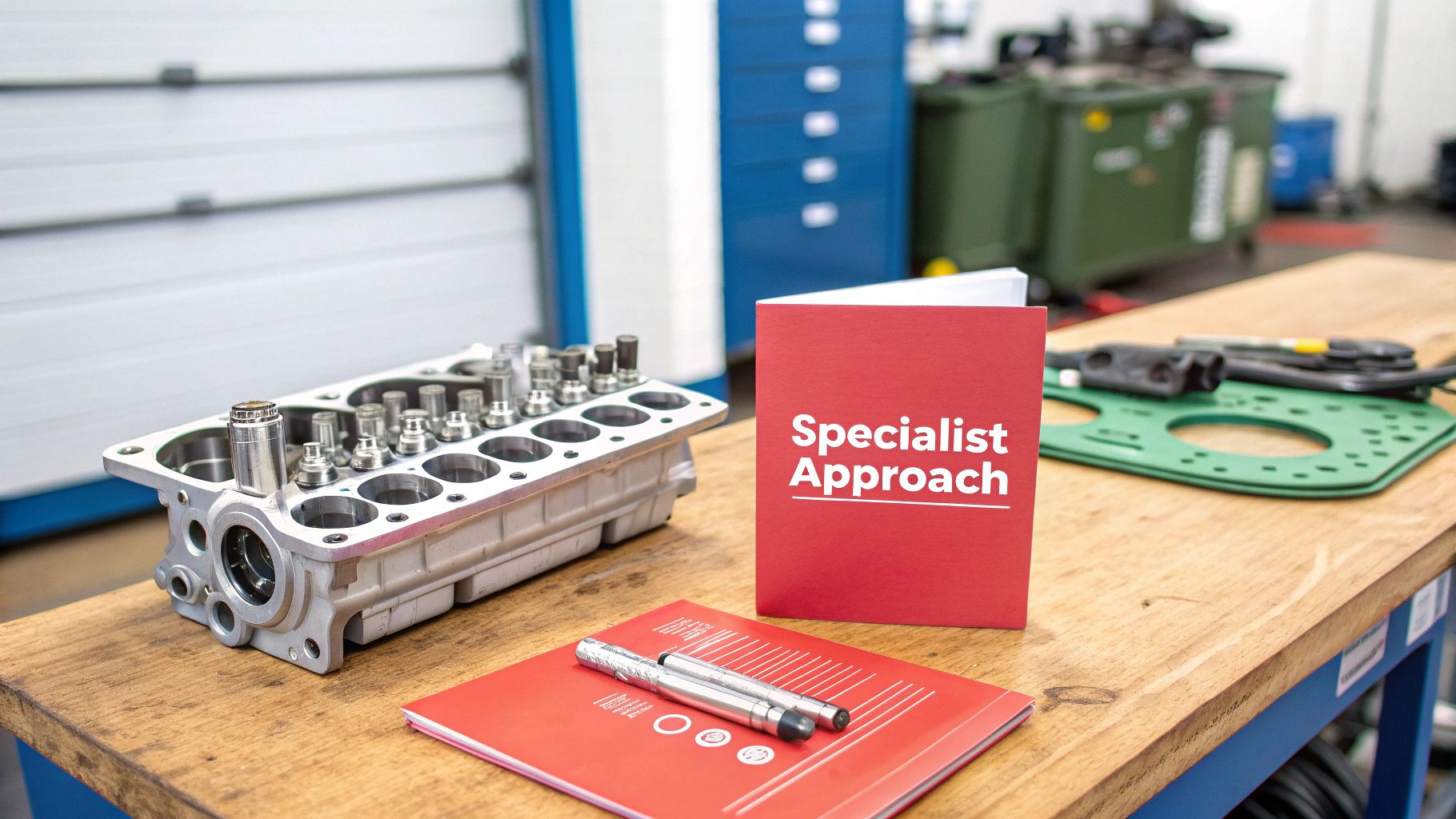
If you're wondering why your marketing budget feels like it’s vanishing with little to show for it, you’re not alone. The UK automotive market is its own beast. Applying a one-size-fits-all strategy is like trying to use a generic socket set on a specialist engine; it just doesn’t fit, and you can end up doing more harm than good.
Most generic agencies treat selling a car like selling a coffee machine. They miss the complex, emotional reality of a high-value purchase and the long, winding road a customer takes before making a decision.
The Unique Buyer Journey
Today's car buyer is incredibly well-informed. Long before they even consider setting foot in a physical dealership, they’ve already sunk hours into online research. In fact, 95% of vehicle buyers use digital platforms as their main source of information, from comparing models on manufacturer sites to watching test drive videos on YouTube.
This journey is anything but linear. A potential customer might:
- Start with a broad search for reviews on a car category.
- Move on to watching specific video walkarounds.
- Check out local dealership inventory and reviews online.
- Look for financing options before they even speak to anyone.
A generic campaign that just hammers "buy now" messages misses all these crucial research stages. It fails to build the trust you absolutely need to turn a browser into a genuine lead.
Fierce Local and Digital Competition
You're no longer just up against the dealership down the road. You're competing with massive national dealer groups, online car marketplaces, and private sellers, all fighting for the same eyeballs on Google and social media.
Your digital showroom is the very first one a customer will visit. If it’s not set up to answer their questions and guide them smoothly, they'll click away to a competitor in seconds—long before they ever think about stepping onto your forecourt.
This intense competition drives up advertising costs, making a highly targeted approach non-negotiable. Spraying your budget across broad campaigns is a guaranteed way to waste money. A specialised strategy, on the other hand, hones in on high-intent local searches and specific customer profiles, making sure every pound spent works towards generating qualified leads, not just meaningless clicks. This is the very core of effective digital marketing for automotive .
Building Your Digital Showroom With SEO
Your website is the most important showroom you own. Long before a potential buyer steps onto your physical forecourt, they’ve already walked through your digital doors. Search Engine Optimisation (SEO) is the key that unlocks those doors and guides genuinely interested buyers inside.
It’s a non-negotiable part of modern digital marketing for automotive businesses. Today, a staggering 76% of vehicle shoppers start their buying process with a search engine . If you’re not visible on that first page of Google, you’re effectively invisible to the overwhelming majority of your market.
This isn’t about ticking boxes with generic SEO. It’s about deploying a targeted, automotive-specific strategy that dominates local search and puts your inventory directly in front of active buyers.
Dominating The Local Forecourt
For most dealerships, winning at SEO means winning locally. When someone searches for a specific car, they’re almost always looking for one nearby. This is where your Google Business Profile (GBP) becomes your most powerful tool.
A fully optimised GBP is what gets you into the coveted "map pack" – those three local results Google displays right at the top of the page. This is prime digital real estate.
To get there, your GBP must be:
- Complete and Accurate: Your dealership name, address, phone number, and opening hours have to be identical everywhere online. Consistency is key.
- Rich with Media: Don't be shy. Regularly upload high-quality photos of your showroom, your current stock, and your team.
- Full of Reviews: Actively encourage happy customers to leave Google reviews and make a point of responding to every single one, good or bad.
- Packed with Information: Use Google Posts to announce new arrivals, special offers, and events. Think of it as your dealership's mini-blog.
This constant stream of activity signals to Google that you are an active, relevant, and trusted local business, pushing you ahead of less active competitors.
Targeting High-Intent Keywords
Great automotive SEO goes way beyond just your brand name. It’s about capturing the exact phrases people use when they are ready to buy. Think like a customer. They aren’t just searching for "car dealership"; they’re searching for things like "used Audi A3 for sale in Devon" or "EV charger installation near Exeter".
Targeting these high-intent, long-tail keywords is crucial. Every single piece of content on your site, from vehicle detail pages to blog posts, should be optimised for these specific terms. This is how you show up at the exact moment a buyer is looking for what you sell. For a deeper dive, our guide on https://www.superhub.biz/seo-for-the-automotive-industry-your-guide-to-driving-traffic provides a full roadmap.
The results of a focused SEO strategy speak for themselves. Recent UK industry data shows that dealerships investing properly in SEO are seeing massive returns. Organic traffic has surged, with some dealer groups reporting increases of over +800% on desktop and +725% on mobile . It’s clear proof that a solid SEO foundation pays huge dividends.
Connecting SEO And Content
Your content and your SEO strategy need to work together to build authority. High-quality vehicle walkaround videos, detailed model review blogs, and side-by-side comparisons don't just engage potential buyers; they supercharge your search rankings.
Every piece of quality content you create is an asset. It acts as a magnet for valuable backlinks from automotive publications and enthusiasts, telling Google that you are a genuine expert in your field. This authority is what pushes you to the top of the search rankings.
This approach positions you as the go-to local expert. When customers watch your videos and read your insightful reviews, they build trust in your brand. By the time they pick up the phone or visit your showroom, they’re already sold on your expertise. For more advanced techniques, this guide on Mastering SEO for Automotive Dealerships provides comprehensive strategies to boost visibility.
Turning Clicks Into Test Drives With Paid Ads
While a solid SEO foundation builds your long-term organic presence, sometimes you just need to get in front of buyers right now. This is where paid advertising comes in. Think of Pay-Per-Click (PPC) platforms like Google Ads as the turbocharger for your marketing, putting your dealership and your stock at the very top of the search results when a buyer is ready to pull the trigger.
The catch? The automotive world is a fiercely competitive arena for paid ads. High demand means a high Cost-Per-Click (CPC), and without a razor-sharp strategy, you can burn through your budget with almost nothing to show for it. Success isn't about outspending your rivals; it's about outsmarting them.
Escaping The High CPC Trap
The average cost to generate a single automotive lead can be eye-watering, often sitting around £225 . A scattergun approach just isn't going to cut it. The secret to a profitable campaign is getting incredibly specific with your targeting, making sure your ads are only ever shown to the most relevant, high-intent audience.
Forget basic location targeting. You need to layer your criteria:
- Behavioural Targeting: Focus on people who have recently visited car review sites, used online finance calculators, or searched for your local competitors.
- Demographic Targeting: Pinpoint your ideal customer by age, income level, or even parental status if you’re promoting a new fleet of family-friendly SUVs.
- Retargeting: This one is huge. Re-engage users who have already been on your website but didn’t make an enquiry. Showing them an ad for the exact model they were looking at is a powerful nudge to bring them back into the fold.
This level of precision means your budget is spent on clicks that are far more likely to turn into actual test drives and sales.
UK Automotive Paid Search Performance Snapshot
It's easy to assume all dealerships pay roughly the same for clicks, but the reality is starkly different. Inefficient campaigns can cost businesses thousands in wasted spend. The table below shows real-world variance in CPCs we've observed among UK dealer groups, illustrating just how much opportunity there is for optimisation.
| Dealership Group | Average Cost-Per-Click (CPC) | Performance Insight |
|---|---|---|
| Group A | £1.85 | Highly optimised campaign with strong ad relevance and targeted keyword strategy. |
| Group B | £4.50 | Moderately targeted but suffering from broad match keywords and low ad quality scores. |
| Group C | £7.20 | Poorly structured campaign with no negative keywords, leading to significant waste. |
As you can see, a smarter strategy doesn't just save a few pence here and there—it can more than triple your budget's efficiency, giving you a massive advantage over less savvy competitors.
Crafting Ads That Actually Convert
Think of your ad copy as your digital sales pitch. It needs to be direct, compelling, and speak directly to what a UK car buyer cares about. Generic, bland ads are a surefire way to get ignored.
So, what should you focus on?
- Highlight Trust Signals: Mention how long you've been in business, your customer review scores, or any local awards you’ve won.
- Create a Little Urgency: Simple phrases like "Limited Stock" or "Offer Ends Friday" are proven to encourage immediate action.
- Be Hyper-Local: An ad that reads "Ford Focus Deals in Devon" will always beat a generic "Ford Focus For Sale" ad when shown to a local searcher. It just feels more relevant.
The single most important element of a successful paid ad campaign is relevance. The journey from the search query to the ad copy to the landing page must feel completely seamless. If a user clicks an ad for a specific model, they must land on a page about that exact model—not your homepage.
Stop Wasting Money With Negative Keywords
Just as important as choosing who to show your ads to is choosing who not to. This is where negative keywords become your best friend. It’s simply a list of search terms you tell Google not to display your ads for, protecting your budget from irrelevant, money-wasting clicks.
For instance, if you only sell used cars, you’d add words like "new," "brand new," and "lease" to your negative keyword list. If you don't offer repairs, terms like "service," "parts," and "MOT" should be blocked.
This simple act of digital housekeeping is a fundamental part of running efficient digital marketing for automotive campaigns. It can save you thousands in wasted ad spend over a year and dramatically improve your return on investment.
Engaging Your Audience With Social Media And Video
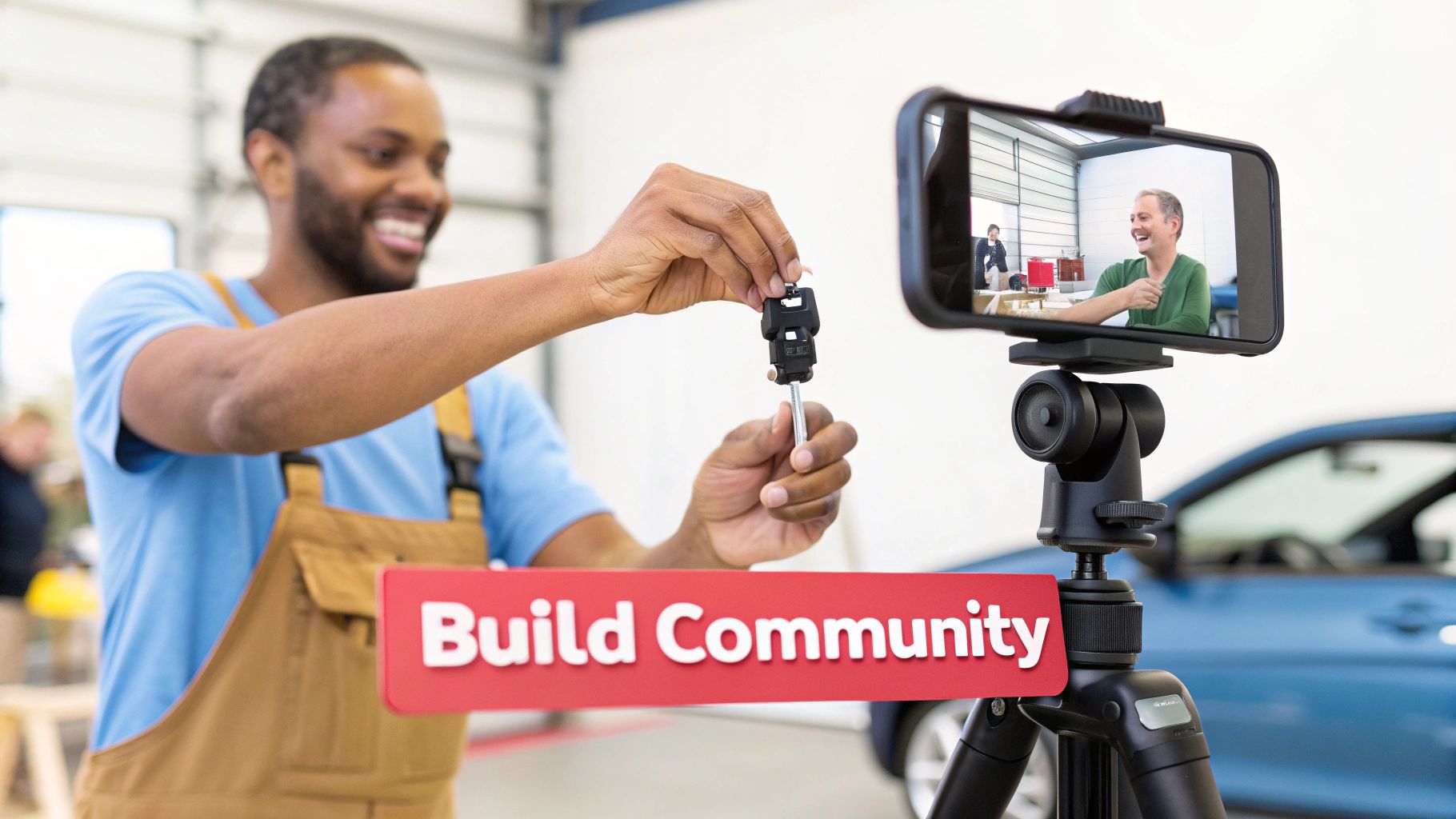
Smart digital marketing for automotive isn’t just about selling cars. It’s about building a brand people trust and a community they genuinely want to join. Social media and video are your most powerful tools for forging these connections, turning passive followers into loyal customers and advocates for your business.
This means getting away from the endless stream of static pictures of cars on the forecourt. Your audience craves authenticity. They want to see the real people and processes behind the badge, building the kind of trust that directly translates into sales.
Beyond The Polished Showroom
Your social media feeds should feel less like a sales catalogue and more like an exclusive, behind-the-scenes pass. The most successful automotive brands don’t just list prices; they use their platforms to tell stories and offer real value.
Think about the kind of content that actually connects with people:
- Workshop Tours: A quick Instagram Reel showing a master technician at work builds massive credibility.
- Customer Handovers: A heartfelt post celebrating a customer collecting their new car creates relatable, powerful social proof.
- Meet the Team: Short video interviews with your sales staff or technicians put a human face on your dealership.
- Quick Tips: A 30-second video on checking tyre pressure is genuinely useful and positions you as a helpful expert.
This isn’t just noise. This is community building. It shows you’re more than just a place that sells cars; you're a trusted part of the local automotive world.
The goal is to make your brand a regular, welcome feature in your audience's daily scroll. When you provide value and entertainment, they'll pay attention when it's time to talk about a sale.
The Unstoppable Power Of Video
If a picture is worth a thousand words, a well-made video is worth a thousand website visits. Video marketing is no longer a 'nice-to-have'—it's an essential driver of engagement and leads in the automotive space. In fact, a staggering 40% of car shoppers discover vehicles they hadn't even considered, all thanks to watching a video.
Platforms like YouTube are absolute goldmines. A well-produced walkaround video of a new model can attract thousands of views from potential buyers actively researching their next purchase. This isn't just content; it's a digital test drive that works for you 24/7. Our guide to video marketing shows you how to captivate your audience with visual content and turn those views into real business.
The UK market has seen a massive shift here. Audience interaction in the auto sector exploded in early 2025, with major brands seeing millions of visits to their apps and websites. This surge is heavily driven by short-form video on TikTok, Instagram, and YouTube Shorts, proving that bite-sized, engaging clips are what capture attention right now. You can discover more insights about these automotive trends on sensortower.com.
Building A Content Calendar That Works
Consistency is the engine of any good social media strategy. Posting randomly when you have a spare five minutes simply won't build momentum. A content calendar is your roadmap, ensuring you have a steady stream of engaging material that lines up with your business goals.
Your calendar should be a strategic mix of different content types, each designed to achieve a specific outcome:
| Content Type | Primary Goal | Example |
|---|---|---|
| Brand Building | Fostering Community & Trust | Behind-the-scenes look at the service department. |
| Lead Generation | Driving Enquiries | Video showcasing a "Car of the Week" with a clear CTA. |
| Educational | Establishing Expertise | "How to..." video on using a car's infotainment system. |
| User-Generated Content | Building Social Proof | Resharing a happy customer's photo with their new car. |
By planning your content, you can make sure it supports key activities, like promoting a new model's arrival or a seasonal service offer. This structured approach transforms your social media from a passive branding tool into an active, lead-generating machine—a core part of any modern digital marketing for automotive strategy that delivers real, measurable results.
Automating Lead Nurturing With Email And AI
Getting a lead is just the starting grid. The real race is won in the follow-up, and honestly, this is where most automotive businesses drop the ball. A lead is only valuable if you actually nurture it, and intelligent automation is the only way to do this at scale without letting good opportunities go cold.
Relying on manual follow-ups is a recipe for failure. Sales teams get swamped, enquiries get missed, and potential buyers lose interest. This is where email marketing, when hooked up to smart automation, becomes one of the highest ROI channels you can have. It lets you stay in front of customers at every single stage of their journey with almost zero manual effort.
Building Your Automated Sales Engine
The goal here is to create automated email sequences—or workflows—that trigger based on what a customer actually does. This makes sure every single prospect gets timely, relevant messages that nudge them closer to a sale. You can get a detailed breakdown of the strategy in our guide that explains what marketing automation is and how it helps UK businesses.
These aren't just generic email blasts. They are targeted conversations, tailored to the individual.
- Post-Enquiry Follow-Ups: Someone enquires about a car. Instantly, an automated sequence can send a thank you, followed by similar models, a video walkaround, and a prompt to book a test drive over the next few days.
- Service & MOT Reminders: Automatically ping customers a month before their MOT is due. This simple act locks in repeat business and keeps your service bays full. It's a no-brainer.
- Personalised Stock Alerts: A customer was looking at a specific model that was out of stock. The second a similar vehicle arrives on the forecourt, an automated alert notifies them.
This approach means no lead is ever forgotten. Every interaction is a planned step in a journey you've designed to lead directly to a sale or a service booking.
Think of automation as your dealership's most reliable employee. It never forgets to follow up, works 24/7, and ensures every single customer gets a consistent, professional experience that builds trust and drives revenue.
Recent UK data shows just how powerful this is. In Q2 2025, targeted automotive email campaigns generated an incredible 263,734 new enquiries . The really specific campaigns, like stock alerts, hit a massive 46% open rate and a 38% click-through rate . Meanwhile, MOT reminders re-engaged customers with a 53% open rate. These figures demolish the performance of generic mailshots. With 60% of UK drivers saying they'd book an MOT early if prompted, it’s a proactive revenue stream you can’t afford to ignore. Read the full findings about these UK automotive benchmarks.
The AI Advantage In Personalisation
The next level in digital marketing for automotive is folding AI into your automation. While standard automation follows a set of pre-written rules, AI can adapt and personalise communication on the fly, making your marketing feel far more human and responsive.
AI-driven tools can analyse a customer's browsing behaviour on your website—the models they view, the finance calculators they use, the blogs they read—to build a unique profile. It then uses this data to deliver hyper-relevant content that actually makes sense to them.
| Feature | Standard Automation | AI-Powered Automation |
|---|---|---|
| Timing | Sends emails on a fixed schedule. | Sends emails when the user is most likely to engage. |
| Content | Sends the same pre-written content to a segment. | Dynamically adjusts content based on individual browsing. |
| Product Suggestions | Recommends pre-selected "similar" models. | Predicts and suggests models the user might like next. |
For example, if a customer spends time looking at SUVs and reads an article on family car safety, an AI system won't send them an offer on a two-seater sports car. It's smarter than that. Instead, it will intelligently send them a video review of your latest SUV, an invitation to a family-focused test drive event, or a tailored finance offer. This level of personalisation at scale was once impossible, but it is now the key to turning casual interest into solid sales.
Your Automotive Digital Marketing Action Plan
Knowledge without action is just noise. This is where we pull everything together into a clear, no-nonsense blueprint for growth. A winning strategy stands on four pillars: specialist SEO, efficient PPC, engaging content, and intelligent automation. This framework is your starting point for putting these ideas to work and getting real results.
Think of this not as a summary, but as a launchpad. Let’s outline the immediate steps you can take to size up your current efforts and pinpoint the biggest opportunities for more leads, whether you’re a local Devon dealership or a national motorsport team.
Assess Your Current Position
Before you can plan your route, you need to know exactly where you are on the map. The first step is a straightforward audit of your existing digital marketing for automotive activities. No jargon, just honest answers.
- SEO Health Check: Where do you actually rank for your most important local keywords, like "[Your car brand] for sale in [Your Town]"? Is your Google Business Profile fully built out and packed with recent, genuine reviews?
- PPC Performance Review: Do you know your true Cost Per Lead? It’s time to dive into your ad campaigns and find out where money is being wasted on irrelevant clicks. Your search term reports will tell you everything you need to know.
- Content and Social Engagement: Take a hard look at your social media insights. What kind of content actually gets likes, comments, and shares? Is your video content driving people back to your website, or is it just getting empty views?
Prioritise The Biggest Opportunities
You can’t fix everything at once, and trying to will only lead to burnout. Instead, focus your energy where it will make the biggest difference, fast. For most automotive businesses, the low-hanging fruit is almost always in local search and plugging the leaks in your lead follow-up process.
The infographic below shows the simple but incredibly powerful flow of nurturing a lead from that first point of contact to a final sale using an automated system.
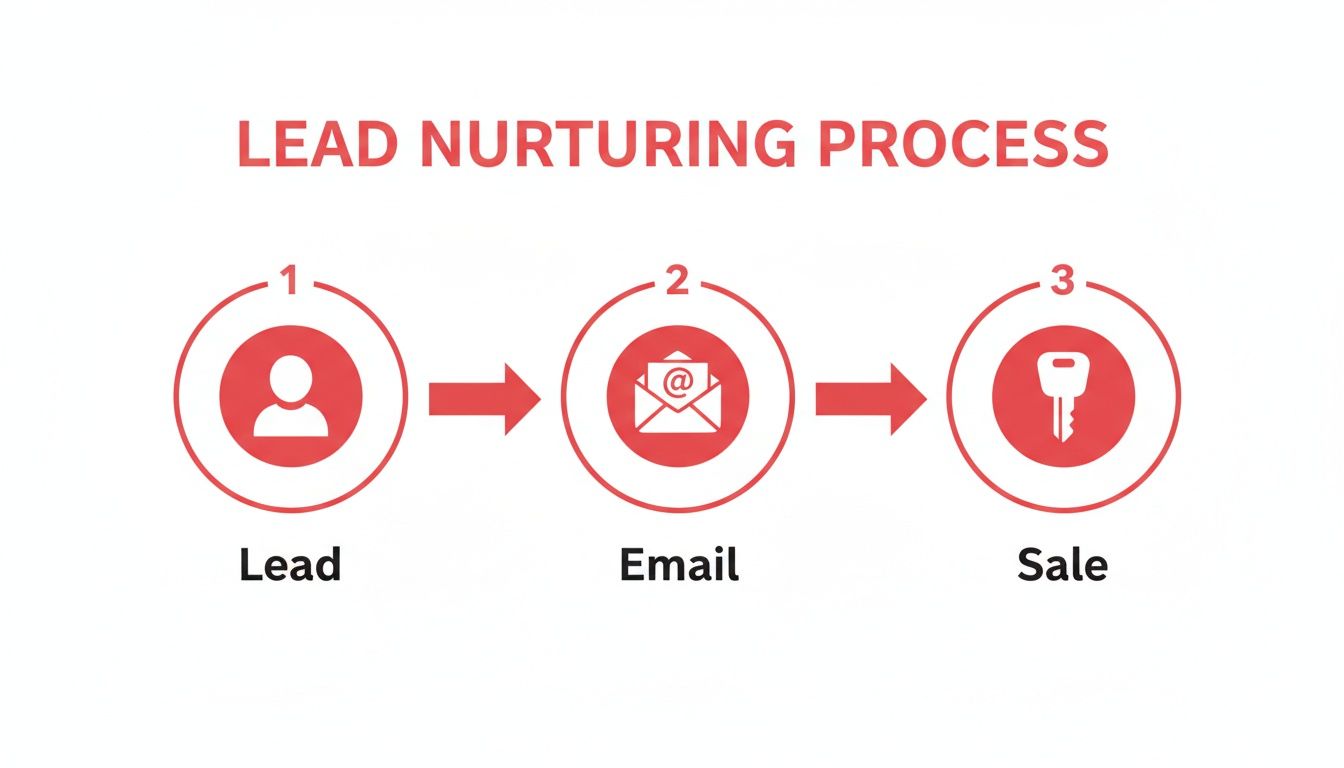
This process isn’t complicated, but it is critical. Having a structured way to nurture interest ensures that potential customers don't get forgotten in a busy inbox.
Your immediate priority should be to set up a simple, automated email follow-up for every single web enquiry. Research shows dealers using marketing automation are twice as likely to see a higher return on investment. It’s the quickest win you can get.
Implement And Measure
Choose one or two key areas from your audit and commit to improving them over the next 90 days . Whether it's completely overhauling your Google Business Profile or setting up that first automated email sequence, the key is to simply start.
Track your progress with clear, simple metrics. Watch your website traffic from organic search, your lead conversion rate from paid ads, and your engagement on social media. This data is the feedback loop that tells you what’s working and what’s not.
To take a broader look at implementing and refining your entire digital strategy, it’s worth exploring other effective digital marketing for automotive strategies. Remember, this is an ongoing process of tweaking and improving, not a one-time fix.
Frequently Asked Questions
A few straight answers to the questions we hear most often from UK automotive and motorsport businesses. No fluff, just what you need to know.
How Much Should A Car Dealship Really Budget For Digital Marketing?
There’s no magic number here, but a solid starting point is 5-10% of your total revenue . The real question, though, isn't about the total spend—it’s about how smart that spend is.
Too many dealerships still burn thousands on poorly aimed ads that get plenty of clicks but no real leads. A better way is to focus every pound on what works: targeted SEO, razor-sharp PPC, and high-value content that brings in qualified enquiries, not just tyre-kickers.
SEO vs PPC: Which One Matters More For Our Business?
Thinking of them as rivals is a common mistake. They're not competing; they're a team. Choosing one over the other just leaves a gap for your competitors to drive right through.
- SEO is your long-term asset. Think of it as owning your digital real estate instead of just renting it. It builds a rock-solid foundation of organic traffic that delivers consistent, high-trust leads for years to come.
- PPC is your short-term accelerator. It’s perfect for getting in front of motivated buyers right now. Use it for new model launches, used car promotions, or seasonal service offers when you need immediate impact.
The winning strategy in digital marketing for automotive businesses uses both in perfect harmony. SEO builds your brand authority for the long haul, while PPC drives immediate action when it counts. Together, they give you total market coverage.
How Can Digital Marketing Help My Motorsport Team Get Sponsorship?
It completely rewrites the sponsorship conversation. Digital marketing transforms your team from just being a logo on a car into a valuable, data-backed media platform that delivers a measurable return for partners.
By building a strong online presence with engaging video, a professional website, and an active social media following, you stop selling empty space and start offering tangible results.
You can walk into a meeting and show potential sponsors hard data on your audience reach, engagement rates, and viewer demographics. This lets you build sponsorship proposals that prove an investment in your team delivers genuine brand exposure and a quantifiable return. It makes you a far more serious and attractive partner than a team that can only offer gut feelings.
Ready to stop wasting your budget and start driving real growth? SuperHub builds bespoke digital marketing strategies for the UK automotive and motorsport sectors. Get in touch with our Devon-based team to see how we can fuel your success. Find out more at https://www.superhub.biz.
Want This Done For You?
SuperHub helps UK brands with video, content, SEO and marketing that actually drives revenue. No vanity metrics. No bullsh*t.