
Go To Market Strategy Template for UK Businesses
Trying to launch a new product without a clear plan is like setting sail without a map or a compass. You might get somewhere, but it probably will not be where you intended. A solid go-to-market strategy template gives you that map, making sure your product actually connects with the right people, with the right message, and delivers a genuine return.
Building Your Go-To-Market Strategy Framework

Let's be blunt: launching anything in the UK market without a detailed plan is a massive gamble. A go-to-market (GTM) strategy is not just another bit of corporate paperwork; it is your operational playbook for success. It gets all your teams on the same page and points your resources in the right direction.
This guide is not about high level theory. It is a practical, step by step walkthrough for building a GTM strategy that works, helping you dodge the common mistakes that sink even the most brilliant products.
The Real Purpose of a Go-To-Market Strategy
So, what does a GTM strategy actually do? For any business, from a startup making its first big splash to an established brand launching a new service, it is about bringing focus and clarity.
At its core, a good GTM plan helps you do three things exceptionally well:
- Nail Your Target Audience: It forces you to get incredibly specific about who your customers are, what keeps them up at night, and exactly how your product solves that problem.
- Get Your Internal Teams Aligned: It makes sure your marketing, sales, product, and support teams are all singing from the same hymn sheet, chasing the same goals. No more silos.
- Spend Your Money Wisely: It shows you where to invest your time, budget, and energy—the channels and activities that will actually move the needle.
Without this structure, teams drift apart, the message gets muddled, and you end up wasting cash on tactics that go nowhere. Think of it as the crucial bridge between your product and your bigger business goals. If you want to dig deeper into the promotional side, our guide on how to write a marketing plan that actually works is a great next step.
A well crafted GTM strategy turns a product launch from a hopeful guess into a calculated, measurable business operation. It gives you the framework to cut through the market noise and drive predictable growth.
Why You Need a Template
Do not just take my word for it—the numbers back it up. A 2025 Vistage UK survey revealed that companies using a formal GTM strategy saw 13% year on year growth in their main market segment. In contrast, those without a plan saw just 5% growth.
The difference came from focus. A huge 78% of businesses with a GTM strategy reported realigning their marketing budgets to double down on their most profitable core markets.
To get you started on the right foot, here's a look at the essential pillars your strategy needs to cover.
Core Components of a Go-To-Market Strategy
| Component | Objective |
|---|---|
| Market Definition | Identify and understand your target market, including its size, trends, and key players. |
| Target Audience | Create detailed personas of your ideal customers and their pain points. |
| Value Proposition | Clearly articulate what makes your product unique and why it is the best solution. |
| Pricing Strategy | Determine a pricing model that reflects your product's value and market position. |
| Channel & Distribution | Select the most effective marketing and sales channels to reach your audience. |
| Messaging & Positioning | Craft the core message that will resonate with your target customers. |
| Launch Plan | Outline the timeline, key activities, and team responsibilities for the launch. |
| Metrics & KPIs | Define how you will measure success and track performance against your goals. |
| Budget & Resources | Allocate the necessary budget and resources to execute the strategy effectively. |
This table provides the skeleton of your GTM plan. To help you flesh this out, a dedicated Go To Market Strategy Template for UK Founders can give you a clear, actionable roadmap. This guide, along with its downloadable template, will equip you to define your market, craft your message, and pick the right channels to hit the ground running.
Pinpointing Your Ideal Customer in the UK Market
Before you sell anything, you need to know exactly who you're selling to. This is not about casting a wide net and hoping for the best; it is about laser focused precision. A successful UK launch lives or dies on how well you understand your audience on a really granular level.
So many businesses fall at this hurdle. They define their market too broadly, which leads to vague messaging that resonates with no one and a marketing budget that disappears without a trace. A solid go-to-market strategy template forces you to get specific and really dissect who you're trying to reach.
We are going to start big and then zoom right in. This ensures your time, money, and effort are all aimed where they will make the biggest impact. Honestly, this step shapes everything that comes next, from your product features to the words you use on your ads.
Sizing Up the UK Market Opportunity
First things first, you need a realistic sense of scale. How big is the prize, really? The best way to do this is to break the market down into three tiers, moving from a massive theoretical number to a tangible, realistic target.
-
Total Addressable Market (TAM): This is the absolute biggest picture view. Imagine you're launching a new EV charging solution. Your TAM would be the entire UK electric vehicle market. It is the blue sky potential.
-
Serviceable Available Market (SAM): This is the slice of the TAM that you can actually serve with what you offer. For your EV charger, maybe your solution only works for homeowners with private driveways in the South East. That is your SAM.
-
Serviceable Obtainable Market (SOM): Now we get real. This is the portion of your SAM you can realistically win. Factoring in your budget, team size, and the competition, you might aim to capture 5% of that market in the first couple of years. This is your immediate, actionable target.
Defining these numbers is not just a box ticking exercise. It gives you a data backed foundation for your sales forecasts and proves to any stakeholders that you've done your homework.
Creating Detailed Buyer Personas
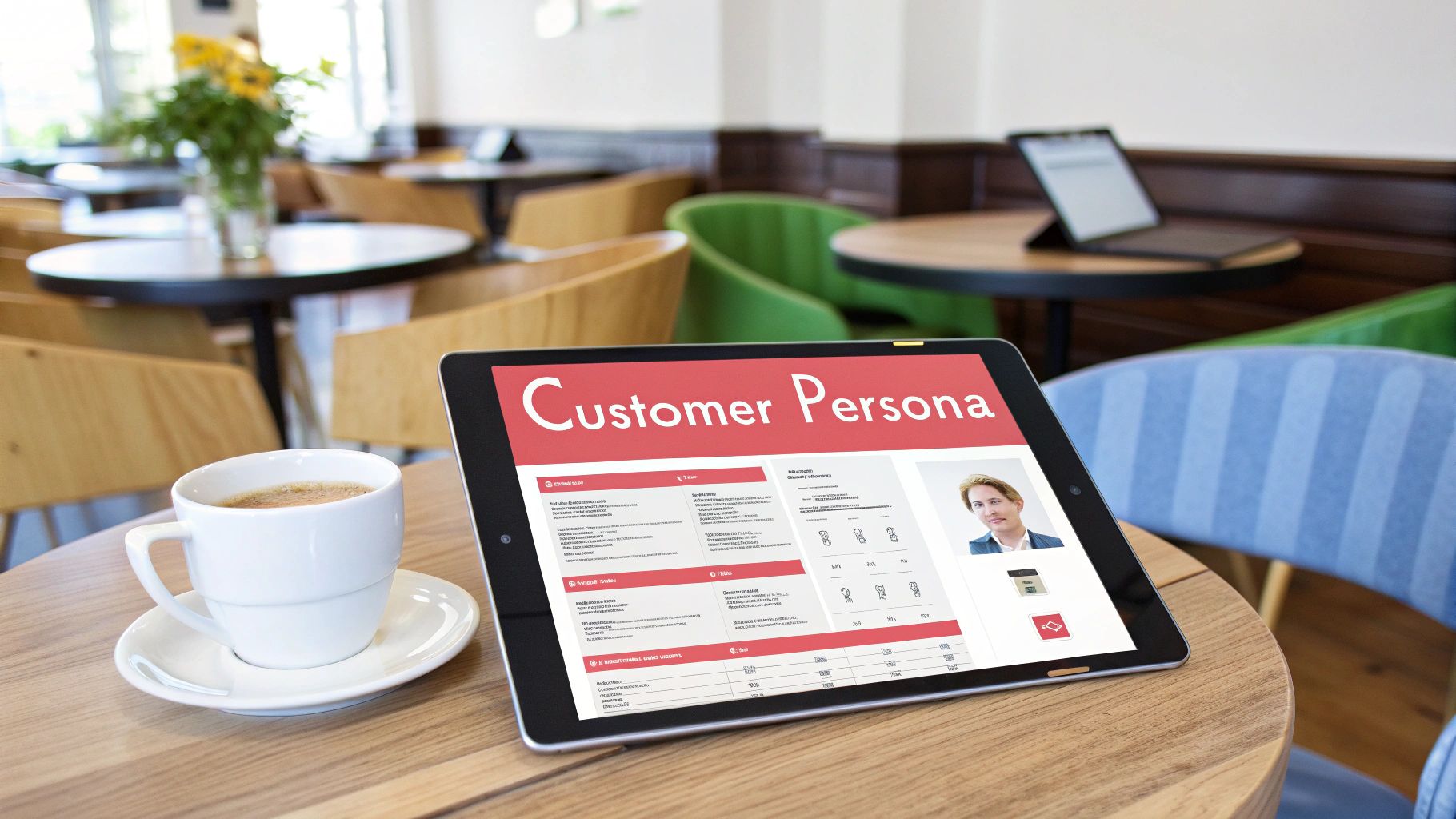
Once you know the size of the pond, you need to figure out what kind of fish you're trying to catch. This is where buyer personas are pure gold. A persona is not just a job title and an age range; it is a semi fictional character that represents your ideal customer, built from real world research and data.
It is about turning raw data into a living, breathing person. Instead of targeting a vague group like 'eco conscious millennials', a sustainable fashion brand in the UK might create someone like this:
Persona Example: 'Sustainable Sarah'
Background: Sarah is a 29 year old marketing manager living in Brighton. She rents a flat with her partner and is genuinely passionate about environmental causes.
Behaviours: She actively looks for brands with transparent supply chains and follows ethical fashion influencers on Instagram. She'd rather invest in one high quality, timeless piece than buy five cheap tops, and she is always scrolling Vinted and Depop.
Pain Points: She is tired of trying to figure out which brands are genuinely sustainable and which are just ‘greenwashing’. She struggles to find stylish clothes that match her values without a ridiculous price tag.
This level of detail is a game changer. It gets your whole team—from the product devs to the marketers—on the same page, focused on the real person they are serving. It tells you how to talk, where to show up, and what problems you actually need to solve. To get even deeper, you should learn what customer journey mapping is and how it can boost your customer experience , as it is the perfect next step after creating personas.
Building these rich profiles is the difference between shouting into an empty room and having a real conversation with people who will become your most loyal customers.
Crafting Your Compelling Value Proposition
In a crowded market, what you do is far less important than why you matter to your customer. That is the entire job of your value proposition: a clear, punchy promise of the unique value you deliver. Honestly, it is the single most important message you will ever create.
It has to answer one simple question from your customer’s point of view: “Why should I buy from you and not your competitor?”
If you cannot answer that instantly and convincingly, your launch is in trouble before it even starts. This part of your go-to-market strategy template is where you build the very core of all your future messaging.
Just to be clear, your value proposition is not a slogan or a list of features. It is a powerful statement about the tangible results someone gets from choosing you.
Uncovering Your Unique Selling Points
Before you can write a compelling value proposition, you need to get brutally honest about what makes you genuinely different. These are your unique selling points (USPs)—the specific advantages that competitors cannot just copy and paste. Think of them as the raw ingredients for your core message.
To nail your USPs, you need to look at three things:
- Your Strengths: What does your business do exceptionally well? Is it your tech, your incredible customer service, or a more sustainable supply chain? Be specific.
- Competitor Weaknesses: Where do your rivals drop the ball? Do they have slow delivery, confusing pricing, or a clunky user experience? Their gaps are your opportunities.
- Customer Needs: What do the customer personas you have already built truly want? This goes beyond features to the real world problems they need to solve.
The sweet spot where these three circles overlap is where your most powerful USPs live. They are the things you do well that your competition does not, which directly solve a real customer headache.
From Features to Benefits
This is one of the most common mistakes I see: businesses talk about what their product is instead of what it does for the customer. People do not buy features; they buy the benefits those features provide. They are buying solutions, not specifications.
It is simple, really. A feature is a technical detail (e.g., “our app has end to end encryption”), while a benefit is the outcome for the user (e.g., “keep your private messages completely secure from prying eyes”). Always translate what you have built into a clear, desirable benefit.
A strong value proposition speaks directly to the customer’s world. It is not about your company’s story or your product’s specs; it is about their problems and your solution.
Let us run through a real world scenario to make this stick.
A Practical FinTech Example
Imagine a UK FinTech startup taking on the big high street banks. Its competitors have massive brand recognition and eye watering marketing budgets. Trying to compete on interest rates alone is a race to the bottom they just cannot win.
So, they focus on the common frustrations we all have with traditional banking: hidden fees, clunky mobile apps, and soul destroying customer service. Their USPs are radical transparency and a frictionless user experience .
Here is how they could frame their value proposition based on benefits, not just features:
| Feature | Obvious (but weak) Benefit | Compelling Benefit |
|---|---|---|
| No hidden account fees | Save money on your banking. | “Bank without the nasty surprises. What you see is what you get, always.” |
| Instant spending notifications | Track your spending easily. | “Stay in complete control of your finances with real time updates on every transaction.” |
| In-app chat support | Get help when you need it. | “Talk to a real human in under a minute, right from the app. No more waiting on hold.” |
See the difference? This approach shifts the entire focus. The message is no longer about the bank’s product; it is about giving the customer power, control, and peace of mind. This compelling message, rooted in genuine USPs, becomes the foundation for every single advert, social media post, and sales conversation they have. It is the engine of their entire GTM strategy.
Picking Your Sales and Marketing Channels
Having an incredible product and a killer message is a great start, but it means nothing if you cannot actually reach your audience. This is the part of your plan where we get into the nitty gritty of where and how you will launch, making sure your value proposition lands squarely in front of the right people.
It is not about being everywhere at once; it is about being exactly where your customers are. The real goal is to choose a smart mix of channels that work together, creating a seamless journey from the first time someone hears about you to the moment they become a loyal fan.
Choosing Your Core Channels
The channels you pick have to line up perfectly with the buyer personas you've already spent time building. Think hard about where they spend their time, where they look for information, and how they make buying decisions. A B2B software company selling to enterprise clients in the UK, for example, is almost certainly going to lean on a direct sales team and laser focused LinkedIn outreach.
On the other hand, a new direct to consumer brand launching a sustainable cleaning product would likely find its audience on Instagram and through partnerships with eco conscious influencers. The trick is always to match the channel to the customer.
Here are some of the main channels you should be thinking about for the UK market:
- Content Marketing & SEO: Creating genuinely useful blog posts, guides, and videos that answer your audience's questions builds your authority and pulls in organic traffic for the long haul. It is the foundation of trust.
- Paid Social Media: Platforms like Instagram, Facebook, and LinkedIn offer incredibly specific targeting, letting you get your message right in front of precise demographics and interest groups.
- Direct Sales: For high value B2B products or complex services, there is often no substitute for a skilled sales team that can build relationships and run demos.
- Email Marketing: Building an email list gives you a direct line to nurture leads and talk to interested prospects, guiding them along their buying journey.
- Affiliate & Influencer Marketing: As you weigh up your options, it is well worth it to explore affiliate marketing strategies as a powerful way to reach new customers through trusted third party advocates.
The Power of an Integrated Approach
Relying on a single channel is a risky game. Today’s customers bounce between multiple touchpoints before they even think about buying. They might see an ad on Instagram, search for reviews on Google, and then sign up for your newsletter. This is exactly why an integrated, omnichannel experience works so well.
The aim is to keep your brand message consistent and effective across every single interaction. A recent analysis shows just how vital this is. According to a 2025 report, UK businesses using omnichannel campaigns in their go-to-market strategy template see 90% higher customer retention rates compared to those stuck on single channel approaches. This is particularly true in the UK’s e-commerce sector, where online shopping is now the go to method for 78% of consumers . You can dig deeper into this by exploring the top digital marketing trends for UK businesses.
An omnichannel strategy does not mean using every channel under the sun. It means picking the right channels and getting them to work together in harmony to create a unified and compelling customer experience.
Mapping Channels to Your Customer Journey
A really practical way to pick your channel mix is to map them to the different stages of the customer journey: Awareness, Consideration, and Decision. Each stage has a different job to do, and therefore needs a different set of channels.
| Journey Stage | Objective | Potential Channels |
|---|---|---|
| Awareness | Introduce your brand and grab attention. | SEO, Paid Social Ads, PR, Influencer Marketing |
| Consideration | Educate your audience and build trust. | Webinars, In-depth Blog Posts, Case Studies, Email Nurturing |
| Decision | Turn interested prospects into customers. | Free Trials, Demos, Direct Sales Outreach, Retargeting Ads |
This structured approach makes sure you have a plan not just to attract potential customers, but to guide them effectively towards a purchase. Your go-to-market strategy template should lay out exactly which channels you will use for each stage, creating a cohesive and purposeful plan of attack.
Setting Goals and Measuring Your GTM Success
A strategy without clear metrics is just a shot in the dark. This is the part where your plan gets real, turning big ambitions into hard numbers and tracking what is actually moving the needle. Without a way to measure performance, you're flying blind, just hoping your budget is not going down the drain.
Any solid go-to-market strategy template worth its salt needs a dedicated section for goals and key performance indicators (KPIs). These are not vanity metrics. They are the vital signs of your launch, telling you what is working, what is not, and where you need to make a change—fast.
Defining Your Key Performance Indicators
Your KPIs should tell the whole story, from the first time someone hears about you to the moment they become a loyal customer. It is all about tracking a balanced mix of metrics that gives you a complete picture, not just a flattering snapshot of one area.
Let's break it down by the different stages of the journey:
- Top of Funnel (Awareness): This is all about grabbing attention. You will want to watch metrics like website traffic , social media engagement , and brand search volume . Are people actually finding you?
- Middle of Funnel (Consideration): Now it is about building interest and trust. Here, you will focus on things like lead generation , newsletter sign ups , and content downloads . Are potential customers leaning in and engaging?
- Bottom of Funnel (Conversion): This is where the action happens. Keep a close eye on conversion rates , the number of new customers , and your Customer Acquisition Cost (CAC) —basically, how much you're spending to win each new customer.
But the story does not end with the first purchase. The real magic is in the long term view. Your Customer Lifetime Value (CLV) shows the total revenue you can expect from a single customer over time. A healthy business model is simple: your CLV needs to be much higher than your CAC.
So many brands get fixated on top of funnel fluff like website visits. While traffic is nice, it does not pay the bills. A truly successful GTM strategy is measured by its ability to drive profitable growth, period.
To help you get started, here's a look at some of the most important GTM metrics to track at each stage of the funnel.
Essential GTM Metrics to Track
| Funnel Stage | Key Metric | Example KPI |
|---|---|---|
| Awareness | Reach & Impressions | New Website Visitors, Social Media Impressions, Ad Reach |
| Consideration | Engagement & Lead Gen | Newsletter Subscribers, Content Downloads, Demo Requests |
| Conversion | Sales & Revenue | Conversion Rate, Number of New Customers, Average Order Value |
| Loyalty | Retention & Advocacy | Customer Lifetime Value (CLV), Churn Rate, Repeat Purchase Rate |
This table is just a starting point, of course. The key is to pick the metrics that genuinely reflect the health of your launch and your business.
Budgeting for a Realistic Return
Your budget is the fuel for your GTM engine. You need to be smart about where you put it, allocating funds to the channels and activities that are actually going to deliver a solid return on investment (ROI). Start by mapping your budget against the funnel stages we just talked about.
For example, a brand new startup will probably throw a bigger chunk of its budget at top of funnel activities to get its name out there. An established brand launching a new product, on the other hand, might double down on bottom of funnel channels to drive immediate sales from an audience that already knows and trusts them. For a deeper dive, our guide on measuring marketing effectiveness offers a practical framework you can follow.
The right tools are also making a huge difference, especially here in the UK. A 2025 report from ICONIQ Capital found that AI Native companies in the UK—those that embed AI into their GTM templates—are seeing a 56% conversion rate from trial phases. That is a massive leap from the 32% seen by non AI Native firms. The full research on these go to market findings shows just how much technology is shaping success.
Creating a Clear Launch Timeline
Finally, your GTM strategy needs a clear, actionable timeline with milestones everyone has agreed on. This is not just a project plan; it is a commitment that gets the whole team aligned. It breaks down what feels like a massive launch into manageable chunks, so everyone knows exactly what they need to do and when.
A good timeline typically includes:
- Pre-Launch Phase: All the prep work. This is your market research, content creation, and getting your marketing channels set up and ready to go.
- Launch Phase: The main event. This covers the official announcement, the big push on your marketing campaigns, and your sales team's initial outreach.
- Post-Launch Phase: The work does not stop when you go live. This phase is all about digging into the performance data, gathering customer feedback, and tweaking your strategy based on what you are seeing in the real world.
By setting these clear goals, budgeting wisely, and sticking to a disciplined timeline, you build a system for constant improvement. This data driven approach means you can keep refining your strategy long after the launch buzz has faded, setting you up for sustained growth.
Turning Your Go-to-Market Strategy into Action
Right, this is where the theory ends and the real work begins. We have covered all the building blocks – market analysis, value props, personas – and now it is time to put them together into a coherent, actionable plan.
This is exactly what our downloadable go-to-market strategy template is for. Think of it less as a document and more as a workshop for your launch. It is structured to walk you through each step, prompting you to fill in the blanks with the details we've discussed, from your ideal customer to the cold, hard KPIs you will be tracking.
Make the Template Your Own
This is not a cookie cutter, one size fits all checklist. Its real value comes from how you adapt it. A motorsport engineering firm selling B2B is going to have wildly different channels and metrics compared to a direct to consumer fashion brand.
Use the prompts in the template to really dig into what success looks like for your specific launch.
This simple flow is at the heart of turning your strategic thinking into a real world launch.

It is a clear progression: secure the budget, execute the launch, and then obsessively measure the results. That last part is what feeds back into your next move, creating a loop of constant improvement.
It is crucial to treat this template as a living document, not something you write once and file away. The market will shift, competitors will react, and you will learn something new about your customers every single day after you go live.
Your GTM strategy should evolve. Revisit and refine your template quarterly, using real performance data to update your assumptions and optimise your tactics. This agility is what separates successful launches from those that fizzle out.
The goal here is to give you more than just a file to download; it is to arm you with the framework and the confidence to execute a powerful, adaptable, and ultimately successful market launch.
A Few Common GTM Questions, Answered
Even with the best template in the world, some practical questions always come up when the rubber meets the road. We get asked these all the time, so let's clear up a few of the big ones.
How Long Does It Take to Build a GTM Strategy?
There is no magic number here. It really depends on the scale of your launch and how much you already know.
For a small startup moving into a market you understand inside out, you could probably nail down a solid plan in 2-4 weeks . But if you're a bigger business launching a completely new product into an international market? That is a different beast entirely. You're looking at 3-6 months of deep research and validation, easily.
The one thing you cannot afford to do is rush the homework. Getting your customer profile or value proposition wrong at this stage creates massive, expensive headaches later. A good go to market strategy template is a huge help, as it gives you a framework to follow, but it does not replace the deep thinking.
Do not mistake speed for progress. A rushed, poorly researched GTM strategy is genuinely worse than no strategy at all. It gives you a false sense of security while sending your team and your budget in completely the wrong direction.
What is the Difference Between a GTM Strategy and a Marketing Plan?
This one trips a lot of people up, but the distinction is pretty simple.
Think of your Go To Market Strategy as the master blueprint for the entire launch. It is the high level plan that covers everything – pricing, sales channels, market analysis, who you are targeting, and even getting your customer support team ready. It gets the whole company, from sales and marketing to product and finance, marching in the same direction.
Your Marketing Plan is a vital piece of that larger GTM strategy. It zooms in on the promotional side of things. It answers the question: "How will we create awareness and get people interested?" This is where you'll find the details on campaigns, social media, content, and ad spend.
In short, the marketing plan is the engine that drives the promotional part of the wider GTM vehicle.
How Often Should I Revisit My GTM Strategy?
Your GTM strategy is not a "set it and forget it" document. The moment you launch, the market starts talking back. Competitors will react, customers will surprise you, and data will start rolling in.
For a brand new launch, I would recommend a monthly check in for the first three months. Things move fast, and this lets you tweak your approach based on what is actually happening, not what you thought would happen.
Once you are out of that initial chaotic launch phase, switching to a full review every quarter is a smart rhythm. It is frequent enough to keep the strategy sharp and relevant without getting bogged down in constant changes.
Ready to build a GTM strategy that actually drives results? The team at Superhub lives and breathes this stuff. We can help you build a plan that gets everyone aligned, speaks directly to your ideal customer, and delivers growth you can measure. Visit us today and let's get started.
Want This Done For You?
SuperHub helps UK brands with video, content, SEO and marketing that actually drives revenue. No vanity metrics. No bullsh*t.