

Social Media Strategy: Craft Winning Growth & Engagement
A social media strategy is more than just a set of random posts. It’s a purposeful plan that aligns your brand’s ambitions with what your audience truly wants. Every update you share has a role to play—and a result to deliver.
Quick Overview Of Social Media Strategy
Think of your strategy as the blueprint for meaningful engagement. When you map out each element, you avoid aimless posting and focus on growth instead.
Key Elements:
- Goals define the outcomes you’re chasing and set the path forward.
- Audience pinpoints exactly who you need to reach—and how.
- Channels decide where you’ll share your story.
- Content Pillars steer your themes, so your narrative stays consistent.
- Calendar organises timing and frequency for maximum impact.
- KPIs track progress and inform your next steps.
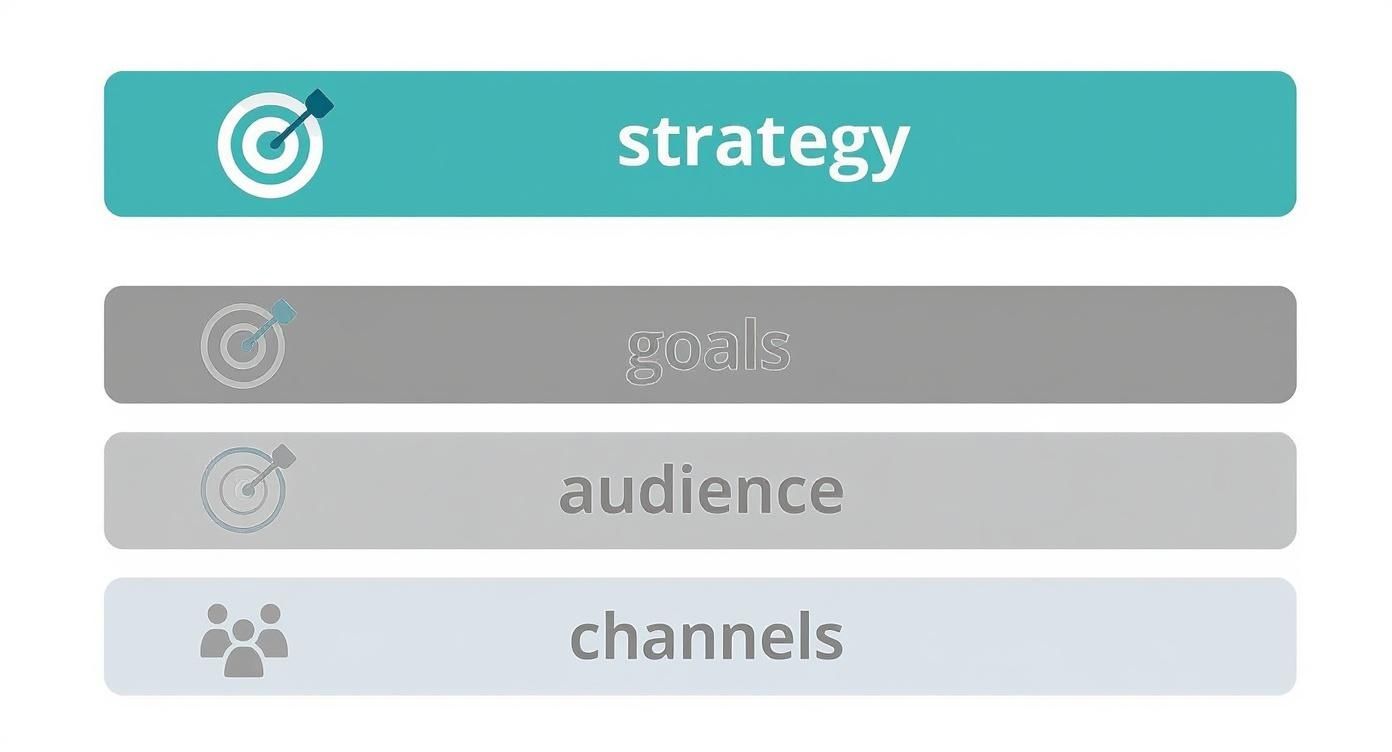
By visualising this hierarchy, you can see how each piece slots into your wider strategy. It starts with clear goals and sharp audience insights —everything else flows from there.
Recent data in the UK shows a 11% decline in daily social media usage between 2023 and 2025, reminding us that quality always trumps quantity. Learn more about these shifts
Core Components Of Social Media Strategy
Below is a quick summary table of the core components that build an effective social media strategy.
| Component | Description |
|---|---|
| Goals | Business objectives aligned with measurable targets |
| Audience | Defined personas and segments for precise targeting |
| Channels | Selected platforms where your content will appear |
| Content Pillars | Thematic categories that guide your storytelling |
| Calendar | A mapped out schedule linking posts to dates and events |
| KPIs | Key metrics that reveal success and inform optimisation |
Keep these six building blocks front and centre. They work together to keep your planning sharp and your engagement strong.
Intentional planning ensures consistency and stronger engagement than ad hoc posting.
You might be interested in learning why social media matters for business success in our article on the importance of social media for your business. For a deeper dive into practical applications, you can explore social media marketing strategy examples to inspire your approach.
Understanding The Key Concepts
Imagine planning a road trip: a social media strategy is your map, guiding you from start to finish rather than leaving you to post at random.
- Strategy : the destination and overall route.
- Tactics : the specific turns you choose along the way.
- Execution : the act of driving, making sure you actually move forward.
With a clear endpoint in mind, the team stays focused. Skip those turn by turn instructions and you risk taking the wrong exit—and wasting time.
Strategy Framework Breakdown
At its heart, a social media strategy rests on three pillars: goals , audience and channels . Nail these and everything else slots into place.
Defining who you want to reach removes guesswork. Pairing your content pillars with that audience then gives you a consistent voice. Over time, this cohesion transforms your feed into a recognisable brand story.
A clear blueprint turns scattered posts into a cohesive journey towards growth.
Without precise tactics, you’ll hit unexpected detours. That might look like drafting posts without context or filling your calendar with gaps. Selecting the right channel at each stage ensures your message lands with impact. And when every piece of content has a purpose, you steer clear of mindless posting.
Break it down: create engaging drafts, lock dates in a calendar and monitor key KPIs . Then test, learn and adjust to keep moving in the right direction.
Avoid Common Detours
Even the best roadmap can veer off course if you’re not vigilant. Posting content that conflicts with your brand voice can erode trust.
- Inconsistent branding undermines recognition and confuses followers.
- Overloading audiences with too many posts can lead to fatigue.
- Ignoring analytics stalls progress and leaves you flying blind.
Spotting these pitfalls early saves time and budget. Regular reviews act as checkpoints, ensuring every tactic serves your big picture goals.
Choose formats that resonate—video reels, carousels, polls—and set clear rules for execution: timely scheduling and genuine responses. That kind of clarity keeps your campaign engine humming.
Team alignment is crucial. Document each task to avoid missed turns. A shared calendar and straightforward approval process become your pit stops for refuelling. Collaboration tools keep everyone on track, making the ride feel smooth.
Building Long Term Momentum
When strategy , tactics and execution sync up, growth compounds over time. Regular check ins and feedback loops let you tweak plans on the fly.
- Track engagement rate to see which content resonates.
- Monitor click throughs to understand what drives action.
- Review conversion metrics to assess your return on effort.
By constantly refining your blueprint, the journey never really ends. Platforms evolve and audiences shift, so your plan must adapt. Next, we’ll dive into setting precise goals and crafting audience personas—your springboard for messaging that converts. Keep your dashboard close and reports within easy reach.
Defining Your Social Media Goals And Audience
Every successful campaign begins with two simple questions: what do you want to achieve, and who are you speaking to? Nail down these basics and you’ll avoid random posts that never move the needle.
Think of your goals as a compass: they point everyone toward the same destination. To keep things clear, adopt SMART objectives — they tie into broader business targets and give you a way to measure progress.
- Specific : Aim for a 15% increase in monthly clicks
- Measurable : Track engagement rate or conversion count
- Achievable : Base targets on past results and available resources
- Relevant : Link each goal to customer acquisition or other business KPIs
- Time-Bound : Set a deadline, like the end of next quarter
With these guidelines, teams stay accountable, and you’ll know exactly when to adjust course. If you miss or surpass your target, there’s no confusion about what comes next.
Mapping Audience Personas
Understanding your audience is like sketching a roadmap before a journey. Personas blend demographic, behavioural and psychographic data to create realistic profiles.
Use surveys, platform analytics and social listening tools to gather insights. Then group your market into segments—say, loyal fans, curious prospects and vocal brand advocates.
- Demographics: age, location, income and education
- Behavioural: purchase history, content preferences and platform habits
- Psychographic: interests, values and lifestyle choices
Write a brief bio for each persona. This makes it easier to pick the right tone, visuals and posting schedule. It works just like offline market research, but tailored for the social sphere.
"Audience personas turn vague impressions into actionable profiles that drive engagement."
Mapping Customer Journeys
A customer journey map spots the moments when social media can nudge someone closer to a decision. Start by breaking the process into clear stages: awareness, consideration and conversion.
Follow this simple framework:
- Identify Stages: awareness, consideration and conversion
- List Interactions: posts, ads, direct messages and comments
- Note Goals: the action you want at each touchpoint
- Define Content: choose the right format and tone
- Assign Channels: pick platforms that fit each interaction
This process reveals gaps and new chances to guide leads forward. For instance, a retailer might use Instagram Stories to spark curiosity and Facebook Ads to bring back window shoppers.
Gen Z and millennial users lead UK social media engagement, with 94% of Gen Z reporting daily usage and TikTok commanding over 83% penetration among the same age group. Discover more insights about UK social media stats on Birdeye.
The screenshot below shows the daily usage breakdown for Gen Z and millennial users across popular platforms.

This chart highlights TikTok’s dominance among Gen Z and the strong engagement levels of younger audiences. Now, let’s turn these findings into content pillars and a calendar that keeps you on track.
Ready for the next stage.
Crafting Content Pillars And Calendar

Content pillars set the scene for a social media strategy . They focus your messaging, bring consistency and spark genuine interest with your followers.
Take a fitness brand, for instance: nutrition tips, workout demos and success stories. These core themes speak directly to what your audience craves.
Begin by jotting down topics that reflect your brand values and answer your customers’ most common questions.
- Identify Brand Strengths And Values
- Map Common Audience Questions
- Research Competitor Content Gaps
- Align Themes With Business Objectives
Brainstorming Pillar Themes
When inspiration feels scattered, structure can help. Sketch a mind map of potential themes and measure them against keyword trends.
Next, tap into social listening or quick polls. That’s where intuition meets real world insight.
- List 10 Potential Themes
- Use Platform Analytics For Popularity Scores
- Check Common Questions On Forums
- Prioritise Topics By Relevance And Search Volume
- Confirm Final Pillars With Stakeholders
This blend of empathy and evidence ensures each pillar lands with your audience.
Designing The Content Calendar
With pillars in hand, it’s time to shape your calendar. Instead of last minute scrambles, your team knows exactly what’s due and when.
Aim for a balanced mix each week:
- Promotional Posts For product or service highlights
- Educational Posts Offering how to insights
- Community Posts Inviting comments, shares and story telling
Layer in seasonal moments—holidays, trade shows or key industry dates—for extra resonance.
“Consistency in timing boosts audience expectations and engagement,” says a veteran community manager.
Templates are lifesavers here. Whether you’re in Trello or a simple spreadsheet, make sure each entry records:
- Date
- Pillar
- Format
- Channel
Don’t forget video. Check out the three types of videos every modern business needs to enrich your mix.
For a deeper dive into scheduling, explore building a social media content calendar. It’s an essential step.
Review performance every month. Swap out underperforming themes or adjust posting frequency to ride the engagement wave.
Applying Seasonal Trends
Tapping into the year’s natural rhythm gives your plan momentum. Think:
- National Holidays For themed campaigns
- Industry Conferences To showcase thought leadership
- Community Events To engage locally
Posting around these peaks lets you join active conversations instead of shouting into silence.
| Frequency | Posts Per Week |
|---|---|
| Low Volume | 3–4 Posts |
| High Volume | 7–10 Posts |
Use this as your starting point, then refine based on real engagement data and team capacity.
A well chosen set of pillars, paired with a living calendar, balances consistency and creativity. Follow this framework to keep your social media both coherent and captivating.
Choosing Social Media Platforms And Formats

Selecting the right channels begins with a clear picture of your audience and your goals. Each network has its own personality, complete with distinct demographics and preferred formats. B2B brands often find fertile ground on LinkedIn while retailers lean on TikTok and Instagram for eye catching visuals.
Think of platform choice like picking the stage for a show: you wouldn’t book a classical quartet at a rock festival. On LinkedIn, you tap into a 706 million -member professional network ideal for whitepapers and case studies. In contrast, TikTok serves up 1 billion active users who crave snappy, entertaining clips.
To decide where to focus your efforts, run through this quick checklist:
- Audience demographics and behaviour
- Formats you can produce consistently
- Whether the algorithm favours freshness, interactions or watch time
- Organic reach potential versus paid amplification
Platform Demographics And Formats
| Platform | Primary Demographic | Favoured Format | Algorithm Focus |
|---|---|---|---|
| 25–54 years, broad UK reach | Link posts, video | Engagement history | |
| 18–34 years, visual-first | Stories, Reels | Recency and interactions | |
| 30–49 years, professionals | Articles, polls | Relevance and connections | |
| TikTok | 16–24 years, Gen Z heavy | Short form video | Watch time and trends |
| 18–49 years, news-seekers | Threads, GIFs | Timeliness and retweets | |
| YouTube | 18–44 years, video lovers | Long form video | Watch duration |
This snapshot helps you align each channel with your content pillars and team capacity. For instance, B2B consultancy BrandBright saw a 120% uplift in qualified leads by zeroing in on LinkedIn polls and document posts. Meanwhile, fashion retailer StyleWave boosted conversions by 30% using Instagram Reels to showcase unboxing experiences.
“Choosing platforms based on genuine audience habits rather than trends is key to sustainable growth.”
– Social Media Manager, Superhub
Emerging Networks And Niche Communities
Beyond the usual suspects, niche spaces can spark lively engagement among focused groups. Tools like Clubhouse and Slack channels offer real time conversations, while Discord servers unite passionate fans around hobbies or special interests.
When testing a new network, apply this simple ranking system:
- Audience size and overlap with your core persona
- Engagement potential per post or event
- Resource demands for moderation and content creation
- Fit with your brand voice and product mix
For example, a gaming startup might launch a Discord server to host live Q&As, while a fintech brand experiments with Clubhouse rooms to discuss investment trends and build credibility.
Platform Selection Criteria
- Reach Versus Relevance – focus on where your persona spends time, not just big user counts
- Resource Capacity – can you sustain high effort formats like YouTube or need quicker turnarounds?
- Paid Versus Organic – some channels demand ad spend for visibility, others reward authenticity
- Community Culture – match your tone and etiquette to each platform’s vibe
Revisit your channel mix regularly as behaviours shift and new features roll out. Use analytics to track reach, engagement and conversions by network. With ongoing measurement and optimisation, you’ll refine your rankings and invest where it truly matters. Superhub can support your team in testing, analysing and scaling the right platforms for enduring growth.
Measuring Success And Continuous Optimisation
Think of your social strategy as a road trip rather than a stab in the dark. From the moment someone first sees your post to when they become a brand advocate, you need clear signposts. When those measurements tie back to SMART goals , you’ll know exactly when to celebrate or when to change course.
Data driven choices keep everyone on track and energised.
Track Key Metrics For Each Stage
Before you begin, pick out four core metrics that act like guideposts:
- Reach shows how many unique users have laid eyes on your content.
- Engagement captures likes, comments, shares and saves.
- Conversion measures actions such as sign ups, downloads or purchases.
- Loyalty tracks repeat visits, subscription renewals or word of mouth referrals.
Link each metric to a specific target—perhaps a 10% uplift in monthly conversions or a 15% growth in reach over three months. Set deadlines, so you keep the momentum going.
Beyond these, brand sentiment and share of voice provide insight into audience perception. Sentiment analysis tools will flag small issues before they explode into crises.
Build Analytics Dashboards And Run A/B Tests
Dashboards turn raw data into a story you can read at a glance. Start by choosing tools like Google Analytics or Sprout Social to visualise performance.
Then, test your way to clarity:
- Define a clear hypothesis.
- Split your audience into equal groups.
- Run the test over a fixed timeframe.
- Check for statistical significance.
- Roll out the winning variant and log what you’ve learned.
Reserve at least 5% of your social media spend for analytics platforms to access deeper insights. Aim for around 1,000 views per variant to reduce false positives.
“Data without interpretation is just noise. Regularly pivot tactics based on what the numbers tell you,” advises a senior marketing analyst.
If headline B outperforms by 20% , introduce it into your next campaign and note the ripple effect in your reports.
Here are a few go-to platforms:
- Google Data Studio for free, custom dashboards
- Sprout Social to benchmark against competitors
- Hootsuite Insights for real time sentiment analysis
- Adobe Analytics when you need enterprise level reporting
Plan your subscriptions carefully—trial periods and tiered pricing can help you match features to budget.
Set Regular Reviews And Create Feedback Loops
Structure your check ins like clockwork:
- Weekly : Quick snapshots of top line metrics
- Monthly : Deep dives and trend analysis
- Quarterly : Strategy pivots and goal resets
A UK B2B consultancy, for example, reviews its monthly dashboard to shift from video demos to interactive polls based on audience feedback.
Check out our guide on measuring ROI for UK marketers to deepen your understanding and refine budget allocations: Measuring ROI for UK Marketers
Consistent reviews help you spot fresh opportunities—be it a new platform feature or a moment begging to go viral.
Continuous optimisation is like sailing: you tweak the sails as the wind shifts, using data to report ROI clearly and sharpen your strategy over time.
Got Questions About Social Media Strategy? We’ve Got Answers.
When you're deep in the trenches of planning and launching a social media strategy, it’s natural for a few questions to pop up. We get it. Here are some of the most common ones we hear, with straightforward answers to help you sharpen your approach.
Where do I even begin with a social media strategy?
It all starts with a simple question: "What are we trying to achieve?" Before you even think about posting, you need to define your business objectives and set some solid, SMART goals to match.
Once you know your 'why', you need to figure out your 'who'. Do the research to build out a clear picture of your ideal customer. Who are they? What do they care about? Where do they hang out online?
Get these fundamentals right, and you’re building on a strong foundation.
How can I actually prove that social media is working?
The million pound question: ROI. The trick is to stop tracking vanity metrics and start measuring what actually matters to your business goals. If you want awareness, track reach and impressions. If you want a community, track engagement. If you want sales, track conversions and leads.
Use a simple dashboard to see what’s working over time. This isn’t about guesswork; it's about connecting the dots between your activity and your bottom line.
Can I just post the same thing everywhere?
You can, but you really shouldn’t. The secret isn't to create new content for every single platform, but to intelligently adapt your core ideas. It's about being efficient without being lazy.
- Got a great blog post? Turn the key points into a sharp infographic for Pinterest or a carousel for LinkedIn.
- That long form video? Chop it into powerful, bite sized Reels or Shorts.
- A glowing customer testimonial? That's a perfect quote graphic for Instagram or a thread for X (formerly Twitter).
This way, you get more mileage out of every idea while still respecting what works on each platform.
Tools And Tactics
What are the best tools for planning and analytics?
For getting your content organised and scheduled, platforms like Buffer or Later are brilliant. They make calendar management a breeze.
When it comes to tracking performance, the native analytics on each platform are a great starting point. But if you want to go deeper, tools like Sprout Social or the insights from Hootsuite can give you a much richer picture.
“Consistent review of analytics helps pivot tactics before small issues become big problems.”
How do you keep everything consistent across different channels?
Consistency is what makes a brand feel reliable. The key is to create a unified content calendar so everyone knows what’s going out, and when.
You also need solid brand guidelines covering everything from tone of voice to your visual style. Batch creating your content and having clear roles for who posts and who approves also helps to keep the message tight and avoid any confusion.
Key Takeaways
- Have a purpose. Make sure every single post ladders up to a SMART goal.
- Fish where the fish are. Focus your energy on the platforms where your ideal audience actually spends their time.
- Don't skimp on analytics. Set aside at least 5% of your budget for proper analytics tools. The insights are worth their weight in gold.
- Review, refine, repeat. Look at your data weekly, do a deep dive monthly, and be ready to adjust your strategy every quarter.
By staying on top of these things, you won't just be posting—you'll be building a social media presence that actually drives results.
Ready to stop guessing and start growing? The team at Superhub builds social media campaigns that deliver.
Want This Done For You?
SuperHub helps UK brands with video, content, SEO and marketing that actually drives revenue. No vanity metrics. No bullsh*t.