

Top Tips: how to choose SEO keywords for smarter growth
Before you even dream of hitting the first page of Google, we need to talk about something far more important than search volume or keyword difficulty: your business goals.
It is a classic mistake. Someone gets excited about SEO, opens up a tool, and immediately starts chasing big, flashy keywords. This almost always leads to what we call 'vanity traffic' – numbers that look great on a report but do absolutely nothing for your bottom line.
Choosing the right keywords is not about finding what is popular; it is about finding what is profitable.
Aligning Keywords with Your Business Goals
Every single keyword you target must be anchored to a solid business strategy. A keyword is only as valuable as the goal it helps you achieve.
Think about it this way: a local plumber in Manchester could rank for "what causes a leaking tap". This is great for building brand awareness and showing expertise. But ranking for "emergency plumber Manchester" is what gets the phone ringing and generates immediate revenue.
Both have their place, but you have to know which game you are playing. Are you educating or are you selling?
Define Your Primary SEO Objective
So, what do you actually want your website's organic traffic to do ? Your answer here will shape every decision you make from this point forward.
Most business objectives fall into one of these buckets:
- Lead Generation: Getting potential customers to request a quote, book a call, or sign up for a demo. This is the bread and butter for most service-based businesses.
- E-commerce Sales: Driving people directly to product pages to make a purchase. For any online shop, this is the entire point.
- Brand Authority and Awareness: Positioning your business as a trusted expert by answering questions and providing real value. This is a longer-term play that targets people early in their buying journey.
- Audience Building: Growing your email list or social media following. You are building a community you can market to directly, time and time again.
This is not just a tick-box exercise. It is the filter you will use to sift through thousands of potential keywords. A keyword that is perfect for e-commerce could be completely useless for a lead generation strategy.
Translate Goals into Customer Language
Once you are clear on your objective, you need to get inside your customer's head. Step away from your industry jargon and think about the actual words and phrases your ideal customer uses when they have a problem you can solve.
A financial adviser's internal language might be "high net worth portfolio management". But their ideal client? They are much more likely to be searching for things like "how to invest my inheritance" or "best retirement savings plan UK". See the difference?
Creating simple customer profiles (or personas) is a brilliant way to keep this thinking organised. If you want to go deeper, understanding how to write a marketing plan that actually works gives you a solid framework for tying your goals to what your audience truly needs.
Nailing this foundational work ensures every keyword you choose is a strategic asset, ready to attract the right people and save you from wasting months chasing traffic that will never, ever convert.
Finding Your Initial Keyword Ideas

Now that you have got your business goals locked in, it is time to get your hands dirty and generate a big, unfiltered list of potential keywords. Do not worry about perfection at this stage. The idea is to cast a wide net and capture all the different ways your customers might search for you.
Think of it as creating a master list of 'seed' keywords. This list will be the foundation for your entire SEO strategy.
To get this right, you need to stop thinking like a business owner and start thinking like a customer. What are their real-world problems? What questions do they ask their friends? Forget your internal industry jargon and focus on the natural language they use every day. It’s part brainstorming, part detective work, and it’s where you will find the best opportunities.
Start with Competitor Analysis
One of the smartest shortcuts in keyword research is looking at what is already working for your competition. They have done a lot of the heavy lifting, so why not learn from their efforts? Analysing their top-ranking pages shows you exactly which search terms are driving traffic in your niche.
This is not about copying their strategy. It’s about using their data as a launchpad to find gaps they have missed. Maybe they are ranking for broad, high-volume terms but have completely ignored the more specific, long-tail questions where you can easily swoop in and win.
A proper competitor deep dive can be a real eye-opener. To make life easier, you can explore some of the best competitor analysis tools, many of which are free to use in 2025.
By seeing which keywords your competitors are winning with, you are not just finding search terms; you are uncovering a proven roadmap of what resonates with your shared audience.
Uncover Questions in Google Search
You do not always need fancy tools. Google itself is a goldmine for discovering what real people are looking for, right now. The search results page is packed with clues.
Just type a broad keyword related to your industry into the search bar and look at what Google shows you.
- People Also Ask (PAA): This box is a direct look into the user’s mind. Each question is a ready-made keyword, usually a long-tail one, perfect for a blog post or an FAQ page.
- Related Searches: Scroll to the bottom of the page. This list gives you brilliant alternative phrases and related topics people are exploring, helping you find synonyms you might not have thought of.
- Autocomplete: As you type, Google’s suggestions show what is popular in real time. This is a great way to tap into current trends and popular queries in your niche.
Explore Online Communities and Forums
To really get the voice of your customer, you need to go where they talk to each other. UK-based forums and online communities are brilliant for finding the exact language people use when they are stuck and need a solution.
Forums like MoneySavingExpert , for example, are invaluable for anyone in finance or retail. You will find thousands of threads full of genuine consumer questions. Niche subreddits on Reddit , like r/UKPersonalFinance or r/DIYUK, offer completely unfiltered access to your audience's biggest pain points.
Digging through these platforms will help you discover keywords that most traditional tools would miss. They are often super specific and signal strong intent, making them perfect for creating targeted content that actually helps people. To pull all this together, it pays to use dedicated software. Take a look at the best keyword research tools to find an option that works for the UK market.
How to Evaluate and Prioritise Your Keyword List
So, you have got a massive list of keyword ideas. Great. Now comes the hard part: sorting the gold from the fool's gold. This is where you bring some strategic thinking to the table, cutting through the noise to find keywords that you can actually rank for and that will bring in the right kind of business.
Chasing huge search volumes is a rookie mistake, and it’s a costly one. A keyword with 50,000 monthly searches is completely useless if the top spots are dominated by untouchable household names, or if the searchers have zero interest in ever buying what you sell.
Smart prioritisation is all about balance. It’s about weighing up the potential reward against the genuine effort required to get there. Your goal is to build a practical list that mixes some quick wins with your more ambitious, long-term targets.
To do that, you need to get comfortable with three core metrics.
Understanding the Key Keyword Metrics
When you drop your keywords into a tool like Ahrefs or Semrush, you are going to see a lot of data. Do not get overwhelmed. For now, just focus on these three numbers—they tell you most of what you need to know.
- Search Volume: This is the average number of times people in the UK search for a keyword each month. Think of it as a measure of market demand, but remember, it’s only one part of the story.
- Keyword Difficulty (KD): This is usually a score from 0-100 that estimates how tough it will be to crack the first page of Google. It’s calculated by looking at the authority and backlink profiles of the pages that are already ranking.
- Cost Per Click (CPC): This shows what advertisers are willing to pay for a single ad click for that keyword. Even though it is a paid search metric, a high CPC is a massive clue that the keyword has commercial value and strong buying intent.
These metrics never work in isolation. You might find a keyword with a tiny search volume but a sky-high CPC, which points to a small but incredibly valuable audience. On the flip side, a high-volume keyword with a low KD could be a golden opportunity to pull in a lot of traffic without a huge fight.
Getting the Balance Right in the UK Market
Knowing how to read these metrics is especially important in a market as crowded as the UK. The accuracy of search volume tools can be a bit shaky; some industry reports suggest tools like Google Keyword Planner are only accurate about 45% of the time, often overestimating volumes more than half the time. Before you pour resources into a high-volume target, it pays to double-check the figures against your own Google Search Console data and other UK-specific trends. You can discover more insights about SEO stats on keywordseverywhere.com.
This is why the Keyword Difficulty score is so vital. The UK's SEO market is booming, with a five-year growth rate of around 11.2% and a 2023 market size hitting £19.2 billion . Competition is fierce and getting fiercer. That’s why many smart UK SEOs start by targeting keywords with low-to-medium difficulty scores to gain some early traction.
High-difficulty keywords are a long game. They take a serious investment in time and backlinks. By focusing on achievable KD scores—often anything under 40—you can start seeing real results in 3–9 months, building a foundation of authority that lets you tackle bigger targets later on.
A Simple Framework for Prioritising
Let us turn all this analysis into a concrete plan. The best way to do this is to get everything into a simple spreadsheet where you can assess each keyword systematically.
Set up a table with these columns:
| Keyword Phrase | Monthly Search Volume (UK) | Keyword Difficulty (0-100) | CPC (£) | Priority (High/Med/Low) |
|---|---|---|---|---|
| Example 1 | e.g., 2,500 | e.g., 15 | e.g., £4.50 | High |
| Example 2 | e.g., 15,000 | e.g., 72 | e.g., £1.20 | Low |
| Example 3 | e.g., 400 | e.g., 28 | e.g., £8.75 | Medium |
Now, use this logic to assign priorities:
- Find Your 'High Priority' Quick Wins: Hunt for keywords with solid search volume, a low KD score (under 40 is a great place to start), and a decent CPC. These are your low-hanging fruit—terms you can probably rank for relatively quickly to bring in valuable traffic.
- Tag Your 'Medium Priority' Contenders: These might have a higher KD (say, 40-60 ) but also offer much more search volume or a seriously high CPC. They are big opportunities that will require more sustained effort and time.
- Label Your 'Low Priority' Long-Term Goals: This is where your high-volume, high-difficulty keywords live. Do not ignore them, but do not make them your immediate focus. You will need to build your site's authority with easier wins before you have a realistic shot at these.
By following this process, you transform a messy brainstorm into a clear, prioritised roadmap. You will know exactly which keywords to go after now, which to work towards, and which to leave alone, making sure every bit of your SEO effort is focused where it counts.
Use Long-Tail Keywords to Attract Red-Hot Traffic
Chasing those big, high-volume "head terms" can feel like the ultimate SEO prize. But for most UK businesses, the real competitive edge is not found in the big leagues—it is in getting much, much smarter.
This is where long-tail keywords come in. These are longer, more specific search phrases that act like a homing beacon for customers who are way further down the buying journey.
Think about it. Someone searching for "plumber" is probably just browsing, kicking tyres. But someone searching "emergency plumber for leaking tap in Bristol"? They have got a genuine, urgent problem and are ready to pay to fix it right now. That’s the raw power of long-tail queries.
You’re essentially trading massive, low-quality volume for a smaller, highly motivated audience. It’s a strategy built on attracting a steady stream of traffic from hundreds of specific searches, which almost always outperforms the high-risk, high-reward chase for a handful of hyper-competitive head terms.
The Obvious Wins of a Long-Tail Strategy
Fewer businesses bother to focus on these super-specific phrases, which immediately creates an opening for you. The competition is naturally lower, making it significantly easier for a small or medium-sized UK business to land on page one of Google.
The real prize, though, is the quality of traffic you get. These users are past the initial research phase. They know exactly what they need, and their specific search query is proof. It’s no surprise that long-tail keywords almost always deliver higher conversion rates—they match what the user actually wants.
Here’s a quick rundown of the benefits:
- Lower Competition: Far fewer websites are optimising for "no win no fee employment solicitor Manchester" than for the generic term "solicitor".
- Higher Conversion Rates: The user searching the long-tail phrase has a specific, urgent need and is likely ready to take action.
- Better Audience Targeting: You pull in exactly the right person with the right problem, meaning more qualified, sales-ready leads.
- Builds Topical Authority: Creating content around dozens of specific, related queries signals to Google that you are an expert in your niche.
How to Find These Hidden Gems
Uncovering these valuable long-tail keywords does not require a suite of expensive tools. You just need to know where to look. In fact, Google itself gives you all the clues you need.
Start by typing a broad "head term" related to your business into the Google search bar. Do not even hit enter yet—just look at the Google Autocomplete suggestions that pop up. These are real-time queries that people are actively searching for.
Next, run the search and scroll right to the bottom of the page. You will find the "Related searches" section. This is an absolute goldmine for discovering different angles and alternative phrases you’d never have thought of. Every single one is a potential long-tail keyword you can build a piece of content around.
The beauty of this is its simplicity. You are using Google's own data to understand your customers, finding keyword opportunities that speak directly to their needs and pain points.
This focus on hyper-specific, local searches is especially potent for service-based businesses. Our guide on local SEO for small businesses offers a growth playbook that works perfectly alongside this long-tail strategy.
Head Term vs Long-Tail Keyword Strategy
To really see the difference, it helps to put them side-by-side. While head terms promise huge numbers, long-tail keywords deliver tangible business results by focusing on intent.
| Characteristic | Head Term (e.g., 'solicitors') | Long-Tail Keyword (e.g., 'no win no fee employment solicitor Manchester') |
|---|---|---|
| Search Volume | Very High | Low to Medium |
| Competition | Extremely High | Low |
| User Intent | Broad, informational, early-stage | Specific, transactional, ready-to-act |
| Conversion Rate | Low | High |
| Cost (PPC) | High | Low |
| Ranking Difficulty | Very Difficult | Much Easier |
The table makes it clear: if you want to attract users who are ready to become customers, a long-tail focus is the most direct and cost-effective route.
The Data Proving Long-Tail Dominance
This is not just a niche tactic; it’s how you tap into the vast majority of all search traffic. Research consistently shows that long-tail keywords now make up around 70% of all searches . If you’re ignoring them, you’re missing out on most of your potential customers.
UK search behaviour, in particular, leans heavily towards multi-word queries. Studies from sources like SearchAtlas show that nearly 70% of searches are four words or longer . To really capture this demand, a UK business needs to build its content strategy around clusters of these specific phrases, creating in-depth pages that answer them completely.
Turning Your Keywords into a Content Plan
A prioritised keyword list is a great starting point, but it is not a strategy. The real magic happens when you turn that raw data into an actionable content plan. This is where you organise your chosen terms into a logical structure, making sure every piece of content you create has a clear purpose and a specific target.
This whole process is what we call keyword mapping . It’s simply the act of assigning your keywords to specific pages on your website. The goal is to build a clear roadmap that tells you exactly what content to create, which pages to optimise, and how each one contributes to your business goals.
Without a map, you risk creating content that fights with itself—a surprisingly common problem known as keyword cannibalisation . This is when multiple pages on your site are optimised for the same or very similar keywords, which just confuses search engines about which one is most important. A solid plan stops this from happening, giving each page a unique job to do.
The Art of Keyword Grouping
Before you can map keywords to pages, you have to group them into logical clusters. This is all about shared topics and, more importantly, shared intent. This is where you bring some order to the chaos.
Think of it like organising a library. You wouldn’t just throw books on the shelves at random; you’d group them by genre and author. Keyword grouping uses the same logic. For instance, a UK-based financial adviser might be looking at these keywords:
- "how to start investing uk"
- "beginner investment guide"
- "best stocks for beginners uk"
These all share an obvious informational intent . They belong together in a topic cluster around 'Beginner Investing' and are perfect for a comprehensive blog post or a downloadable guide.
On the other hand, keywords like "financial adviser near me" or "retirement planning services London" have a clear commercial intent . These should be grouped separately and mapped to your service pages or even your contact page, as they attract people who are ready to make a move.
A keyword map is not just a spreadsheet; it is a blueprint for your website's architecture. It dictates how you will build topical authority and guide users from discovery to conversion, one targeted page at a time.
Assigning Keywords to Pages
With your keywords neatly grouped, the next step is assigning them to specific URLs. This creates a direct line between what someone is searching for and a piece of your content, ensuring you have the perfect page ready to meet their needs.
Your keyword map should clearly define the role of each term:
- Primary Keyword: This is the main focus for a page. It should be the most relevant, highest-priority term that perfectly sums up the page's content. A service page for a Bristol plumber would have "emergency plumber Bristol" as its primary keyword.
- Secondary Keywords: These are the related terms, synonyms, and long-tail variations that support the primary keyword. For that same plumber's page, secondary keywords could include "24-hour plumber Bristol" and "leaking pipe repair Bristol".
This diagram illustrates the strategic flow, moving from broad discovery to specific, high-intent searches.
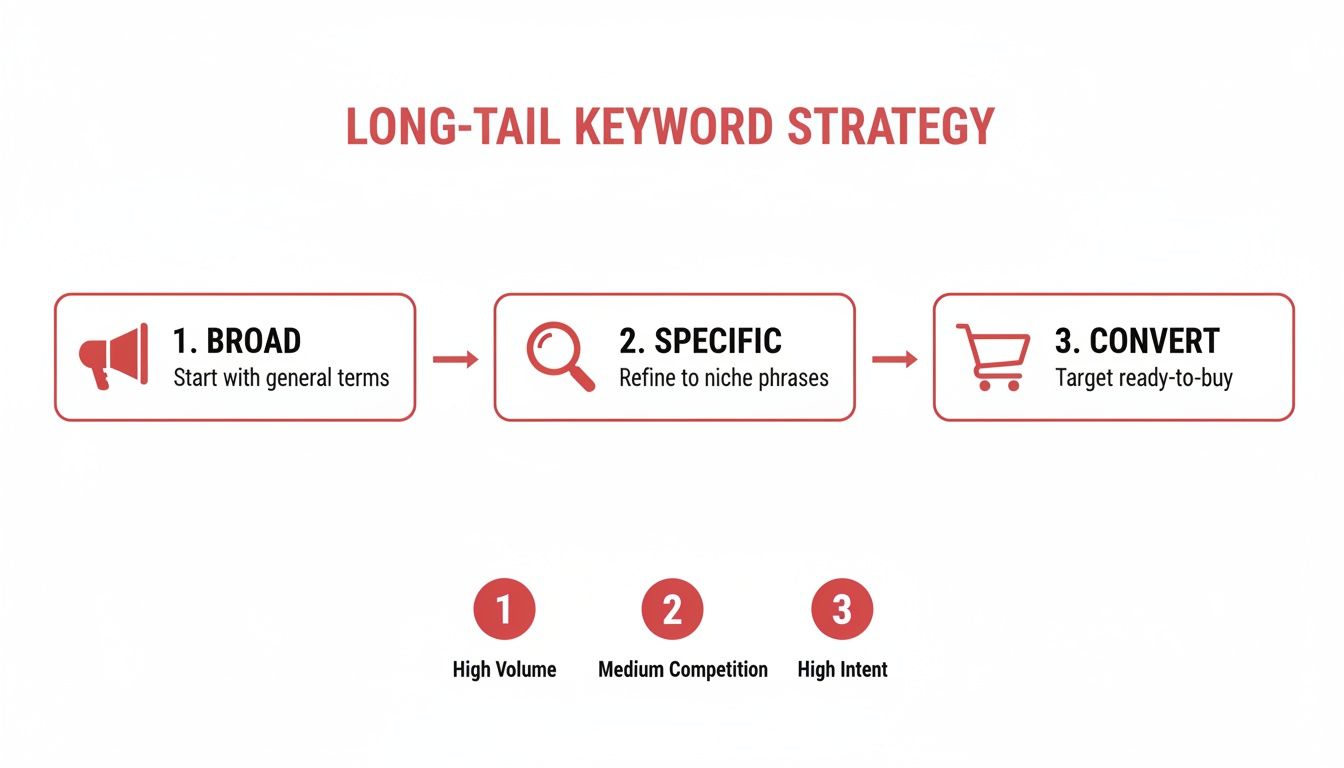
It’s a great visual for how a content plan can capture users at every stage of their journey, guiding them towards a conversion with increasingly specific keywords.
Building Your Content Roadmap
Honestly, a simple spreadsheet is all you need to create an effective keyword map. This document will become your team’s single source of truth for content creation and optimisation for months to come.
Here is a basic framework you can adapt:
| Page URL | Primary Keyword | Secondary Keywords | Content Type | Status |
|---|---|---|---|---|
| /services/roof-repair | roof repair manchester | roof leak repair, emergency roofer | Service Page | Published |
| /blog/how-to-spot-a-leak | how to spot a roof leak | signs of leaking roof, water stains on ceiling | Blog Post | Writing |
| / | roofer in manchester | local roofing company | Homepage | Optimised |
This simple structure provides a huge amount of clarity. It tells your team exactly which keywords to target, what kind of content to produce, and where it all fits within your wider strategy. It eliminates the guesswork and makes sure every piece of content is a strategic asset.
Once you have built your content plan, the next stage is turning those keywords into compelling copy and articles. If you are looking for pointers on creating great web content for your business, you might find this guide helpful. This planning phase is what turns a simple list of words into a powerful engine for driving targeted, profitable growth.
A Few Common Keyword Research Questions
Even with the best process in place, a few nagging questions always seem to pop up during keyword research. It’s a discipline full of nuances, and it’s easy to get stuck on the details.
Let us clear up some of the most common queries we get. Getting these right will help you dodge the usual mistakes and build your content plan with a lot more confidence.
How Long Does It Actually Take to Rank for a Keyword?
This is the million-dollar question, and the only honest answer is: it depends. The time it takes for your content to show up on page one is tied to a few big factors.
If you have a brand-new website and you’re going after a low competition keyword (think a Keyword Difficulty score under 30 ), you could start seeing some real movement in the search results within three to six months . That’s assuming you’re creating genuinely good content and building a bit of authority from the get-go.
For the more competitive keywords , you’re playing a much longer game. Trying to rank for those high-difficulty terms often takes anywhere from six months to over a year of consistent, focused effort. This means not just great content, but a serious push for high-quality backlinks, too.
SEO is a marathon, not a sprint. The smart money is on consistently creating valuable content for achievable keywords to build momentum. Chasing the hyper-competitive terms from day one is just a recipe for frustration.
Should I Bother Targeting Keywords with Zero Search Volume?
It sounds completely backwards, but the answer is often a resounding yes. Keywords that tools show as having "zero" or next-to-no search volume (maybe under 10 searches a month) can be absolute gold.
Here’s why you should not just scroll past them:
- The Tools Are Not Perfect: Keyword research tools are brilliant, but they are not infallible. They often miss data for super-niche or brand-new search queries. "Zero volume" does not always mean nobody is searching for it.
- The Intent is Crystal Clear: These terms are usually incredibly long and specific, like "best waterproof walking boots for wide feet uk". Anyone typing that into Google knows exactly what they want and is probably very close to buying.
- They’re an Untapped Resource: Because most people filter them out, these keywords often have practically zero competition. It can be surprisingly easy to rank for them and hoover up small, targeted pockets of highly qualified traffic.
A strategy that deliberately includes a collection of these ultra-specific terms can add up to a significant amount of valuable traffic over time.
How Often Should I Do Keyword Research?
Keyword research is not a task you tick off once when you launch your site and then forget about. It needs to be a regular, ongoing part of your marketing rhythm.
Here’s a practical approach:
- A major review every quarter: Once every three months, set aside time for a proper deep dive. Re-evaluate your topic clusters, see what your competitors are up to, and look for any new trends bubbling up in your industry.
- A quick check for every new piece of content: Before you even start writing a new blog post or building a new page, spend a few minutes doing fresh research for that specific topic. This makes sure you are targeting the most relevant primary and secondary keywords right now.
Search trends shift, new players enter the market, and the language your audience uses evolves. Staying on top of your keyword research is the only way to keep your content strategy sharp and effective.
Ready to stop guessing and start growing with a keyword strategy that delivers real business results? The expert team at Superhub can help you uncover the profitable keywords your competitors are missing and build a content plan that attracts your ideal customers. Learn more about our SEO services.
Want This Done For You?
SuperHub helps UK brands with video, content, SEO and marketing that actually drives revenue. No vanity metrics. No bullsh*t.