

Growth Hacking: A Practical Guide to Rapid Business Growth
Growth hacking is not some mystical secret club or a magic button for instant success. At its core, it is a mindset built around one thing: rapid experimentation . It is about relentlessly testing every part of your business—from marketing and sales to product development—to find the quickest, most efficient paths to growth.
Think of it as a much more agile, data-obsessed cousin of traditional marketing.
What Growth Hacking Really Means

Let's cut through the buzzwords. Growth hacking is not about pulling a rabbit out of a hat. It is a disciplined, scientific approach that treats the entire customer journey as one big experiment waiting to be optimised.
Imagine a traditional marketer as an artist, carefully painting a huge billboard to grab mass attention with a single, big budget campaign. A growth hacker, on the other hand, is a scientist in a lab coat. They are not focused on one big masterpiece; they are running hundreds of small, controlled tests across every single touchpoint a customer has with the business.
This constant cycle of testing, learning, and iterating is what sets growth hacking apart. It swaps big, upfront marketing spends for rapid learning and scalable tactics that actually work.
The Core Mindset of a Growth Hacker
More than a set of tactics, growth hacking is a way of thinking. It is driven by intense curiosity and an obsession with improvement. It is not about following a rigid playbook, but about adopting a few key principles:
- Data Driven Decisions: Every move is backed by data, not guesswork. Growth hackers measure everything, from the first click on an ad to the final customer referral, to truly understand what drives the needle.
- Creative Problem Solving: The aim is to find clever, often unconventional, and low cost solutions to growth challenges. This could be anything from discovering an untapped marketing channel to using existing tools in a completely new way.
- Full Funnel Focus: Traditional marketing often stops after getting a customer in the door ( acquisition ). Growth hacking obsesses over the entire customer lifecycle, including keeping them happy ( retention ) and turning them into brand advocates ( referral ).
This scientific method has become a cornerstone for modern businesses. Its adoption has been championed by UK incubators and government backed scale up programmes, which pinpointed digital experimentation as a critical growth lever for creating skilled tech jobs.
A Process of Relentless Optimisation
Ultimately, growth hacking is about building a repeatable and scalable engine for growth. It is not about chasing one off viral hits. The real goal is to create a system of continuous improvement, to figure out why you grow, and then find ways to make it happen again and again—but more efficiently each time.
The central question in growth hacking isn’t 'how do we get more customers?' It's 'how can we build a system that turns one customer into two, and two into four, with increasing efficiency?' This shifts the entire focus from isolated campaigns to creating sustainable growth loops.
This approach requires constant analysis and being comfortable with the fact that most experiments will fail. But the few that succeed? They can deliver explosive results. If you want to dive deeper into the fundamentals, this guide on What Is Growth Hacking? Your Startup's Guide To Growth is a great place to start.
The Origins and Evolution of Growth Hacking
Let's rewind to understand what growth hacking really is. The term first popped up back in 2010 , coined by Sean Ellis, a Silicon Valley marketer trying to define a new kind of specialist for startups. He needed someone obsessed with one thing and one thing only: growth .
This was not just a fancy new job title; it was a solution to a very real problem. Early stage tech companies, rich in ideas but poor in cash, simply could not afford traditional, big budget marketing. They did not have millions to throw at billboards or TV ads with no guarantee of a return.
They needed a completely different playbook. A method that was cheap, fast, and, most importantly, measurable. Growth hacking was born out of that necessity, becoming the go to strategy for companies that had to show explosive user growth to survive and lock in their next funding round.
From Silicon Valley to the UK Startup Scene
It did not take long for this mindset to jump across the pond and land in the UK's booming tech scene. As venture capital started flowing into British startups, founders were under immense pressure to prove their ideas had legs—and fast. The environment was a perfect breeding ground for growth hacking.
As UK venture funding exploded between 2010 and 2016 , so did the adoption of these tactics. This injection of cash created a wave of companies that scaled their user bases at double and even triple digit rates year on year, often using clever referral mechanics and product led growth. You can dive deeper into the economic impact of these growth trends here.
Growth hacking emerged not from an abundance of resources, but from a scarcity of them. It forced a focus on ingenuity over budget, creating a discipline where a clever experiment could outperform a multi million pound campaign.
You could really see this shift take hold in a couple of key sectors:
- Fintech: Challenger banks and payment startups tore up the rulebook, using slick onboarding and juicy referral bonuses to pull customers away from the big, slow moving banks.
- E-commerce: Online shops got creative, running everything from viral social media giveaways to using customer photos and reviews to build a genuine community and drive sales without a massive ad spend.
Evolution into a Core Business Discipline
What started as a scrappy, almost guerrilla tactic for startups has matured into a core discipline for businesses of all sizes. The core ideas—testing everything, making data driven decisions, and looking at the entire customer journey—are now seen as fundamental for sustainable growth. It has moved from the marketing team's side project to a central part of modern business strategy.
Today, growth hacking is not just a collection of clever tricks. It is a systematic process for finding out what works and then pouring fuel on the fire. Its history shows a clear journey from a survival kit for cash strapped founders to a sophisticated, data led function that is vital for any company that wants to grow quickly and efficiently.
Adopting the Growth Hacking Mindset
To get growth hacking, you have to look past the tactics and zero in on the philosophy. It is much more about how you think than what you do. It is a complete shift away from old school, campaign based marketing towards a non stop cycle of data led improvements that touches every single part of the business.
This philosophy is built on a few core pillars. It demands an obsessive focus on data, a relentless appetite for experimentation, a deep understanding of the entire customer funnel, and creative, cross functional teamwork. Each one feeds into the next, creating a powerful engine for sustainable growth.
An Obsessive Focus on Data
At the heart of the growth hacking mindset is a deep respect for data. Every single decision—from changing the colour of a button to launching a new feature—is guided by numbers, not just gut feeling. Guesswork gets replaced by hypotheses you can actually test and measure.
Think of a growth hacker like a detective at a crime scene. They do not make assumptions; they hunt for clues and hard evidence. Website analytics, user behaviour reports, and conversion rates are the fingerprints that tell them exactly what is going on and where the next opportunity is hiding.
This data first approach makes sure that time and money are always channelled into activities that have a proven, measurable impact on growth. It is not about being right; it is about finding out what is right through proper analysis.
Relentless Experimentation
Once the data points to an opportunity, it is time to experiment. The growth hacking mindset is all about high tempo testing, where the real goal is to learn as fast as possible. This means running dozens of small, controlled tests—like A/B testing a landing page or trying out different email subject lines—to see what truly moves the needle.
Imagine a chef perfecting a new dish. They do not just throw ingredients in and hope for the best. They try small variations—a pinch more salt here, a little less sugar there—and taste the results of each tiny change. A growth hacker does exactly the same with their marketing and product, constantly tweaking and iterating to find the perfect recipe for growth.
The core belief here is that failure is just data. An experiment that does not work out isn't a loss; it is a valuable lesson that informs the next test, bringing the team one step closer to a breakthrough.
This process of continuous experimentation creates a powerful feedback loop. You test an idea, measure what happens, learn from the outcome, and apply that knowledge to the very next experiment.
A Deep Understanding of the Full Funnel
Traditional marketing often stops at the top of the funnel—getting as many eyeballs as possible ( acquisition ). A growth hacker, on the other hand, is obsessed with the entire customer journey, from the first time someone hears about the brand to the moment they become a die hard fan.
This holistic view covers every single stage:
- Acquisition: How do people find us in the first place?
- Activation: Do they have a great first experience that makes them stick around?
- Retention: Are they coming back for more?
- Referral: Do they love our product enough to tell their friends?
- Revenue: How do we actually turn users into a profitable business?
Ignoring any part of this funnel is like trying to fill a bucket riddled with holes. It does not matter how much water you pour in the top if it is all leaking out the bottom. The growth mindset is about plugging those leaks and optimising every step to maximise the lifetime value of a customer.
Creative Cross Functional Collaboration
Finally, growth hacking is not a solo sport. It demands you break down the traditional walls that separate marketing, product, sales, and engineering. The smartest growth ideas almost always come from the intersection of these different worlds.
For instance, the marketing team might spot a huge drop off rate during user sign up. The product and engineering teams can then work with them to simplify the process—a small technical tweak that could have a massive impact on growth. This collaborative approach gets the entire company focused on a single, shared goal, making the business far more agile and effective at driving real results.
Practical Growth Hacking Frameworks and Models
While having the right mindset is the starting point, you need a roadmap to turn that philosophy into action. This is where frameworks come in. Think of them less as rigid rules and more as practical guides that bring structure to your creativity, ensuring every experiment is organised, measurable, and aimed at a specific goal.
One of the most powerful and widely used models is the AARRR framework. It is often called 'Pirate Metrics' (just say A-A-R-R-R out loud, you will get it). This framework is brilliant because it forces you to look beyond vanity metrics and breaks down the entire customer journey into five distinct stages. It helps you diagnose exactly where your business is leaking customers and focus your energy where it will make the biggest difference.
The AARRR Pirate Metrics Funnel
Developed by investor and entrepreneur Dave McClure, the AARRR framework is a lens for optimising the entire customer lifecycle. It stops you from just celebrating new sign ups and pushes you to think about creating genuine, long term value.
Each stage answers a critical question about the health of your business:
-
Acquisition: How do people find us? This is the very top of your funnel, covering all the channels that bring visitors to your digital doorstep, from SEO and paid ads to social media campaigns.
-
Activation: Do they have a great first experience? It is not enough to get someone to click; activation is about that 'aha!' moment. It measures whether a new user takes a key first step, like creating their first project or completing their profile.
-
Retention: Do they come back for more? This is arguably the most important stage. A business with poor retention is like a bucket full of holes—it does not matter how much you pour in. This tracks how many users stick around and continue to engage over time.
-
Referral: Do they love it enough to tell their friends? This is the holy grail of growth. It is about turning happy customers into your most powerful marketing channel through word of mouth, reviews, and referral programmes.
-
Revenue: How do we make money? This final stage connects all your efforts to the bottom line. It tracks the actions that generate income, whether that is upgrading to a paid plan, making a repeat purchase, or any other monetisation event.
To give you a clearer picture, here is a simple breakdown of how the AARRR framework, or Pirate Metrics, functions in practice.
The AARRR Pirate Metrics Framework Explained
| Funnel Stage | Primary Goal | Example Key Metrics |
|---|---|---|
| Acquisition | Attract potential customers through various channels. | Website Traffic, Click Through Rate (CTR), Cost Per Acquisition (CPA) |
| Activation | Deliver a fantastic first time user experience. | Sign Up Completion Rate, Core Feature Adoption, Time to First Key Action |
| Retention | Keep users coming back and engaging over the long term. | Churn Rate, Daily/Monthly Active Users (DAU/MAU), Repeat Purchase Rate |
| Referral | Encourage users to become brand advocates. | Net Promoter Score (NPS), Viral Coefficient, Number of Invites Sent |
| Revenue | Convert users into paying customers. | Customer Lifetime Value (CLV), Monthly Recurring Revenue (MRR), Conversion Rate |
By monitoring these distinct stages, you gain a clear, honest view of what is working and, more importantly, what is not.
Defining Your North Star Metric
While the AARRR funnel helps you dissect the journey, your team still needs one single, unifying goal to rally behind. Without it, different departments can end up pulling in opposite directions. This is where your North Star Metric (NSM) comes in.
Your NSM is the one metric that best captures the core value your product delivers to its users.
For a company like Airbnb, the NSM is 'nights booked'. For Spotify, it is 'time spent listening'. A powerful NSM is a leading indicator of future success; it reflects customer satisfaction and aligns the entire company—from marketing to product development—around one shared objective.
Your North Star Metric isn’t a vanity number like social media followers or total sign ups. It is a measure of real value that connects your team’s daily work to long term, sustainable growth.
The diagram below shows how this data driven, experimental mindset is the engine that drives everything we have discussed.

It is this blend of data analysis, constant iteration, and creative problem solving that lets you find your true North Star and effectively optimise every stage of the AARRR funnel.
Applying Frameworks for Measurable Results
When you start using these frameworks, you move from random acts of marketing to a structured, scientific process for growth. By mapping your key performance indicators (KPIs) to each stage of the AARRR funnel, you can instantly see where your biggest opportunities and weaknesses are.
For instance, if your Acquisition numbers are great but Activation is low, you know your marketing message is landing, but your onboarding or initial product experience is falling flat. If Retention is poor, it points to a deeper issue with your product's long term value.
This approach lets you prioritise your experiments with surgical precision. It is also where metrics like customer lifetime value become so important. To really get this right, check out our guide on mastering customer lifetime value calculation. When you understand what a customer is truly worth over time, it becomes much easier to justify investing in the retention and referral strategies that create profitable, long lasting growth.
Growth Hacking Strategies You Can Use
So, we have covered the frameworks. Now let's get into the good stuff—the actual tactics and strategies that growth hackers use in the real world to spark rapid expansion.
These are not just random shots in the dark. Each one is a calculated experiment, meticulously designed to move the needle on a specific part of the AARRR funnel. Whether it is cleverly embedding growth into the product itself, creating genuinely useful content, or running razor sharp ad campaigns, every approach has its place.
Product Led Growth and Referral Mechanics
Without a doubt, one of the most elegant growth strategies is to build marketing directly into your product. It creates a self fuelling cycle where simply using the product encourages more people to get on board. Done right, it turns your existing users into your most powerful and authentic sales team.
The textbook example here is Dropbox. When it first launched, most people had no idea what "cloud storage" even was. Instead of blowing millions on ads to educate the market, they built a simple two way referral system. If you invited a friend who signed up, you both got extra storage space for free.
This was genius for two reasons. It gave users a compelling reason to share, and the reward itself instantly demonstrated the product's core value (more space!). This simple mechanic created a viral loop that fuelled much of their early, explosive growth.
Building growth into the product turns user satisfaction into a marketing engine. When the reward for sharing is more of the product's core value, referrals feel like a natural, helpful act rather than a sales pitch.
UK businesses have seen incredible success with similar models. Research into practical growth hacking examples found that referral programmes generated conversion uplifts of 20–50% in some cases.
Content Marketing and Viral Loops
In the world of growth hacking, content marketing is not just about writing blog posts. It is about creating valuable, often interactive, tools and resources that solve a real problem for your target audience—usually in exchange for an email or a social share.
Think of HubSpot's free "Website Grader" tool. It delivers genuine value by analysing a website’s performance and offering solid advice. In return, HubSpot gets a stream of highly qualified leads for its main software suite. In the same way, clever online quizzes or calculators can easily go viral as people share their results, driving brand awareness and traffic almost effortlessly.
This strategy works because it follows a simple, human principle: give value before you ask for anything in return .
Well executed content strategies have also been shown to slash customer acquisition costs. In certain UK sectors, smart SEO and content plans have reduced cost per acquisition (CPA) by 30–60% when compared to just relying on paid search ads.
Hyper Targeted Advertising and CRO
While growth hacking often gets a reputation for being all about low cost tricks, it absolutely does not write off paid advertising. Instead, it treats it like a science experiment. Growth hackers use paid channels—like social media or search ads—to run small, focused tests.
The goal is not to spend big from day one. It is to quickly prove or disprove ideas about audiences, messages, and offers before committing a serious budget. By pairing these targeted ads with disciplined conversion rate optimisation (CRO) on landing pages, they ensure every single pound spent works as hard as it possibly can.
Here is what that looks like in practice:
- Audience Testing: Run several small ad campaigns, all with the same creative but aimed at different demographics or interest groups. This quickly reveals which audience bites.
- Message Testing: Take your winning audience and show them different ad headlines or images to see which message resonates most powerfully.
- Landing Page A/B Testing: Send traffic from one ad to two different landing page variations to discover which one turns more visitors into leads or customers.
This methodical process cuts down on wasted ad spend and pushes your return on investment through the roof. If you are looking to sharpen your own tactics, our detailed guide explains more about what is conversion rate optimisation. For more hands on examples, RebelGrowth's blog is also packed with great insights.
Building Your Own Growth Hacking Process
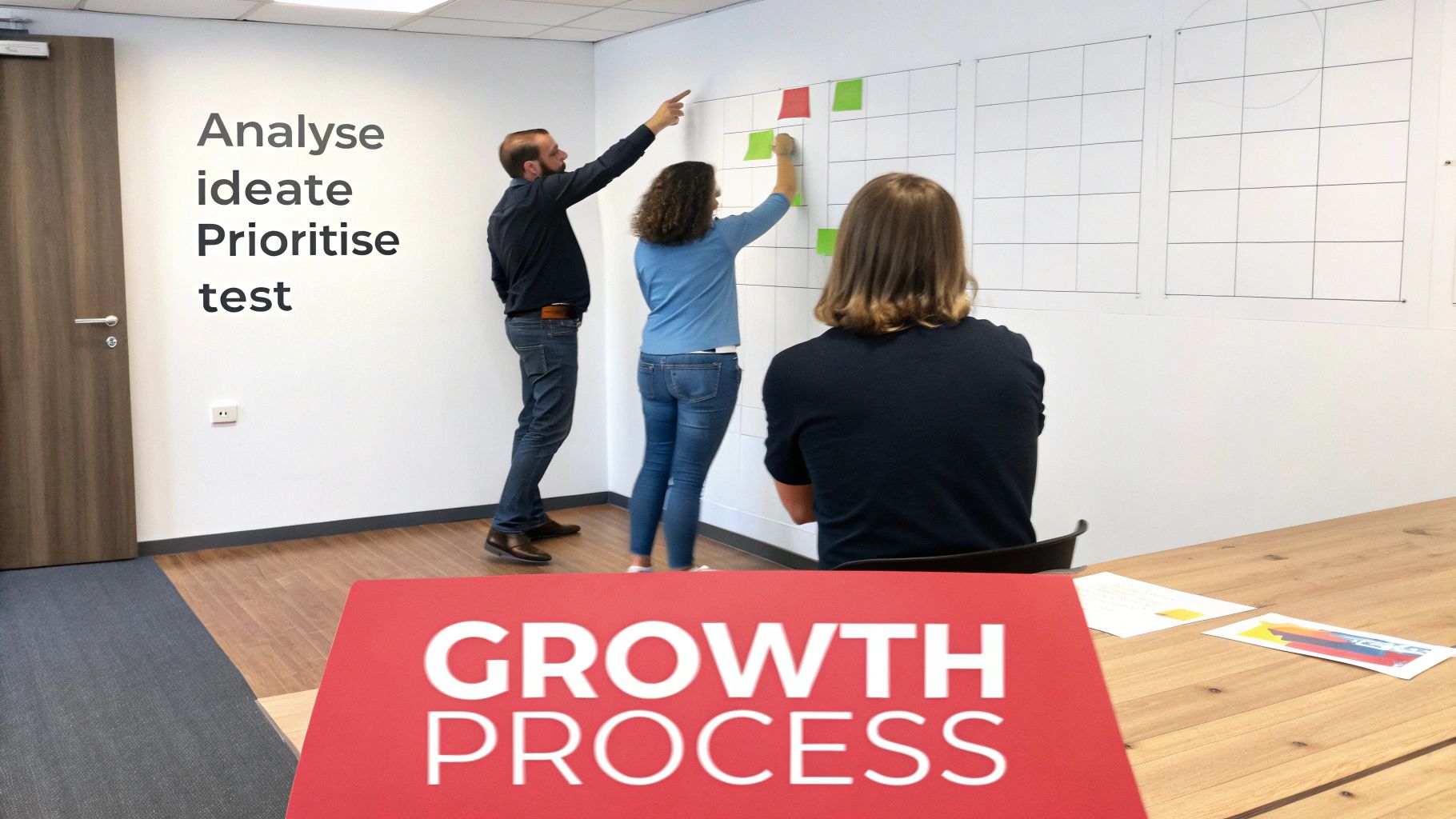
Knowing the theory is one thing, but making growth happen requires a solid, repeatable process. This is not about throwing random tactics at the wall and hoping something sticks; it is about building an engine for continuous improvement that becomes part of your company’s DNA.
The journey starts by getting everyone focused on a single, powerful objective.
Your first move? Define your North Star Metric (NSM) . As we have mentioned, this is the one metric that truly reflects the core value you deliver to customers. It is the compass that ensures your product, marketing, and engineering teams are all pulling in the same direction, not working in silos.
Once your NSM is locked in, you need the right crew. Pull together a cross functional growth team with people from marketing, product, data, and engineering. This mix of skills is crucial—it means you can spot opportunities in the data, dream up creative solutions, and actually build and ship the experiments you design.
The Growth Hacking Cycle
At the heart of any successful growth operation is a simple, four step loop: Analyse, Ideate, Prioritise, and Test . Think of it as the scientific method, but for your business. This cycle is all about high tempo learning, helping your team move from insight to action quickly and efficiently.
-
Analyse Data and Find Opportunities : Get your hands dirty in the analytics. Look at user behaviour. Where are people dropping off? What features do your most loyal customers use constantly? Hunt for the patterns and friction points that scream, "there's an opportunity here!"
-
Ideate Potential Solutions : This is the brainstorming part. Get the team together and generate a ton of experiment ideas based on what you found in the data. No idea is too wild or too small at this stage—the aim is to build a healthy backlog of potential growth levers.
-
Prioritise Your Experiments : You cannot test everything at once, so you need to be smart. Use a simple framework like ICE ( Impact , Confidence , Ease ) to score each idea. How big of an impact could this have? How confident are we it will work? And how easy is it to actually implement? This forces you to focus on the highest potential tests first.
-
Test and Measure the Results : Time to run the experiment and see what happens. Did the change deliver the results you hoped for? Was your hypothesis right? Document everything you learn, whether the test was a home run or a total flop.
Turning Ideas into Actionable Tests
Coming up with ideas is often the easy bit. Let’s say your analysis shows that new users are not sticking around—your activation rate is low. Your team might brainstorm a few different solutions.
- An experiment to gamify the onboarding process to make it more engaging.
- A test to send a series of welcome emails that explain key features.
- A simple change to the user interface to make the very first action clearer.
Each of these tackles the same problem from a different angle. Using the ICE framework, you would score them. The email campaign might score high on ‘Ease’ but maybe lower on ‘Impact’, while a full gamification feature would be the complete opposite. This data led prioritisation stops you from wasting time and ensures you are always working on what matters most.
The real purpose of the growth cycle isn’t to be right every time. It is to build a system that learns faster than your competition. A failed experiment that gives you a clear insight is far more valuable than a lucky guess that works without you ever knowing why.
This process transforms growth from a dark art into a manageable, data informed discipline. It gives you a systematic way to tackle challenges right across the customer funnel.
For example, if you are focused on the Acquisition stage, you could test different lead magnets. For a deeper look into this, our guide on how to build an email list and grow subscribers fast breaks it down. Every insight you gain from one test feeds directly into the next, creating a powerful momentum of continuous improvement.
Your Growth Hacking Questions, Answered
As we have unpacked the mindset, frameworks, and tactics behind growth hacking, a few questions probably came to mind. Let's tackle some of the most common ones to really cement your understanding of how this all works in the real world.
Think of this as a quick fire round to clear up any lingering confusion and help you see where growth hacking fits—and where it does not.
Isn't This Just a Fancy Name for Marketing?
Not quite. While growth hacking and marketing both swim in the same pool, they are doing very different strokes. Traditional marketing is often focused on the bigger picture—brand awareness, top of funnel engagement, and playing the long game.
Growth hacking, on the other hand, is obsessed with data and rapid experiments across the entire customer journey. From the very first touchpoint right through to keeping customers happy and getting them to refer others. It pulls in product and engineering teams in a way marketing rarely does, with one single minded goal: fast, measurable growth.
Does This Stuff Only Work for Tech Startups?
While it was born in the fast paced world of Silicon Valley startups, the core principles can be adapted for almost any business you can think of—B2B, e-commerce, and even long established corporations. The secret sauce is not the tactic, it is the mindset: a relentless drive to experiment, measure everything, and pivot quickly.
A local coffee shop could use growth hacking principles to test new loyalty schemes with QR codes. A B2B consultancy could experiment with free assessment tools to generate qualified leads. The specific plays will change, but the data driven method is universal.
Growth hacking is a methodology, not a fixed set of tactics. Its ethical application depends entirely on the practitioner. At its best, it creates genuine value to encourage growth, like Dropbox offering free storage for referrals.
But like any powerful tool, it can be misused. Some fall into the trap of creating misleading offers or using ‘dark patterns’ to trick users into action. Ethical growth hacking always focuses on sustainable, customer centric growth , not cheap wins that destroy user trust. The real goal is to build a loyal customer base, and you cannot do that without their confidence.
Ready to build a growth strategy that delivers real, measurable results? The team at Superhub combines data driven insights with creative execution to build a growth engine that is built for your business. Discover how we can help you grow.
Want This Done For You?
SuperHub helps UK brands with video, content, SEO and marketing that actually drives revenue. No vanity metrics. No bullsh*t.