

Digital Transformation for Small Businesses: A Practical Guide
When people hear the term ‘digital transformation,’ they often think of complex corporate jargon and huge, expensive tech overhauls. Let's cut through the noise.
For a small business, digital transformation is simply about using modern technology to change how you work and how you serve your customers for the better. It is about swapping old, manual ways of doing things for smarter, more efficient ones so you can compete in a world that is increasingly online.
What Digital Transformation Really Means for Your Business

Think of it like upgrading a traditional high-street shop. The old shop relied on people walking past, taking stock by hand, and serving customers face-to-face. A digitally transformed business still cherishes that personal touch, but it uses technology to connect with people far beyond its local postcode.
It might use an e-commerce website to sell products nationwide, build a loyal community on social media, or use a CRM system to remember a regular customer’s favourite order. It is the same business at its core, just running faster, smarter, and with a much bigger reach. This is not a luxury for big companies any more; it is a vital move for small and medium-sized businesses across the UK.
It’s a Mindset, Not Just New Software
One of the biggest mistakes we see is businesses thinking digital transformation just means buying a new piece of software. While technology is the tool, the real change happens in your mindset and your processes. It is about rethinking how you get things done to create better results for your team and your customers. To really get to grips with this, it is worth exploring what a proper digital transformation strategy involves.
This strategic shift focuses on three key areas:
- Sharper Operational Efficiency: This is all about getting rid of those time-sucking manual jobs. Think about ditching paper invoices and clunky spreadsheets for an automated accounting system that can chase late payments for you.
- A Better Customer Experience: Technology helps you serve your customers on their terms. This could be a simple online booking system that lets clients book an appointment at 10 pm, or personalised emails that offer discounts on products they actually want.
- Finding New Ways to Make Money: Digital tools can open up revenue streams you never thought possible. A local restaurant could start selling meal kits across the country, or a consultant could package their knowledge into an online course for a global audience.
The Power of Automation
Automation is the engine room of efficiency. A recent survey found that 52% of small business leaders are counting on AI and similar tech to make their operations smoother. By automating the repetitive stuff, you free up your time and your team’s brainpower to focus on what actually grows the business. This is a massive part of the journey, and you can learn more about making it happen in our guide to business automation.
Digital transformation is not about becoming a tech company. It is about using technology to become a better, more resilient version of the company you already are. It empowers you to work smarter, not just harder.
Ultimately, this is a fundamental shift in your business culture. It is about embracing new ways of working to make sure your business does not just survive but is still thriving years from now.
Right, let's cut through the noise. What does "going digital" actually mean for a small business in the UK, and what are the real-world hurdles you are likely to face? Forget the buzzwords; let's talk about tangible results and the genuine worries that can make this whole thing feel a bit intimidating.
The benefits are not just theoretical fluff. We are talking about real, measurable improvements to how you work every day. Think about it: switching to a cloud accounting tool like Xero to automate your invoicing could genuinely give you back 10-15 hours a week . That is time you could spend talking to customers or, you know, actually growing the business.
It is the same with sales. Bringing in a simple Customer Relationship Management (CRM) system gets you away from relying on scattered notes and a good memory. Suddenly, your whole team has a clear picture of every customer conversation. The result? Faster follow-ups and a much more professional feel for your clients.
The Real Advantages of Going Digital
For small businesses, the true power here is in solving nagging problems and opening up new doors. The biggest wins usually show up in a few key areas:
- You'll Get More Done: Automating all those repetitive jobs does not just cut down on mistakes; it frees up your team to do the work that actually matters. Less time on admin, more time on growth. Simple as that.
- Your Customers Will Love It: Digital tools let you be there for your customers whenever and however they want. From online booking systems to marketing that actually speaks to them, you can build a smooth, responsive experience that makes people want to come back.
- Stop Guessing, Start Knowing: Gut feelings are great, but data is better. Basic analytics from your website or social media can tell you what is selling, what is not, and which marketing messages are hitting the mark. It helps you make smarter decisions that actually make you money.
A Quick Story from Devon
Picture a small, family-run bakery in Devon. For years, they have run the whole show from a paper diary. Orders are taken over the phone, payments are manual, and their only customers are the ones who walk past the front door. But as they got more popular, things got messy—orders were missed, they were constantly running out of flour, and the owner was beyond stressed.
This is where a bit of digital thinking comes in. It is not about a massive, complex overhaul. It is about a simple e-commerce website with a built-in stock system. Now, they can take orders 24/7, automatically track their inventory, and even offer a click-and-collect service. That one change did not just fix their operational headaches; it opened them up to a whole new customer base outside their village.
This story gets to the heart of it: Digital transformation is not about trying to be the next tech giant. It is about finding your single biggest bottleneck and using a specific digital tool to fix it.
Facing the Hurdles Head-On
Of course, it is not always a walk in the park. Plenty of UK SMEs have the same valid concerns. A recent report from the World Economic Forum pointed out that one in four SMEs see just implementing new tech as a major business challenge.
These worries usually boil down to three things:
- The Perceived Cost: This is the big one. The fear of a massive upfront bill for software and expertise is enough to put anyone off.
- The Skills Gap: "We are bakers/builders/consultants, not tech people." It is a common and fair point. The idea of training everyone on new systems feels like a huge task when your team is already flat out.
- The Fear of Disruption: Taking time out of the day-to-day to change things feels risky. There is a genuine worry that the transition will cause more short-term problems than it solves.
These hurdles are real, but they are absolutely beatable if you have a clear plan. By starting small, focusing on your most urgent problems first, and getting the right support, you can work through these challenges. The trick is to see them not as stop signs, but as checkpoints to plan for along the way.
Your Step-by-Step Digital Transformation Roadmap
Kicking off a digital transformation can feel like trying to plan a massive journey without a map. It is overwhelming. To cut through the noise, we have broken the whole process down into a clear, five-stage roadmap.
This is not about flipping a switch and changing everything overnight. It is about taking smart, progressive steps to build a stronger, more efficient business. Each stage builds on the one before, making sure you have a solid foundation before you move on. Before you start, a solid understanding digital transformation strategy is key to setting your vision. Let's turn a daunting concept into a doable plan.
Stage 1: Assess and Strategise
First things first: you need to know where you are starting from. Before you even think about new tech, take a proper look at your current processes, tools, and—most importantly—your biggest operational headaches. This is not some complex technical audit; it is an honest look at what works and what is holding you back.
Start by asking some simple questions:
- Which manual tasks eat up the most time every week?
- Where do mistakes or delays happen most often?
- What is the single biggest complaint you hear from customers?
The answers will point you directly to your digital priorities. If invoicing is a constant bottleneck, that is where you begin. If managing customer enquiries is a mess, focus there first. This initial strategy work ensures you are aiming your efforts at real-world problems, which guarantees a much better return on your investment.
Stage 2: Secure Quick Wins
Momentum is everything. Instead of kicking off with a massive, expensive project, find some "quick wins." These are low-cost, high-impact changes that get you noticeable results fast, often within a few months. This approach builds confidence and proves the value of digital change to the rest of your team.
A perfect example is switching to a cloud accounting tool like Xero to automate invoicing. That change alone can free up hours of admin work almost immediately. Another quick win could be setting up a proper email marketing service to keep in touch with customers, or using a social media scheduler to stay present online without it being a full-time job. These small steps bring instant relief and build the case for bigger changes down the line.
Stage 3: Choose Your Core Platforms
With a few wins under your belt, it is time to think bigger. This is where you choose the core systems that will support your long-term growth. These are the foundational platforms your business will run on, so picking the right ones is crucial. The goal is to find solutions that are scalable and can grow with you.
Common core platforms for small businesses include:
- Customer Relationship Management (CRM) System: This becomes your single source of truth for all customer data, interactions, and sales tracking.
- E-commerce Platform: If you sell products online, a powerful platform is non-negotiable for managing sales, inventory, and shipping.
- Project Management Software: Absolutely essential for service businesses to keep track of tasks, deadlines, and team collaboration.
When you are looking at platforms, put integration at the top of your list. You want your CRM to talk to your email tool, and your e-commerce site to sync with your accounting software. Getting this right prevents data getting trapped in silos and makes sure your whole operation runs smoothly.
Stage 4: Integrate Your Processes and People
Great tech is only half the battle. Your team is the other half. Bringing new digital tools into the business successfully requires a real effort to build a digital-first culture. That means proper training and clear communication about why these new systems are a good thing.
You have to show your team how a new tool will make their job easier , not just add another task to their to-do list. This stage is also about rethinking your workflows. It is not enough to just digitise an old, clunky paper-based process. You need to redesign the process itself to take full advantage of what the new technology can do.
The goal is not just to do the same things digitally. It is to use digital tools to find entirely new and better ways of doing things.
Stage 5: Measure, Adapt, and Grow
Finally, digital transformation is not a one-and-done project. There is no finish line. It is a continuous cycle of measuring results, adapting your strategy, and pushing for more growth. Use the data you get from your new digital tools to make smarter decisions.
Your website analytics will tell you which products are a hit, and your CRM data will reveal where your best customers are coming from. Use these insights to refine your marketing, improve your services, and spot new opportunities. This data-driven approach turns guesswork into strategy, making sure your business keeps evolving and thriving.
The infographic below shows the main hurdles SMEs often face—hurdles this roadmap is designed to help you clear.
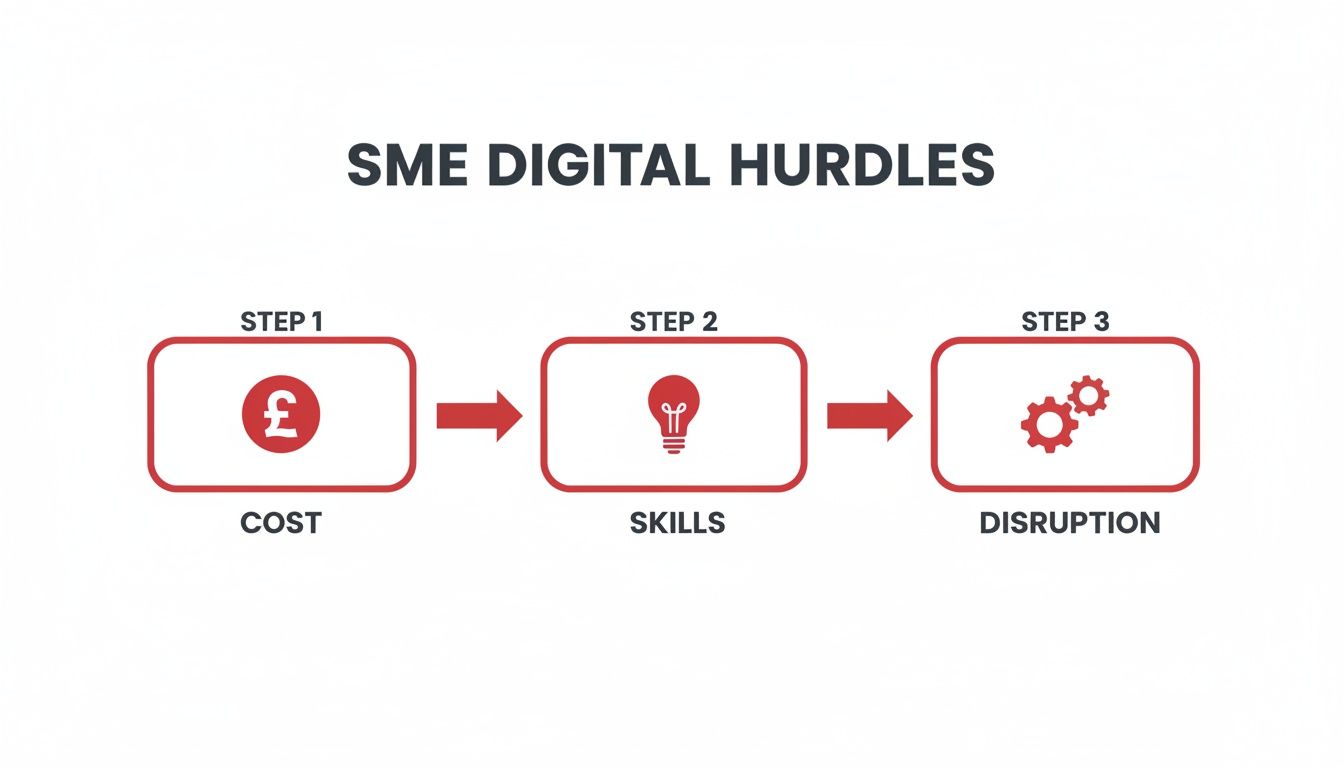
As you can see, challenges like cost, skill gaps, and disruption are all connected. This structured journey is increasingly supported by national initiatives. The UK government’s SME Digital Adoption Taskforce, launched in April 2024, is set to deliver reports aiming for SMEs to lead in AI and digital tech by 2035. Its action plan includes financial support and awareness programmes to tackle barriers like low AI uptake, where only 8% of UK businesses had successfully introduced AI by recent measures.
Putting It All Together: Your Roadmap at a Glance
This roadmap provides a clear, actionable framework for any small business. To make it even simpler, here is a summary of how each stage works and where Superhub can step in to help you succeed.
Digital Transformation Roadmap for Small Businesses
| Stage | Focus | Key Activities | Superhub's Role |
|---|---|---|---|
| 1. Assess & Strategise | Understanding your current state and defining clear goals. | Auditing existing processes, identifying pain points, setting priorities, and creating a vision. | We conduct a digital health check and help you build a practical, goal-oriented strategy. |
| 2. Secure Quick Wins | Building momentum with low-cost, high-impact changes. | Implementing cloud tools (accounting, scheduling), setting up basic automation, and improving email marketing. | We identify and implement the fastest, most effective wins to deliver immediate value. |
| 3. Choose Core Platforms | Selecting scalable, foundational software (CRM, e-commerce). | Researching options, prioritising integration capabilities, and choosing tools that fit your long-term vision. | Our experts guide you through platform selection to ensure you invest in the right tech for your future. |
| 4. Integrate Processes & People | Aligning your team and workflows with new technology. | Providing team training, redesigning processes, and fostering a digital-first culture. | We offer training and support to ensure smooth adoption and help you rethink workflows for maximum efficiency. |
| 5. Measure, Adapt & Grow | Using data to make informed decisions and drive continuous improvement. | Analysing performance data, refining strategies, identifying new opportunities, and setting new goals. | We provide ongoing analytics and strategic reviews to help you adapt and stay ahead of the curve. |
By breaking the journey down into these manageable stages, digital transformation becomes an achievable and empowering process for your business, not an intimidating overhaul.
Budgeting for Transformation and Measuring ROI
Let's talk about the elephant in the room: money. For most small businesses, the cost of digital transformation is the biggest hurdle. But here is the good news—you do not need to win the lottery. A smart, phased approach to your budget makes the whole thing manageable and, most importantly, profitable.
Thinking about the cost should not feel like staring at one big, scary number. It is much more helpful to break it down into two separate buckets. Getting your head around this is the first real step to building a financial plan that actually works.
This way, you avoid sticker shock and can plan for both the big initial spends and the smaller, regular running costs. It is about building your digital future on solid financial ground.
One-Off Investments vs. Ongoing Costs
First up, you have your one-off capital investments . These are the big, foundational purchases you make right at the start. Think of it like building a new e-commerce website from scratch or buying the initial software licences for a crucial system like a CRM. These are planned, chunky expenses.
Then, you have the ongoing operational costs . These are the recurring fees that keep everything ticking over. This includes things like your monthly software subscriptions for marketing tools, website hosting fees, or a retainer for digital support. These are predictable costs that need to be baked into your regular budget.
A classic mistake is to focus all your attention on that big initial investment and completely forget about the running costs. A solid budget plans for both, making sure you can not only launch your new projects but keep them going for the long haul.
Creating a Practical Budget
The secret to a manageable budget? Start small. You absolutely do not need to do everything at once. Put your money where your biggest problem is—the one you found in your initial assessment. This focused approach means your first investment delivers real value, fast.
Here is a practical way to think about it:
- Start with Quick Wins: Put a small part of your budget towards low-cost, high-impact tools first. This could be a simple social media scheduler or an email marketing platform that gets immediate results.
- Phase Your Major Investments: Instead of a massive, one-time overhaul, break down your bigger projects. For example, launch a basic website first, then add the full e-commerce shop in a later phase.
- Explore Funding and Grants: Always keep an eye out for government schemes or local grants designed to help SMEs in the UK adopt new technology. These can seriously lighten the financial load.
This step-by-step approach feels much less daunting and lets you use the returns from your early wins to help fund the next stage.
Proving the Value by Measuring ROI
So, how do you know if any of this is actually working? You have to measure your Return on Investment (ROI). This is the proof in the pudding—it shows your digital efforts are paying off and builds a rock-solid case for spending more in the future. But ROI is not just about a spike in sales.
ROI is not just about revenue. It is about measuring gains in efficiency, customer loyalty, and operational resilience. These metrics paint a much fuller picture of the value you are creating.
To get a true feel for your return, you need to track a mix of metrics. These include direct financial gains as well as the huge efficiency boosts that save your business time and money. We have put together a detailed guide that explains how to calculate marketing ROI in the UK, which is a brilliant starting point.
Here are a few key ROI metrics you should be tracking:
- Hours Saved Through Automation: Work out the time your team saves by automating repetitive tasks, then multiply it by their hourly cost. It adds up fast.
- Improved Customer Retention Rate: Even a small bump in customer loyalty can have a massive impact on your long-term revenue.
- Increase in Qualified Leads: Track how many more high-quality leads your new digital marketing is bringing in.
- Reduced Operational Costs: Measure the savings from going paperless or cutting down on errors that used to need costly fixes.
By tracking these metrics, you stop hoping your investment is working and start knowing it is. This data-driven insight is what separates a successful, long-term transformation from a one-off project that fizzles out. It gives you the proof and the confidence you need to keep pushing forward.
Seeing Digital Transformation in Action

Theory is one thing, but seeing how digital tools actually work in the real world is where it all starts to click. Let’s look at some practical, no-nonsense examples from businesses you will probably recognise.
These are not just stories; they are mini case studies showing how specific tech solves everyday business problems. We will use a simple ‘Problem-Solution-Result’ format to show you the direct, tangible impact of a smart digital plan.
It is about moving past abstract ideas and looking at the concrete outcomes – real growth, better efficiency, and happier customers for businesses just like yours.
The Automotive Garage Boosting Bookings
Problem: A local garage in Devon was stuck in the past, relying on phone calls to book every job. This meant they were constantly missing calls during busy services, had no way of taking bookings after hours, and the workshop diary was a mess of scribbled, hard-to-read notes. Their only marketing was word-of-mouth, which meant their workflow was a frustrating cycle of feast or famine.
Solution: The first step was to build a clean, professional website optimised for local searches. We then integrated a simple online booking system. Now, customers could see exactly when the garage had a free slot and book their MOT or service anytime, day or night. To get the phone ringing (and the online bookings flowing), Superhub kicked off a targeted local SEO campaign to get them right at the top of Google for searches like "car service near me."
Result: It was a game-changer. Within six months, 40% of all appointments were coming through the website, massively cutting down on phone interruptions. The steady flow of leads from their top Google ranking filled the diary, smoothed out the workflow, and boosted their overall revenue by a solid 15% .
The Local Retailer Expanding Its Reach
Problem: A lovely boutique clothing shop had a fiercely loyal local customer base, but online, they were completely invisible. Sales were tied directly to footfall, making them vulnerable every time the high street was quiet. They had unique, beautiful products but absolutely no way to sell them to anyone outside their immediate postcode.
Solution: We helped them launch an e-commerce store using a platform like Shopify, putting their entire collection online for the world to see. This was then hooked up to shopping features on Instagram and Facebook, where high-quality photos and targeted ads could reach thousands of new, potential customers. We also set up an email marketing system to keep in touch with customers and let them know about new arrivals.
Result: The shop started making sales across the UK in the very first month. A year later, online sales accounted for 30% of their total revenue . Their social media following blossomed into a real community of engaged customers, who became not just repeat buyers but genuine brand advocates.
These examples show that digital transformation is not about becoming a technology company. It is about using the right technology to solve a specific problem and serve your customers better.
For UK SMEs, the potential here is massive. Research shows that if small businesses embraced digital tools more effectively, it could add an incredible £232 billion to the economy.
But there is a gap. Despite all this opportunity, many businesses are getting left behind. For example, only 15% are currently using AI, compared to 68% of larger firms. That is a huge difference, and it is exactly where partners like Superhub come in. You can dig into the full report on the impact of small enterprise tech adoption to see the sheer scale of what is possible.
By making these changes, you are not just modernising; you’re building a stronger, more competitive, and more profitable business that is ready for whatever comes next.
Finding Your Digital Transformation Partner
Kicking off a digital transformation can feel like a mammoth task, but you absolutely do not have to go it alone. The right partner acts as your guide, helping you cut through the complexity and turn your vision into a practical, profitable reality. It is all about finding an expert team that gets both the technology and the unique pressures you face as a small business owner.
This journey is about so much more than just shiny new software; it is about building a rock-solid digital foundation for future growth. That process starts with a powerful website and smart SEO to make sure you get found online. From there, it is about engaging social media and creating content that builds real, lasting relationships with modern customers.
A Partnership Built on Your Goals
Every small business is completely different. That is precisely why a one-size-fits-all approach to digital marketing is a recipe for disaster. The best partnerships are built on a bespoke, data-driven strategy that is laser-focused on your specific goals. You need a team that takes the time to get under the skin of your business before they even think about recommending a single tool or tactic.
The goal is to create a clear, actionable plan that delivers tangible results—whether that is boosting online sales, streamlining your operations, or reaching a whole new audience. It is about making technology work for you, not the other way around.
Choosing the right agency is a critical first step. It is a big decision, which is why we have put together a full guide on how to choose a digital marketing agency to help you make a properly informed choice.
Bridging the Digital Divide
The pressure on UK businesses to get with the times is immense. According to the Startups’ 100 survey for 2025, a massive 82% of UK businesses feel this intense pressure to integrate new technologies.
Yet, only 15% of small businesses have actually adopted AI, compared to a staggering 68% of larger companies . This gap represents a huge missed opportunity for efficiency and growth. Without action, SMEs risk getting left behind, but an expert partner is perfectly positioned to bridge this divide. You can read more about the challenges facing UK SMEs in 2025 to get the full picture.
At Superhub, we specialise in helping small businesses close that gap. Our expertise in website development, SEO, and creative content provides the exact solutions you need to compete and thrive. We are here to demystify the entire process and build a strategy that fits your budget and delivers real, measurable results.
Ready to start a conversation about your digital future? Let's talk.
Frequently Asked Questions
Taking the leap on any big business change is bound to bring up questions. It is completely normal. To help give you some clarity, we have put together answers to the questions we hear most often from small business owners just like you.
The goal here is not to bog you down with technical jargon. It is about giving you straightforward answers so you feel confident enough to take that next step. Getting your head around these key points makes the whole thing feel a lot less daunting and a lot more doable.
How Long Does Digital Transformation Take?
This is the big one, and the honest answer is that real digital transformation is not a project with a finish line. It is more of a mindset, a new way of operating that focuses on constantly getting better.
But that absolutely does not mean you will be waiting years to see a difference. By homing in on a few high-impact "quick wins," you can see genuine improvements in how you work and how your customers feel within just three to six months . Getting the first few systems in place might only take a few weeks, but you will often start feeling the positive ripple effects almost immediately.
What Is the Single Most Important First Step?
With so many tools and platforms out there, it is easy to get paralysed by choice. The single most important first step is not about technology at all—it is to simply take an honest look at your current processes . You do not need a fancy consultant for this; just a clear-eyed audit of your day-to-day.
Get your team together and ask some simple questions:
- What is that one manual task that eats up everyone's time?
- Where do our biggest customer complaints seem to come from?
- Which part of our process is most likely to go wrong due to human error?
The answers will point you directly to your biggest headaches. Fixing those first means your initial investment solves a real, painful problem. It delivers immediate value and builds the momentum you need for the rest of the journey. This is the bedrock of any successful digital transformation for small businesses .
Can My Business Really Afford This?
This is often the biggest hurdle, but it is usually built on a myth. Digital transformation does not have to mean a massive, one-off bill that makes your eyes water. The whole point is that it can be scaled to fit your budget.
Try to see it not as a cost, but as an investment in your company's future and its ability to handle whatever comes next. The price of standing still is almost always higher than the cost of moving forward.
You can start small. There are plenty of low-cost or even free tools for social media scheduling, basic project management, or email marketing. Many of the most powerful software platforms offer affordable monthly plans designed for businesses exactly your size. By phasing your investments and focusing on changes that will clearly pay for themselves, you make the whole process financially manageable.
Ready to make a change but not sure where to begin? Superhub specialises in creating practical digital strategies that get real results for small businesses. Start your journey today.
Want This Done For You?
SuperHub helps UK brands with video, content, SEO and marketing that actually drives revenue. No vanity metrics. No bullsh*t.