

How to create a content strategy that actually works
Right, let's get into it. A proper content strategy is not just about throwing ideas at the wall to see what sticks. It is a game plan. It is the roadmap connecting what your business needs to achieve with every single article, video, and social post you create.
This means you have got to define your goals, get under the skin of your audience, audit what you have already got, figure out your core topics, plan your distribution, and then measure everything. Nothing is left to chance.
Building Your Content Strategy Foundation
Before a single word is written, you need a solid foundation. This is where you stop guessing and start defining what success actually looks like for your business. It is all about setting a clear direction so that every piece of content has a specific, measurable job to do.
Forget about creative brainstorming for a minute—this part is pure strategic planning. Without this groundwork, even the most brilliant content can fall flat. Why? Because it was not aimed at the right people or designed to hit a specific business goal.
Defining Your Business Objectives First
Your content does not exist in a vacuum. It is a tool for your business. So, the very first thing you need to do is connect your content directly to your company's big picture objectives. Are you trying to generate better quality leads for the sales team? Or maybe the focus is on keeping existing customers happy with valuable support after they have bought from you.
Your goals need to be crystal clear. They might look something like this:
- Increasing Brand Awareness: Getting your name in front of a whole new market segment.
- Generating Marketing Qualified Leads (MQLs): Attracting potential customers who are a genuine fit for what you offer.
- Boosting Customer Loyalty: Creating content that helps current customers and keeps them coming back.
- Establishing Thought Leadership: Positioning your brand as the undisputed expert in your field.
Here in the UK, this kind of planning really pays off. We see companies with a documented content strategy achieve up to a 33% higher Return on Investment (ROI) compared to those just winging it. It is proof that careful planning and clear goals make your content work harder.
Understanding Your Audience Deeply
Once the goals are set, you need to know exactly who you are talking to. This is where you create detailed audience personas—semi fictional profiles of your ideal customers. These should not be vague sketches; they need to feel like real people with real frustrations, career goals, and online habits.
A great persona goes way beyond basic demographics. It uncovers the 'why' behind what your audience does—what keeps them up at night, what problems they are desperate to solve, and what they are actually typing into Google.
To get this right, you need to dig into real data. Talk to your customers, send out surveys, and get familiar with your analytics. Answering these questions brings your persona to life and makes sure your content hits home on a personal level. This is a fundamental part of the wider digital marketing landscape we navigate, which you can read more about at https://www.superhub.biz/digital-marketing-fundamentals-made-simple. And to keep all this valuable content organised, understanding digital asset management best practices is a must.
This simple workflow shows how it all fits together, moving from high level goals to audience deep dives and detailed planning.
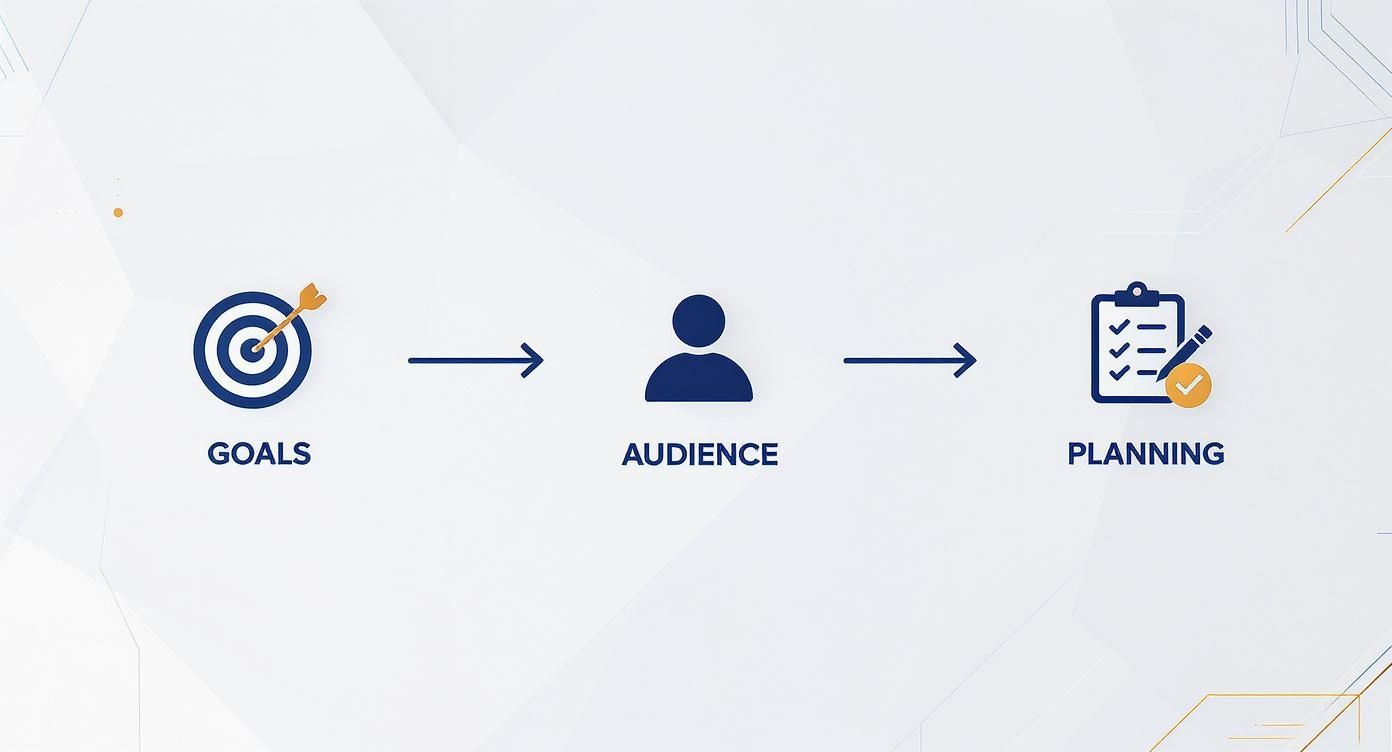
The main takeaway here is that each step builds on the last. It is a logical process that ensures your final plan is both razor sharp and purposeful.
Getting to Grips with Your Content and the Competition
Before you can map out where you are going, you need to know exactly where you stand. It is tempting to jump straight into creating new content, but without taking stock of what you already have—and what your competitors are up to—you are essentially flying blind. This audit phase is what separates a strategy built on guesswork from one designed for real results.
You would be surprised what you can find. An audit is not just about weeding out the duds; it is about uncovering hidden gems. I have seen countless businesses sitting on a goldmine of existing articles that, with a bit of a polish, could be driving serious traffic.

Taking a Full Content Inventory
First things first, you need to get everything down in one place. This means creating a master list—a spreadsheet is your best friend here—of all your published content. We are talking every blog post, landing page, case study, and video.
For each piece of content, pull in the data that tells its story. This is not just a list; it is a diagnostic tool.
Make sure your inventory tracks the essentials:
- URL: The direct link to the asset.
- Content Title: The headline you went with.
- Format: Is it a blog post, video, white paper, etc.?
- Key Metrics: Grab stats like page views, time on page, and bounce rate from your analytics.
- SEO Data: Note the primary keyword it is targeting and where it currently ranks.
Laying it all out like this gives you a brilliant bird's eye view. It becomes instantly obvious what is pulling its weight and what is just gathering digital dust. This is your starting point for making some tough but necessary decisions.
Finding Your Gaps and Opportunities
With your inventory ready, the real analysis can begin. Start looking for patterns. Group your content by topic or theme. Where are you strong? Where are the glaring holes?
This analysis will push you towards one of four clear actions for every single piece of content on your list:
- Keep: It is performing well, it is still relevant, and it is hitting your goals. Do not touch it. This is a top tier asset.
- Update: The topic is solid, but the content is out of date or just not performing. It is crying out for fresh stats, better on page SEO, or new examples. That blog post on 2021 social media trends? A perfect candidate.
- Consolidate: You have got several weak articles all nibbling at the same topic. Merge them. Creating one comprehensive, powerhouse piece is far better for both users and search engines.
- Remove: The content is irrelevant, low quality, and gets zero traffic. It happens. Pruning this "thin" content can actually boost your site's overall SEO health.
This is not just housekeeping. It is a strategic realignment. Refreshing your existing content is often the quickest win you will get, delivering big traffic gains for a fraction of the effort of starting from scratch.
Sizing Up the Competition
Here is the thing: your content does not exist in a vacuum. You need to know what your competitors are doing, not to copy them, but to find your own angle and exploit the opportunities they have missed.
Pick your top three to five direct competitors—the ones really fighting you for the same audience. Then, it is time to go digging. What are their core content pillars? What formats do they lean on most? Which keywords are bringing them the most traffic?
Tools like Semrush or Ahrefs are indispensable here. They will show you exactly what is working for others in your field.
By seeing where they are strong, you can figure out where to be different. Maybe their blog game is on point, but they have zero video content. Or perhaps they completely ignore a niche topic that you know your audience is passionate about. These are your openings. This is how you carve out your own space and stop fighting for scraps.
Developing Your Core Content Pillars and Formats
Right, you have done the hard graft with your audits. Now it is time to turn all that insight into a clear, creative game plan. This is where you build the backbone of your strategy, defining your core content pillars and picking the best formats to bring your stories to life.
Think of your content pillars as the three to five big ticket themes your brand is going to own. These are not just random topics you have plucked from thin air; they are the foundational subjects that grow directly from your audience's biggest headaches and your unique expertise. Nailing this ensures everything you create is consistent, focused, and actually matters to the people you are trying to reach.
Establishing Your Content Pillars
Your pillars act as a strategic filter for every single idea. If a suggestion for a blog post or a video does not tuck neatly under one of them, it is probably off strategy. This focus stops your content from becoming a jumbled mess of unrelated stuff and, instead, builds a cohesive library that cements your authority.
For example, imagine a Devon based garage that specialises in classic car restoration. Their pillars might look something like this:
- Restoration Techniques: Covering everything from bodywork and paint jobs to full engine rebuilds.
- Classic Car Maintenance: Practical, hands on advice for keeping vintage motors in peak condition.
- Motorsport Heritage: Digging into the history and iconic stories behind classic racing cars.
- Buying Guides: Helping enthusiasts make smart, informed decisions when they are ready to buy.
Each pillar is broad enough to spark an endless stream of specific ideas but tight enough to constantly reinforce the garage's niche expertise. It is a framework that guarantees they are always speaking the right language to their ideal customer.
The content marketing funnel below shows how different types of content are needed to guide someone from first hearing about you to finally making a purchase.
As you can see, you need a smart mix of formats to gently guide a potential customer from that initial "who are you?" moment right through to the final decision.
Choosing the Right Content Formats
Once your pillars are locked in, the next question is how you will bring them to life. The format you choose is just as crucial as the message itself. A brilliant idea wrapped in the wrong package will fall completely flat.
Your decision should come down to three things: the message you are delivering, the audience you are talking to, and the platform you are using. A complex technical breakdown might work perfectly as a detailed blog post with diagrams, whereas a customer success story will hit much harder as a short, punchy video.
Your content mix needs variety. Relying on a single format, like blog posts, is a surefire way to bore your audience. A balanced approach keeps things fresh and holds their attention.
Start thinking about a well rounded mix of formats:
- In depth Blog Posts: Perfect for detailed guides, sharing your expert opinion, and climbing the SEO ranks.
- Compelling Case Studies: The best way to show real world results and build serious trust.
- Engaging Videos: Brilliant for tutorials, brand storytelling, and grabbing attention on social media. We have got a great guide on the 3 types of videos every modern business needs.
- Interactive Quizzes: Fantastic for getting your audience involved and capturing valuable lead information.
Choosing the Right Content Format for Your Goal
To help you decide, here is a quick table matching common business goals with the content formats that deliver the goods.
| Business Goal | Primary Content Format | Secondary Content Format | Key Metric |
|---|---|---|---|
| Build Brand Awareness | Short form Video (Socials) | Infographics, Blog Posts | Reach, Impressions |
| Generate Leads | Webinars, Ebooks | Quizzes, Checklists | Form Fills, Downloads |
| Nurture Prospects | Case Studies, White Papers | Email Newsletters, Demos | MQLs, Sales Pipeline |
| Drive Sales/Conversions | Product Videos, Testimonials | Comparison Guides, Reviews | Conversion Rate, Revenue |
| Improve Customer Loyalty | How To Guides, Tutorials | Community Forums, Q&As | Customer Lifetime Value |
Ultimately, the goal is to create a library of content that meets your audience where they are, no matter what they are looking for.
In the UK market, the depth and format of your content really matter. People here often favour substantial, engaging material. In fact, research shows that web pages with 1,500 to 2,000 words tend to get more clicks, proving that in depth content adds real value. On top of that, interactive formats like quizzes can pull in double the engagement of static articles. You can find more stats on content engagement at research.aimultiple.com.
By carefully choosing your pillars and balancing your formats, you create a powerful, sustainable engine for attracting, engaging, and converting your target audience.
Planning Your Content Distribution and Promotion
Creating a brilliant piece of content is a fantastic achievement, but let us be honest—it is only half the job. Without a solid plan to get it in front of the right people, even the most insightful article will fail to make an impact. This is where distribution moves from an afterthought to a core part of your strategy.
A proactive approach ensures your hard work does not just sit on your website gathering digital dust. Instead, it becomes an active tool that consistently attracts, engages, and converts your audience. It is about turning your content into a reliable engine for growth.

Leveraging Your Owned Channels
Your owned channels are the platforms you control completely. We are talking about your company blog, email newsletter, and your main social media profiles. These are your foundational distribution points and, frankly, the most cost effective way to reach an audience that has already given you a nod of approval.
For every single piece of content you publish, you should have a clear checklist for promoting it across these channels. This is not just about slinging a link out into the void; it is about tailoring the message for each platform.
- Your Blog: This is your content’s home base. Make sure every post is properly optimised for search engines to pull in organic traffic for months and years to come.
- Email Marketing: Segment your email list. Sending relevant content to specific audience groups will do wonders for your engagement. A well timed email can drive a huge spike in initial traffic.
- Social Media Profiles: Do not just post the title and a link. Create custom graphics, pull out killer quotes, or chop up a short video clip to make your content stand out in a ridiculously busy feed.
A classic mistake is to "post and pray," just hoping people stumble across your work. The most successful strategies I have seen treat content publication as the starting line for promotion, not the finish line.
Earning Media and Building Outreach
Earned media is gold. It is the visibility you get from word of mouth, shares, and mentions from other people and brands. It is incredibly valuable because it is a powerful form of social proof. The key to getting it? Building relationships.
Start by identifying key influencers, journalists, and other blogs in your niche. I do not mean spamming them with requests to share your latest article. That never works. Instead, focus on building genuine connections over time by engaging with their content and offering value first.
When you do have a piece of content that is a perfect fit for their audience, your outreach will be warm and far more likely to get a response. A single mention from a respected voice in your field can send a wave of targeted traffic your way and give your credibility a massive boost.
Amplifying Your Best Work with Paid Media
Owned and earned media are essential, but paid media allows you to guarantee your content reaches a specific, targeted audience. This is especially useful for putting some budget behind your best performing pillar content—those in depth guides and resources that have real power to attract new customers.
Think about using targeted advertising on the platforms where you know your audience hangs out.
- Social Media Ads: Platforms like LinkedIn and Facebook let you get incredibly granular with your targeting. You can put your content right in front of users based on their job title, interests, and online behaviour.
- Search Engine Marketing (SEM): Promoting content with search ads helps you capture high intent users who are actively looking for the exact solutions your content provides.
- Content Discovery Networks: Services like Outbrain or Taboola can place your articles on major publisher sites, introducing your brand to a much broader audience.
The role of social media in shaping UK content strategies cannot be overstated. With the UK's social media advertising market projected to hit £9.95 billion in 2025, it is a dominant channel. On top of that, influencer marketing ad spend is expected to exceed £1.04 billion in the same year, showing just how much brands are aligning content with platform demographics to boost their reach. You can learn more about these social media trends in the UK.
By combining owned, earned, and paid approaches, you create a robust distribution system. This ensures your content consistently finds the right audience, driving your business goals forward.
Building an Efficient Content Production Workflow
Even the best strategy is just a document until you build a system to bring it to life. This is where the big ideas meet the day to day reality of actually making content. An efficient production workflow is the engine room of your entire strategy, making sure you can create brilliant content, consistently, without the last minute chaos.
A solid process gets rid of bottlenecks, keeps everyone on the same page, and turns that content calendar from a wish list into a reliable production line. By systemising your approach, you create a repeatable process that can grow right alongside your ambitions.
Creating a Practical Content Calendar
Think of your content calendar as the single source of truth for the entire team. It is far more than a list of publish dates; it is the central hub that tracks every single piece of content, from a spark of an idea right through to promotion. A good calendar brings clarity to what is coming, who is responsible, and when every task is due.
To be genuinely useful, it needs to track a few key details for every item:
- Topic and Title: The working title and a quick summary of the angle.
- Content Pillar: Which of your core strategic pillars this piece supports.
- Format: Is it a blog post, a video, a case study, or something else?
- Target Keyword: The main SEO keyword the content is aiming to rank for.
- Status: A clear sign of where it is in the workflow (e.g., Briefing, Drafting, Review, Published).
- Owner: The one person ultimately responsible for getting it over the finish line.
This level of detail is what turns a simple schedule into an active project management tool.
Assigning Clear Roles and Responsibilities
Fuzzy ownership is the enemy of an efficient workflow. When people are not 100% sure what they are meant to be doing, deadlines slip and quality drops. Defining clear roles means a smooth handover between each stage of the production process.
A classic bottleneck is the review and approval stage. Assigning a single, decisive editor or stakeholder stops content getting stuck in an endless feedback loop between multiple people.
Think about the key roles your workflow needs:
- Content Strategist: Owns the calendar, generates ideas, and makes sure everything aligns with the bigger picture.
- Writer/Creator: Does the heavy lifting of drafting the content based on the brief.
- Editor: Reviews for quality, accuracy, brand voice, and on page SEO.
- Designer: Creates any visuals needed, from header images to custom infographics.
- Publisher: Loads the final content into the CMS, schedules it, and does the final checks before it goes live.
Establishing Quality Guidelines and Content Briefs
Consistency is everything when you are building a brand people recognise. Your quality guidelines should spell out your brand's tone of voice, style preferences (like how you format headings), and your overall standards. This document is the north star for every creator, making sure every piece feels like it came from you.
To make this happen, every single piece of content should kick off with a detailed content brief . This is the document that translates the strategic goal into clear, actionable instructions for the creator. A solid brief stops people from wasting time and ensures the first draft is already 90% of the way there.
It should include the target audience, the primary keyword, key talking points, internal links to include, and a very clear call to action. No more guesswork.
Measuring Performance and Optimising Your Strategy
Your content strategy is not a static document you create once and file away. Think of it as a living plan—one that needs to breathe, adapt, and evolve based on what the real world data is telling you. This final piece of the puzzle is all about measurement, creating a feedback loop that proves your content is actually delivering a return.
Without this, you are just guessing. Effective measurement is what turns your content from a purely creative exercise into a predictable engine for growth. It is how you find out what is truly hitting the mark with your audience and what is falling flat, letting you double down on the winners and learn from the rest.

Selecting KPIs That Truly Matter
First things first, you need to choose Key Performance Indicators (KPIs) that tie directly back to the business goals you defined right at the start. It is easy to get distracted by vanity metrics like 'likes' or impressions. They might give you a temporary buzz, but they do not tell you if your content is actually moving the needle on what counts—like generating qualified leads or driving sales.
Simply put, your KPIs should reflect the job you hired that piece of content to do.
- For Brand Awareness: You will want to track things like organic traffic , keyword rankings for your core topics, and social media reach. This shows if you are successfully getting in front of new eyeballs.
- For Lead Generation: Here, your focus shifts to conversion rates from blog posts, the number of ebook downloads, or webinar sign ups. These are direct signals of genuine audience interest.
- For Customer Engagement: Keep an eye on metrics like time on page, comments, and email open rates. This tells you if your content is genuinely holding your audience's attention and building a relationship.
Getting a handle on these numbers is vital. For example, knowing How to Measure Social Media Engagement properly can completely transform how you approach those platforms.
Using Data to Refine and Improve
Once you have defined your KPIs, you need a solid system for tracking them. A tool like Google Analytics is non negotiable here, giving you a clear picture of how people interact with your content. But remember, data is useless without analysis and, more importantly, action.
Set up a regular review cycle—maybe monthly, maybe quarterly—to actually sit down with the numbers and ask some hard questions. Why did one article drive hundreds of leads while another barely got any traffic? Which channels are sending you the most engaged readers?
This process is not about finding fault; it is about finding patterns. Your data tells a story about your audience’s needs and interests. Your job is to listen to it and adjust your strategy accordingly.
This data driven feedback loop is what separates a good strategy from a great one. It helps you sharpen your content pillars, re-evaluate your distribution channels, and spot opportunities to give older content a quick update for a performance boost. The insights you gain are invaluable for measuring marketing effectiveness across the board, far beyond just your content efforts.
A Framework for Continuous Optimisation
To help you stay sharp, here is a straightforward table that connects your content efforts to real business outcomes at every stage of the customer journey.
Key Content Metrics Aligned to Business Goals
This table breaks down the essential KPIs to track for each stage of the marketing funnel, helping you measure the true impact of your content strategy.
| Funnel Stage | Business Goal | Primary KPI | Example Metric |
|---|---|---|---|
| Top of Funnel | Brand Awareness | Reach & Traffic | Unique Visitors, Keyword Rankings |
| Middle of Funnel | Lead Generation | Conversion Rate | Gated Content Downloads, Form Fills |
| Bottom of Funnel | Sales Enablement | Pipeline Influence | MQLs Generated, Demo Requests |
| Post-Purchase | Customer Loyalty | Engagement & Retention | Time on Page, Repeat Visits |
By consistently measuring what matters and using that data to make smarter decisions, your content strategy becomes more than just a plan. It turns into a responsive, agile system that gets better over time, ensuring every piece of content you create contributes directly to the growth of your business. This constant cycle of refinement is the real secret to long term success.
Got Questions? We've Got Answers
You are not alone if you have still got a few questions rattling around. Building a proper content strategy is a big undertaking. Let us tackle some of the most common queries we hear from clients.
How Often Should I Update My Content Strategy?
Your content strategy needs to breathe. It is a living document, not something you carve in stone and forget about.
We recommend a deep dive review at least once a year, but the real magic happens with quarterly check ins. This is your chance to see what is working, what is not, and react to shifts in the market or how your audience is behaving. Staying agile keeps you relevant.
What's The Difference Between a Content Strategy and a Content Plan?
This one trips a lot of people up, but it is simple when you break it down.
-
* Your Content Strategy is the 'why'. * It is the high level vision. It answers the big questions: Why are we creating this content? Who is it for? What are we trying to achieve? This is where your goals, personas, and brand voice live.
-
* Your Content Plan (or Calendar) is the 'how, what, and when'. * This is the granular, on the ground stuff. It maps out the exact blog posts, videos, or social updates you are creating and when they will go live.
Think of it this way: your strategy is the roadmap for the entire journey, while your content plan is the turn by turn navigation for the next few miles. You cannot get to your destination without both.
How Long Until I See Real Results?
I will be straight with you: content marketing is a long game. It is a marathon, not a sprint. While you might get some quick wins from a paid campaign, the true value—building organic traffic, authority, and trust—takes time.
Realistically, you should expect to see meaningful results kick in around the six to nine month mark, assuming you are executing consistently. It demands patience, but the payoff is an incredibly powerful and reliable growth engine for your business.
Ready to build a content strategy that actually moves the needle?
At Superhub , our Devon based team builds marketing strategies that get brands noticed. From nailing your SEO to managing your social media, we have got the expertise to help your business grow.
Find out how we can help over at https://www.superhub.biz.
Want This Done For You?
SuperHub helps UK brands with video, content, SEO and marketing that actually drives revenue. No vanity metrics. No bullsh*t.