

What is programmatic SEO? A Practical Guide to Scale Your Content
Programmatic SEO is a way of creating hundreds, or even thousands, of unique web pages by connecting a structured set of data to a single, flexible page template. It’s a seriously smart way to scale your organic reach by answering highly specific user questions, using automation to do the heavy lifting.
Understanding Programmatic SEO Without the Jargon
Let's cut through the noise. Imagine you're building a massive, highly organised library. Instead of writing every single book from scratch, you have a master template for the cover and layout, plus a huge database of facts and stories to fill the pages. Programmatic SEO works just like that.
This isn't about churning out spammy, low-quality content. When it's done right, it's an incredibly powerful technique for growth. Think of it as the intersection of data, design, and automation, creating a potent engine for organic traffic. At its heart, it relies on the same principles as any good SEO work, which you can read about in our simple guide to how SEO works.
The Core Idea: Scaling Value
The goal here is to serve those highly specific, long-tail search queries that are often too numerous to target with manually written articles. By spotting a repeating pattern in what users are searching for, you can build a system that automatically generates a unique page for each variation of that search.
The key components are pretty straightforward:
- A Structured Dataset: This is your library of facts. It could be anything from product specifications and property listings to motorsport race statistics. The important thing is that the data must be well-organised and unique.
- A Flexible Page Template: This is your book cover and layout. It's a well-designed web page that can dynamically pull in information from your dataset to create a finished, useful page for the user.
- An Automated Process: This is the tech that connects your data to your template. It publishes new pages as your dataset grows and makes sure they're all internally linked correctly.
A classic example comes from Zapier, which creates thousands of pages for every possible software integration they offer.
This page is built from a template, automatically pulling in the logos, names, and functions of the two apps from a database. It perfectly serves a very specific user need without anyone having to write it by hand.
Why It Works So Well
This method is incredibly effective because it targets bottom-of-the-funnel keywords—searches from people who are very close to making a decision. The results can be massive. For example, one UK case saw organic signups jump from 67 to over 2,100 per month —a 3,035% increase —within just ten months of launching a programmatic SEO project.
This shows how programmatic pages, built from reliable datasets, can turn broad keyword coverage into tangible business results. You can read more about these programmatic SEO results to see the full impact.
The Three Pillars of a Programmatic SEO Project
A successful programmatic SEO project doesn’t just happen. It’s built on a solid foundation, a bit like constructing a high-performance race car. You need three core components working in perfect harmony: a powerful engine (your data ), a sleek and aerodynamic chassis (your page templates ), and the skilled engineering that connects them (your technology ).
Leave one of these out and the whole structure wobbles. A fantastic dataset is useless without a compelling template to show it off and the tech to publish it all at scale. It’s this architecture that turns a clever idea into a serious asset for organic growth.
This concept map shows how data, templates, and automation are all interconnected at the core of any programmatic SEO strategy.
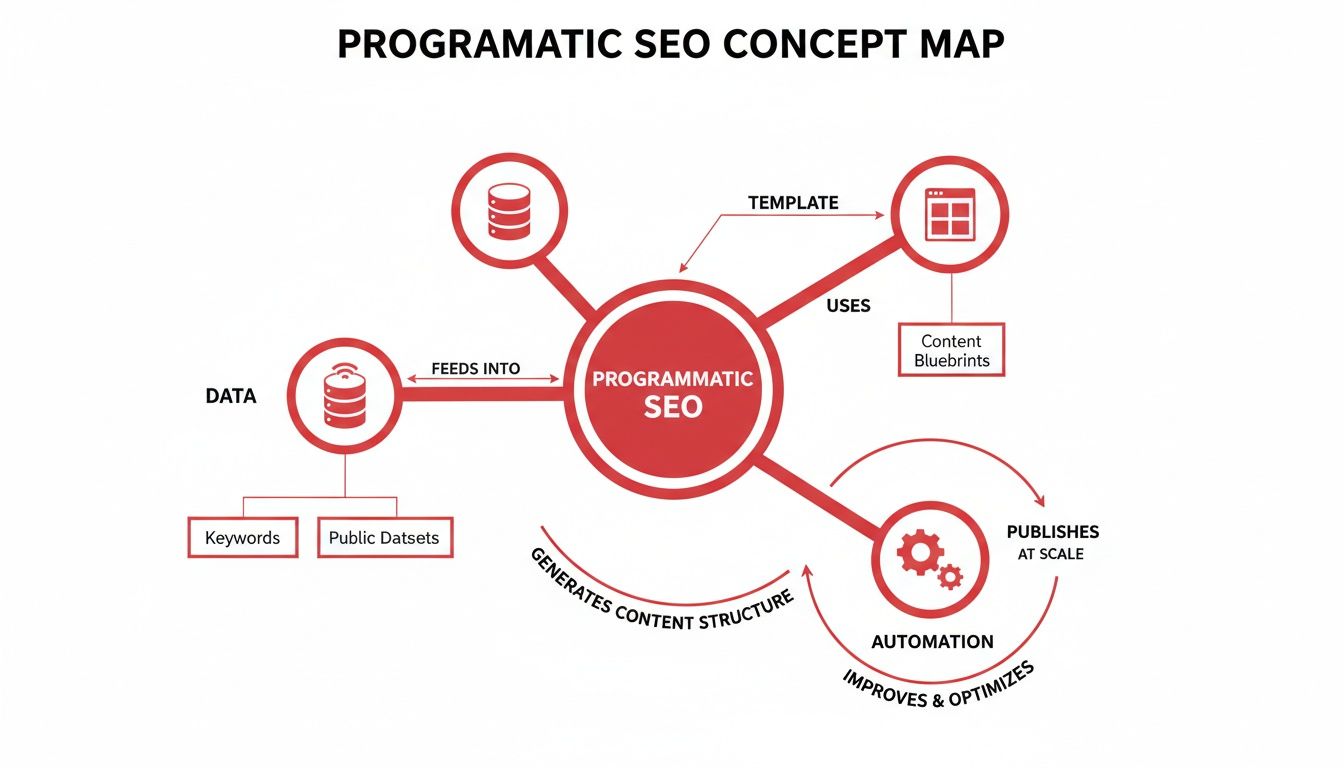
As you can see, none of these pillars can function on its own. Each one directly influences and depends on the others to get the job done.
Pillar 1: The Data
Data is the fuel for your programmatic engine. It’s the raw material that gives each of your thousands—or hundreds of thousands—of pages its unique value and reason for being. Without a rich, structured, and reliable dataset, your project is dead in the water before it even begins.
The source of this data can vary hugely but its quality is completely non-negotiable. Common sources include:
- Internal Data: This is often the goldmine you're already sitting on. Think product catalogues, user-generated reviews, or performance metrics from the motorsport industry.
- Public APIs: Plenty of organisations offer public APIs giving you access to huge datasets, from government statistics and weather patterns to financial market data.
- Scraped Data: This involves collecting information from other websites. It’s a powerful method but one that needs careful ethical and legal thought to make sure you’re staying compliant.
Whatever the source, the data must be rigorously cleaned, organised, and structured. Every data point—whether it's a city name, a car model, or a race circuit—will eventually become a variable on your page, so consistency is absolutely critical.
The key takeaway here is that the more unique and valuable your dataset is, the stronger your competitive edge will be. Anyone can scrape generic info but blending multiple sources or layering in your own proprietary insights creates a resource that's incredibly difficult for others to copy.
Pillar 2: The Page Templates
If data is the engine, your page template is the chassis—the carefully designed framework that holds everything together and presents it beautifully to the user. This is so much more than just a pretty design; it’s a strategic blueprint for user experience and SEO performance.
Your template needs to be flexible enough to handle variations in your data while keeping a consistent, intuitive layout. For example, a page about a specific race track might need to display its length, number of corners, and lap record. A page for a driver, on the other hand, would feature their team, wins, and championship position. A great template handles all of this dynamically.
Pillar 3: The Technology
Technology is the engineering that bolts your powerful data engine to your sleek page template. This is the technical infrastructure that automates the creation, publication, and management of thousands of pages, turning your concept into a live, traffic-driving asset.
This involves several crucial technical decisions:
- URL Structure:
Crafting clean, keyword-rich, and logical URLs (like
/race-circuits/uk/silverstone) is vital for both users and search engines. - Internal Linking: An automated system for internal linking isn't just a nice-to-have; it's essential. This ensures search engine crawlers can actually find all your pages and that authority flows logically through your site.
- Tech Stack: Choosing the right content management system (CMS) and development framework is key to managing content at this scale without killing your site speed or performance.
Together, these three pillars— Data , Templates , and Technology —form the backbone of any programmatic SEO initiative that's built to last.
Learning from Real-World Programmatic SEO Examples
Theory is one thing but seeing programmatic SEO in action is where you really grasp its power. Let's look at how smart companies are using it to dominate their niches because that’s how you translate strategy into actual traffic and growth. The principles are the same whether you're in tech, tourism, or anything in between.
The central idea is always this: find a search query people repeat, then build a system to answer it at scale. Someone searching for ‘things to do in Devon’ wants the exact same type of information as someone searching ‘things to do in Yorkshire’—only the place name changes. That’s the sweet spot for programmatic SEO.
Giants of the Game: Zapier and Rightmove
Two names always come up when talking about this: Zapier and Rightmove. And for good reason. They are masters of the craft and their models offer a clear blueprint for what excellence looks like in both B2B and B2C.
-
Zapier's Integration Machine: This software automation platform has created thousands of landing pages from one simple, powerful pattern: ‘Connect [Software A] to [Software B]’. They knew their users were looking for specific integration solutions. Their data source? Their own internal list of apps they support. The template dynamically pulls in the names, logos, and key functions for each pair of tools, creating a super-specific and valuable page for every long-tail search.
-
Rightmove's Property Portal: In the UK, property giant Rightmove generates a unique page for countless combinations of locations and property types. A search for ‘ 3 bedroom houses for sale in Bristol’ is a programmatic query. Rightmove’s data source is the enormous database of listings uploaded by estate agents. Its page template is designed to display these listings with maps, photos, and crucial details, perfectly matching what the user needs.
These examples teach a vital lesson: the whole strategy is built on a foundation of unique, valuable data that serves a clear user purpose. It’s a very different beast from other automated marketing tactics. If you're interested in another automated strategy, you can learn more by reading about what programmatic advertising is.
UK-Specific Use Cases
You don't have to be a global giant to make this work. The same principles are being applied with huge success right here in the UK, across all sorts of sectors. The pattern of combining a service with a location or another variable is a simple and effective approach.
The real power of programmatic SEO lies in its ability to serve niche, long-tail queries at a scale that would be impossible to manage manually. It connects specific user needs with specific data-driven answers, creating value for both the user and the business.
Think about these UK-focused examples:
-
Financial Comparison: A financial services website could create pages for ‘best mortgage rates in [City]’ or ‘top savings accounts in [Town]’. The data source would be a live feed of financial product information and the template would present it in a clean, comparable format for each specific location.
-
Travel and Tourism: A travel company focused on the staycation market could generate pages for ‘things to do in [National Park]’ or ‘family-friendly hotels in [Seaside Town]’. Their dataset would be a curated list of attractions, hotels, and activities, all organised by location and category. This allows them to capture very specific travel planning searches.
-
Automotive and Motorsport: For a company like Superhub, with deep expertise in the automotive world, this could mean creating pages for ‘find a [Car Brand] specialist garage in [County]’. It could even be ‘[Motorsport Series] race results at [Circuit]’. The data might come from internal business directories or public race results, providing huge value to enthusiasts and car owners alike.
Each of these examples breaks down into the same core parts: a structured dataset, a flexible page template, and a sharp understanding of the long-tail keywords their audience is actually typing into Google. By looking at these real-world cases, you can start to see a clear model for applying programmatic SEO to your own industry.
Your Step-by-Step Implementation Plan

Turning a programmatic SEO idea into a live, traffic-driving asset isn't magic; it’s a structured process. It demands a clear plan that moves methodically from high-level strategy to the nuts and bolts of execution.
We’ll break this journey down into four distinct phases. Think of it as a roadmap designed to guide you from that first spark of an idea right through to launch and beyond, ensuring everything is built for long-term success.
Phase 1: Ideation and Keyword Discovery
This is where it all begins: finding your opportunity. Before you write a single line of code or touch any data, you need to identify a promising keyword pattern. This is the repeatable search query your audience uses, the one you can build an entire project around.
Think in terms of a 'head term' that can be combined with different variables. A motorsport site might spot patterns like ‘[race series] results at [circuit]’, while a travel business could target ‘best hotels in [city]’. The goal is to find a query with hundreds or thousands of potential variations that real people are searching for.
Once you have a potential pattern, you have to validate it. Use your favourite keyword research tools to check two critical things:
- Sufficient Search Volume: While individual long-tail keywords will have low volume, you need to confirm that the total search volume across all the variations is big enough to make the project worthwhile.
- Achievable Keyword Difficulty: Make sure you aren't trying to compete with industry giants you can't realistically outrank. Look for that sweet spot of decent volume and low competition.
Phase 2: Data Sourcing and Structuring
With a validated idea, you now need the fuel for your project: high-quality data. This is arguably the most important phase. The uniqueness and depth of your dataset will define your project's value and give you an edge over the competition.
Your data can come from anywhere—internal company databases, public APIs, or even by carefully scraping public information.
The real work isn't just getting the data but meticulously cleaning and structuring it. Every row in your database will become a page on your site and every column will be a piece of dynamic content. Consistency is everything. Make sure all data is formatted uniformly and that any errors or duplicates are stamped out.
A truly powerful programmatic project often combines multiple data sources. Blending your own proprietary data with information from a public API can create a resource that is incredibly difficult for competitors to replicate.
Phase 3: The Technical Build
Now, your project starts to take shape. This phase involves designing the page template, choosing your technology stack, and building the automation that will generate and publish your pages at scale.
The page template itself needs to be designed for both user experience and SEO. It requires a logical structure, fast load times, and enough flexibility to display your data in a clear, compelling way. Your choice of technology will hinge on your budget and in-house skills. No-code tools like Webflow and Airtable have made programmatic SEO more accessible than ever. For larger or more complex projects, however, a custom build might be the only way to go.
A crucial part of this phase is planning your internal linking structure. This is essential for helping Google discover and index all of your thousands of new pages. To make sure your pages perform, it is also crucial to understand how to write SEO articles that consistently rank.
Phase 4: Launch and Optimisation
The final phase is the launch itself and, just as importantly, the ongoing optimisation. A common mistake is to publish thousands of pages all at once. It's often far better to launch in smaller batches, maybe starting with a few hundred pages to test the waters. This allows you to see how Google reacts and make tweaks before a full rollout.
Once the pages are live, the job isn't over. You need to constantly monitor performance using tools like Google Search Console and Google Analytics. Track key metrics like how many pages are being indexed, where you're ranking, and how much organic traffic you’re getting.
Look for ways to improve your pages by adding more unique data, refining the user experience, or building backlinks. Programmatic SEO is not a 'set it and forget it' strategy. It’s a living project that needs ongoing attention to deliver sustainable results.
Navigating Common Pitfalls and Costly Mistakes

While programmatic SEO offers incredible scale, it’s a path littered with traps for the unwary. A poorly executed project can do more than just fail; it can actively damage your website’s authority and create costly, long-term headaches.
Knowing the risks upfront is the difference between building a sustainable asset and a short-lived experiment that ends in a search engine penalty. Get these fundamentals right and your efforts will deliver genuine, lasting value.
The Cardinal Sin: Thin and Duplicate Content
The single biggest mistake is pumping out thousands of pages that offer little to no unique value. This is what Google calls thin content . Imagine creating a page for every town in the UK that just says, “We offer services in [Town Name]” and nothing more.
That kind of approach is a massive red flag for search engines. It adds nothing new to the web and looks like a clumsy attempt to game the system, attracting penalties from algorithm updates designed to reward helpful, user-first content.
Your best defence is a unique, high-quality dataset. When each page you generate provides distinct, valuable information—whether it’s unique property details, specific car performance stats, or local event listings—you stop creating spam and start providing a genuine resource.
The core principle is simple: every single page must be the best possible answer for the specific query it targets. If your programmatic pages are just slight variations of each other with no real substance, the project is destined to fail.
Ignoring the User Experience
A fantastic user experience is non-negotiable. It’s a huge mistake to get lost in the automation and data while forgetting that a real person has to land on and use these pages. If your pages are slow, clunky, or poorly designed, people will simply leave.
Those negative signals tell Google your pages aren't helpful, which will slowly kill your rankings. Key things to nail include:
- Page Load Speed: Generating pages at scale can hammer your server. Your site must be optimised for speed, even with thousands of pages.
- Mobile-Friendliness: Most of your users will be on their phones. Your templates have to be fully responsive and easy to use on a small screen.
- Clear Navigation: Users should be able to find what they need easily and discover other relevant pages across your site.
In the UK, the changing search landscape makes user experience even more critical. With the rise of zero-click searches and AI-driven answers, your pages must provide clear, immediate value. Studies show that 79% of British professionals now use AI at work, meaning content needs to be structured not just for human readers but for the machines powering these new search features.
This makes mass-generated pages without unique, useful data extremely vulnerable to being de-ranked. You can explore more on this in these UK statistics on AI in SEO.
Overlooking Technical SEO Foundations
Finally, basic technical mistakes can completely derail an otherwise solid project. Two of the most common tripwires are poor internal linking and indexation bloat.
A smart internal linking strategy is essential. It’s how you guide search engine crawlers to discover all your new pages and how you spread authority throughout your site. Without an automated, logical linking structure, many of your pages might never even get indexed.
Indexation bloat is what happens when you ask Google to index thousands of low-value pages. This dilutes your site's authority and wastes your "crawl budget." You need to be strategic, ensuring only your most valuable pages are submitted for indexing.
Measuring Success and Calculating Your ROI
So, you've launched thousands of pages. Great. But how do you know if any of it is actually working?
Launching a programmatic SEO project is one thing; proving it delivers real business value is another entirely. Success isn't about vanity metrics like 'total pages indexed'. It's about the tangible impact on your bottom line.
To get to the truth, you have to move beyond those surface-level numbers and focus on the key performance indicators (KPIs) that really matter. This means isolating the performance of your programmatic pages to see exactly what they’re contributing to your overall organic growth.
Key Metrics to Track for Programmatic SEO
First things first: you need a dedicated dashboard. Get into Google Analytics and Google Search Console and set up specific segments or filters just for your programmatic page URLs. This is the only way to track the metrics that drive genuine business value.
Your primary focus should be on these four areas:
- Organic Traffic Growth: Are sessions and users to your programmatic pages actually increasing? You need to see clear month-on-month growth in this specific segment.
- Long-Tail Keyword Rankings: Track how many long-tail keywords your new pages are ranking for. Success here means you’re capturing thousands of highly specific, high-intent searches that your core pages would never touch.
- User Engagement: Look at signals like average time on page and bounce rate for this group of pages. If engagement is high, it’s a good sign your templates and data are genuinely useful to visitors.
- Conversions: This is the big one. You must track how many leads, sign-ups, or sales originate directly from your programmatic pages.
Calculating Your Return on Investment
Connecting your efforts to revenue is the ultimate goal. To justify the investment in programmatic SEO, you have to accurately calculate your content marketing return on investment. This involves adding up all your costs—development time, data sourcing, tooling—and weighing them against the value of the conversions generated.
For businesses in the UK, this level of scrutiny is becoming standard. In 2024, UK digital ad spending hit a massive £35.54 billion , with programmatic strategies getting a huge slice of that investment. And with surveys showing that 77% of UK businesses now invest in SEO, the pressure to demonstrate clear returns has never been higher.
By connecting organic traffic from your programmatic pages directly to conversions, you can calculate a precise cost per acquisition (CPA). This gives you the hard numbers to show stakeholders that the project isn't just a traffic play—it's a powerful engine for profitable growth.
This approach gives you a clear financial justification for the entire project. For a deeper dive into this process, check out our detailed guide on how to calculate marketing ROI in the UK.
Got Questions About Programmatic SEO?
Even with a clear idea of what programmatic SEO is, you’ve probably got a few questions about how it all works in the real world. Let's tackle some of the most common ones.
Is Programmatic SEO Just for Big Companies?
Not at all. While the big players with huge datasets get a lot of attention, some of the smartest programmatic strategies come from startups and smaller businesses that focus on a specific niche.
Success here isn't about company size; it’s about having access to a unique and genuinely useful set of data. A small travel blog could create pages for ‘Best Weekend Trips from [UK City]’, or a local service business could build out pages for ‘[Service] in [Neighbourhood]’. The scale is different but the principle is exactly the same: answer specific user needs with targeted data.
How Is This Different from AI Content?
This is a really important distinction. Think of programmatic SEO as using structured data to fill in the blanks on a smartly designed template. The real value comes from the quality and uniqueness of that data.
AI-generated content, on the other hand, typically uses a language model to write an entire article from scratch, often without a unique data source to back it up.
You can definitely use AI to enrich programmatic pages – maybe to write a unique description based on a few data points. But the heart of programmatic SEO is data-driven, not just AI-written . Google’s guidelines have always favoured content made for people. Good programmatic content serves very specific user searches beautifully, whereas low-effort, mass-produced AI content just adds to the noise.
The thing to remember is that programmatic SEO is about scaling value with data and templates. The automation is there to serve the strategy, not to replace the need for quality. You're building a machine to answer thousands of questions well, not just to churn out thousands of pages.
How Long Until We See Results?
This isn’t a quick win. Programmatic SEO is a long-term play and the results won't show up overnight. How fast you see traction depends on your website's current authority, how competitive your niche is, and, frankly, how well you execute the plan.
As a rough guide, you can expect to see the first signs of life within 3 to 6 months as Google begins to crawl, index, and test your new pages. Real, meaningful traffic growth often starts to build between the 6 and 12-month mark, as the pages gather authority and start ranking for a whole universe of long-tail keywords.
Ready to build a powerful engine for organic growth with a data-driven strategy? The team at Superhub specialises in creating bespoke digital marketing solutions that deliver real results. Visit Superhub to find out how we can elevate your brand.
Want This Done For You?
SuperHub helps UK brands with video, content, SEO and marketing that actually drives revenue. No vanity metrics. No bullsh*t.