

MINI CHALLENGE: What It Really Costs to Race in 2026
So you've been looking at MINI racing and you've found some numbers online. Eighteen grand for a Trophy season, thirty for JCW Sport, maybe forty five to eighty for a JCW drive. Sounds manageable, doesn't it. You could just about get there with a remortgage and a sympathetic accountant.
Those numbers are wrong. Not slightly wrong, not rounded down a bit, but roughly a third of what drivers are actually charged. And the reason I know is that we work with drivers in that paddock, and I've seen what lands on the invoice.
Here's the honest version.
What a MINI CHALLENGE Season Actually Costs
These are season costs charged to the driver, including a minimal test programme of about three or four days. Not the car. Not a headline entry fee with everything stripped out of it. What you pay to go racing for a year.
- Trophy, the Cooper Class: £60,000 to £80,000
- JCW Sport: £90,000 to £100,000
- JCW: around £120,000
You'll find published figures putting those at £18,000 to £32,000, £30,000 to £55,000 and £45,000 to £80,000. I don't know where they came from and I'd be interested to find out, because the same source lists a fourth MINI CHALLENGE tier that isn't a MINI CHALLENGE class at all.
The gap matters more than the argument, though. A family budgeting eighteen grand for a Trophy season and discovering it's sixty is not a family that finishes the year. That's how drivers end up parked in August with three rounds to go, and it happens every single season to somebody.
The Three Classes, and What You're Actually Buying
Trophy, the Cooper Class
The R50 MINI Cooper, largely road specification, around 130bhp, racing in the MINI CHALLENGE Trophy. Officially it's the Cooper Class, but nobody in the paddock calls it that. It's Trophy.
This is the entry point to the ladder proper. It isn't the cheapest MINI racing available, and if pure cost per lap is what you're after there are better answers further down this page. What Trophy gives you is the TOCA package, which is the thing everything else on this page hangs off.
JCW Sport
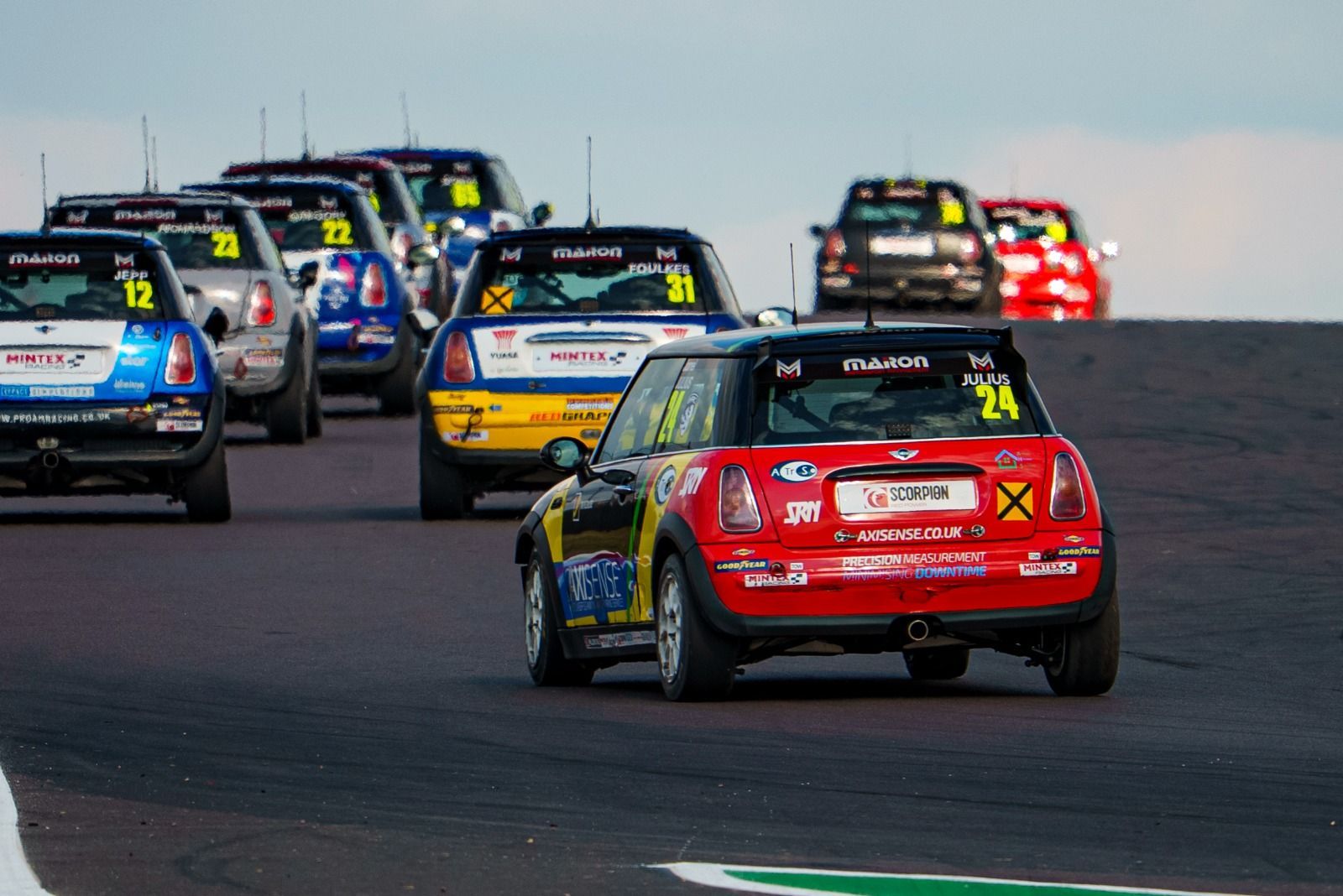
Added in 2024 to bridge a gap that had become a chasm. A 2 litre turbocharged engine producing around 225bhp, six speed H pattern gearbox, three way adjustable Nitron dampers, Alcon brakes, Goodyear slicks. Designed to be upgradeable to full JCW specification, which matters if you're planning a two or three year programme rather than a season.
JCW
The top of the tree. A Damico tuned 2 litre producing somewhere between 240 and 265bhp depending on application and fuel, and crucially a Quaife sequential gearbox rather than an H pattern. MINI's own line is that JCW sits closer in specification to the BTCC cars it shares a stage with than any other single make championship in the UK, at a fraction of the cost.
At £120,000 against a BTCC seat starting around £250,000, that claim holds up. It's one of the few bits of championship marketing I've read that survives contact with the invoice.
The Bit Nobody Explains: Trophy or Clubsport
There's a separate series called MINI CHALLENGE Clubsport, run by the BARC rather than on the TOCA package. Five weekends, fifteen races, running alongside the British Truck Racing Championship at five events in 2026. Three classes running together as one field: Cooper S for the R53 and R56, Open, and Cooper Am.
And here's the thing that makes this a real decision rather than a straightforward one. Cooper Am runs the R50, which is the same car used in the Trophy , but with a more flexible set of technical rules. Same machinery, different series, and Clubsport is cheaper.
So why would anybody pay the difference?
Two reasons, and they're the only two that matter.
Television. The TOCA package means you're on TV in front of a BTCC audience. Clubsport is livestreamed. That single difference is the entire commercial case, because a sponsor is buying an audience and a livestream is not the same audience. If you have any intention of funding your racing rather than paying for it out of your own pocket, this is the whole ballgame.
Progression. Trophy leads to JCW Sport, JCW leads to BTCC or GT. There is a route. Clubsport is a place to race, and a good one, but it doesn't go anywhere.
There's also a nice irony in the specifications. The Clubsport Cooper S at around 195bhp is considerably more powerful than the Trophy R50 at around 130bhp, and it's the cheaper series. Power does not track price. What you're paying for in Trophy isn't the car, it's the shop window. Same principle as Formula 2 costing three times GB3 for a car that isn't three times faster.
If you want to race, and you're funding it yourself, and a career isn't the point, Clubsport is the sensible answer and anybody who tells you otherwise is selling something. If you want to build towards a paid drive, you need the television, and that means paying for the TOCA package.
Where MINI Sits Against Everything Else
Worth some context, because MINI looks expensive until you compare it to the alternatives at the same ambition level.
A British F4 season costs £400,000 just to get on the grid and £500,000 to £600,000 to be competitive. That's four to five times a full JCW campaign, in a car that is slower than the JCW around most circuits, on a ladder that leads to Formula 1 and nowhere else.
A BTCC seat runs £250,000 to £600,000, with the car itself costing £600,000 to £700,000 a season to run.
So the JCW driver at £120,000 is on a ladder that connects to both BTCC and GT, on television, at a quarter of what the single seater route costs. For a driver whose realistic ceiling is a professional career rather than a Formula 1 seat, and that is almost everybody, it's the better buy by a distance. Nobody says this out loud because there's more money in selling single seater dreams.
What the Money Doesn't Cover
Season costs are season costs. Budget separately for the things that appear later and always at the worst moment.
- Damage. Contact happens. It happens more in close single make racing than anywhere else, because that's what makes it good to watch. Have a contingency or you'll be funding it out of the following month's budget.
- Testing beyond the three or four days included. Every extra day is money, and the drivers at the front are doing extra days.
- Travel, accommodation and food for the weekend. Doesn't appear in any quote, appears on every credit card statement.
- Your licence, your kit, your medical. Small individually, not small together.
- Photography and content. If you want sponsors, you need assets you own the rights to. Buying the circuit photographer's images is not optional if you intend to licence them onward.
Funding It
Very few people write a cheque for a MINI season out of income. Most of the grid is some combination of family money, business money, and sponsorship, and the ratio shifts as you go up.
At Trophy level, a portfolio of small local sponsors is realistic. Ten businesses at a few thousand each is a much more achievable ask than one company at sixty grand, and it's more stable, because losing one sponsor out of ten is a problem rather than a season ending disaster.
At JCW level you're into proper commercial territory. You're on television, you're supporting the BTCC, and you have something genuinely worth selling. That's a different conversation with a different sort of company, and it's one you should be having in September for the following season, not in February.
The single most common mistake I see is drivers approaching sponsors with a price list of sticker sizes. Sponsors do not buy stickers. They buy access to an audience, content they can use in their own marketing, and hospitality they can put clients in front of. A MINI CHALLENGE weekend gives you all three. Sell those.
Where to Go Next
Pick the one that's actually true for you.
"I've got a budget of about twenty grand and I want to race MINIs." Look at Clubsport rather than the Trophy, and go in with your eyes open about what you're not getting. Read our guide to what motorsport sponsorship actually costs before you decide whether the step up is fundable.
"I'm planning a Trophy season and I need sponsors to make the numbers work." Start in September, not February. Our Race Ready packages build the brand, the site and the materials a sponsor needs to see. Book a call and we'll tell you honestly whether we can help in your timeframe.
"I'm a parent and I'm trying to work out whether we can afford this." Use the real numbers on this page, not the ones you'll find elsewhere, and add a contingency. Then talk to us before you commit to a season, because the worst outcome is stopping in August.
"I'm already racing and I want to be on the JCW grid next year." That's a commercial problem more than a driving one. Book a call.
"I want to understand how sponsorship actually works before I spend anything." Race Funded covers the whole thing, valuation, targeting, pitching, delivery and renewal. Read that first.
Frequently Asked Questions
Season costs charged to the driver, including a minimal test programme, run at £60,000 to £80,000 for the Trophy Cooper Class, £90,000 to £100,000 for JCW Sport and around £120,000 for JCW. Published figures elsewhere are substantially lower and do not reflect what drivers are actually invoiced.
Trophy runs on the TOCA package supporting the BTCC, with television coverage and a progression route through JCW Sport and JCW to BTCC or GT. Clubsport is a separate BARC series running alongside the British Truck Racing Championship, livestreamed rather than televised, with more flexible technical rules and no progression ladder. Clubsport is cheaper. Trophy is where a career gets built.
Trophy runs the R50 MINI Cooper at around 130bhp in largely road specification. JCW Sport runs a 2 litre turbo at around 225bhp with a six speed H pattern gearbox. JCW runs a Damico tuned 2 litre at 240 to 265bhp with a Quaife sequential gearbox. Clubsport, a separate series, takes the R53 and R56 Cooper S plus the R50 in its Cooper Am class.
Yes, and it is one of the few genuine ones. MINI CHALLENGE runs on the TOCA package alongside the BTCC, and JCW is specified deliberately close to touring car practice. Drivers coming out of JCW move into BTCC or into GT racing, so the ladder connects to two destinations rather than one.
Considerably. A full JCW season is around £120,000. British F4 costs around £400,000 to get on the grid and £500,000 to £600,000 to be competitive, which is four to five times as much for a car that is not faster and a ladder that leads only towards Formula 1.
Yes, and it is more achievable than at most levels because the TOCA package gives you television exposure a sponsor can actually value. At Trophy level a portfolio of smaller local sponsors is realistic. At JCW level the exposure supports proper commercial partnerships. Approach in late summer for the following season, because budgets are set in autumn.
Damage, testing beyond the three or four days included, travel and accommodation, licence and personal equipment, and photography you own the rights to. Budget a contingency for all of them, particularly damage, because close single make racing produces contact.
Trophy, if a career or sponsorship is the goal, because that is where the television and the ladder are. Clubsport, if the point is to race enjoyably at the lowest cost, and it also runs a Novice Cup specifically for first time racers. Both are legitimate answers to different questions.
James Foster is the founder of SuperHub and the author of Race Funded. SuperHub works with drivers and teams across the TOCA package and has raised more than thirty million pounds in motorsport funding and sponsorship.
Want This Done For You?
SuperHub helps UK brands with video, content, SEO and marketing that actually drives revenue. No vanity metrics. No bullsh*t.