


What is user generated content: A Clear Guide for Modern Marketing
Picture this: your happiest customers turn into your most effective marketers. That's the real power behind User Generated Content (UGC) . It’s any content—think reviews, photos, videos, or social media shout-outs—created by actual people instead of the brand itself.
In short, it’s the digital version of a glowing, trusted recommendation from a friend.
What Is User Generated Content, Really?

At its core, UGC marks the shift from a brand talking about itself to its customers sharing their genuine experiences. It’s the difference between an advert telling you a product is amazing and a customer posting a video showing you it is.
That raw authenticity is its secret weapon. When potential buyers see real people using and loving a product, it triggers a powerful sense of social proof . This builds a level of trust that even the most polished, professional marketing campaigns can only dream of.
The Power of Authentic Voices
The ripple effect of this kind of content is huge. In the UK alone, there are 54.8 million people on social media, creating a massive community of potential storytellers for your brand. And the numbers don't lie: a staggering 80% of consumers say they trust this type of content more than traditional adverts.
If you want to dig deeper, you can explore more data on the importance of social media in the UK to see just how big the opportunity is.
This isn’t just a passing fad; it’s a core part of modern marketing. This trust has a direct impact on purchasing decisions and is key to building real, lasting brand loyalty.
User Generated Content is the modern-day word-of-mouth. It builds a bridge of trust between a brand and its audience by showcasing real, unfiltered experiences from the people who matter most—the customers.
UGC Versus Branded Content
To really get why UGC is so valuable, it helps to put it side by side with traditional branded content. Both have their place, of course, but they play very different roles and leave a completely different impression. One is carefully crafted by marketers; the other is born from genuine customer satisfaction.
The table below breaks down the key differences, showing exactly why UGC is such a compelling tool for any brand wanting to feel more relatable and trustworthy.
UGC vs Branded Content At a Glance
| Characteristic | User Generated Content (UGC) | Branded Content |
|---|---|---|
| Creator | Customers, fans, and advocates | The brand's internal team or agency |
| Authenticity | High; seen as genuine and unbiased | Low; perceived as polished and sales-focused |
| Cost | Often low-cost or free to acquire | High production and creative costs |
| Influence | Strong impact on purchase decisions | Can be met with scepticism by consumers |
| Goal | To share a real experience or opinion | To promote a specific product or message |
Ultimately, while branded content talks at an audience, UGC invites them into a conversation, making them part of the brand’s story. This simple distinction is what gives it its unique edge.
Exploring The Different Forms of UGC
User-Generated Content isn’t just one thing. Think of it as a huge, varied collection of authentic stuff your customers create and share. To really get what user generated content is, you need to see its many faces—from a simple star rating to a full-blown video story. Each type gives you a totally different way to connect with your audience.
The world of UGC is massive. It covers pretty much anything a customer might create and share about their experience with you. It could be a quick review they tap out on a product page or a detailed blog post they spend hours writing. By tapping into these different formats, you can weave together a powerful story of trust and customer satisfaction.
Reviews and Testimonials
This is the bread and butter of UGC. It’s often the very first thing a potential customer looks for when they need that hit of social proof before buying. Reviews are just straight-up, honest accounts of someone’s experience with your product or service.
They’re incredibly powerful because they answer the one question every single buyer has: "Will this actually work for me?" A glowing review can be the final nudge that turns a hesitant visitor into a confident customer.
Let that sink in: customer content has 9.8 times more impact than branded content. When someone’s on the fence, a detailed testimonial from a real person just like them feels way more trustworthy than a slick, polished advert.
Places like Trustpilot, Google Reviews, and niche industry forums are goldmines for this kind of content. Brands that actively encourage and show off these reviews are building a transparent and credible reputation, one customer story at a time.
Social Media Content
Visuals are king on social media, making it the perfect hunting ground for some of the most engaging UGC out there. This category is a mixed bag, including everything from photos and videos to simple mentions in a post.
When customers share photos or videos, they bring your product to life in a way that professional marketing shots just can't. It shows your product out in the wild, being used and enjoyed by real people.
Here are a few of the most common formats you'll see:
- Photos: People posting snaps of themselves using your stuff. Maybe it’s a new outfit, a piece of furniture that ties their room together, or a great meal they had. A simple tag or a branded hashtag is all it takes to link it back to you.
- Videos: This area is exploding. It covers everything from snappy unboxing videos on TikTok to in-depth "how-to" guides on YouTube. If you want to see how brands can really nail this, check out our guide on 10 powerful types of videos for marketing your brand.
- Stories and Reels: These short, punchy formats on Instagram and Facebook are perfect for capturing those off-the-cuff moments and genuine reactions to a product or service.
Blogs and Forum Discussions
Step away from the fast-paced world of social media, and you’ll find a deeper, more considered form of UGC: long-form content. We're talking about detailed blog posts from brand fans or passionate discussions kicking off in online communities and forums like Reddit.
A dedicated blog post reviewing your product is pure gold. It gives an in-depth look at the features, the benefits, and the writer's personal experience with your brand. These articles often do great in search results too, giving you some long-term SEO juice.
In the same way, discussions on community forums offer unfiltered feedback. They create a space where potential customers can ask questions directly to people who are already using your product. That kind of organic conversation builds a real sense of community and gives you priceless insights into what your customers actually think.
The Strategic Business Value of UGC
Knowing what user generated content is is one thing. Understanding how it directly affects your bottom line is what really matters. So, why should you make UGC a priority? Because it delivers tangible, game-changing results that redefine your marketing and strengthen the bond you have with your customers.
This isn’t just theory; it’s about real-world value. It’s about fundamentally changing how people see and interact with your brand. Let's break down the powerful benefits a proper UGC strategy brings to the table.
Building Authentic Trust and Credibility
In a world saturated with adverts, consumers are rightly sceptical. They crave authenticity, and UGC delivers it in a way polished brand messages simply can't. When a potential customer sees a real person enjoying your product, it immediately feels more genuine. More trustworthy.
This raw, unfiltered perspective builds a powerful foundation of credibility. Think of it as the digital version of a friend’s recommendation—far more persuasive than any billboard. This is the cornerstone of building a lasting relationship with your audience.
User generated content acts as powerful social proof, answering the silent question in every customer's mind: "Is this brand really as good as it claims to be?" Seeing others validate your product fosters a deep-seated trust that traditional marketing struggles to achieve.
From customer reviews to unboxing videos and social media shout-outs, UGC gives people a transparent look at your brand through the eyes of the people who matter most.
The infographic below shows some of the most common types of UGC that brands can tap into to build this essential trust.
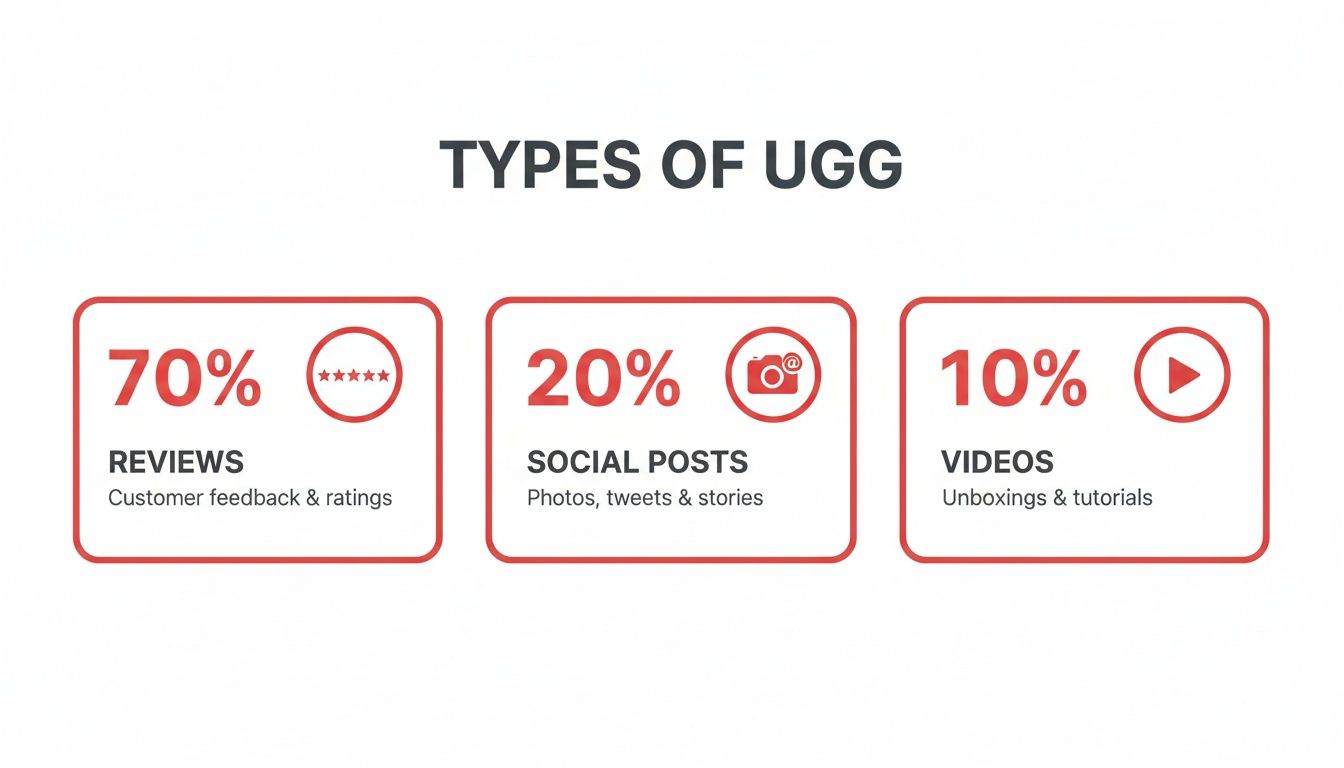
It’s clear how different formats, from simple text reviews to dynamic videos, each play a unique role in backing up your brand’s promises.
Boosting Conversions and Driving Sales
Authenticity isn't just a fluffy concept; it has a direct and measurable impact on your sales. Placing UGC at critical points in the customer journey can seriously increase conversion rates. Picture a product page featuring not just professional photos, but a gallery of customer images showing the item in real-life settings.
This immediately adds a layer of social proof that reassures hesitant buyers. It’s no surprise that 84% of consumers trust peer reviews over branded hype, with 66% basing their final buying decisions on them. When someone sees that others have already bought and loved your product, it lowers their perceived risk and nudges them over the line. You can learn more about this effect in our detailed guide on https://www.superhub.biz/what-is-social-proof-in-marketing-and-how-it-builds-trust.
Slashing Costs and Improving SEO
Creating a constant stream of high-quality marketing content is both expensive and exhausting. UGC offers a cost-effective solution, giving you an almost endless supply of fresh, relevant material created by your own community. This radically cuts your content budget while adding huge variety to your marketing assets.
Even better, this constant stream of fresh content is fantastic for your SEO. Search engines reward websites that are regularly updated with new material. Customer reviews, testimonials, and blog posts all contribute unique, keyword-rich content that can help improve your search rankings and pull in more organic traffic. To get the most out of it, you need to understand and implement powerful User Generated Content strategies.
Measuring the Impact of Your UGC Campaigns
To truly understand the value UGC brings, you need to track the right metrics. It's not just about collecting content; it's about measuring its direct impact on your business goals.
| KPI Category | Metric to Track | Why It Matters |
|---|---|---|
| Engagement | Likes, Comments, Shares, Saves | Shows how well your audience is connecting with the content. High engagement signals resonance. |
| Conversion | Click-Through Rate (CTR), Conversion Rate | Directly measures how UGC influences sales and lead generation on product pages, adverts, and emails. |
| Reach & Awareness | Impressions, Reach, Brand Mentions | Tracks how far the UGC is spreading and how many new people are being exposed to your brand. |
| Cost Efficiency | Content Production Cost vs. UGC Cost | Calculates the direct savings on your content budget by comparing professional creation costs to UGC. |
| Website Performance | Time on Page, Bounce Rate, Organic Traffic | Indicates if UGC-rich pages are more engaging and if they're improving your search engine visibility. |
Tracking these KPIs will give you a clear, data-backed picture of your return on investment and help you refine your strategy over time.
How Winning Brands Use UGC in the Real World
Theory and stats are one thing, but seeing user generated content in action is where you really get it. To properly grasp the power of UGC, we need to look at how real brands have woven it into their marketing, turning their everyday customers into their most powerful storytellers.
From global giants to nimble start-ups, these mini case studies are a practical blueprint. They break down the brand's goal, the specific campaign they ran, and the actual results they saw.
GoPro: Capturing Real-Life Action
GoPro is the absolute masterclass in UGC. Why? Because their entire business model is practically built on it. They don't just sell tough little action cameras; they sell the ability for their customers to capture and share their own adventures. This creates a brilliant, self-sustaining cycle of authentic content.
The company actively encourages its users to share their most breathtaking videos and photos. By using hashtags like #GoPro , customers submit thousands of pieces of content every single day. This gives the brand an almost endless library of high-quality, real-world footage that’s far more thrilling than any polished, studio-shot commercial could ever be.
GoPro's strategy is simple yet brilliant: "Be a Hero." They empower their customers to create the very content that sells the product, turning their YouTube channel and social feeds into a showcase of incredible, user-filmed adventures.
This approach has been a phenomenal success. Some of their most-viewed videos, racking up hundreds of millions of views, were filmed entirely by customers. This not only provides massive social proof but also dramatically slashes their content production costs.
Lululemon: Building a Community with #thesweatlife
Athleisure giant Lululemon has built an incredibly loyal community, and UGC is right at the heart of it. They understood early on that people weren't just buying leggings; they were buying into a lifestyle of wellness, activity, and self-improvement.
To tap into this, they created the hashtag #thesweatlife . It was a simple invitation for their audience to share photos of themselves wearing Lululemon gear during workouts, yoga sessions, or just living their active lives. This straightforward prompt created a vast, searchable gallery of authentic brand endorsements.
This strategy is so effective for a few key reasons:
- It provides endless visual content: Lululemon can easily feature real people of all shapes and sizes, making the brand feel inclusive and much more relatable.
- It reinforces the community: Seeing thousands of others share their "sweat life" makes each customer feel part of a bigger, like-minded movement.
- It expands organic reach: Every post using the hashtag acts as a personal recommendation to that user's followers. A key part of this involves knowing how to repost Instagram posts for viral growth, amplifying the authentic content their audience creates.
Apartment Therapy: Focusing on the User, Not the Brand
Lifestyle and home decor blog Apartment Therapy proves that UGC isn't just for physical products. Their mission is to help people make their homes happier and healthier, and they use their own community's content to bring this to life.
Instead of just preaching about design principles, they invite users to submit photos and stories of their own homes for popular features like "House Tours." They also run brilliant community challenges, like the #SmallCoolChallenge , which celebrates clever and beautiful design in small living spaces.
This user-first approach makes their content feel incredibly genuine and inspiring. Readers see real homes, not just perfectly styled magazine shoots, which makes great design feel achievable for everyone. By putting its community first, Apartment Therapy has built a deeply engaged audience that trusts its advice and feels a real connection to the brand. They prove that sometimes, the most powerful stories are the ones your audience is already waiting to tell.
A Practical Guide to Encouraging Customer Content

Authentic customer content rarely just happens by magic. You need to create an environment where sharing feels like a natural, rewarding part of the experience. The trick is to build a reliable system that makes it incredibly easy for your audience to create and share what they love about your brand.
It’s about shifting from passively hoping for content to actively building a community of creators. It all starts with a simple idea: if you want people to share, you need to ask them and give them a good reason why.
Create a Clear and Memorable Hashtag
One of the simplest and most effective ways to collect UGC is with a unique, branded hashtag. Think of it as a digital filing cabinet for every piece of content your community makes. It needs to be short, easy to remember, and even easier to spell.
Slap that hashtag everywhere—on your product packaging, in your social media bios, and inside your email newsletters. This gives your customers a single, consistent way to tag their posts, making them dead simple for your team to find and feature later on.
Run Engaging Contests and Giveaways
Nothing gets people moving like a bit of friendly competition. Running a contest with a clear call to action is a surefire way to get a sudden burst of brilliant user content. The prize doesn’t have to break the bank, either. Often, a product bundle, a gift card, or just the chance to be featured on your main social media account is more than enough.
For instance, you could launch a photo contest asking customers for their most creative shot using your product. Keep the rules simple: follow us, use the branded hashtag, and tag a mate. This doesn't just get you content; it expands your organic reach to whole new audiences. If you want to dive deeper, check out this practical guide for UK brands on how to improve social media engagement.
The key to a successful UGC campaign isn't just what you ask customers to do; it's about what you give back. Recognition, rewards, and a genuine sense of community are the most powerful currencies.
Just Ask Your Customers Directly
Sometimes, the most direct approach works best. Don't be shy about asking for what you want. You can weave these requests into different touchpoints all along the customer journey.
Here are a few simple but effective methods:
- Post-Purchase Emails: A few days after an order arrives, send a friendly follow-up email. Ask them how they’re enjoying their new purchase and nudge them to share a photo or leave a review.
- Website Pop-Ups: Use a subtle pop-up or a banner on your site asking happy customers to share their stories on social media.
- Product Packaging Inserts: Pop a small, well-designed card into your packaging that prompts customers to share a photo and tag your brand.
Showcase and Celebrate Your Community
People love being noticed. When you feature customer content, you're doing more than just getting free marketing material. You're showing your entire community that you see them and value what they create. This kicks off a powerful feedback loop where more people are inspired to share, hoping they’ll be next.
Create a dedicated gallery on your website, a "Community" highlight on Instagram, or a weekly feature on your social channels. By consistently celebrating your customers' creativity, you turn them from passive buyers into genuine brand advocates. This simple act of recognition makes your audience feel like a real part of your story.
Navigating The Legal Side of Using UGC
It's a great feeling when customers start creating amazing content featuring your brand. But before you rush to share it, you need to understand the rules. Jumping the gun without a grasp of the legal side can land you in some seriously hot water, damaging both your reputation and your bank balance.
At the end of the day, the person who created that photo, video, or review owns it. That's their copyright. Just because they slapped your hashtag on it or tagged your account doesn't give you a free pass to use it for your own marketing. Using their work without permission isn't just bad manners—it's a potential breach of copyright law.
Always Get Explicit Permission
The golden rule here is breathtakingly simple: always ask for permission first. Never, ever assume you can just grab and repost content. Getting a clear "yes" not only covers you legally but also shows you respect your customers, which is fundamental to building a strong, loyal community.
Getting the green light doesn't have to be complicated. Here are a few straightforward ways to do it:
- Direct Outreach: The most personal approach. Drop a comment on the original post or send a quick direct message. Keep it simple and clear, asking if you can feature their content and mentioning where (e.g., "on our Instagram feed and website").
- Campaign Terms and Conditions: If you're running a contest or a specific UGC campaign, build the content rights directly into the rules. A simple line stating that using the campaign hashtag grants you a licence to use their submission is all you need.
- Official Submission Forms: For a more buttoned-up approach, set up a dedicated page or form on your website. Here, users can upload their content and actively tick a box to agree to your terms of use.
Give Credit Where Credit Is Due
Once you have permission, giving proper credit is non-negotiable. It's a small act that acknowledges the creator's work and builds a huge amount of goodwill. Forgetting to tag someone makes your brand look lazy at best, and exploitative at worst.
When you feature a piece of UGC, always tag the creator's social media handle in the caption. If you can, tag them in the photo or video itself. This transparency not only gives them the nod they deserve but also proves to your audience that the content is genuine, coming from a real person.
Always remember that behind every piece of user generated content is a person. Treating creators with respect by asking permission and giving clear credit is the foundation of an ethical and legally sound UGC strategy.
Moderating Content Responsibly
Finally, your brand is accountable for the content it chooses to put on a pedestal. This means you need a solid moderation policy to ensure any UGC you share aligns with your brand values and doesn't contain anything inappropriate, offensive, or that infringes on someone else's rights.
This involves a quick check for things like copyrighted music in the background of a video, logos of other brands, or making sure anyone clearly visible in a photo has also agreed to its use. A little diligence here protects your brand from being associated with dodgy content and keeps your marketing positive, authentic, and legally clean.
Got Questions About User Generated Content? We've Got Answers
As you start to explore what user generated content is and how you could use it, a few common questions always pop up. This final section tackles the ones we hear most often, giving you clear, practical answers so you can get your UGC strategy off the ground with confidence.
Think of this as tying up the loose ends and making sure you have all the pieces of the puzzle.
How Do I Start a UGC Campaign if I'm on a Tiny Budget?
Not only is it possible to start with a small budget, it’s actually the best way to get going. The trick is to focus on low-cost moves that make a big impact.
The absolute simplest first step? Create a unique, branded hashtag and actively encourage your customers to use it. When you see fantastic posts pop up, feature them on your own social media channels. It costs nothing but a bit of time, and the public recognition is huge for your customers.
Another brilliant, no-cost tactic is to just engage with people already saying nice things about you online. Reach out, say thanks, and ask for their permission to share what they’ve posted. You can also slip a call to action into your post-purchase emails, asking happy customers to share a photo or leave a quick review of their new product.
What's the Best Platform for Collecting UGC?
There’s no single "best" platform. The right choice is all about your brand and, more importantly, where your audience actually hangs out online.
If you’re a highly visual brand – think fashion, food, or travel – then platforms like Instagram and TikTok are your powerhouses. Their entire format is built for showcasing products in real-life situations, making them perfect for collecting great photos and videos.
On the other hand, if your business is built on trust and detailed feedback, like in B2B or professional services, your focus should be on reviews. Putting your energy into platforms like Trustpilot, Google Reviews, or niche industry forums will get you the kind of content that really matters. The goal is always to meet your customers where they already are.
Choosing the right platform isn't about chasing trends. It's about understanding your audience's natural behaviour and making it incredibly simple for them to share their experiences in a way that feels authentic to them and valuable to your brand.
How Should My Brand Handle Negative UGC?
Seeing negative UGC can be nerve-wracking, but it's actually a golden opportunity to show you have outstanding customer service and that you're transparent. The number one rule is to never ignore or delete negative feedback (unless it’s offensive or obvious spam, of course).
Your first move should always be to respond quickly and publicly. Acknowledge their specific issue, show genuine empathy for their bad experience, and then offer to sort the problem out privately via DM or email.
That public response shows every potential customer watching that you take feedback seriously and are committed to making things right. A negative review handled with grace can often build more trust than a dozen positive ones because it makes your business feel human and shows you’re accountable.
Ready to build authentic trust and drive growth with a content strategy that works? The expert team at Superhub specialises in creating bespoke marketing solutions that turn your customers into your greatest advocates. Find out how we can help your brand today.
Want This Done For You?
SuperHub helps UK brands with video, content, SEO and marketing that actually drives revenue. No vanity metrics. No bullsh*t.