


Choosing a B2B Lead Generation Agency in the UK That Delivers
Let's be blunt: most B2B lead generation agencies in the UK don't work. They’ll show you a slick presentation promising a tidal wave of new business, but what you usually end up with is a list of useless contacts and a lighter bank account. The problem isn’t that they're not busy; it's that they fundamentally misunderstand what actually grows a business.
Why Many B2B Lead Generation Agencies Fail
Before you even think about hiring an agency, you need to understand where it all goes wrong. Countless UK businesses have been burned by firms that talk a great game but deliver nothing of substance. This isn't about being cynical. It's about learning to spot the red flags from a mile off. The landscape is littered with failed campaigns, and they usually crash for the same few reasons.

They Chase Volume Over Value
The single biggest failure is an obsession with quantity over quality. An agency might proudly announce they’ve delivered 100 “leads,” but if 99 of them are students, tyre-kickers, or companies in the wrong country, that’s not a win. It’s a waste of everyone's time.
This focus on vanity metrics is a classic sign of an agency that doesn’t get your business. They hit their internal targets, send you a glossy report, and pat themselves on the back, leaving your sales team to sift through a digital haystack for a single needle.
Generic Strategies and a Lack of Specialism
Too many agencies roll out a one-size-fits-all template for every client. It doesn’t matter if you’re a motorsport engineering firm in Silverstone or a tourism business in our home county of Devon—you get the exact same generic LinkedIn outreach and email sequence.
This cookie-cutter approach completely misses the nuances of your industry and the real-world problems your ideal customer faces. A campaign that actually works needs a deep understanding of the market, the right language, and the right channels. Anything else is just noise.
A key reason many B2B lead generation agencies fail is their disregard for established best practices. Understanding these core principles can help you quickly identify a capable partner and avoid those who rely on outdated or ineffective methods. Familiarising yourself with proven B2B lead generation best practices is your first line of defence against empty promises.
Misaligned Incentives and Opaque Contracts
Often, the agency's own business model is working directly against you. If you're stuck in a long-term retainer with no clear performance metrics, what's their incentive to deliver? They get paid whether the leads they find turn into revenue or not.
Be on the lookout for:
- Vague Deliverables: Contracts promising “outreach” or “engagement” without a crystal-clear definition of what a qualified lead actually looks like for your business.
- Long Notice Periods: Getting locked into a 6 or 12-month contract without performance-based escape clauses is a massive risk.
- Hidden Costs: Setup fees, ad spend management percentages, and extra charges for creative work can quickly blow your budget apart.
This should be a partnership built on mutual success. If the contract feels one-sided, it is. The goal is to find a B2B lead generation agency in the UK that ties its own success to yours, focusing on results that actually hit your bottom line, not just their monthly invoice.
Defining What a High-Quality Lead Means for You
Walking into a discussion with a potential agency and just saying "get me more leads" is a guaranteed way to waste your money. It’s like telling a builder to "build me a house" without handing over any blueprints. You’ll end up with a mess.
Any successful partnership with a B2B lead generation agency here in the UK has to start with a crystal-clear brief from you. Before they can find your ideal customers, you need to tell them exactly who they are. This isn't some fluffy branding exercise; it’s about giving the agency specific, data-backed parameters to work with.
Anything less, and you’re forcing them to guess. That just leads to a high volume of low-value contacts that waste your sales team’s time and drain your budget.
Pinpoint Your Ideal Customer Profile
Your Ideal Customer Profile (ICP) is a forensic description of the perfect company you want to do business with. Forget vague notions like "SMEs" or "manufacturing companies." You have to get granular.
For instance, a UK automotive brand we work with isn't just looking for "car companies." Their ICP is incredibly specific:
- Industry: Motorsport engineering, specifically BTCC or British GT teams.
- Company Size: 15-50 employees.
- Job Title: Commercial Director, Team Principal, or Sponsorship Manager.
- Pain Point: Struggling to secure title sponsors for the upcoming season.
Similarly, a Devon-based hospitality client's ICP isn't "anyone needing a room." It's "London-based corporate event managers at FTSE 250 companies booking off-site strategy weekends for 20-40 executives."
This level of detail is non-negotiable. It dictates the targeting, the messaging, and the channels an agency will use to find these people.
Calculate Your Customer Lifetime Value
Once you know who you're targeting, you need to know what they're worth. Your Customer Lifetime Value (CLV) is the total revenue you can realistically expect from a single customer over the entire time they do business with you.
Knowing this number is critical for setting budgets that make sense. If a typical client is worth £50,000 over three years, you can justify spending a lot more to acquire them than if they're a one-off £500 purchase. An agency needs this figure to understand the stakes and build a campaign with a justifiable return on investment.
To ensure your chosen agency focuses on truly valuable prospects, defining what a high-quality lead means for you is crucial. This process is deeply explored through effective lead qualification, a framework for sorting prospects who are genuinely likely to buy from those who are just browsing. It's the system that separates real opportunities from digital noise.
Establish Your Cost Per Acquisition Target
With your CLV figured out, you can work backwards to set a target Cost Per Acquisition (CPA). This is simply the maximum amount you're willing to spend to win a new customer. There’s no single “right” answer; it depends entirely on your profit margins and business goals.
A simple way to think about it is:
- Start with your CLV (e.g., £50,000 ).
- Subtract your cost of service delivery and desired profit margin (e.g., £40,000 ).
- The remaining amount is your maximum allowable CPA (e.g., £10,000 ).
Giving an agency a target CPA of £10,000 completely changes the conversation. It forces them to move beyond vague promises and build a proposal with a clear, measurable path to profitability for you. This one metric is one of the most powerful tools you have. You can explore a variety of powerful B2B lead generation strategies that can help you hit these targets.
By taking the time to document your ICP, CLV, and target CPA, you arm yourself with a data-backed brief. This forces any prospective B2B lead generation agency in the UK to demonstrate exactly how they will meet your specific commercial objectives, holding them accountable from day one.
How to Properly Vet a UK Lead Generation Agency
Right, you’ve got a shortlist. Now comes the hard part: separating the agencies that talk a good game from the ones that actually deliver.
Forget the glossy brochures and slick sales pitches for a moment. Your job now is to dig for hard evidence and tangible proof that they know what they’re doing, specifically in the UK market. This isn’t about ticking boxes; it’s an investigation. You’re looking for signs of genuine expertise, a transparent process, and a team with the strategic depth to understand your business, not just sell you a generic service.
Dissect Their Case Studies and Past Work
Any agency can cherry-pick its best results and put them on a slide. Your task is to look past the headline numbers and scrutinise the details. Don't let them get away with vague claims of "increased leads."
You need to demand specifics. Get forensic with questions like these:
- How recent are these results? A success story from 2019 is pretty much irrelevant now. The market has changed dramatically, and you need to see proof they can win in the current climate.
- Are they relevant to my industry? Getting leads for a local plumber in Devon is a completely different challenge from securing sponsorship for a British Touring Car Championship (BTCC) team. Look for direct, comparable experience in your sector.
- Can you show me the actual campaign assets? Ask to see the email copy, the LinkedIn ad creative, or the landing pages they used. This tells you if their approach is sophisticated and thoughtful or just generic spam.
- What was the original definition of a 'qualified lead'? This is a big one. Cross-reference their case study results with the client's initial brief. Did they actually deliver on the specific goals that were set, or did they just hit a vanity metric?
Look Beyond the Salesperson
It’s one of the oldest tricks in the agency book: a senior, experienced director handles the sales process, only to pass you off to a junior account manager the second the contract is signed.
You are hiring the team, not the sales pitch. Insist on speaking with the actual strategist or campaign manager who will be your main point of contact. Gauge their understanding of your business and their ability to think strategically on their feet.
Before you sign anything, get absolute clarity on the team structure. Who is responsible for strategy? Who executes the campaigns? And who is your direct line for reporting and questions? If they can't give you a straight answer, it's a major red flag. For a deeper dive into this and other crucial questions, check out our comprehensive guide on how to choose a digital marketing agency.
Scrutinise Their Methodology and Tech Stack
How an agency generates leads is just as important as the results they claim. A modern, effective B2B lead generation agency in the UK should be using a multi-channel approach. If they’re sticking to a single channel, that’s a massive problem.
The UK's competitive B2B environment demands a blended strategy. In fact, data shows that companies using multiple touchpoints across channels like email, LinkedIn, and targeted calls see conversion rates increase by as much as 287% compared to single-channel efforts. With 73% of UK decision-makers now expecting the first contact to be digital, an agency's ability to orchestrate a sophisticated outreach sequence is non-negotiable.
This process flow shows the core components an agency must help you define: the ideal customer profile, the value of that customer, and the cost you're willing to pay to acquire them.
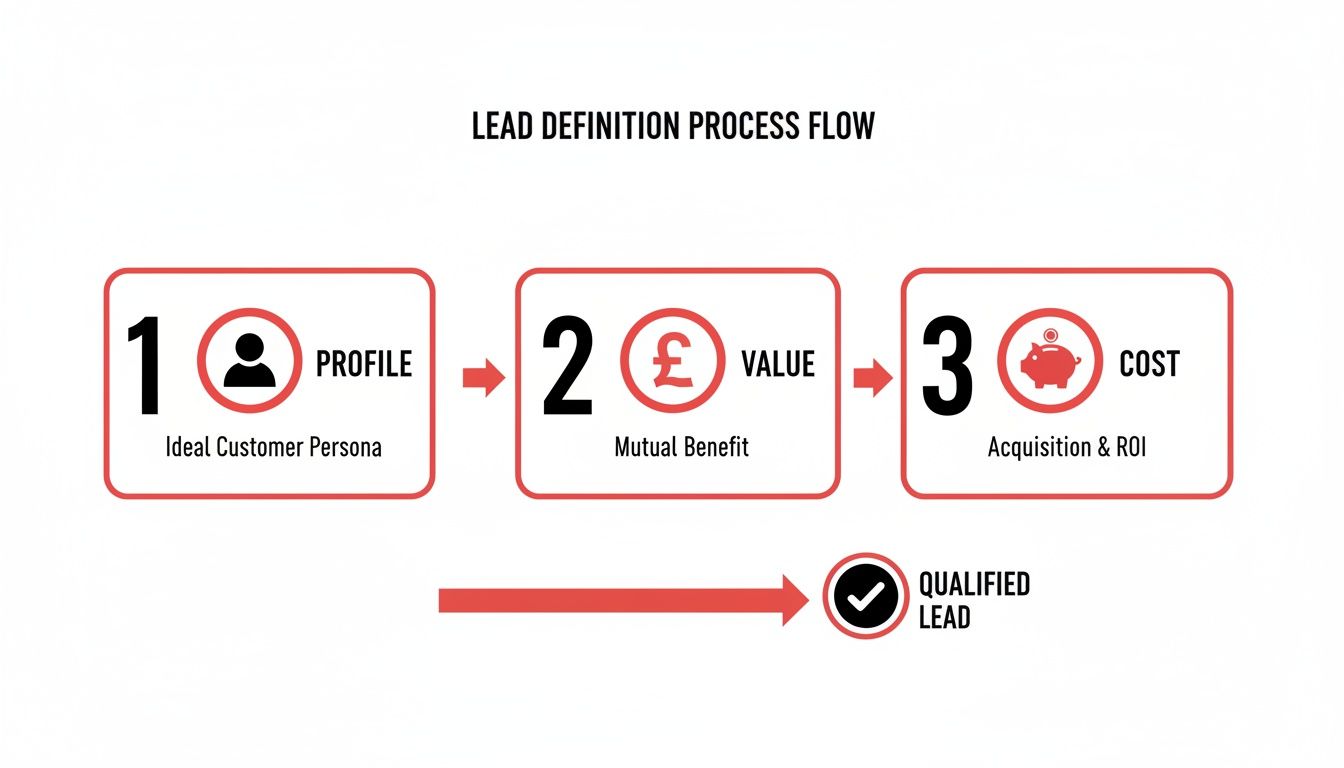
This shows that a successful campaign isn't just about activity; it's about targeting the right people at a cost that makes commercial sense for your business.
To help you get straight to the point, we've put together a checklist of key questions to ask any potential agency.
Agency Vetting Checklist Key Questions to Ask
| Area of Enquiry | Question to Ask | What a Good Answer Looks Like |
|---|---|---|
| Strategy & Expertise | "Talk me through a campaign you ran for a business like ours. What was the strategy, what worked, and what didn't?" | A detailed, honest account. They should be able to articulate the 'why' behind their decisions and admit where they had to pivot. Vague answers are a warning sign. |
| Team & Communication | "Who, specifically, will be working on my account day-to-day, and can I speak with them before signing?" | A clear introduction to the actual account manager or strategist. A great agency will want you to meet the team to ensure a good fit. |
| Process & Technology | "What is your process for defining an ICP and a qualified lead, and how do you use technology to support this?" | A structured, collaborative process. They should talk about using data, your input, and their experience, mentioning specific tools they use for research and outreach. |
| Reporting & KPIs | "Can you show me an example of a monthly report? What key metrics do you focus on beyond just the number of leads?" | A report that clearly links activity to business outcomes (e.g., SQLs, pipeline value, cost per acquisition). It should be easy to understand, not just a data dump. |
| Contracts & Pricing | "What does your pricing model look like, and what are the contract terms regarding notice periods and performance clauses?" | Transparent pricing (retainer, performance-based, or hybrid) with clear deliverables. They should be upfront about contract length and what happens if things don't work out. |
These questions are designed to cut through the fluff and get to the core of an agency's competence and integrity. A good partner will welcome this level of scrutiny.
Ask to Speak with Past and Current Clients
Testimonials on a website are nice, but they're carefully curated marketing assets. The real insight comes from speaking directly with their clients—especially those who have worked with them recently.
Don't just ask if they were "happy." Ask pointed, specific questions:
- "How was the communication and reporting throughout the campaign?"
- "Did they deliver on the specific KPIs that were outlined in the contract?"
- "When challenges or issues arose, how did the agency handle them?"
- "Would you say they delivered a positive, measurable return on your investment?"
Here’s a pro tip: ask for a reference from a client who stopped working with them. A reputable agency with nothing to hide won't shy away from this. How they handled the end of a relationship can tell you more about their character and professionalism than a dozen glowing reviews.
Getting to Grips with Agency Pricing Models and Contracts
Agency pricing can feel deliberately confusing. It’s a messy world of retainers, percentages, and performance fees that makes comparing one quote to another feel impossible.
But when you cut through the jargon, there are really only three models a UK B2B lead generation agency will use. Getting your head around them is the key to negotiating a fair deal that actually works for your business.
Your goal is to find a structure that gives the agency a real incentive to deliver results, not just tick off a list of tasks. The wrong model means you end up paying a fortune for activity that has zero impact on your bottom line.
The Common Pricing Structures, Demystified
Most agencies will pitch one of the following models, or maybe a blend of them. Each has its place, and the right one for you comes down to your goals, budget, and how much risk you’re comfortable with.
-
Monthly Retainer: This is the old faithful. You pay a fixed fee each month for an agreed list of activities. It’s predictable and great for budgeting, but it can feel disconnected from actual performance. A simple, local campaign for a tradesperson in Devon might start around £1,500 - £2,500 per month. A complex, multi-channel national campaign for a motorsport brand, on the other hand, could easily be £5,000+ .
-
Performance-Based (Pay-Per-Lead): This sounds like the dream ticket – you only pay for the leads you get. The problem is, the devil is always in the detail. You need a rock-solid, legally tight definition of what a "lead" actually is. This model often leads to a higher cost per lead, and some agencies can’t resist the temptation to pump up the volume at the expense of quality just to hit their numbers.
-
Hybrid Model: This is often the sweet spot. It combines a smaller monthly retainer with a performance bonus. The retainer covers the agency’s basic costs, and the bonus kicks in when they hit specific, pre-agreed targets, like delivering a certain number of Sales Qualified Leads (SQLs). It’s a good balance that gets both you and the agency pulling in the same direction.
Be wary of any agency that gets vague about pricing or refuses to link at least some of their fee to performance. A transparent partner is confident in their ability to deliver. They'll be willing to tie their financial success to yours.
The Contract Small Print That Really Matters
The proposal is easy. The handshake feels good. The contract, though? That’s where you need to switch on and pay serious attention. I’ve seen too many businesses get burned by clauses buried deep in a 20-page document. Don’t just skim it. Read every single word.
Zoom in on these critical areas:
-
Notice Period: A 30-day notice period is standard, fair, and reasonable. Be extremely cautious of anything longer. I’ve seen 90-day and even 6-month lock-ins, and they are a massive red flag. Long notice periods only benefit the agency, removing any real pressure for them to perform month after month.
-
Setup Fees: Are there one-off costs for onboarding, research, or initial campaign builds? These are normal, but they must be clearly itemised and justified upfront. A surprise "strategy fee" on the first invoice is a classic sign of an agency that isn't being straight with you.
-
Data and Asset Ownership: This is a big one. Who owns the campaign data, the ad accounts, and the creative if you decide to part ways? The answer must be you. Any B2B lead generation agency in the UK worth its salt will insist on building campaigns inside your accounts. This ensures you keep all the historical data and intellectual property if you move on.
-
Scope of Work & Deliverables: The contract needs to be explicit about what the agency is delivering each month. Vague phrases like "lead generation activities" aren't good enough. It needs to specify the number of outreach emails, the channels being used, the reporting frequency, and exactly what you're paying for.
Ultimately, a good contract is there to protect both of you. It sets clear expectations and provides a solid foundation for a healthy, results-driven partnership. If it feels one-sided, it probably is. Don’t ever be afraid to push back and negotiate terms that hold the agency accountable.
Setting KPIs to Measure Real Business Impact
You’ve signed the contract. Now the real work begins.
A successful partnership with a B2B lead generation agency isn’t built on a slick sales pitch; it’s forged through rigorous performance tracking and honest, open communication.
This is where you cut through the fluff and focus on what actually moves the needle for your business. Forget vanity metrics like social media impressions or email open rates. These numbers might look impressive in a report, but they don't pay the bills. A genuine partnership is measured by its direct impact on your revenue.
Focusing on Metrics That Matter
Your entire focus should be on the Key Performance Indicators (KPIs) that track a prospect's journey from their first click to a signed deal. Everything else is just noise.
You absolutely must agree on these KPIs before any campaign launches. Get them in writing, make them part of your agreement, and ensure they form the basis of every single report and review meeting.
Here’s what you actually need to track:
- Marketing Qualified Leads (MQLs): This is a lead who ticks all the boxes you defined in your brief (your ICP). They've shown interest and fit your target profile, making them ready for your sales team to pick up the phone.
- Sales Qualified Leads (SQLs): An MQL becomes an SQL only after your sales team has spoken to them and confirmed a genuine, immediate opportunity exists. This handover is a critical moment.
- Sales Conversion Rate: Out of all the SQLs the agency delivers, what percentage actually become paying customers? This is the ultimate test of lead quality. A high volume of SQLs that never close is a massive red flag.
- Return on Investment (ROI): This is the final score. For every pound spent with the agency, how much new revenue has been generated? This figure tells you, in black and white, if the partnership is working commercially.
Your goal isn't to track activity; it's to track outcomes. An agency that constantly talks about how many emails they’ve sent or calls they’ve made is trying to distract you from what really counts—the new business on your books.
Too often, we see businesses get sidetracked by metrics that feel good but mean very little. Here’s a quick guide to separate the meaningful from the meaningless.
Essential B2B Lead Generation KPIs vs Vanity Metrics
| Metric Type | Metrics that Matter (Track These) | Vanity Metrics (Ignore These) |
|---|---|---|
| Lead Quality | SQLs , MQL-to-SQL Conversion Rate | Email Open Rates, Social Media Followers |
| Sales Impact | Sales Conversion Rate , Customer Lifetime Value (CLV) | Website Traffic, Page Views |
| Financial | ROI , Cost Per Acquisition (CPA) | Likes, Shares, Comments |
| Pipeline | Pipeline Velocity , Number of Demos Booked | Click-Through Rates (in isolation) |
Focusing on the metrics in the middle column keeps everyone honest and aligned with what really drives business growth.
Establishing a Communication Rhythm
Clear, consistent communication is the backbone of any healthy agency relationship. Don’t wait for problems to build up. From day one, establish a regular rhythm for meetings and updates.
A weekly check-in is perfect for the first month to make sure everything is bedding in properly. After that, a bi-weekly or monthly strategic review should be enough.
These meetings shouldn't just be a report-reading exercise. They are your chance to give feedback, ask the tough questions, and collaborate on strategy. To get the most out of them, review the reports beforehand and come prepared with specific points to discuss. This isn’t about pointing fingers; it’s about working together to refine the campaign. For a deeper look, check out our guide on how to measure marketing campaign effectiveness in the UK.
Knowing When to Course-Correct
No campaign is perfect right out of the gate. There will always be a need to tweak the targeting, messaging, or channels based on real-world data. A good agency will be proactive about this, coming to you with ideas for optimisation.
Be wary of an agency that gets defensive about results or resists feedback. You need a partner who sees course correction as a normal part of the process, not as an admission of failure.
If, after a reasonable period (typically 3-4 months ), you aren't seeing progress towards your core KPIs—specifically, a steady flow of high-quality SQLs—it's time for a serious conversation. A partnership must be built on mutual growth. If the results aren't there, you need to be prepared to make a change.
Frequently Asked Questions
We get asked these questions all the time. Here are the straight answers about finding and working with a B2B lead generation agency in the UK. No waffle, just practical advice based on years of experience.
What Is a Realistic Timeframe to See Results?
Anyone promising a flood of high-quality leads in the first 30 days is either lying or simply doesn't get B2B sales cycles. Doing this properly takes time.
Think of the first month as the foundation phase. It’s all about deep-dive research, hammering out the strategy, and getting the campaign architecture right. In month two, the initial outreach begins, and you'll start seeing the first trickles of data. By the end of month three, you should be looking at a consistent, predictable flow of Marketing Qualified Leads (MQLs) hitting your pipeline.
Don't mistake activity for progress. A good agency will spend the initial period getting the fundamentals right—your Ideal Customer Profile, messaging, and technical setup. Rushing this stage is the number one reason campaigns fail.
From month four onwards, the game shifts to optimisation and scaling. A realistic timeline is your best friend here; impatience is the enemy of sustainable lead generation.
How Much Should I Expect to Pay a UK Agency?
This is the big one, and the honest answer is: it depends entirely on the scope and how competitive your industry is. But to give you a real-world idea, here are some benchmarks we see.
- Local Service Businesses (e.g., Devon Tradespeople): For a tightly focused local campaign, you should budget between £1,500 - £3,000 per month on a retainer.
- National Mid-Market Companies (e.g., UK Automotive Suppliers): A multi-channel campaign targeting a national audience will typically run from £3,000 - £6,000+ per month.
- Highly Niche/Competitive Sectors (e.g., Motorsport Sponsorship): For specialised industries with long sales cycles and high-value deals, retainers can easily top £7,000 per month. This reflects the intensive, strategic work needed to get a result.
Be very wary of any agency offering to do this for a few hundred quid a month. You’ll get exactly what you pay for: poor-quality data, generic templates, and zero results. The cost reflects the expertise, time, and tech required to generate leads that actually turn into business.
Is a Performance-Based Model Better Than a Retainer?
On paper, a "pay-per-lead" model sounds fantastic. In reality, it’s often a false economy. The problem is the incentive structure.
When an agency is only paid per lead, their main driver becomes volume, not quality. This usually leads to them cutting corners to hit targets, flooding your sales team with poorly qualified contacts that waste everyone's time.
A monthly retainer, when tied to clear performance KPIs, aligns the agency with your long-term goals. It gives them the breathing room to invest proper time in strategy, research, and optimisation. The best setup is often a hybrid: a fair retainer to cover the strategic heavy lifting, combined with performance bonuses for hitting key targets like SQLs or sales meetings booked. That creates a real partnership focused on mutual success.
Who Should Own the Data and Ad Accounts?
You. The answer is always you.
This is a non-negotiable. Any campaign data, lead lists, ad accounts, or creative assets generated for you should be 100% owned by your business . A reputable B2B lead generation agency in the UK will insist on working within your accounts (like your LinkedIn Campaign Manager or your CRM).
This is about protecting your business. If you ever decide to part ways, you keep all the valuable historical data and intellectual property. An agency that wants to run everything through their own accounts is effectively holding your data hostage. Don't ever agree to it.
Tired of the usual agency nonsense and ready for a B2B lead generation partner that delivers tangible results? SuperHub cuts through the noise. We build and manage lead generation systems that actually grow your business. Get in touch to see how we do it.
Want This Done For You?
SuperHub helps UK brands with video, content, SEO and marketing that actually drives revenue. No vanity metrics. No bullsh*t.