
In House vs Agency Marketing Which Is Right for You
At its core, the choice boils down to a simple trade-off: an in-house marketing team gives you unparalleled brand immersion and total control, whereas a marketing agency offers a plug-and-play solution with diverse, specialised expertise. Deciding which way to go is one of the most significant strategic moves a business can make.
Choosing Your Marketing Path: In-House or Agency?
This isn't just about crunching the numbers; it's a strategic decision that will define your brand's voice, its ability to react, and its entire growth trajectory.
Think of an in-house team as an extension of your company’s very DNA. They are completely immersed in your products, your mission, and your culture. They live and breathe the brand every single day, which means communication is instant and strategic pivots can happen in a heartbeat.
An external agency, on the other hand, acts as a specialist partner. They walk in the door with a wealth of experience from working across dozens of industries, bringing fresh perspectives that an internal team, by its very nature, might miss. If you're leaning towards bringing in external firepower, getting a feel for the digital marketing outsourcing landscape is a smart first step.
Here’s a quick look at the fundamental differences.
| Feature | In-House Marketing Team | External Marketing Agency |
|---|---|---|
| Primary Focus | Laser-focused on the success of one brand. | Juggles a portfolio of multiple clients. |
| Expertise | Develops incredibly deep brand and industry knowledge. | Brings a broad arsenal of specialised skills to the table. |
| Cost Structure | Fixed overheads (salaries, benefits, software). | Variable costs (retainers, project-based fees). |
| Control Level | Complete, direct control and day-to-day oversight. | A collaborative partnership with structured processes. |
This table lays out the high-level trade-offs, but the real story is in the nuances of how each model operates in practice.

As the screenshot shows, an in-house agency basically functions as an internal department handling tasks that were once exclusively outsourced. This trend has really gathered pace, especially here in the UK.
The drive for more control, faster turnarounds, and tighter strategic alignment is undeniable. In fact, recent data shows that 90% of UK marketers are now either using or seriously considering bringing their marketing in-house.
Ultimately, there's no single "right" answer. The best path forward depends entirely on where your company is right now, where you want it to be, and what resources you have to get it there.
Cost, Control, and Culture: The Core of the Debate

The in-house vs. agency conversation almost always starts with money. But simply comparing a salary against an agency retainer is a dangerously incomplete picture. The real financial decision lies in the total cost of ownership for each model, which goes far beyond the obvious numbers.
Beyond the balance sheet, the decision gets into the fuzzier, but equally critical, territory of control, speed, and cultural fit. These are the factors that determine how quickly your marketing can react and how genuinely it connects with your audience.
The True Cost of Marketing
On paper, an in-house team looks like a straightforward, fixed cost. In reality, that salary is just the tip of the iceberg. The full investment is much larger once you account for all the associated expenses.
These aren't one-offs; they're recurring and significant:
- Recruitment & Onboarding: The cost and time drain of finding, interviewing, and getting new hires up to speed.
- Salaries & Benefits: This isn't just the take-home pay; it includes National Insurance, pension contributions, and healthcare.
- Tools & Tech: The software stack for analytics, SEO, social media, and automation can easily run into thousands of pounds a year.
- Training & Development: Keeping skills sharp means a constant investment in courses, workshops, and industry events.
- Overheads: Don't forget the cost of a desk, a laptop, and a slice of the office utility bills for every person you hire.
An agency, on the other hand, packages everything into a predictable retainer or project fee. That £4,000 per month might look steep next to one person's salary, but it buys you access to an entire team of specialists—an SEO strategist, a PPC expert, a content writer—plus their entire arsenal of premium tools, which would be incredibly expensive to license yourself.
The real financial trade-off is this: the fixed, ever-growing overheads of an internal team versus the flexible, bundled cost of an external one. It’s a question of whether you need one dedicated generalist or on-demand access to a whole team of specialists.
Let's break down the strategic differences at a glance.
In House vs Agency: A Side by Side Strategic Comparison
This table offers a direct comparison of the key strategic factors involved in choosing between an in-house team and a marketing agency, helping businesses evaluate the trade-offs at a glance.
| Decision Factor | In House Marketing Team | External Marketing Agency |
|---|---|---|
| Cost Structure | High fixed costs (salaries, benefits, tech, overheads). Predictable but less flexible. | Variable, bundled costs (retainers/project fees). Flexible and often more cost-effective for specialist skills. |
| Skill Access | Limited to the expertise of your hires. Building a diverse skill set is slow and expensive. | Instant access to a wide range of specialists (SEO, PPC, content, design) and advanced tools. |
| Control & Agility | Complete control over priorities and daily tasks. Extremely agile and can pivot instantly. | Operates within a defined scope. Major strategic shifts may require contract adjustments and add delays. |
| Brand & Culture | Deep, organic understanding of company culture, values, and brand voice. Unmatched authenticity. | Requires a dedicated effort to learn the client's culture. Can sometimes lack the "insider" nuance. |
| Scalability | Scaling up or down is slow and costly (hiring/redundancies). Difficult to adapt to fluctuating needs. | Highly scalable. Can quickly increase or decrease activity based on budget and campaign requirements. |
| Focus & Perspective | Deeply focused on a single brand, which can sometimes lead to an internal echo chamber. | Brings a broad, external perspective from working across multiple industries and clients. |
This comparison highlights that the "best" choice is never universal; it's entirely dependent on your business's immediate needs, long-term goals, and internal resources.
Gaining Control and Moving Fast
For many businesses, control is non-negotiable. An in-house team gives you absolute command. You set the priorities, you define the processes, you own the daily schedule. When a new market opportunity appears, you can redirect the entire team's efforts in a single meeting, no change orders or contract negotiations needed.
This level of direct control creates incredible agility. Your marketer can literally walk over to the sales team to hammer out a new promotion or sit with developers to really understand a new product feature. This kind of seamless, real-time collaboration is the secret to making smart, fast decisions—something that's much harder to achieve with an external partner.
Agencies, by necessity, are more structured. They work to a pre-agreed scope, and while they're built to be responsive, a major strategic pivot often involves a formal process. Their workflows are optimised for serving multiple clients efficiently, which can feel less nimble than the singular focus of an internal team.
Nailing the Cultural and Brand Fit
This is where an in-house team has a massive, undeniable advantage. Your own people are immersed in your company’s mission, vision, and quirks from day one. They live and breathe the brand, which means the marketing they create feels authentic and true.
As research from specialists like EMR Recruitment highlights, this deep connection to culture is a major driver for UK companies bringing marketing in-house. It allows for tight integration with other departments, like sales, and lets marketers adjust campaigns on the fly in response to internal strategy shifts without the extra costs an agency might charge.
An agency, no matter how committed, is always on the outside looking in. The best ones work tirelessly to understand your culture, but they can't replicate the instinctual knowledge of an employee. For a business in a passion-driven sector like motorsport, that insider feel isn't just a nice-to-have; it's everything. The messaging has to have the soul of the brand, and that's easiest to find from within.
Evaluating Skills and Capability Gaps

When you're weighing up in-house vs agency marketing , the conversation always comes back to talent. The skills your team has—or doesn't have—will make or break your ability to get results. It’s not just about having people on the payroll; it’s about having the right skills at the right time.
An in-house team builds a deep, almost instinctual, understanding of your brand, your products, and the quirks of your industry. That kind of specialised knowledge is gold for creating marketing that feels authentic and really connects with your audience.
But this focus can be a double-edged sword.
The risk is that your internal team’s knowledge becomes incredibly deep but dangerously narrow. They might be masters of your niche but find it tough to keep up with the relentless pace of change across technical SEO, programmatic ads, or complex data analytics.
The In-House Skill Set Challenge
Building a truly well-rounded internal marketing team is a huge undertaking. The dream for many is to assemble a group of 'T-shaped' marketers —people with a broad knowledge of many channels (the top of the 'T') and deep, specialist expertise in one or two areas (the stem).
This model creates a strong, adaptable team. The problem? Finding, hiring, and keeping these people is both incredibly difficult and very expensive. For most businesses, the reality is that their in-house team will always have gaps.
- Deep but Siloed Expertise: Your team might be fantastic at writing blog posts but lack the technical SEO chops to actually get them to rank.
- Slow on the Uptake with New Tech: Without the constant pressure of different client challenges, they can be slower to master the latest marketing platforms and tools.
- The Risk of an Echo Chamber: A purely internal view can easily stifle fresh thinking, with the team unknowingly reinforcing the same old ideas and biases.
This is why knowing how to build one that scales is critical if you’re committed to the in-house route. Without a clear plan for developing skills, even the best internal team will eventually fall behind.
The Agency Advantage: Specialist Knowledge on Tap
An agency, on the other hand, gives you immediate access to a whole pool of specialists. By its very nature, an agency is a collective of T-shaped marketers and deep subject matter experts, all under one roof. You aren’t just hiring an account manager; you're tapping into the collective brainpower of their entire team.
Their whole business model is built to provide broad expertise on demand. Agency teams are constantly working across different industries, testing new strategies, and solving unique problems for multiple clients. This cross-pollination of ideas delivers a fresh perspective that’s almost impossible to replicate in-house.
An agency’s entire value proposition is expertise. They have to invest heavily in continuous training and top-tier software because their success depends on staying ahead of the curve. You get the benefit of cutting-edge tactics without footing the entire bill for training and tech yourself.
This model is a powerful fix for the capability gap problem. When you partner with an agency, you’re essentially plugging in a team of experts exactly where you need them, whether it’s for a specific PPC campaign or a full-blown digital strategy overhaul.
Conducting a Capability Audit
To make the right call, you first need to know where you stand. A simple capability audit will give you clarity and point you in the right direction. It just means taking an honest look at your team's current skills versus what you need to achieve your goals.
Practical Audit Framework
Take a moment to rate your team's skills against what your goals demand.
| Marketing Discipline | Current In-House Skill Level (1-5) | Goal Requirement (1-5) | Skill Gap (Goal - Current) |
|---|---|---|---|
| Technical SEO | 2 | 5 | -3 |
| Content Strategy & Creation | 4 | 4 | 0 |
| Paid Media (PPC & Social) | 1 | 4 | -3 |
| Data Analysis & Reporting | 2 | 4 | -2 |
| Email Marketing & Automation | 3 | 3 | 0 |
This quick exercise will immediately show you where the most critical gaps are. A gap of -2 or -3 is a red flag—a major weakness that needs to be addressed now.
Once you see the gaps, the choice becomes much clearer. Do you invest the significant time and money required to hire and train someone? Or do you bring in an agency that already has that expertise ready to go from day one?
Scaling Your Marketing Efforts for Growth
As your business grows, your marketing needs will naturally follow suit. The ability to ramp operations up or down to match market shifts, seasonal peaks, or new opportunities isn’t just a nice-to-have; it's vital for survival and success. This is where the structural differences between an in-house team and an agency partner really come into focus.
The choice between building your own team and hiring an agency often boils down to how you plan to handle growth. Each option presents a completely different approach to scalability, with major implications for your budget, agility, and people. Getting this right means choosing a model that fuels your ambitions, not one that holds you back.
The In-House Scaling Challenge
For a business with an in-house team, scaling up is a very deliberate, and often slow, process. It’s not just about bumping up the marketing budget. It means kicking off the entire recruitment cycle: defining roles, writing job specs, sifting through candidates, and handling the onboarding.
This isn’t just time-consuming; it's a serious financial commitment. The costs tied to a new hire—recruitment fees, salaries, benefits, and new kit—are significant and long term.
Scaling down is an even tougher proposition. If the market turns or a big campaign ends, shrinking an in-house team often leads to painful redundancy conversations. This comes with financial costs, of course, but it also takes a heavy toll on morale and company culture, making it a rigid solution for a business with fluctuating needs.
For an in-house team, scalability is a stepped function. Growth happens in large, costly increments of hiring new staff, while shrinking the team is a painful, disruptive process. This model is best suited to businesses with predictable, steady growth trajectories.
The Agency Model: Built for Flexibility
An agency, on the other hand, is built for scalability from the ground up. It offers a level of flexibility that’s almost impossible to mirror with an internal team. When you need to go all-in for a product launch or a seasonal push, you don’t need to post a single job ad.
Instead, you simply work with your agency to adjust the scope of your retainer. This gives you instant access to more resources, whether that’s extra specialists or more hands on deck to manage ad spend, allowing you to respond to opportunities with real agility. Because an agency serves multiple clients, its entire structure is designed to absorb these kinds of fluctuations seamlessly.
This flexibility is just as powerful in reverse. If you need to pull back on the budget or make a strategic pivot, you can scale down your agency engagement without any of the HR headaches that come with letting people go. This agility is a massive asset, especially for businesses in fast-moving or unpredictable industries. For a deeper dive, our guide explores many of the key benefits of outsourcing your marketing to a digital marketing agency in greater detail.
Scalability Across Different Business Stages
The right choice really depends on where your company is on its growth journey. The needs of a start-up are a world away from those of an established enterprise.
- For Start-ups: Agility is everything. An agency gives you access to expert marketing support without the heavy upfront cost and long-term commitment of hiring. This lets the start-up test different channels and scale quickly once it finds product-market fit.
- For Established Businesses: A growing SME might find its in-house team is stretched thin. An agency can come in to supplement their efforts, filling specific skill gaps and providing the extra horsepower needed to enter new markets or launch major campaigns without permanently increasing headcount.
- For Large Enterprises: Even with a big in-house department, large companies often lean on agencies for their scalability. They might bring in a specialist agency for a major, time-sensitive project, which frees up the core team to stay focused on their day-to-day operations.
Which Marketing Model Is Right for Your Business?
Deciding between an in-house team, an agency, or a blend of both isn't a simple, one-off choice. The right answer is a moving target, shifting with your company's size, immediate goals, and the market you operate in. What works wonders for a lean start-up will almost certainly hold back an established enterprise.
This section offers clear, situational recommendations to help you map your business stage to the most effective marketing structure. Think of it as the decision-making hub, designed to move beyond theory and give you practical guidance for your specific context.
The Start-up and Early-Stage Playbook
For a new business, cash is king and agility is everything. Your main focus is nailing product-market fit, not building a complex marketing department. In this phase, marketing is usually founder-led or handled by a small team wearing many hats.
A lean, direct approach is almost always best:
- Founder-Led Marketing: The founder's passion and deep product knowledge are your most powerful assets. They can handle the initial social media, content creation, and networking themselves.
- Freelance Specialists: Instead of a full agency retainer, bring in freelancers for specific, high-impact tasks like setting up your first PPC campaigns or designing a logo. This keeps costs low and flexible.
- Focus on 'Sweat Equity': Prioritise channels that reward effort over budget, such as organic content, SEO, and genuine community building.
An agency is often overkill at this stage. The high monthly retainer can drain precious cash flow, and your business model is probably still too fluid to lock into a long-term strategy.
The SME and Established Business Scenario
Once a business has found its footing and is generating consistent revenue, the marketing needs get a lot more complex. The founder can no longer do it all, and the cracks in a freelancer-only approach start to show. This is where you need a more structured setup.
For many Small and Medium-sized Enterprises (SMEs), a hybrid model offers the perfect balance. It combines the strategic oversight and brand immersion of an internal hire with the specialised, on-demand firepower of an agency.
A common and highly effective structure involves hiring an in-house Marketing Manager or Head of Marketing. This person becomes the strategic core, owning the brand voice and making sure all marketing activity lines up with wider business goals. They then manage relationships with specialised agencies for technical execution.
For example, your in-house manager could handle content strategy and social media, while outsourcing technical SEO and complex paid media campaigns to an agency that has the dedicated tools and expertise. As you weigh your options, it's useful to explore resources that compare the effectiveness of an outsourced vs. in-house marketing manager to understand the nuances of this hybrid role.
The Large Enterprise and Corporate Structure
Large enterprises often have the resources to build substantial in-house marketing departments. With dedicated teams for content, digital, brand, and analytics, they can achieve a level of product knowledge and integration that an external partner would struggle to match. At this scale, an in-house team ensures total brand consistency across global campaigns.
However, even the biggest companies still lean on agencies. They often bring in external partners for:
- Major Creative Campaigns: Tapping world-class creative agencies for a fresh perspective on a major product launch or rebrand.
- Specialised New Channels: Using an agency to explore emerging channels like TikTok or advanced programmatic advertising before building internal capabilities.
- Objective Audits: Hiring an agency to conduct an impartial audit of their SEO or digital performance to identify internal blind spots.
The infographic below illustrates the fundamental decision path when you're considering how to scale your marketing resources.
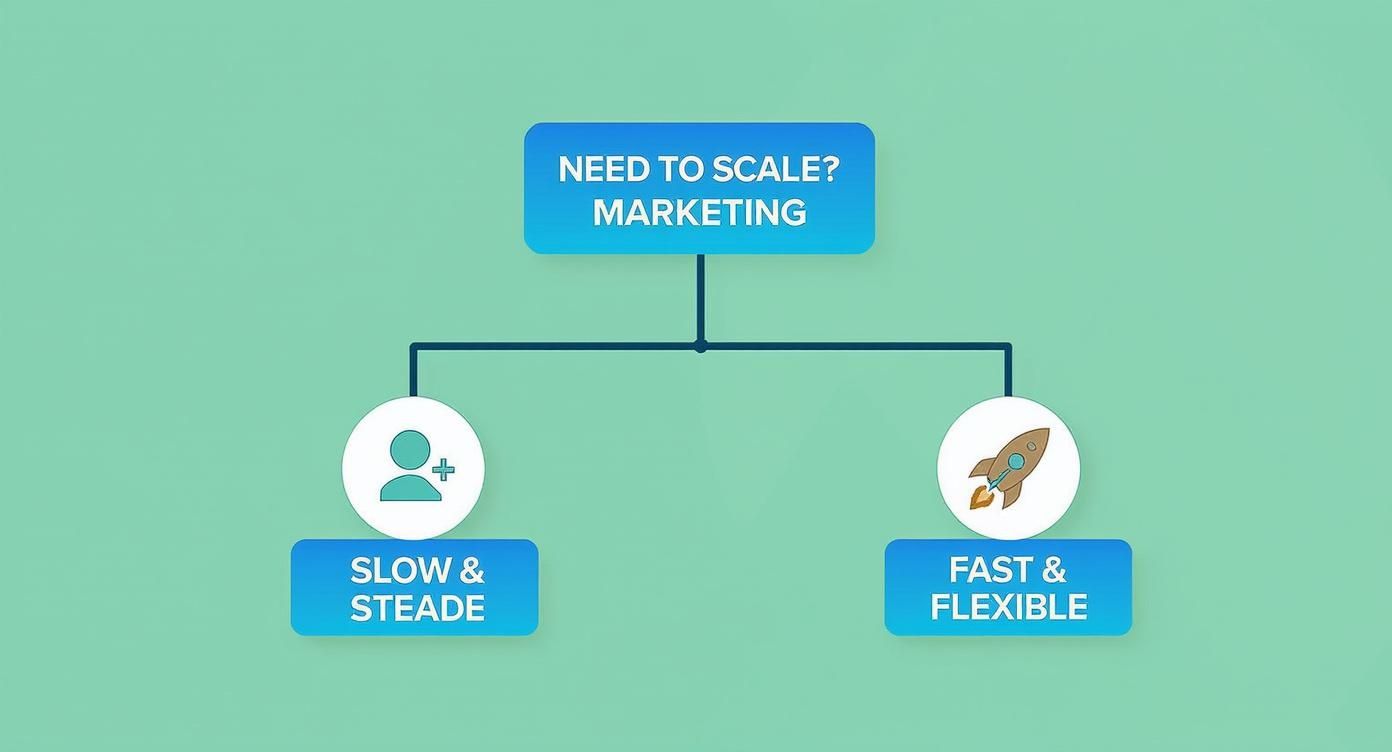
This visual guide highlights the core trade-off: in-house provides deep integration but often slower growth, while agencies offer rapid, flexible scaling.
Your Decision-Making Checklist
To apply these insights to your own business, ask yourself these critical questions. Your answers will shine a light on the best path forward for your specific situation.
- What is our primary goal right now? Is it rapid growth, brand building, or market consolidation? Rapid growth often favours the flexibility of an agency.
- What is our realistic budget? Be honest about the total cost. If you can only afford a junior marketer, an agency might deliver far better results for the same investment.
- Where are our biggest skill gaps? Do a quick capability audit. If you lack technical SEO or paid media skills, an agency is a quick and effective fix.
- How important is deep brand immersion? For highly technical or passion-driven industries like automotive or motorsport, an in-house team's deep knowledge is a massive advantage.
- How quickly do we need to scale? If you anticipate fluctuating needs, the agile nature of an agency partnership is invaluable. If you have a steady growth plan, building in-house is more viable.
Ultimately, choosing the right partner is just as important as choosing the right model. If you decide an agency is the best fit, it's crucial to select one that aligns with your goals and culture. Our guide on how to choose a digital marketing agency can help you navigate this important process.
Frequently Asked Questions
Choosing between building your own marketing team or hiring an agency brings up a lot of practical questions. It's not just about the marketing itself, but about cost, culture, and what you’re really capable of.
Here are some straight answers to the questions we hear most often.
When Does an In-House Marketer Become More Cost-Effective Than an Agency?
There’s no magic number, but the calculation starts by comparing an agency’s annual retainer to the fully loaded cost of a new hire.
A decent UK agency retainer can be anywhere from £3,000 to over £10,000 a month. On the other hand, the real cost of an in-house marketing manager—once you factor in salary, National Insurance, pension, benefits, and equipment—is likely to be £50,000 to £75,000 per year .
The tipping point usually happens when your monthly agency spend starts to look a lot like a senior salary. But it's never just a numbers game. Remember, one person can't replicate the diverse skill set of an entire agency team. The real question is whether the skills that one person brings are the only skills you need right now.
How Can We Ensure a Marketing Agency Understands Our Niche Brand and Culture?
It all comes down to the onboarding. A great agency relationship is a partnership, and it’s on you to immerse them in your world right from the start.
Kick things off with a deep-dive session. Get their team in a room with your key people to go through the company history, the mission, and the vision. The time you invest here pays off massively down the line.
To get it right, you need to:
- Arm them with a brand bible: This means proper brand guidelines, detailed buyer personas, and access to any relevant data you have.
- Give them a single point of contact: Having one person on your side for them to talk to keeps communication clear and consistent.
- Set up regular check-ins: A weekly or bi-weekly call is crucial for tracking progress and making sure everyone is still on the same page.
Treat your agency like an extension of your team, not a supplier. The best ones are genuinely curious about your business from the moment you first speak to them. Their success is your success, and that collaborative mindset is what gets results.
What Are the First Roles to Hire for a New In-House Marketing Team?
When you’re starting from scratch, you need a versatile core, not a team of hyper-specialists. You're looking for a small group that can handle the essentials and grow as the business does.
Your first three hires should give you a solid foundation covering both strategy and execution.
- A 'T-Shaped' Marketing Manager: This is your strategic lead. They need a broad understanding across all channels (the top of the 'T') but deep expertise in one or two areas that really matter to you, like content or SEO. They’ll own the strategy and manage everything else.
- A Content Creator or Copywriter: Good content is the engine of modern marketing. You absolutely need someone to write the blog posts, website copy, social media updates, and emails that build your brand’s voice and connect with your audience. This role is non-negotiable.
- A Digital Marketing Executive or Specialist: This is your doer. They're the one in the trenches, running the PPC campaigns, actioning the SEO plan, managing social media, and digging into the performance data.
This trio gives you strategic oversight, content firepower, and the technical skills to get things done. It’s a well-rounded foundation you can build on with more specialised roles as you scale.
At Superhub , we know that getting the in-house vs agency decision right is a critical moment for your business. Our team in Devon brings the specialised skills and strategic thinking needed to push your brand forward. Whether you need to plug a specific gap or you're looking for a full-service partner, we’re here to deliver real, tangible results.
Find out how we can transform your marketing at https://www.superhub.biz.
Want This Done For You?
SuperHub helps UK brands with video, content, SEO and marketing that actually drives revenue. No vanity metrics. No bullsh*t.