

Website Audit Services That Boost SEO and Conversions
Think of a website audit as a proper MOT for your most valuable digital asset. It’s a comprehensive health check designed to uncover all the hidden gremlins lurking under the bonnet – the kinds of issues that sabotage your performance, hurt your search rankings, and turn away potential customers.
This isn't just about ticking boxes on a checklist. It's a deep dive that gives you a clear, strategic roadmap to fix what’s broken and make your website work harder for your business.
So, What's the Real Value of a Website Audit?

Your website is your 24/7 shopfront, your number one salesperson, and the very heart of your brand online. Just like any high-performing asset, it needs regular tune-ups to stay in peak condition. That’s where a professional audit comes in.
It goes way beyond a quick scan for broken links. A proper audit is a systematic look at everything, from the technical code that Google reads to the actual journey a real customer takes on your site. The aim is simple: find out what's working, what isn't, and crucially, why.
Stop Guessing and Start Making Data-Driven Decisions
Without an audit, most businesses are just guessing. You might see a dip in traffic or a frustrating slump in sales, but you’re blind to the root cause. Is it a technical glitch stopping Google from finding your most important pages? Is your site agonisingly slow on mobile? Or is your content just not hitting the mark with your audience?
A comprehensive audit swaps that guesswork for hard data, giving you a clear path forward. For businesses in Devon and across the UK, working with an agency like Superhub can uncover those critical flaws – the SEO errors, slow load times, or security holes that plague a staggering 70% of UK websites . You can read more about the challenges facing UK businesses on mordorintelligence.com.
This process shifts you from constantly putting out fires to making smart, proactive improvements. It sets a performance baseline, so you can actually measure the impact of every single change you make.
A website audit is the bedrock of any serious digital marketing strategy. It gives you the clarity to stop wasting money on tactics that don’t work and start investing in changes that deliver real, measurable results.
To give you a clearer picture, here’s a breakdown of the key areas a professional audit digs into. We look at every angle to build a complete understanding of your site's health.
Core Components of a Professional Website Audit
| Audit Area | Focus of Analysis | Business Impact |
|---|---|---|
| Technical SEO Health | How easily can search engines like Google crawl, index, and understand your website's content? | Directly affects your visibility in search results. Poor health means you’re invisible to buyers. |
| Site Performance | How fast does your site load on desktop and mobile? Is the code clean and efficient? | Slow sites kill conversions. Even a one second delay can drastically increase your bounce rate. |
| User Experience (UX) | Is the site easy to navigate? Can visitors find what they need quickly and without frustration? | A confusing UX frustrates users and sends them straight to your competitors. |
| Security | Are there vulnerabilities that could expose your site or customer data to cyber threats? | A security breach can destroy your reputation, lead to fines, and lose customer trust forever. |
| Content Effectiveness | Is your content relevant, persuasive, and aligned with what your target audience is searching for? | Great content builds authority, drives traffic, and persuades visitors to take action. |
Essentially, a thorough audit leaves no stone unturned. By examining each of these pillars, we can build a 360-degree view of your website's strengths and weaknesses, creating a prioritised action plan that focuses on what will make the biggest difference to your bottom line.
The Six Pillars of a Comprehensive Website Audit
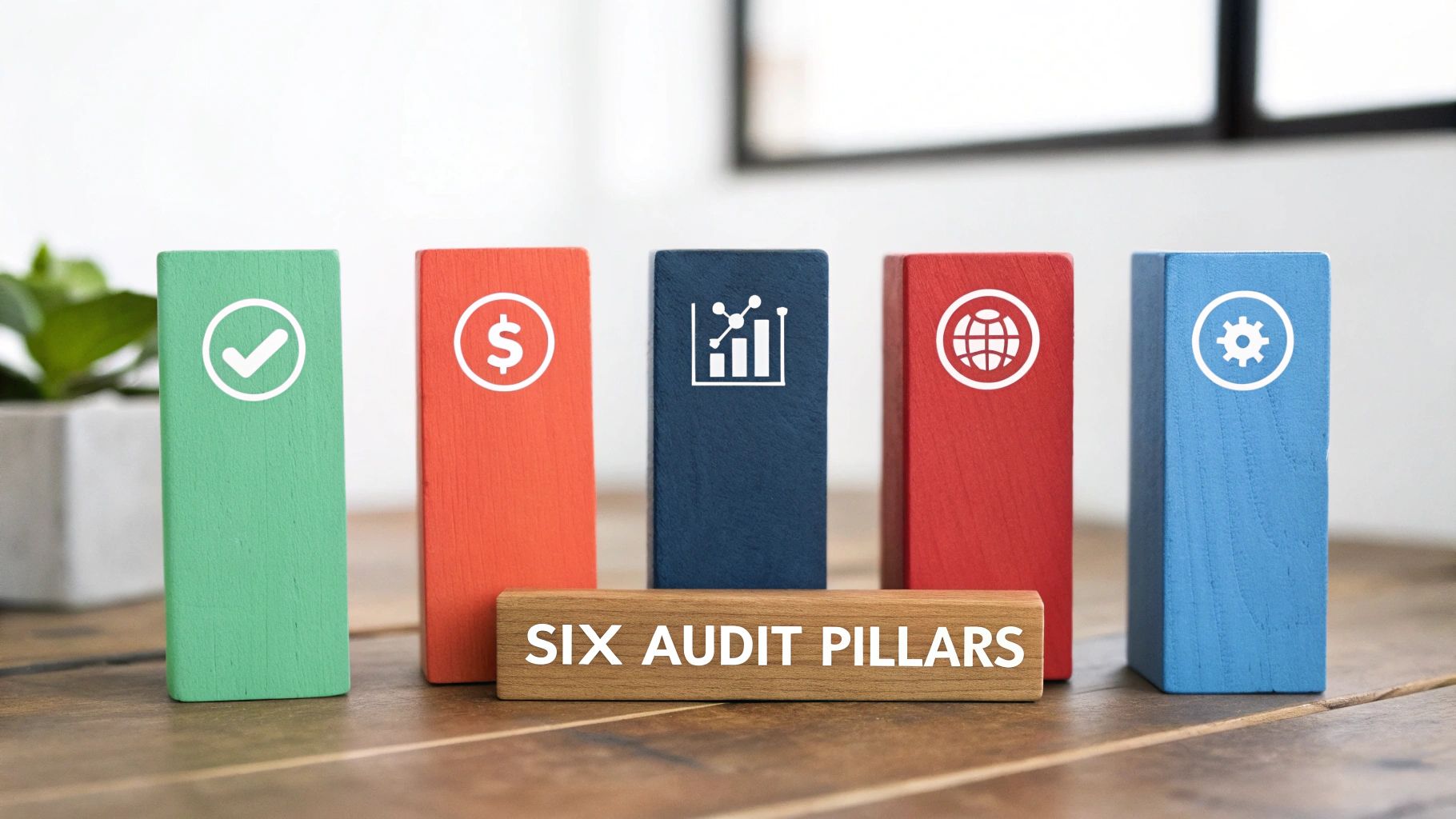
A proper website audit isn’t just a quick once-over. It’s a deep dive across six crucial areas that hold up your entire online presence. Think of them as foundational pillars – if even one is shaky, the whole structure suffers.
Each pillar covers a specific part of your website’s health, from the technical code that only search engines see to the final click a customer makes to buy. Getting to grips with how these distinct but connected areas work together is the first step in turning a basic website into a serious business asset.
Let's break them down.
1. Technical SEO Health
This is the absolute bedrock of getting found online. Technical SEO is all about making sure search engines like Google can find, crawl, and understand your website without hitting any roadblocks. It’s like ensuring your shop has clear signs, wide aisles, and a logical layout so that the stocktakers (search engines) can easily see everything you’re selling.
A technical audit digs into the stuff that users don't see but search engines absolutely do. This includes:
- Crawlability and Indexability: Are there broken links, messy redirect chains, or rogue "noindex" tags stopping Google from seeing your most important pages?
- Site Architecture: Is your website laid out logically? A clear structure helps both users and search engines figure out how your pages relate to each other.
- XML Sitemaps and Robots.txt: Are these essential files set up correctly to guide search crawlers to your best content and steer them away from the private or duplicate stuff?
Get this wrong, and even the most beautifully designed website will be invisible to the people you want to reach. You can dive deeper into this with our complete guide to technical SEO audits for UK businesses.
2. Performance and Page Speed
How fast your site loads isn't just a technical detail; it’s a huge factor for both user happiness and your search rankings. People today expect things to be instant. A delay of just a couple of seconds is often enough to make someone give up and go to a competitor.
A performance audit measures exactly how quickly your pages load on desktop and mobile, then pinpoints what’s causing the slowdown. It’s often big, unoptimised images, clunky code, or a slow server holding you back. Fixing these issues has a direct impact on your bottom line by cutting bounce rates and keeping people engaged.
3. Security
In a world full of cyber threats, website security isn’t optional. It’s essential. A security audit is your proactive defence to protect your business, your data, and the trust you’ve built with your customers. It involves scanning for weak spots that could be exploited by hackers.
A single security breach can wreck your brand’s reputation and lead to massive fines. A proactive audit is your first line of defence, keeping customer data safe and your site online where it belongs.
This pillar review checks for things like out-of-date software, sloppy password rules, and missing security basics like HTTPS. A secure website isn't just good practice—it's the price of entry for being a trustworthy brand online.
4. User Experience (UX)
User Experience, or UX , is all about how a visitor feels when they use your site. Is it a smooth, intuitive ride, or a frustrating mess? Can they find what they’re looking for without wanting to throw their laptop out of the window? A good UX is what turns casual browsers into loyal customers.
An audit of this pillar looks at:
- Navigation: Is the menu clear and does it make sense?
- Mobile Responsiveness: Does your site work perfectly on a phone, or is it a pinch-and-zoom nightmare?
- Readability: Is the text easy on the eye, with clear headings and good colour contrast?
Great UX isn’t about flashy design; it’s about guiding users effortlessly to where they want to go, whether that’s buying a product or filling in a form.
5. Content Quality
Your content is your voice. It’s how you show your value, build authority, and connect with your audience. A content audit checks if what you’re saying is relevant, engaging, and actually helping you hit your business goals.
We’ll look at whether your content meets Google’s quality standards, often guided by the latest E-A-T principles(Expertise, Authoritativeness, and Trustworthiness). This review covers everything from blog posts to product descriptions, making sure they’re optimised for search engines but, more importantly, actually resonate with your ideal customer.
6. Conversion Rate Optimisation (CRO)
Finally, we get to the moneymaker. Conversion Rate Optimisation (CRO) is the science of getting more visitors to take the action you want them to take. That "conversion" could be buying something, signing up for a newsletter, or booking a call.
A CRO audit puts your call to action buttons, forms, and the entire customer journey under the microscope to find and fix any friction points. For businesses serious about growth, this isn't just a nice-to-have. We've seen focused CRO work lead to a 30-50% uplift in online leads , even in hypercompetitive sectors like motorsport. By tweaking these elements, you can get a much bigger return from the traffic you already have.
From Analysis to Action: What Our Website Audit Process Looks Like
Knowing what a website audit delivers is one thing, but understanding exactly how it works is what gives you real confidence. A professional audit isn't some mysterious black box where we take your data and spit out a report. It’s a structured, collaborative process with clear stages, designed to turn a complex analysis into a straightforward plan for improvement.
Think of it like getting a custom suit made. It starts with precise measurements and a clear chat about your style (your business goals), moves on to cutting the cloth (collecting the data), and ends with expert tailoring and fitting (analysis and implementation). Every step is deliberate, making sure the final result is a perfect fit for your business.
This transparent approach means no nasty surprises—just a clear, actionable roadmap.
Stage 1: Discovery and Goal Setting
It all starts with a conversation. Before we even think about running a single tool, we need to get to the heart of what you want to achieve. Are you looking to drive more online sales? Generate better quality leads? Climb the Google rankings? Or just fix a website that feels slow and clunky?
This initial chat is crucial. It ensures the entire audit is aligned with your commercial goals, so we’re not just spotting technical errors but hunting for opportunities that will directly affect your bottom line. We’ll talk about your target audience, who you’re up against, and what success actually looks like for you.
- Objective Alignment: We tie every single part of the audit back to your core business goals.
- KPI Definition: We agree on the key performance indicators (KPIs) we'll use to measure success.
- Scope Confirmation: We pinpoint the specific areas of your site that need the deepest dive.
This discovery phase makes sure all the technical work that follows is laser-focused on what really matters.
Stage 2: Data Collection and Technical Analysis
With clear goals locked in, the deep dive begins. This is where we bring out the heavy-duty tools to gather huge amounts of data on every single aspect of your website. It’s like sending in a team of specialist surveyors to map out the entire property, checking the foundations, the plumbing, and the electrics.
We use industry-leading platforms like SEMrush and Ahrefs to analyse everything from your backlink profile to your keyword rankings. Google Analytics and Search Console give us invaluable intel on user behaviour, traffic sources, and how search engines see your site. Then, specialised crawlers like Screaming Frog meticulously scan every single page, image, and line of code.
This stage is all about gathering the raw intelligence we need to make an accurate diagnosis.
Stage 3: Analysis and Strategic Reporting
Data on its own is just noise. The real magic of a professional website audit happens in the analysis, where we turn all that raw data into meaningful insights. Our experts sift through everything we’ve gathered, connecting the dots between a technical finding and your business objectives.
For example, we don't just tell you a page is slow. We identify the specific oversized image or bloated bit of code causing the bottleneck, show you how it's affecting your bounce rate, and give you a clear, step-by-step solution. All our findings are organised, prioritised, and compiled into one comprehensive report.
The audit report is more than a list of problems; it’s a strategic document. It explains the ‘what’, clarifies the ‘why’, and provides a prioritised ‘how-to’ for fixing each issue based on effort versus impact.
The report is designed for total clarity, starting with a high level executive summary for stakeholders and drilling down into detailed, actionable recommendations for your development team.
Stage 4: Implementation and Continuous Monitoring
The audit isn’t over once the report is in your hands. The final, and most critical, stage is putting our recommendations into action. We work alongside you to implement the prioritised fixes, starting with the quick wins that will deliver the biggest and most immediate impact.
Once the changes are live, we shift into a monitoring phase. Using analytics and tracking tools, we measure the effect of the improvements against the benchmarks we set right at the start. This proves the fixes are working as intended and opens the door for further optimisation, creating a cycle of continuous improvement that keeps your website performing at its absolute peak.
How to Understand Your Audit Report and Prioritise Fixes
Getting a thick website audit report dropped on your desk can feel a bit much. They’re often crammed with technical jargon, endless data, and a laundry list of things to fix. But the real value isn’t in the report itself—it’s in turning that insight into action.
Think of it less like a school report card and more like a detailed Haynes manual for your website. It’s a step-by-step guide to building a better, faster, higher-performing online presence. The trick is to know how to read it, understand the commercial impact of what’s inside, and tackle the fixes in an order that actually makes a difference to your bottom line.
Breaking Down the Anatomy of an Audit Report
A good audit report is never just a data dump. It’s built to be useful for everyone, from the MD who needs the 30,000 foot view to the developer who needs the nitty-gritty details.
Typically, you’ll find it’s broken down into these core parts:
- Executive Summary: A short, sharp overview for stakeholders. It highlights the most critical findings and what they mean for the business, all in plain English.
- Key Findings: This is where we get into the details, grouping the major issues by area—like Technical SEO , Security , or User Experience .
- Prioritised Recommendations: This is the heart of the document. It’s an actionable list of fixes, organised by priority, turning problems into a clear project plan.
- Appendices: Here you’ll find the raw data, outputs from tools, and other supplementary info for anyone who wants to dive deeper.
The whole point is to translate a complex technical issue into a straightforward task. For example, a finding like "high cumulative layout shift on mobile" becomes a clear recommendation: "Optimise above-the-fold image assets to improve core web vitals and user experience," complete with a priority level. Simple.
From Finding to Fix: A Real-World Example
Let’s make this real. Imagine your audit uncovers poor mobile usability—a classic conversion killer. The report wouldn’t just state the problem. It would connect it directly to your business goals and lay out a clear path to fix it.
A great audit report doesn't just identify problems—it translates them into commercial opportunities. It connects a technical flaw like slow mobile speed to a business problem like lost sales and provides a prioritised roadmap for recovery.
Here’s a snapshot of how we turn a finding into a tangible, prioritised fix.
From Finding to Fix An Example Audit Action Plan
This table shows how a common issue is broken down into a clear, prioritised action with a measurable business goal attached.
| Finding | Priority | Recommended Action | Expected Outcome |
|---|---|---|---|
| Poor Mobile Usability | High | Implement responsive design elements and simplify menus. | Decrease mobile bounce rate by 15% and increase mobile conversions. |
This approach cuts through the noise. You know exactly what the issue is, how critical it is, what needs to be done, and the commercial benefit you can expect. For security-specific findings, looking at a penetration testing report template can also help you understand the typical structure for those recommendations.
Our process is designed to be this clear from start to finish.
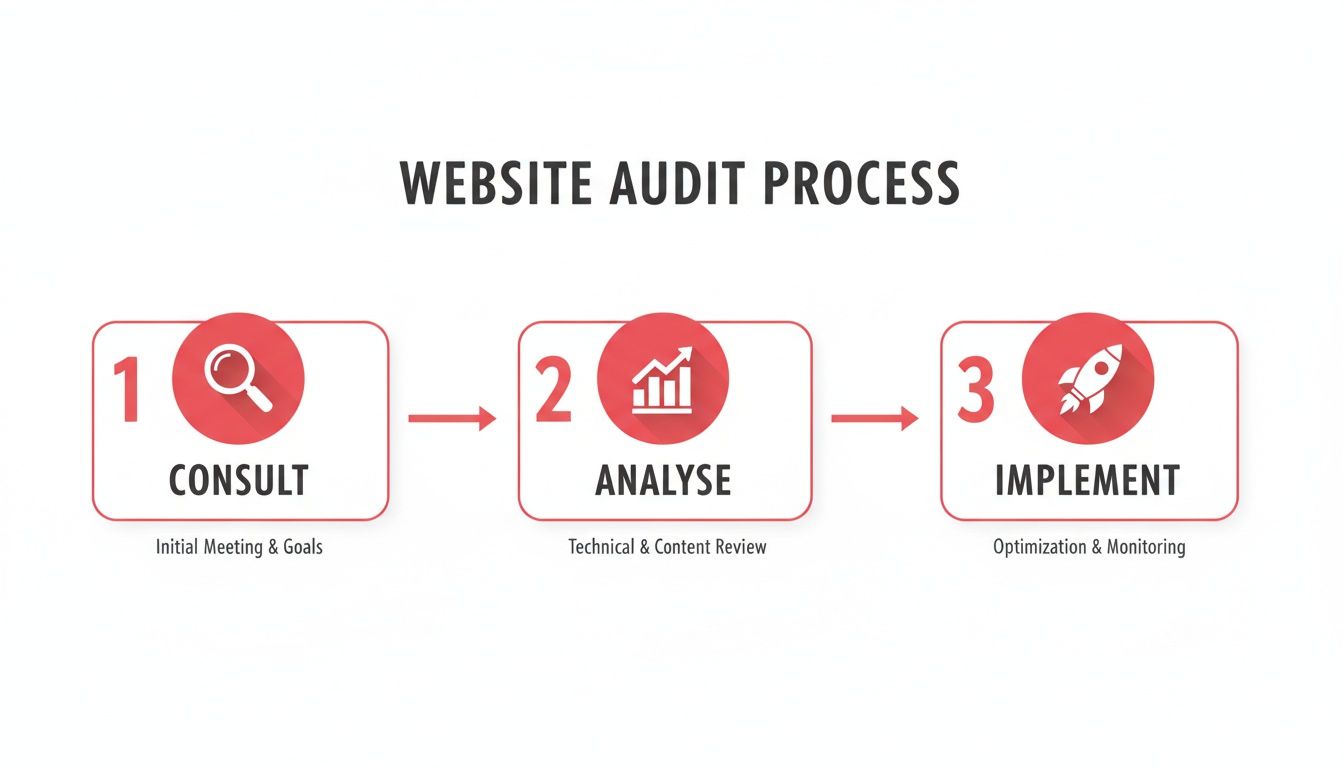
This simple flow shows how an audit is a journey, moving from initial discovery right through to measurable improvement.
The impact can be massive, especially in competitive industries. For automotive and motorsport brands we’ve worked with, a post-audit optimisation has led to traffic boosts of up to 45% —a game-changer in a crowded market.
By prioritising fixes based on effort vs. impact, you make sure every bit of resource is channelled into the changes that actually grow your business. It’s how you turn an audit from a cost into an investment with real, measurable returns.
If you want to dig deeper, you should also learn more about improving your website conversion rate in our detailed guide.
Choosing the Right Website Audit Provider in the UK
Picking the right partner for a website audit is a make-or-break decision. It directly affects the quality of the advice you get and, ultimately, the commercial success that comes from it. The truth is, not all providers are the same. You need an agency that delivers strategic thinking, not just a generic, automated checklist.
Your goal is to find a partner who digs deeper. Someone who asks the right questions about your business goals before they even think about running a tool. A proper audit specialist is more of a business consultant, obsessed with how technical fixes translate into real-world commercial gains. It's about moving past a simple list of errors and building a genuine roadmap for growth.
What to Look for in an Audit Partner
When you’re weighing up potential providers, you have to look past the sales pitch. You need an agency with a proven track record, a transparent process, and genuine expertise. They should be able to show you not just technical chops, but a real understanding of your specific market and business challenges.
Here’s what you should be looking for:
- Proven Industry Experience: Can they show you case studies or real-world examples of successful audits for businesses like yours?
- Client Testimonials and Reviews: What are their past clients actually saying? Look for feedback that points to strategic advice and measurable results, not just fluff.
- Transparent Process: Do they lay out their methodology, timelines, and exactly what you can expect from the final report in plain English?
- A Focus on Strategy: Are they talking about your business goals, or do they immediately dive into technical jargon? A great partner connects every single finding back to your bottom line.
Asking the Right Questions
To really get a feel for a provider's expertise, you need to ask the right questions. This is how you figure out if they’re the right long-term fit for your company and can deliver an audit that’s truly built for you. You’ll see this same idea in our guide on how to choose a digital marketing agency.
Interestingly, since 2014 , the 'Big Four' firms have tightened their hold on the UK audit market, jumping from 71.5% to 79% market share. This just goes to show the unique value that specialised, local providers can offer—blending creative thinking with data-led strategy for a more personal touch. You can discover more insights about the UK audit market here.
Choosing an audit provider is like hiring a key member of your team. You need someone who not only has the right skills but also understands your vision and is genuinely invested in your success.
Make sure you ask any potential agency these questions:
- How will you tie the audit findings directly to our specific commercial goals?
- What does your process for prioritising fixes look like?
- Can you show us a sample report so we can see exactly what we'll get?
Finding a partner who can answer these questions with confidence is how you know you're investing in a service that will drive real, sustainable growth for your business.
Still Got Questions About Website Audits?
Even after laying it all out, it's completely normal to have a few questions before you commit. We get it. Investing in a proper, deep dive audit is a big decision.
So, to clear things up, we've answered some of the most common queries we hear from businesses just like yours. This isn't generic advice – it's the straight-talking insight you need to understand the difference between a quick scan and a strategic overhaul.
How Often Should I Get a Website Audit?
For most businesses, we recommend a full, comprehensive website audit at least once a year . But that’s just the baseline. If you’re about to launch a major redesign, kick off a new marketing campaign, or you've seen a sudden, worrying drop in traffic or leads, then you need an audit, stat.
Think of it like your car’s MOT. The annual check is essential to keep things running smoothly, but if the engine starts making a funny noise, you’re not waiting 12 months to get it looked at. Regular audits make sure your website stays healthy, secure, and actually aligned with your business goals.
Can’t I Just Do a Website Audit Myself?
Look, there are plenty of free online tools that will give you a quick, surface level peek at your site's health. They’re great for spotting the obvious stuff like broken links or missing meta descriptions, but they are no replacement for a professional website audit.
A free tool gives you data; a professional audit gives you a diagnosis. It’s the difference between seeing a symptom and understanding the underlying cause and the most effective treatment.
A real expert connects the dots. We don't just find technical faults; we show you how they're hitting your bottom line. We prioritise fixes based on what will actually make you more money – a level of strategic insight an automated tool just can't deliver.
So, How Much Do Website Audits Cost?
The honest answer? It varies. The cost of a proper website audit depends on the size and complexity of your website, what you need us to look at, and how deep we need to go.
Pricing usually falls into one of these buckets:
- Fixed Price Audits: A set fee for a clearly defined scope of work. This is perfect for businesses wanting a complete, end to end review.
- Project Based Pricing: Quoted for a specific job, like a technical SEO check before a new site launch or a deep dive into your conversion rates.
- Retainer Agreements: Often part of a bigger ongoing SEO or marketing partnership where we conduct audits periodically to keep you on track.
An audit isn't a cost; it's an investment. It gives you a clear, actionable roadmap to improve performance, give your users a better experience, and ultimately, drive more revenue.
Ready to stop guessing and start improving? The expert team at Superhub provides comprehensive website audit services that turn data into a clear plan for growth. Get in touch today to schedule your website health check.
Want This Done For You?
SuperHub helps UK brands with video, content, SEO and marketing that actually drives revenue. No vanity metrics. No bullsh*t.